
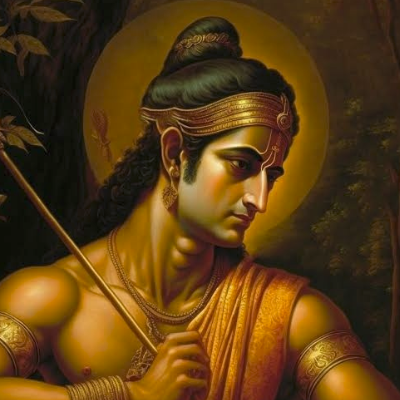
About
Brihadbala — King of Kosala, Last Major Ruler of the Ikshvaku Solar Dynasty
Brihadbala · Brhadbala · Brihadbala of Kosala · Barhadbala
Brihadbala was a human king of the Kosala kingdom and a member of the Ikshvaku Solar Dynasty — the ancient royal line descending from the sun god Surya through the great king Ikshvaku. He is recorded in the Bhagavata Purana as the son of Takshaka, himself the son of Prasenajit, and is identified as a descendant of Kusha, the son of Rama. He is placed by the Bhagavata Purana as the last significant ruler of the Ikshvaku line before the dynasty's eventual extinction, and the Purana Index entry on the basis of the Bhagavata Purana and Brahmanda Purana designates him as the last of the Ikshvakus at his historical moment. He appears as a warrior-king on the side of the Kauravas in the Kurukshetra war and is killed by Abhimanyu, the son of Arjuna, on the thirteenth day of the battle. Brihadbala features in the Mahabharata across multiple Parvas — the Adi Parva, Sabha Parva, Drona Parva — and is recorded in the Bhagavata Purana, Vishnu Purana, Brahmanda Purana, Vayu Purana, Matsya Purana, Skanda Purana, and Harivamsha.
✦ The Name
The name Brihadbala is a Sanskrit compound formed from brihad, meaning great or mighty, and bala, meaning strength or force. The compound thus means one who possesses great strength, and the Monier-Williams Sanskrit dictionary records its meaning precisely as having great strength. As a designation for a warrior-king of a celebrated martial dynasty, the name reflects the qualities appropriate to a ruler of the Solar lineage.
✦ Lineage
- Dynasty: Ikshvaku Solar Dynasty (Suryavamsha) — the royal lineage founded by Ikshvaku, son of Manu Vaivasvata, itself deriving from the sun god Surya; one of the two great royal lineages of Hindu tradition alongside the Lunar Dynasty.
- Father: Takshaka — a human king of the Ikshvaku line and son of Prasenajit; recorded as a ruler in the Bhagavata Purana's genealogical list of the Kosala-Ikshvaku succession. This Takshaka is a distinct figure from the Naga king Takshaka who is associated with the death of Parikshit; the shared name across two entirely separate figures is a source of confusion in secondary literature.
- Paternal Grandfather: Prasenajit — an Ikshvaku king of Kosala, son of Vishvasahva, recorded in the Bhagavata Purana's ninth skandha genealogical sequence.
- More Distant Paternal Ancestry (per Bhagavata Purana IX.12): The lineage ascending from Brihadbala through Takshaka and Prasenajit reaches Vishvasahva, Mahasvan, Amarshana, Sandhi, Prashruta, Maru, Shighra, Agnivarna, Sudarshana, Dhruvasandhi, Pushya, Hiranyanabha, Vidhriti, Khagana, Vajranabha, Sthala, Bala, Pariyatra, Aniha, Devanika, Kshemdhanva, Pundarika, Nabha, Nishadha, Atithi, and ultimately Kusha — the son of Rama — who is the son of Dasharatha of the Ikshvaku line of Ayodhya.
- Son: Brihadrana — recorded in the Bhagavata Purana as Brihadbala's son who will rule after him; the Vishnu Purana names this son Brihadkshana in a variant genealogy.
✦ The Takshaka Confusion: Human King and Naga King Distinguished
A significant nomenclatural coincidence in the Puranic record requires careful attention. Brihadbala's father is named Takshaka in the Bhagavata Purana (IX.12.8) and the Brahmanda Purana (III.74.104), which situates him squarely within the human Ikshvaku succession of Kosala kings. This Takshaka is a mortal ruler, son of Prasenajit and grandson of Vishvasahva, occupying a fixed position in a documented line of human kings stretching back to Rama.
The Naga king Takshaka — the serpent ruler who kills Parikshit, the grandson of Arjuna, as recounted in the Bhagavata Purana and the Adi Parva — is an entirely separate figure belonging to the race of serpents descended from the sage Kashyapa and Kadru. The claim that Brihadbala is the son of the Naga Takshaka, and thereby a sibling or counterpart of the Naga prince Ashvasena, is not supported by any verified primary source. The Bhagavata Purana is unambiguous: the Takshaka who is Brihadbala's father is a human Ikshvaku king. The apparent Naga connection arises purely from the shared name and has no scriptural foundation.
✦ Brihadbala Before the War: Submission to the Pandavas
Prior to the Kurukshetra war, Brihadbala was encountered by the Pandava Bhimasena during the latter's military expedition to the eastern regions in preparation for the Rajasuya sacrifice of Yudhishthira. The Puranic Encyclopedia records that Bhimasena defeated Brihadbala during this eastern campaign, and that following his submission, Brihadbala provided fourteen thousand horses as tribute for the Rajasuya, the imperial horse sacrifice that marked Yudhishthira's claim to sovereignty over all kings. This detail establishes Brihadbala as one of the many regional kings who acknowledged Pandava supremacy during the period of their ascendancy.
✦ Alignment with the Kauravas
Despite having submitted to the Pandavas and contributed to Yudhishthira's Rajasuya, Brihadbala ultimately aligned himself with Duryodhana and the Kaurava coalition at the outset of the Kurukshetra war. He is listed among the kings of the Kaurava army in the Udyoga Parva. The Bhagavata Purana's genealogical section itself characterises him as a contemporary of the Pandavas who fought as an ally of the Kauravas. The political circumstances of this alignment — whether driven by prior enmity, diplomatic inducement, or other considerations — are not elaborated in the primary sources consulted.
✦ Death at the Hands of Abhimanyu in the Padmavyuha
The defining episode of Brihadbala's narrative is his death on the thirteenth day of the Kurukshetra war. On that day, the military commander Drona — one of the supreme masters of warfare among the Kauravas — arrayed his forces in the Padmavyuha, also called the Chakravyuha, a circular and near-impenetrable battle formation of exceptional complexity. Of all the Pandava warriors, only Arjuna and Krishna possessed full knowledge of how to enter and exit this formation. When Arjuna was drawn away to another sector of the battlefield, the young warrior Abhimanyu — Arjuna's son by his wife Subhadra, the sister of Krishna — entered the formation alone. Abhimanyu knew how to penetrate the formation but had not been taught the method of egress.
Within the Padmavyuha, Abhimanyu fought with extraordinary valour against the assembled Kaurava commanders. The Mahabharata records Brihadbala among those who engaged Abhimanyu within the formation. According to the Puranic Encyclopedia, citing Drona Parva Chapter 40 Verse 20, Abhimanyu killed Brihadbala in this battle. The Vishnu Purana describes Brihadbala as the son of Vishvabhava and records his death at Abhimanyu's hands, while the Bhagavata Purana refers to the same event. The Puranic Encyclopedia also records that Brihadbala fought with both Abhimanyu and Ghatotkacha — the son of Bhima and the Rakshasa woman Hidimbi — in the course of the war.
✦ Textual Variants and Inconsistencies
The Puranic sources present several variant genealogical details for Brihadbala that require careful notation. The Bhagavata Purana (IX.12.8) and the Brahmanda Purana (III.74.104) both identify his father as Takshaka, son of Prasenajit, making Brihadbala the son of a human Ikshvaku king of that name. The Vishnu Purana (IV.4.112) records Brihadbala as the son of Vishvabhava, which represents a distinct genealogical tradition. The Brahmanda Purana (III.63.213), the Vayu Purana (88.212; 99.290), and the Vishnu Purana (IV.22.2) give yet another tradition in which Brihadbala is the son of a figure named Vishrutavat or Vishrutavant (an Aikshvaku ruler). The Matsya Purana (271.4) places him in the Solar race as the father of Urukshaya, diverging again from the Bhagavata Purana tradition in which his son is named Brihadrana (or Brihadkshana in another variant).
These variant traditions may reflect the preservation of distinct regional genealogical lists across different Puranic schools, or may represent scribal or editorial divergences within the manuscript traditions. The Bhagavata Purana's account is the most detailed and internally consistent, providing the full genealogical chain from Kusha downward. All sources agree on the fundamental facts: Brihadbala was a Kosala king of the Ikshvaku Solar Dynasty, he fought on the Kaurava side, and he was killed by Abhimanyu.
Additionally, the Wisdomlib Purana Index records a separate entry for a Brihadbala who was a son of Devabhaga and Kamsa (Bhagavata Purana IX.24.40), and a further Brihadbala who was an ally of Kartavirya killed by Parashurama (Brahmanda Purana III.39.2, 7). These are entirely distinct figures sharing the same name and have no connection to the Kosala king who is the subject of this profile.
✦ Theological and Dynastic Significance
Brihadbala occupies a singular position in the dynastic genealogy of the Ikshvaku Solar line. As the last king of that dynasty to participate in a major event of cosmic significance — the Kurukshetra war — and as the king killed during the slaughter within the Padmavyuha, he represents the decline of his line at a moment of universal catastrophe. The Bhagavata Purana's genealogical chapter on the Ikshvaku race frames his position in precisely these terms: the great Solar kings are enumerated, Brihadbala is named as the one killed by Abhimanyu, and the text then projects the dynasty forward through future kings who will reign in the Kali Yuga before the line finally expires with Sumitra.
His alignment with the Kauravas places him in an historically ironic position within the structure of Puranic theology. The Ikshvaku dynasty is the lineage of Rama, who is the seventh avatar of Vishnu. The war of Kurukshetra is the context in which Krishna, the eighth avatar of Vishnu, acts. Brihadbala, as a descendant of Rama, thus stood in opposition to the cause championed by Krishna — a tension within the epic's dynastic framework that the texts record without explicit theological commentary but which later interpreters have noted.
✦ Connection to the Wider Genealogy
Brihadbala stands at a crucial juncture in the Solar Dynasty's recorded history. Ascending his lineage, he is linked through an unbroken chain of human kings to Kusha, son of Rama and Sita; to Rama himself, the seventh avatar of Vishnu and the hero of the Ramayana; to Dasharatha, Rama's father; and ultimately to Ikshvaku, the founder of the dynasty, and through him to Manu Vaivasvata and Surya, the sun god. Descending from Brihadbala, the dynasty continues through Brihadrana, Urukriya, and the long list of kings enumerated in the Bhagavata Purana who will reign in the Kali Yuga, terminating finally with Sumitra as the last of the Ikshvaku line before the dynasty becomes entirely extinct. Abhimanyu, who kills Brihadbala, is himself the son of Arjuna and Subhadra — Subhadra being the sister of Krishna and a member of the Vrishni branch of the Yadava clan, a lineage entirely distinct from the Solar dynasty.
✦ References
- Bhagavata Purana, Skandha IX, Chapter 12, Verses 8–9: Primary source. The fullest and most detailed genealogical record of Brihadbala's position in the Ikshvaku succession: identifies him as the son of Takshaka (an Ikshvaku human king), son of Prasenajit; confirms he was a contemporary of the Pandavas, allied with the Kauravas, and killed by Abhimanyu; names his son as Brihadrana.
- Bhagavata Purana, Skandha IX, Chapter 12, Verses 1–7: Primary source. Provides the complete ascending genealogical chain from Kusha, son of Rama, down through multiple generations to Prasenajit, Takshaka, and Brihadbala.
- Brahmanda Purana, III.74.104: Primary source. Confirms Brihadbala as the last of the Ikshvakus, corroborating the Bhagavata Purana's account.
- Brahmanda Purana, III.63.213; Vayu Purana, 88.212 and 99.290; Vishnu Purana, IV.22.2: Primary sources presenting the variant tradition in which Brihadbala is the son of Vishrutavat (an Aikshvaku ruler), differing from the Bhagavata Purana's identification of his father as Takshaka son of Prasenajit.
- Vishnu Purana, IV.4.112: Primary source. Records Brihadbala as the son of Vishvabhava and confirms his death at Abhimanyu's hands in the Bharata war.
- Matsya Purana, 271.4: Primary source. Places Brihadbala in the Solar race as father of Urukshaya, a variant differing from the Bhagavata Purana tradition.
- Mahabharata, Adi Parva, Chapter 1, Stanza 237: Primary source. Names Brihadbala as a king in ancient India, establishing his presence in the epic's framework from the very opening genealogical lists.
- Mahabharata, Sabha Parva, Section 29: Primary source. Records Bhimasena's defeat of Brihadbala during the eastern military expedition in preparation for the Rajasuya sacrifice.
- Mahabharata, Udyoga Parva, Section 197: Primary source. Lists Brihadbala among the kings of the Kaurava army assembled for the Kurukshetra war.
- Mahabharata, Drona Parva, Chapter 40, Verse 20: Primary source. Records the death of Brihadbala at Abhimanyu's hands within the Padmavyuha on the thirteenth day of the war.
- Harivamsha: Primary source. Referenced in the Monier-Williams Sanskrit dictionary entry for Brihadbala as a source that mentions him in the context of the Kosala kingship.
- Skanda Purana, Section 1, Chapter 196: Primary source. Contains a narrative episode in which Brihadbala proceeds to the city of Anarta, providing additional biographical detail beyond the genealogical and war contexts.
- Vettam Mani, Puranic Encyclopaedia (1975): Modern reference. The entry for Brihadbala synthesises information from multiple Mahabharata Parvas, confirms the tribute of fourteen thousand horses for the Rajasuya, notes his battles with both Abhimanyu and Ghatotkacha, and provides the Drona Parva chapter reference for his death.
- Wisdomlib.org — Definition page for Brihadbala; Bhagavata Purana Chapter 12 translation (G.V. Tagare): Modern reference. The translated chapter of the Bhagavata Purana's ninth skandha was directly consulted to verify the genealogical sequence and the primary source wording; the Purana Index entries were consulted to identify variant textual traditions across multiple Puranas.
- Cologne Digital Sanskrit Dictionaries — Monier-Williams: Modern reference. Confirms the compound etymology of the name Brihadbala and lists the primary textual references including the Mahabharata, Harivamsha, and various Puranas.