
About
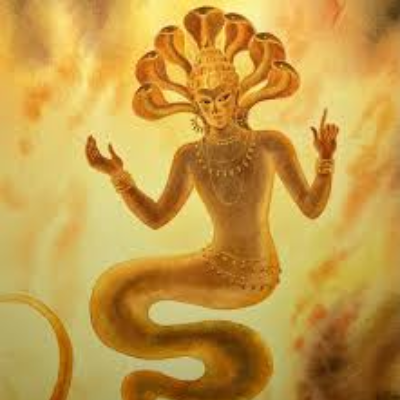
Karkotaka — Naga King, Cursed by Narada, and Liberator of Nala
Karkotaka · Karkoṭaka · prince of snakes · Naga king
Karkotaka is a naga king who appears in the Nalopakhyana — the Tale of Nala — embedded in the Vana Parva of the Mahabharata, where he plays a pivotal role in the restoration of King Nala to his true form and the ultimate recovery of his kingdom and wife. He is a son of Kashyapa and Kadru and belongs to the family of divine serpents. His narrative is structured by a curse and a liberation: having deceived the great sage Narada, Karkotaka was condemned by the sage to remain fixed in one place until King Nala of the Nishadha kingdom should carry him away. His liberation came when Nala, wandering alone after abandoning his wife Damayanti, found the immobilised serpent in a raging forest fire and rescued him. Karkotaka in return bit Nala on the tenth step of his walk, altering his form and colour beyond recognition — an act that was not a betrayal but a planned protective intervention designed to conceal Nala from his enemies, weaken Kali's possession of him, and guide him toward the path that would eventually restore everything he had lost.
✦ The Name
The name Karkotaka is Sanskrit. Karkota is associated in Sanskrit lexicology with a class of serpent or with the plant karela (bitter gourd), whose creeping form has some analogy with the sinuous movement of a snake. The nominal form Karkotaka thus denotes a being of the karkota serpent class. The name occurs in the Mahabharata passage in the formula preserved at Mahabharata 3.66 — Karkotakasya nagasya, meaning of the naga Karkotaka — which forms the opening of a mantra or invocation of the naga's name. The Indica Today Nala account preserves the full invocatory verse from the Nalopakhyana: Karkotakasya Nagasya Damayantyaha Nalasyacha / Rituparnasya Rajarshehe Keertanam Kali Nashanam — meaning that the recitation of the names of Karkotaka, Damayanti, Nala, and King Rituparna destroys the influence of Kali. This mantra underscores Karkotaka's status as a sacred name whose very utterance has protective power against the malevolent influence that caused Nala's downfall.
✦ Lineage and Character
- Class: Naga — born of Kashyapa and Kadru within the serpent race that descends from this couple. The Indica Today account describes him as belonging to the family of divine serpents. The Wisdomlib Ashtanaga essay places him among the most notable of Kadru's progeny alongside Vasuki, Ananta, Kambal, Padma, Mahapadma, Shankha, and Kulik.
- Character: The Wisdomlib account describes Takshaka as generous and helpful by nature, which may also apply to Karkotaka within the broader naga characterisation; the primary text of the Nalopakhyana portrays Karkotaka as forthright, strategic, and genuinely benevolent toward Nala once the terms of his liberation are met. He acts not from malice but from a considered plan to help, having been forewarned by Narada's curse of the circumstances of his liberation.
✦ The Curse of Narada
The primary text of the Nalopakhyana at Mahabharata 3.66, as translated in the Sacred Texts Archive, records Karkotaka's account of his own situation. He had deceived the great sage Narada — a deception not specified in its details in the passage but implying a transgression of sufficient gravity to draw the sage's wrath. Narada, angered, cursed him in these words: Stay here like an immobile thing, until one Nala takes thee hence. And, indeed, on the spot to which he will carry thee, there shalt thou be freed from my curse. This curse reduced the king of snakes, whose natural power was enormous, to complete immobility. He could not stir a single step. The curse also embedded within itself the condition of its own resolution — only Nala, specifically, could free him, and only at the place to which Nala would carry him. This detail is important: Narada's curse was not merely punitive but prophetic, weaving together Karkotaka's liberation with the precise circumstances of Nala's crisis.
✦ The Meeting with Nala and the Bite
After Nala had abandoned the sleeping Damayanti in the forest — himself possessed and corrupted by the malign demigod Kali — he wandered alone and came upon a raging forest fire. From within the fire, he heard cries for help. Nala, who had received a boon from Agni that fire would not harm him, plunged into the blaze and found a mighty naga lying coiled in the flames. The serpent, joined hands trembling, identified itself as Karkotaka and narrated the circumstances of the curse. He asked Nala to carry him out of the fire. In demonstration of this plan, Karkotaka shrank himself to the size of a thumb so that Nala could easily carry him.
Nala carried the tiny serpent out of the fire to an open spot. As he reached safety and was about to set Karkotaka down, the serpent asked him to continue walking a few more steps, promising to do him great good. As Nala walked and counted his steps, Karkotaka bit him at the tenth step. At that moment Nala's form changed suddenly and completely — his handsome appearance disappeared, his skin darkened, his body became stunted, and his colour altered. Nala was amazed and alarmed. Karkotaka then expanded to his full enormous form and, comforting Nala, explained the purpose of the bite: the alteration of Nala's appearance would make him unrecognisable to his enemies and to the usurper Pushkara; the venom would burn and torment Kali, who had been possessing Nala's mind since the dice game; and the disguise would protect Nala as he lived incognito. The Katha Kids account adds: the poison will cause him no pain but will burn and torture the evil Kali inside him — making Karkotaka's bite a form of healing through poison, a reversal of the typical snake-bite's function.
✦ Karkotaka's Instructions and the Gift of Celestial Cloth
Karkotaka then gave Nala three pieces of guidance and a gift. He instructed Nala to present himself at the court of King Rituparna of Ayodhya under the name Vahuka and offer his exceptional skills in horsemanship in exchange for Rituparna's famed knowledge of dice. He told him that Rituparna, descended from the Ikshvaku line, would become his friend, and that through this exchange Nala would eventually recover the ability to defeat Pushkara, reunite with Damayanti, and reclaim his kingdom. He assured Nala he would be ever victorious in battle. Finally, he presented Nala with two pieces of celestial cloth and told him that whenever he wished to resume his true form, he should remember Karkotaka and put on the garment — whereupon his original appearance would be restored. Having spoken and given these gifts, Karkotaka made himself invisible.
The Wikipedia Nala article confirms the resolution of this plan: at the end of the Nalopakhyana, Nala donned the divine garments provided by Karkotaka and his true form was restored, completing the serpent's promised restoration. The Sahapedia Nala-Damayanti analysis identifies Karkotaka as the agent of Nala's self-awareness, the intervention through which Nala's suffering is directed toward ultimate recovery.
✦ The Mantra and Cultural Legacy
The protective mantra preserved in the Nalopakhyana — in which the names of Karkotaka, Damayanti, Nala, and Rituparna are recited together as a charm against Kali's influence — gives Karkotaka a ritual significance extending beyond the narrative. His name is not merely the designation of a character in a story but an invocable protective power. The Tamil and Vedas blog notes that the Sangam Tamil work Sirupan Atrppadai, at lines 96–97, also refers to a divine naga garment given by Neelanagan to a chieftain, suggesting an ancient connection between naga-given celestial cloth and the naga tradition in south India. The Indica Today account identifies the Nala-Damayanti episode as a model that anticipated the Pandavas' own period of incognito service in Virata's court — with Arjuna's transformed appearance under Urvashi's curse parallel to Nala's transformed appearance under Karkotaka's bite, Yudhishthira's acquired skill in dice parallel to Nala's skill, and Nakula's skill with horses parallel to Nala's ashva hridaya vidya.
✦ References
Primary Sources
- Mahabharata, Vana Parva, Nalopakhyana Parva, 3.66–3.67 — the primary source; contains Karkotaka's self-identification, account of Narada's curse, his request of Nala, the bite at the tenth step, his explanation of the transformation's purpose, his instructions to go to Rituparna, and the gift of the two celestial garments.
Modern Reference Works
- Sacred-texts.com, Mahabharata Book 3, Nalopakhyana Parva (direct translation) — provides the full primary text passage of Karkotaka's speech, instructions, and gift.
- Wikipedia, "Nala" and "Nala and Damayanti" — secondary account of the Karkotaka episode within the Nala narrative; records the resolution when Nala dons the celestial garments.
- Indica Today, "Nala Damayanti Charitra Part I" — preserves the protective mantra invoking Karkotaka's name and analyses his role as the liberating agent of Nala's recovery.
- Vyasaonline.com, "Nalopakhyana: The Story of Nala" — secondary narrative of the episode within the full Nala story.
- Sahapedia, "The Nala-Damayanti Narrative" — literary analysis identifying Karkotaka as the agent of Nala's self-awareness and connecting the Nala-Karkotaka episode to the Pandavas' own incognito period.
- Tamil and Vedas blog, "Snakes and Snake Bites in Mahabharata" — records the Mahabharata chapter reference for Karkotaka's bite (3.66) and notes the wider naga-cloth tradition in Tamil literature.