
About
Karkotaka — Naga King, Cursed by Narada, and Liberator of Nala
Karkotaka · Karkoṭaka · prince of snakes · Naga king
Karkotaka is a naga king who appears in the Nalopakhyana — the Tale of Nala — embedded in the Vana Parva of the Mahabharata, where he plays a pivotal role in the restoration of King Nala to his true form and the ultimate recovery of his kingdom and wife. He is a son of Kashyapa and Kadru and belongs to the family of divine serpents. His narrative is structured by a curse and a liberation: having deceived the great sage Narada, Karkotaka was condemned by the sage to remain fixed in one place until King Nala of the Nishadha kingdom should carry him away. His liberation came when Nala, wandering alone after abandoning his wife Damayanti, found the immobilised serpent in a raging forest fire and rescued him. Karkotaka in return bit Nala on the tenth step of his walk, altering his form and colour beyond recognition — an act that was not a betrayal but a planned protective intervention designed to conceal Nala from his enemies, weaken Kali's possession of him, and guide him toward the path that would eventually restore everything he had lost.
✦ The Name
The name Karkotaka is Sanskrit. Karkota is associated in Sanskrit lexicology with a class of serpent or with the plant karela (bitter gourd), whose creeping form has some analogy with the sinuous movement of a snake. The nominal form Karkotaka thus denotes a being of the karkota serpent class. The name occurs in the Mahabharata passage in the formula preserved at Mahabharata 3.66 — Karkotakasya nagasya, meaning of the naga Karkotaka — which forms the opening of a mantra or invocation of the naga's name. The Indica Today Nala account preserves the full invocatory verse from the Nalopakhyana: Karkotakasya Nagasya Damayantyaha Nalasyacha / Rituparnasya Rajarshehe Keertanam Kali Nashanam — meaning that the recitation of the names of Karkotaka, Damayanti, Nala, and King Rituparna destroys the influence of Kali. This mantra underscores Karkotaka's status as a sacred name whose very utterance has protective power against the malevolent influence that caused Nala's downfall.
✦ Lineage and Character
- Class: Naga — born of Kashyapa and Kadru within the serpent race that descends from this couple. The Indica Today account describes him as belonging to the family of divine serpents. The Wisdomlib Ashtanaga essay places him among the most notable of Kadru's progeny alongside Vasuki, Ananta, Kambal, Padma, Mahapadma, Shankha, and Kulik.
- Character: The Wisdomlib account describes Takshaka as generous and helpful by nature, which may also apply to Karkotaka within the broader naga characterisation; the primary text of the Nalopakhyana portrays Karkotaka as forthright, strategic, and genuinely benevolent toward Nala once the terms of his liberation are met. He acts not from malice but from a considered plan to help, having been forewarned by Narada's curse of the circumstances of his liberation.
✦ The Curse of Narada
The primary text of the Nalopakhyana at Mahabharata 3.66, as translated in the Sacred Texts Archive, records Karkotaka's account of his own situation. He had deceived the great sage Narada — a deception not specified in its details in the passage but implying a transgression of sufficient gravity to draw the sage's wrath. Narada, angered, cursed him in these words: Stay here like an immobile thing, until one Nala takes thee hence. And, indeed, on the spot to which he will carry thee, there shalt thou be freed from my curse. This curse reduced the king of snakes, whose natural power was enormous, to complete immobility. He could not stir a single step. The curse also embedded within itself the condition of its own resolution — only Nala, specifically, could free him, and only at the place to which Nala would carry him. This detail is important: Narada's curse was not merely punitive but prophetic, weaving together Karkotaka's liberation with the precise circumstances of Nala's crisis.
✦ The Meeting with Nala and the Bite
After Nala had abandoned the sleeping Damayanti in the forest — himself possessed and corrupted by the malign demigod Kali — he wandered alone and came upon a raging forest fire. From within the fire, he heard cries for help. Nala, who had received a boon from Agni that fire would not harm him, plunged into the blaze and found a mighty naga lying coiled in the flames. The serpent, joined hands trembling, identified itself as Karkotaka and narrated the circumstances of the curse. He asked Nala to carry him out of the fire. In demonstration of this plan, Karkotaka shrank himself to the size of a thumb so that Nala could easily carry him.
Nala carried the tiny serpent out of the fire to an open spot. As he reached safety and was about to set Karkotaka down, the serpent asked him to continue walking a few more steps, promising to do him great good. As Nala walked and counted his steps, Karkotaka bit him at the tenth step. At that moment Nala's form changed suddenly and completely — his handsome appearance disappeared, his skin darkened, his body became stunted, and his colour altered. Nala was amazed and alarmed. Karkotaka then expanded to his full enormous form and, comforting Nala, explained the purpose of the bite: the alteration of Nala's appearance would make him unrecognisable to his enemies and to the usurper Pushkara; the venom would burn and torment Kali, who had been possessing Nala's mind since the dice game; and the disguise would protect Nala as he lived incognito. The Katha Kids account adds: the poison will cause him no pain but will burn and torture the evil Kali inside him — making Karkotaka's bite a form of healing through poison, a reversal of the typical snake-bite's function.
✦ Karkotaka's Instructions and the Gift of Celestial Cloth
Karkotaka then gave Nala three pieces of guidance and a gift. He instructed Nala to present himself at the court of King Rituparna of Ayodhya under the name Vahuka and offer his exceptional skills in horsemanship in exchange for Rituparna's famed knowledge of dice. He told him that Rituparna, descended from the Ikshvaku line, would become his friend, and that through this exchange Nala would eventually recover the ability to defeat Pushkara, reunite with Damayanti, and reclaim his kingdom. He assured Nala he would be ever victorious in battle. Finally, he presented Nala with two pieces of celestial cloth and told him that whenever he wished to resume his true form, he should remember Karkotaka and put on the garment — whereupon his original appearance would be restored. Having spoken and given these gifts, Karkotaka made himself invisible.
The Wikipedia Nala article confirms the resolution of this plan: at the end of the Nalopakhyana, Nala donned the divine garments provided by Karkotaka and his true form was restored, completing the serpent's promised restoration. The Sahapedia Nala-Damayanti analysis identifies Karkotaka as the agent of Nala's self-awareness, the intervention through which Nala's suffering is directed toward ultimate recovery.
✦ The Mantra and Cultural Legacy
The protective mantra preserved in the Nalopakhyana — in which the names of Karkotaka, Damayanti, Nala, and Rituparna are recited together as a charm against Kali's influence — gives Karkotaka a ritual significance extending beyond the narrative. His name is not merely the designation of a character in a story but an invocable protective power. The Tamil and Vedas blog notes that the Sangam Tamil work Sirupan Atrppadai, at lines 96–97, also refers to a divine naga garment given by Neelanagan to a chieftain, suggesting an ancient connection between naga-given celestial cloth and the naga tradition in south India. The Indica Today account identifies the Nala-Damayanti episode as a model that anticipated the Pandavas' own period of incognito service in Virata's court — with Arjuna's transformed appearance under Urvashi's curse parallel to Nala's transformed appearance under Karkotaka's bite, Yudhishthira's acquired skill in dice parallel to Nala's skill, and Nakula's skill with horses parallel to Nala's ashva hridaya vidya.
✦ References
Primary Sources
- Mahabharata, Vana Parva, Nalopakhyana Parva, 3.66–3.67 — the primary source; contains Karkotaka's self-identification, account of Narada's curse, his request of Nala, the bite at the tenth step, his explanation of the transformation's purpose, his instructions to go to Rituparna, and the gift of the two celestial garments.
Modern Reference Works
- Sacred-texts.com, Mahabharata Book 3, Nalopakhyana Parva (direct translation) — provides the full primary text passage of Karkotaka's speech, instructions, and gift.
- Wikipedia, "Nala" and "Nala and Damayanti" — secondary account of the Karkotaka episode within the Nala narrative; records the resolution when Nala dons the celestial garments.
- Indica Today, "Nala Damayanti Charitra Part I" — preserves the protective mantra invoking Karkotaka's name and analyses his role as the liberating agent of Nala's recovery.
- Vyasaonline.com, "Nalopakhyana: The Story of Nala" — secondary narrative of the episode within the full Nala story.
- Sahapedia, "The Nala-Damayanti Narrative" — literary analysis identifying Karkotaka as the agent of Nala's self-awareness and connecting the Nala-Karkotaka episode to the Pandavas' own incognito period.
- Tamil and Vedas blog, "Snakes and Snake Bites in Mahabharata" — records the Mahabharata chapter reference for Karkotaka's bite (3.66) and notes the wider naga-cloth tradition in Tamil literature.
Kaliya — Venomous Naga of the Yamuna, Subdued by Krishna
Kaliya · Kāliya · Kaliya Naga · the serpent of the Yamuna
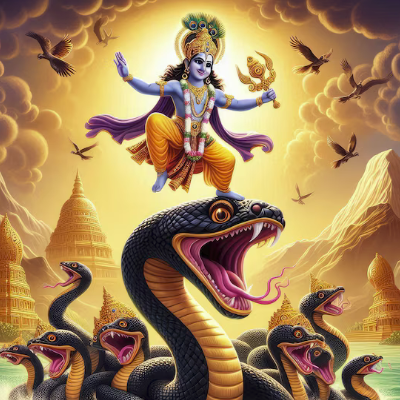
Kaliya is a powerful and venomous naga who appears in the sixteenth chapter of the Tenth Canto of the Bhagavata Purana and in the Harivamsa as the antagonist in one of the most celebrated episodes of Krishna's childhood in Vrindavan. Driven from his native island of Ramanaka by fear of Garuda, Kaliya took up residence in a deep pool of the Yamuna river at Vrindavan, where his extreme venom poisoned the river and its banks for a radius of four leagues, killing birds, cattle, and people who came near and causing the water to bubble and boil with dark toxicity. The episode of Kaliya Mardana — the subduing of Kaliya — records how the young Krishna entered the river, was seized by Kaliya, then freed himself, climbed onto the serpent's hoods, and performed a divine dance upon them until the naga was broken in pride and strength. Kaliya's wives pleaded for mercy. Krishna accepted Kaliya's submission, pressed his divine footprints onto the serpent's hoods as a permanent protection against Garuda, and expelled him and his family to the ocean. The Yamuna was immediately purified. The episode is one of the defining narratives of the Krishnalila cycle and has inspired an extraordinary body of art, literature, dance, and temple sculpture across India and southeast Asia.
✦ The Name
The name Kaliya is Sanskrit, derived from kala, which carries senses of darkness, blackness, time, and death — and is also one of the names of Yama, the god of death. The association of Kaliya with darkness is reinforced by his effect on the Yamuna: the Wikipedia Yamuna article records that one legend attributes the river's dark colour to Kaliya's entry into her waters, and this connection between the serpent's darkness and the river's name Kalindi — derived from kala — is noted in several secondary accounts. In the symbolic reading of the episode, Kaliya thus represents not merely physical venom but the darkness of time, ego, and poisonous agency that pollutes both the external environment and the inner life.
✦ Lineage and Habitation
- Class: Naga — a powerful serpent being, venomous and multi-hooded, belonging to the naga race that descends from Kashyapa and Kadru in the broader Puranic genealogy.
- Original home: Ramanakadwipa — the island of Ramanaka, identified in some regional traditions as a distant island in the ocean. The Wikipedia Kaliya article states that Ramanaka was Kaliya's proper home but that he was driven away from it by fear of Garuda, the great eagle and enemy of all serpents, who preyed upon the nagas. As a result, Kaliya sought a place where Garuda could not reach him.
- Refuge at Vrindavan: Kaliya knew that the sage Saubhari, who dwelt at Vrindavan on the banks of the Yamuna, had cursed Garuda that if he ever came to Vrindavan he would meet his death there. Garuda was therefore unable to enter Vrindavan. Knowing this, Kaliya chose Vrindavan as his residence and settled in a deep pool of the Yamuna, bringing his family with him. This is the context in which the episode unfolds.
- Wives: Kaliya had multiple wives, referred to collectively as the Nagapatnis. At the climax of the episode they emerged from the river and pleaded with Krishna to spare their husband's life.
- Heads: The texts vary in the number of hoods attributed to Kaliya. The Bhagavata Purana accounts speak of multiple hoods; the Met Museum catalogue entry for an eighteenth-century Bhagavata Purana illustration identifies him as hundred-headed; the Villains Wiki article notes that descriptions range between five and a hundred heads depending on the textual version.
✦ The Poisoning of the Yamuna
Kaliya's venom was of exceptional potency. The Bhagavata Purana account describes the water of the Yamuna for four leagues around him as boiling and bubbling with poison. No bird could fly over the affected stretch of river without being killed by the toxic vapour. No animal could drink the water. A single kadamba tree grew on the poisoned bank — the tradition holds this is because the kadamba is the sacred tree of Krishna and therefore immune to Kaliya's venom. The inhabitants of Vrindavan — the cowherds, their cattle, and their families — were effectively cut off from that stretch of the river, which created ongoing suffering, danger, and fear in the community. The Historyreads account notes that the birds flying over the Yamuna were dying and the animals who drank its water were dead, giving a vivid picture of the ecological devastation Kaliya had caused in the sacred landscape of Vraja.
✦ Krishna's Entry into the Yamuna and the Battle
The Bhagavata Purana Tenth Canto, Chapter 16, narrates how the young Krishna initiated the encounter. While playing with his cowherd companions near the banks of the Yamuna, a ball fell into the river near the spot where Kaliya resided. Krishna's friends warned him not to go in after it, knowing the danger of the poisoned pool. Krishna disregarded their warnings, climbed a kadamba tree on the bank, and plunged into the river.
When he entered the water, Kaliya became enraged at the intrusion and rose up to attack. He coiled around Krishna in his powerful serpentine grip, attempting to crush him. The villagers of Vrindavan, watching from the banks — including Krishna's mother Yashoda, his brother Balarama, and the assembled gopis — were struck with terror. Some fell unconscious. Balarama and those who knew Krishna's divine nature watched with understanding, but others wept in fear.
Krishna, however, effortlessly freed himself from Kaliya's coils by expanding his body, forcing the serpent to release him. He then assumed a position on Kaliya's hoods and began to dance — a cosmic dance described as the Kaliya Naga Mardan or Naga Nrittya. The dance was not merely physical combat; it was a performance of supreme divine power pressing down upon the serpent's pride and strength. As Krishna leaped from hood to hood with the full weight of the universe concentrated in his divine feet, Kaliya's hoods began to bleed and crack. The serpent grew weaker under the pressure. The Wikipedia Kaliya account records that Krishna summoned the weight of the whole universe and bore down upon Kaliya's head. The people watching on the banks, when they saw that Krishna had risen from the water and was dancing on Kaliya's hoods, began to dance in joy themselves.
✦ Submission, Mercy, and the Boon of the Footprints
As Kaliya grew exhausted and nearing death, his wives — the Nagapatnis — emerged from the waters and approached Krishna. They offered their obeisances to the Lord and pleaded for their husband's life, identifying Krishna as the Supreme Personality of Godhead and acknowledging the justice of his correction of Kaliya's behaviour. Their prayers acknowledged that the venom and arrogance of Kaliya had polluted the sacred river and harmed innocent beings, and they begged for mercy in terms appropriate to a fully surrendered devotee.
Kaliya himself, having regained consciousness and broken in pride, offered words of submission and praise to Krishna, acknowledging his supremacy and asking for protection for himself and his family. Krishna accepted his contrition. Rather than killing Kaliya, he issued the following terms: Kaliya was to take his family and leave the Yamuna immediately, proceeding to the ocean — the domain appropriate to a serpent of his power. He was no longer to harm the inhabitants of Vraja. As a final act of grace, Krishna imprinted his divine footprints onto Kaliya's hoods. The Cottage9 account records that Krishna promised Kaliya that Garuda would not trouble him in the future because of these footprints — the divine marks of the Lord's feet serving as a permanent protection against his former persecutor. Freed from the fear of Garuda that had originally driven him from Ramanaka, Kaliya departed the Yamuna with his wives, children, and followers and entered the ocean.
✦ Aftermath and the Purification of the Yamuna
Immediately upon Kaliya's departure the Yamuna was purified. The dark, boiling, poisoned water became clear and clean, restored to the quality the texts describe as nectar-like. People and cattle returned to the river banks. Life in Vrindavan was restored to its natural order. The Historyreads account notes that Krishna slowly rose from the river while dancing on Kaliya's head and that the people on the banks too danced ecstatically. The episode in the Bhagavata Purana closes with the purified Yamuna flowing again through the sacred land of Vraja, marking a definitive moment in the narrative of Krishna's childhood.
A regional legend recorded in the Cottage9 account adds that Krishna instructed Kaliya not to look back toward Vrindavan and the Yamuna when he left, warning that he would turn to stone if he did. A village called Jait, located about twenty kilometres from Mathura, is identified by local tradition as the place where Kaliya looked back and was turned to stone, and a temple there contains what is held to be a stone statue of Kaliya Naga. According to the Kaliya Wikipedia article, another regional tradition — maintained by Fiji Indians — identifies the Ramanik Deep to which Krishna banished Kaliya with the islands of Fiji.
✦ Symbolic Interpretation
In the Vaishnavite devotional tradition, the Kaliya Mardana episode is read as a demonstration of the supreme ease with which divine power subdues the forces of ego, darkness, and poison in the created world. Kaliya represents the pride of the powerful, the pollution of the sacred, and the terror that unchecked venom causes to innocent life. Krishna's dance on the serpent's hoods is simultaneously a physical subduing, a cosmic performance, and a transformative grace — the serpent who submitted received not death but divine protection, marked forever by the footprints of the Lord. The Krishnaverse account articulates this explicitly: the episode teaches that formidable errors and poisonous tendencies can be overcome by divine grace and sincere repentance, and that surrender to Krishna purifies and redirects life toward non-harmful existence. The dancing form of Krishna on Kaliya's hoods — Kaliya Nrittya — is one of the most reproduced images in Hindu religious art.
✦ Art, Literature, and Worship
The Kaliyamardana episode has been depicted in miniature painting across Rajput, Pahari, and Mughal traditions. The Metropolitan Museum of Art holds multiple works including a Guler or Kangra Pahari painting of circa 1785 and a Mughal school illustration from 1590–95 for the Harivamsa. Temple sculpture from the Hoysaleswara temple in Karnataka (thirteenth century) and from Prasat Muang Tam in Thailand (late tenth century) show the episode, evidence of its reach into southeast Asian religious culture. Classical dance forms — Bharatanatyam, Kathak, and Kuchipudi — have developed specific repertoire based on the Kaliya Mardana narrative. The Naga Nrittya or Naga Nataiyya festival celebrates the episode in the Braj region and is associated in some traditions with Nag Panchami. Vrindavan's devotional geography preserves specific sites associated with the episode, including the kadamba tree and the ghat on the Yamuna identified with the location where Krishna entered the river.
✦ References
Primary Sources
- Bhagavata Purana, Skandha 10, Chapter 16 — the primary source for the entire Kaliya episode; records the poisoning of the Yamuna, Krishna's entry, the battle, the dance on the hoods, the pleas of the Nagapatnis, Kaliya's submission, the granting of mercy, the imprinting of the divine footprints, the expulsion to the ocean, and the purification of the river.
- Harivamsa — parallel account of the Kaliya episode; the source for Mughal-era illustrations such as the 1590–95 Razmnama-related manuscript in museum collections.
Modern Reference Works
- Wikipedia, "Kaliya" — comprehensive secondary account; covers the Ramanaka origin, Saubhari's curse on Garuda, the Yamuna poisoning, the battle, submission, and regional traditions including the Fiji and Jait legends.
- Krishnaverse.com, "Kaliya — The Serpent of the Yamuna" — detailed secondary narrative; records the devotional significance of the episode and Kaliya's submission speech.
- Historyreads / Deccan Views blog, "Kaliyamardana — A Story from the Bhagavata Purana" — records the full narrative arc from Kaliya's origin to the purification of the Yamuna; notes the artistic traditions across India.
- Metropolitan Museum of Art collection entries — provide art-historical documentation of the Bhagavata Purana series paintings illustrating the episode.
- Cottage9.com, "Krishna the Subduer of Kaliya" — records the boon of the divine footprints, the protection against Garuda, and the regional Jait stone tradition.
- Tell-a-tale.com, "Krishna Tames the Serpent Kaliya" — records the role of Sage Saubhari's curse as the reason for Kaliya's settlement at Vrindavan.
- Wikipedia, "Yamuna in Hinduism" — records the legend connecting Kaliya's entry into the Yamuna with the river's dark colour.