
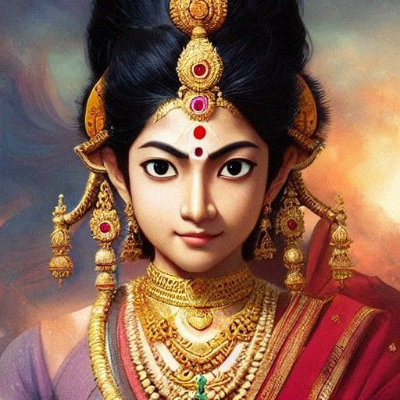
About
Iravati — Mother of the Celestial Elephant Airavata
Iravati · Irāvatī · daughter of Bhadramada · associated with the Iravati river
Iravati is a figure in Hindu mythology best known as the mother of Airavata, the magnificent four-tusked white celestial elephant who serves as the mount of Indra, king of the devas. She is described in the Aranya Kanda of the Valmiki Ramayana as the daughter of Bhadramada — also rendered Bhadramanda or Bhadramana — who was herself one of the daughters born to Krodhavasha, a wife of the sage Kashyapa by Daksha. The Grokipedia account, drawing on the Valmiki Ramayana Aranya Kanda Sarga 14, records the precise genealogical verse: Bhadramada gave birth to a daughter named Iravati, and Airavata the great elephant, protector of the world, is Iravati's son. This places Iravati as a granddaughter of Kashyapa through the Krodhavasha line, and her son Airavata as a great-grandson of Kashyapa — a being of divine descent several generations removed from the primordial sage. The Wikipedia Iravati article additionally identifies her with the sacred Iravati river, one of the names of the Ravi river of Punjab in the Vedic period, and notes the possibility that the name of the Irrawaddy river of Myanmar may trace to this same Sanskrit designation.
✦ Critical Distinction: Iravati Is Not a Direct Daughter of Kadru
The profile request identifies Iravati as a naga and the Shesha Wikipedia article lists the birth order of Kadru's children as Shesha, Vasuki, Iravati, and Takshaka — apparently placing Iravati among Kadru's direct naga children. However, the Valmiki Ramayana Aranya Kanda 3.14.22–24, which is the primary text source on which the Grokipedia account draws, does not identify Iravati as a child of Kadru. Instead, it places her as a daughter of Bhadramada, who was a daughter of Krodhavasha — a different wife of Kashyapa. Krodhavasha bore eight daughters: Mrgi, Mrgamanda, Hari, Bhadramada, Matangi, Sharduli, Sveta, Surabhi, Surasa, and Kadruka (lists vary between nine and ten). Of these, Bhadramada was Iravati's mother.
The Isvara.org Kadru account specifically notes that in the Valmiki Ramayana it is Krodhavasha, not Kadru, who is one of Kashyapa's wives and that Kadru herself is in this tradition a daughter of Krodhavasha. If this reading is accepted, the genealogy becomes more complex. In the simpler Mahabharata tradition, Kadru is a direct wife of Kashyapa and the mother of all nagas. The Shesha Wikipedia article's listing of Iravati in the birth order of Kadru's direct children may reflect a telescoped version of a more complex genealogy, or may refer to a different figure also named Iravati who appears in the naga context — distinct from the Iravati of Aranya Kanda who is the mother of the elephant Airavata. The profile treats the Valmiki Ramayana Aranya Kanda 3.14.24 as the primary source for Iravati specifically as the mother of the elephant Airavata.
✦ The Name
The name Iravati is Sanskrit, from ira meaning water, refreshment, or nourishment, and the adjectival suffix vati forming a noun meaning one who possesses water or abundance. The name is thus associated with the nourishing and life-giving qualities of water, a resonance that connects the figure of Iravati with her identification as the name of the sacred Ravi river of the Punjab — one of the seven rivers of the Vedic Sapta Sindhu. The Grokipedia account notes this river association explicitly and observes that the Irrawaddy river of Myanmar may derive its name from the same Sanskrit root through regional transmission.
✦ Lineage and Extended Family
- Maternal grandfather: Kashyapa — the primordial sage, progenitor of all living beings.
- Maternal grandmother: Krodhavasha — one of Kashyapa's wives, a daughter of Daksha, whose name means anger or wrathful will. She bore the various species of predatory and fierce animals and beings.
- Mother: Bhadramada — one of the eight or ten daughters of Krodhavasha, and the direct mother of Iravati. In the Valmiki Ramayana the name is given as Bhadramada or Bhadramanda.
- Son: Airavata — the great four-tusked white elephant, described in the Valmiki Ramayana as the protector of the world. He is the vehicle of Indra and one of the most magnificent beings in the tradition. The Dharmawiki Airavata account cites the Vishnu Purana (1.22.5–7) as recording that Brahma appointed Airavata as chief of all elephants alongside appointing Soma as chief of stars, Kubera as chief of rajas, Shesha as chief of serpents, Garuda as chief of birds, and Indra as chief of devas.
The Grokipedia account further records that in Puranic texts Iravati is described as the consort of the sage Pulaha, one of the Saptarishis, and that together they are credited with producing the four directional elephant guardians: Airavana, Vamana, Kumuda, and Anjana, who uphold the quarters of the universe according to the Brahmanda Purana (III.7.289–292) and Vayu Purana (69.211). The Bhagavata Purana (III.12.13) additionally links her as a wife to Rudra in some accounts. These Puranic elaborations go beyond the etiological Ramayana passage and reflect later developments in her mythological identity.
✦ Narrative Role and Textual Status
Iravati's appearance in the Valmiki Ramayana is within the catalogue of species origins narrated by the vulture Jatayu to Rama during their encounter in the Aranya Kanda. Jatayu explains the genealogical derivation of various creatures from Kashyapa's multiple wives, and the passage at Sarga 14 places Iravati within this genealogical framework solely as the mother of Airavata. She is accorded no independent narrative episode and speaks no words in the text. Her significance is entirely genealogical — as the mother of one of the tradition's most celebrated celestial beings, she holds a position of quiet importance in the cosmological ordering of the divine animal world. The Mahabharata Adi Parva Adhyaya 66 parallel account similarly mentions Airavata as the son of Bhadramana without expanding on Iravati's own character or role.
✦ References
Primary Sources
- Valmiki Ramayana, Aranya Kanda, Sarga 14, Shloka 22–24 — the primary source; records Bhadramada as one of Krodhavasha's daughters and Iravati as Bhadramada's daughter, and identifies Airavata the great elephant as Iravati's son.
- Mahabharata, Adi Parva, Adhyaya 66 — parallel account naming Airavata as the son of Bhadramana in the context of the origin of all creatures.
- Brahmanda Purana, III.7.289–292 — records Iravati as consort of Pulaha and mother of the directional elephant guardians Airavana, Vamana, Kumuda, and Anjana.
- Vayu Purana, 69.211 — parallel account of Iravati's sons as directional elephants.
Modern Reference Works
- Wikipedia, "Iravati" — records Iravati as daughter of Kadru or Bhadramada and Kashyapa and as mother of Airavata; notes the river association.
- Grokipedia, "Iravati" — the most detailed secondary account; provides the primary text shloka from the Ramayana, the genealogical chain through Krodhavasha and Bhadramada, the Puranic accounts linking her to Pulaha and Rudra, and the river associations.
- Dharmawiki, "Airavata" — provides the Sanskrit verse from Valmiki Ramayana 3.14.24 recording Bhadramada as Iravati's mother and Airavata as Iravati's son.
- Re: IRAVATAM-ADDITION mail-archive account — records the Valmiki Ramayana verse in transliteration and translation; distinguishes the elephant Airavata from the naga Airavata (son of Kadru).
- Wisdomlib, "Ashtanaga" and Kadru/Isvara.org accounts — provide the Mahabharata birth-order context in which an Iravati appears alongside Shesha, Vasuki, and Takshaka.