
About
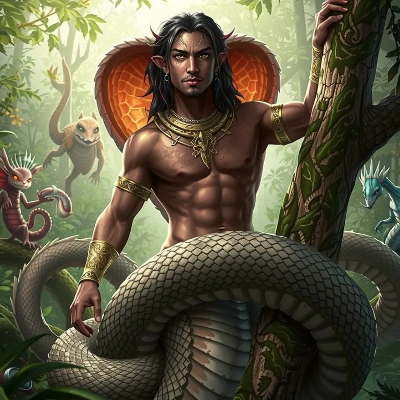
Airavata — Naga Son of Kadru, and the Name-Bearer of the Celestial Elephant Lineage
Airavata · Airāvata nāga · son of Kashyapa and Kadru · third-born naga
The name Airavata is shared by two distinct figures in Hindu mythology whose identities are frequently conflated in secondary literature. The first is Airavata the naga — a serpent son of Kashyapa and Kadru, listed in the Mahabharata Adi Parva among the principal nagas of the thousand born of Kadru, placed third in the birth order after Shesha and Vasuki. The second is Airavata the celestial elephant — a magnificent four-tusked white elephant who is the vehicle of Indra, king of the devas, and who is said in one tradition to be the son of Iravati. These are different figures, and the present profile concerns exclusively the naga Airavata, son of Kadru. The elephant Airavata is addressed in the Iravati profile above and is not treated further here. The Dharmawiki Airavata account, drawing on the Sanskrit verse at Mahabharata Adi 1.35.5, makes this distinction explicit: the name Airavata applies both to a serpent born of Kadru and to an elephant, and the shared name reflects the broader practice in the epics of using the same designation for representatives of different natural classes who bore comparable status or power within their respective lineages.
✦ The Name
The name Airavata is Sanskrit, typically derived as a patronymic from Iravati — he who is born of Iravati, or he who belongs to the Iravati lineage. The association with the river Iravati (the Ravi) carries connotations of aquatic power and cosmic abundance. In the Mahabharata birth-order verse the name appears as Airāvatas Takṣakaśca Karkoṭakadhanañjayau — Airavata and Takshaka and Karkotaka and Dhananjaya — listing the third and subsequent principal nagas of Kadru's line. The Purankosh.in Airavata entry notes that the shared name across serpent and elephant contexts likely reflects the Naga tribes of ancient India being marked differently in different textual traditions as serpents and elephants, both being classified as nagas in the broader sense of the word.
✦ Lineage and Birth Order
- Father: Kashyapa — the sage, progenitor of all beings.
- Mother: Kadru — mother of all nagas, daughter of Daksha.
- Birth order: Third among Kadru's principal sons, after Shesha and Vasuki, and before Takshaka, Karkotaka, and Dhananjaya. This is established by the Sanskrit verse at Mahabharata Adi Parva 1.35.5: Sheshah prathamato jato Vasukistadanantaram / Airavatas Takshascha ca Karkotakadhananjayau — Shesha was born first, then Vasuki, then Airavata and Takshaka, and Karkotaka and Dhananjaya. The Shesha Wikipedia article gives a slightly different order at one point — Shesha, Vasuki, Iravati, Takshaka — but the Mahabharata primary verse and the Dharmawiki account are consistent in placing a naga named Airavata third.
✦ Role in the Naga Tradition
The naga Airavata has several distinct attestations in the tradition beyond the birth-order list. The Dharmawiki account records that Kauravya — the king of nagas of the Airavata lineage, who was the father-in-law of Arjuna and the father of the naga princess Ulupi — is specifically identified in the Mahabharata Adi Parva 213.18 as born of Airavata: Airāvatakule jātah kouravyo nāma pannagah. This makes Airavata the progenitor of the Kauravya lineage of nagas, and thus the patrilineal ancestor of Ulupi and of Iravan, Arjuna's son by Ulupi who fought on the Pandava side in the Kurukshetra War. The Purankosh.in account additionally records that many nagas of the Airavata clan were burned in Janamejaya's Sarpa Satra, that Narada introduced a naga of the Airavata clan to Matali (Indra's charioteer) in the Udyoga Parva as a candidate groom for Matali's daughter, and that Airavata Naga is described in the Vishnu, Vayu, and Brahmanda Puranas as accompanying the chariot of Surya during the month of Kartika.
The Religion Wiki Surasa account also attributes Vasuki, Takshaka, Airavata, and other sons of Surasa as dwelling in Bhogavati — reflecting a textual variant in which these nagas are assigned to Surasa rather than Kadru as their mother. This is a variant arising from the overlapping and sometimes interchangeable roles of Kadru and Surasa as naga mothers in different Puranic recensions, and does not contradict the primary Mahabharata placement of Airavata among the sons of Kadru.
✦ The Airavata Lineage in the Mahabharata
The significance of Airavata Naga in the Mahabharata tradition extends beyond his own person to the clan that bears his name. The Kauravya nagas of the Airavata line are the clan of Arjuna's naga wife Ulupi, whose son Iravan participated directly in the Kurukshetra War and was killed in battle. The Purankosh.in account records that this clan's involvement in supporting the Pandavas represents a significant intersection of the naga world with the human dynastic struggle of the Mahabharata. The Airavata lineage thus serves as the genealogical foundation for one of the most important human-naga relationships in the epic.
✦ Textual Variants and the Distinction from Airavata the Elephant
As noted, secondary literature frequently conflates Airavata the naga son of Kadru with Airavata the elephant son of Iravati. The Dharmawiki account is the most careful in separating these, noting that the name refers sometimes to a serpent and sometimes to an elephant in the epics and Puranas, and attributing this to the shared designation naga, which in Sanskrit covers both serpent and elephant in certain contexts. The mail-archive discussion cited by Dharmawiki records that Airavata Naga is separately attested in the Vishnu and Vayu Puranas (2.10.12) as accompanying Surya's chariot in the month of Kartika — a role distinct from anything attested for Airavata the elephant. The Bhagavata Purana places the naga Airavata on Surya's chariot in the month of Phalguna.
✦ References
Primary Sources
- Mahabharata, Adi Parva, 1.35.5 — the primary source for the birth order of Kadru's principal sons; places Airavata third after Shesha and Vasuki and before Takshaka.
- Mahabharata, Adi Parva, 213.18 — identifies Kauravya as born in the race of Airavata; establishes Airavata as the progenitor of the Kauravya naga lineage and thus the patrilineal ancestor of Ulupi.
- Vishnu Purana, 2.10.12 and Vayu Purana — record Airavata Naga as accompanying Surya's chariot during the month of Kartika.
- Bhagavata Purana — records Airavata Naga on Surya's chariot during the month of Phalguna.
Modern Reference Works
- Dharmawiki, "Airavata" — the most careful secondary account distinguishing the naga Airavata from the elephant Airavata; provides the Sanskrit birth-order verse, the Kauravya lineage reference, the Surya chariot attestation, and the conceptual explanation of the shared naga name.
- Purankosh.in, "Airavata 2" — the Mahabharat-Puran Kosh entry focusing on the naga Airavata; records the lineage of Ulupi and Iravan through Kauravya's descent from Airavata, the Sarpa Satra context, and the Surya chariot role.
- Wikipedia, "Shesha" — records the birth-order sequence including the name Iravati in third position; also relevant as a cross-reference to the naming complexity.
- Wisdomlib, "Ashtanaga" — records Airavata as one of Kadru's named naga sons in the broader list of the Ashtanaga context.
- Religion Wiki, "Surasa" — notes a variant attribution in which Vasuki, Takshaka, and Airavata are listed as sons of Surasa rather than Kadru; represents a Puranic recension variant.
- Mail-archive discussion on Iravatam — provides the Vishnu Purana verse (2.10.12) distinguishing Airavata Naga on Surya's chariot from the elephant Airavata and recording both as named Airavata in different contexts.