
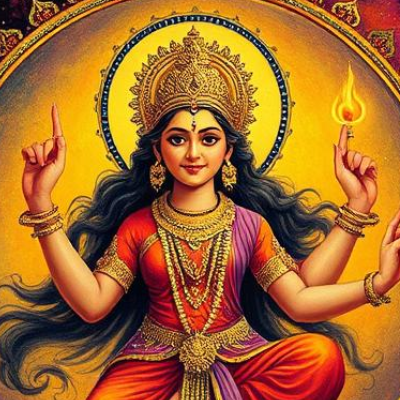
About
Rohini — Principal Wife of Chandra and Mother of Budha
Rohini · Chandrapatni · Dakshakanya · Sasanka-priya · Rohini-nakshatra
Rohini is a daughter of Daksha, the primordial progenitor lord and one of the Prajapatis appointed by Brahma to oversee the multiplication of living beings, and the most beloved of the twenty-seven or twenty-eight wives of Chandra — the moon god, also called Soma, who is among the principal luminaries of the Vedic and Puranic cosmos and the progenitor of the entire Lunar dynasty from which the Pandavas and Kauravas of the Mahabharata descend. Rohini is identified with the Rohini nakshatra — the fourth lunar mansion in the classical system of twenty-seven nakshatras — which corresponds to the star cluster known in modern astronomy as the Hyades in the constellation Taurus, particularly the bright red star Aldebaran. She is the mother of Budha, the planetary deity identified with the planet Mercury, through whom the Lunar dynasty's line of descent reaches the historical kings and heroes of the Mahabharata. Rohini appears in the Vishnu Purana, the Bhagavata Purana, the Brahma Purana, the Mahabharata, the Harivamsa, and several other texts, and is further referenced in Jyotisha — the traditional astronomical and astrological literature — where the Rohini nakshatra holds a position of particular auspiciousness.
✦ The Name
The name Rohini derives from the Sanskrit root ruh, meaning to rise, to grow, or to ascend, with a secondary association with the colour red or reddish-brown — the same root that gives rohita, meaning red or the red deer, and that connects to the reddish star Aldebaran with which the nakshatra is associated. The name thus carries a double resonance: the rising or ascending quality and the redness of the star. In the Rigveda, Rohini is invoked as a nakshatra deity of considerable auspiciousness — the moon's most beloved resting place and the station associated with growth, fertility, and abundance. The epithet Chandrapatni means "wife of Chandra" and Sasanka-priya means "beloved of Sasanka," Sasanka being another name for the moon derived from the image of the hare (shasha) visible in its surface.
✦ Lineage
- Father: Daksha — a Prajapati and primordial progenitor, son of Brahma, who gave his daughters to Chandra in marriage along with their twenty-six sisters, all of whom are identified with the twenty-seven nakshatras.
- Siblings: Rohini's twenty-six sisters are the other wives of Chandra and the other nakshatra deities. They are collectively known as the twenty-seven daughters of Daksha given to Chandra. Their names correspond to the twenty-seven nakshatras of the classical Indian astronomical system: Ashvini, Bharani, Krittika, Rohini, Mrigashira, Ardra, Punarvasu, Pushya, Ashlesha, Magha, Purva Phalguni, Uttara Phalguni, Hasta, Chitra, Svati, Vishakha, Anuradha, Jyeshtha, Mula, Purva Ashadha, Uttara Ashadha, Shravana, Dhanishtha, Shatabhisha, Purva Bhadrapada, Uttara Bhadrapada, and Revati. Some texts give twenty-eight nakshatras including Abhijit, in which case there are twenty-eight daughters. Rohini is the fourth nakshatra and is consistently presented as Chandra's most favoured wife.
- Spouse: Chandra — the moon god, also called Soma, Indu, and Sasanka. He is the son of the sage Atri and his wife Anusuya according to the Puranic account, and is among the most prominent of the non-Aditya divine figures. He is the progenitor of the Lunar dynasty (Chandravamsha) through his son Budha.
- Son: Budha — the planetary deity identified with the planet Mercury, born of Chandra and Rohini. Budha is the father of Pururavas by the celestial nymph Urvashi, and through Pururavas the Lunar dynasty descends through the lines that eventually produce Yayati, Puru, Kuru, and ultimately the Pandavas and Kauravas of the Mahabharata.
✦ Chandra's Favouritism and Daksha's Curse
The most significant narrative in which Rohini is central — not as an active agent but as the cause of a cosmic dispute — is the episode of Chandra's excessive favouritism and Daksha's curse, narrated across the Vishnu Purana, the Bhagavata Purana, the Brahma Purana, and the Mahabharata, with some variation in detail. Daksha gave his twenty-seven daughters to Chandra in marriage with the stipulation that Chandra treat each of them equally and with equal affection. Chandra, however, was entirely captivated by Rohini and spent almost all of his time with her, neglecting his other twenty-six wives. The neglected wives complained to their father Daksha, who warned Chandra on several occasions to fulfil his obligations to all his wives equally. Chandra persisted in his devotion to Rohini and continued to disregard the others.
Daksha, exhausted by Chandra's repeated failure to comply, pronounced a curse upon him: that he would be afflicted with consumption (kshaya), causing him to progressively wane and diminish. The effects of this curse became immediately apparent in the waning of the moon. The gods, alarmed at the disappearance of the moon — whose light was essential to the growth of plants, the nourishment of the Pitrs (ancestors), and the proper functioning of the cosmos — approached Brahma for a remedy. Brahma directed Chandra to bathe in the sacred Prabhasa tirtha — a holy site on the western coast associated with the ocean — and to worship Shiva there. Through this act of devotion and penance, Chandra was able to mitigate the curse but not entirely remove it, since Daksha's curse had been properly pronounced and could not be wholly undone. The compromise was that Chandra would wax and wane in a perpetual cycle: he would diminish progressively for fifteen days and then recover his fullness over the following fifteen days in an unending alternation. This is presented in the Puranic tradition as the origin of the lunar cycle of waxing and waning.
In some versions of this episode — particularly in the Shiva Purana and certain Shaiva accounts — Chandra's devotion at the Prabhasa tirtha is directed to Shiva, and Shiva wears the waxing crescent moon on his head as an emblem of his act of grace in partially relieving Chandra's curse. This is the standard Shaiva explanation for the moon's position in Shiva's iconography. The Bhagavata Purana and Vishnu Purana give broadly consistent accounts of the curse and its resolution, though the degree of detail and the theological framing vary.
✦ Rohini as a Nakshatra
Rohini's identity as a nakshatra deity is inseparable from her identity as a wife of Chandra in the Puranic tradition, since the system of twenty-seven nakshatras is conceptualised as the twenty-seven houses or stations through which the moon passes in the course of its sidereal month, each of which is personified as one of Chandra's wives. Rohini-nakshatra corresponds to the Hyades star cluster in the constellation Taurus and is dominated by the bright red star Aldebaran. In the Jyotisha literature, the Rohini nakshatra is regarded as particularly auspicious — it is associated with abundance, beauty, fertility, and the growth of crops, and it is considered the most beloved station of the moon, consistent with the Puranic mythology of Chandra's preference for Rohini among all his wives. The moon is described as exalted (in its highest dignity) when positioned in the Rohini nakshatra, which in astrological terms reinforces the mythological narrative of Chandra's special bond with this particular station.
✦ Rohini in the Vedic Literature
The Rohini nakshatra is one of the most ancient and frequently mentioned nakshatras in Vedic literature. The Rigveda, the Atharvaveda, the Taittiriya Brahmana, and the Yajurveda contain references to Rohini in astronomical and ritual contexts. The Taittiriya Brahmana in particular contains material on the nakshatras that identifies Rohini as Prajapati's (here meaning the creator's) most beloved daughter and narrates an episode in which Prajapati pursues Rohini in the form of a deer, and the gods create the figure of Mrga (the deer-constellation, corresponding to Orion) to shoot an arrow at Prajapati in punishment. This Vedic narrative is distinct from the Puranic account and involves different characters and a different cosmological setting; it represents an earlier and separate tradition associated with the name Rohini that was not fully integrated into the later Puranic genealogical framework. The Puranic Rohini as a daughter of Daksha and wife of Chandra is a different construction from the Vedic Rohini-as-Prajapati's-daughter, and the texts do not explicitly reconcile the two.
✦ Textual Variants and Inconsistencies
The primary textual inconsistency regarding Rohini is the distinction between the Vedic and Puranic frameworks for her identity, as described above. Within the Puranic tradition itself, the accounts of Daksha's curse on Chandra are broadly consistent across the Vishnu Purana, Bhagavata Purana, Brahma Purana, and Mahabharata, though they differ in the number of warnings Daksha gave before pronouncing the curse, in the specific form of the curse's resolution, and in whether the resolution is obtained through Brahma's guidance alone or through Brahma directing Chandra to Shiva at the Prabhasa tirtha.
A further variant concerns whether Budha is said to be the son of Chandra and Rohini specifically, or simply the son of Chandra without a named mother. The Vishnu Purana and Bhagavata Purana name Rohini as Budha's mother in the context of the Lunar dynasty's genealogy, but some passages in the Mahabharata's genealogical sections refer to Budha as Chandra's son without specifying which of his wives bore him. The identification of Rohini as Budha's mother is, however, the dominant and consistent Puranic position.
✦ Theological Significance
Rohini's theological significance operates at several levels simultaneously. As the most beloved nakshatra — the station in which the moon is exalted and most fully at home — she represents the ideal resting place of the lunar principle and the state of maximum lunar abundance and fertility. Her role as Budha's mother places her at the root of the Chandravamsha, the Lunar dynasty whose descendants include virtually every major royal and heroic lineage of the Mahabharata. The narrative of Chandra's excessive attachment to her is used by the tradition to explain the origin of the lunar cycle — one of the most cosmologically significant regularities of the natural world — through a domestic narrative of marital jealousy, paternal authority, and divine curse. This pattern of deriving large cosmological facts from narratives of personal and familial relations is characteristic of the Puranic mode of mythological thought.
✦ Connection to the Wider Genealogy
Through her father Daksha, Rohini connects to the Brahma-descended line of primordial progenitors. Through her husband Chandra she is the principal wife of the progenitor of the Lunar dynasty. Through her son Budha, whose son Pururavas fathered the lineage through the apsara Urvashi, Rohini is the grandmother of Pururavas and thus the remote ancestress of Yayati, Puru, Kuru, the Pandavas, the Kauravas, and all the other royal figures whose genealogies are traced through the Chandravamsha in the Mahabharata, the Vishnu Purana, and the Bhagavata Purana. She is also, through Daksha, a sister of Aditi — mother of the twelve Adityas — and of the other wives of Kashyapa, making the Rohini-Chandra household and the Aditi-Kashyapa household structurally connected through the same patriarchal line of Daksha.
✦ References
Primary Sources
- Vishnu Purana, Book 4, chapter 6: Narrates Chandra's marriage to Daksha's twenty-seven daughters, his favouritism toward Rohini, Daksha's curse, and the establishment of the waxing-waning cycle; also names Rohini as Budha's mother and gives the Chandravamsha genealogy through Budha.
- Bhagavata Purana, Book 9, chapter 1; Book 6, chapter 6: Book 6 lists Rohini among Daksha's daughters given to Chandra. Book 9 traces the Lunar dynasty through Budha, confirming Rohini as his mother.
- Brahma Purana, chapters 24–25: Contains an account of Daksha's curse on Chandra and the resolution through the Prabhasa tirtha, consistent with the Vishnu Purana narrative.
- Mahabharata, Adi Parva, sections 66–67: Names Rohini among Daksha's daughters and includes genealogical material on the Chandravamsha relevant to Rohini's position as Budha's mother.
- Shiva Purana, Rudra Samhita: Presents the resolution of Daksha's curse on Chandra through Chandra's worship of Shiva at Prabhasa, providing the Shaiva theological framework for Shiva's association with the crescent moon.
- Taittiriya Brahmana, Book 1, chapter 5: Contains the Vedic narrative of Rohini as the most beloved nakshatra and the Prajapati-Rohini episode in the deer-form, representing the distinct Vedic stratum of the Rohini tradition.
- Atharvaveda, Book 19: References to the nakshatras including Rohini in ritual and astronomical contexts.
- Harivamsa, chapters 1–2: Supplement to the Mahabharata that elaborates the Chandravamsha genealogy, confirming Rohini's position as Budha's mother.
Modern Reference Works
- Vettam Mani, Puranic Encyclopaedia (1975): Entry on Rohini; comprehensive collation of the narrative of Daksha's curse, Rohini's genealogical position, and her identification with the nakshatra.
- David Pingree, Jyotihshastra: Astral and Mathematical Literature (1981): Scholarly analysis of the nakshatra system and the astronomical identification of Rohini with the Hyades cluster and Aldebaran; relevant to understanding the astronomical dimension of her identity.
- A. A. Macdonell and A. B. Keith, Vedic Index of Names and Subjects (1912): Entry on Rohini nakshatra; collates Vedic references and establishes the antiquity of the Rohini nakshatra tradition independent of the Puranic genealogical framework.