
About
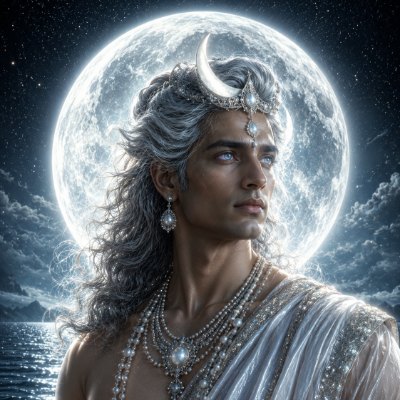
Chandra — The Moon God, Lord of the Nakshatras, and Progenitor of the Lunar Dynasty
Chandra · Soma · Indu · Sasanka · Nishanatha · Oshadhipati · Nakshatranatha · Chandrama · Shashin · Himamshu · Glau · Mriganka · Atrisuta · Abja
Chandra is the moon god of the Hindu Vedic and Puranic tradition — one of the principal luminaries of the cosmos, the lord of the twenty-seven nakshatras or lunar mansions, the presiding deity of the night sky, and the progenitor of the entire Lunar dynasty, the Chandravamsha, from which descend the great royal and heroic lineages of the Mahabharata including the Pandavas and the Kauravas. He is also identified with Soma — the sacred ritual drink of the Vedic sacrifice and the divine substance that nourishes the gods, the ancestors, and the plant world — making him simultaneously a celestial body, a deity of sovereign importance, and the embodiment of a cosmologically vital substance. In the Puranic genealogical tradition he is the son of the sage Atri and his wife Anusuya — figures of the highest ascetic standing — though variant accounts of his origin also exist. He is counted among the Navagrahas — the nine planetary deities whose positions govern human destiny in the Jyotisha tradition — and his importance spans the Rigveda, the Atharvaveda, the Shatapatha Brahmana, the Mahabharata, the Ramayana, and virtually every major Mahapurana. He is among the most theologically and narratively consequential figures in the entire Hindu canonical tradition.
✦ The Names
Chandra is among the most richly named figures in the tradition, and the range of his names reflects the multiple dimensions of his identity as a celestial body, a deity, a ritual substance, and a cosmic sovereign.
Chandra derives from the Sanskrit root chand, meaning to shine, to be bright, or to be pleasing — a root associated with the brilliance of the moon and with the pleasurable quality of moonlight. The name thus means "the brilliant one" or "the shining one." Soma is among the most ancient and theologically layered of his names: in the Rigveda, Soma is primarily the sacred plant whose pressed juice constituted the supreme oblation of the Vedic sacrifice, believed to confer immortality on the gods and to nourish all living beings. The identification of the moon with Soma — as the celestial vessel in which the soma substance is stored and from which the gods drink as the moon wanes each fortnight — is a central concept of Vedic cosmological thought. Indu means a bright drop or a shining point, specifically the drop of soma juice, reinforcing the connection between the lunar deity and the sacred drink. Sasanka means "he who bears the mark of the hare" — a reference to the dark markings visible on the moon's surface, which the Indian tradition reads as the outline of a hare. Nishanatha means "lord of the night." Oshadhipati means "lord of herbs and medicinal plants" — a name reflecting Chandra's sovereignty over the plant world, which is said to draw its vital moisture and life-force from the moon. Nakshatra-natha means "lord of the nakshatras." Himamshu means "he whose rays are cool" — from hima (cool or cold) and amshu (ray) — a name that captures the cooling, soothing quality of moonlight as opposed to the heat of the sun. Mriganka means "marked with the deer" — an alternative reading of the lunar markings, some traditions seeing a deer rather than a hare. Atrisuta means "son of Atri." Abja means "born of water" or "the water-born one," a name connecting Chandra to the aquatic and fluid dimension of the tradition.
✦ Lineage
- Father (principal account): Atri — one of the seven primordial sages, the Saptarishis, and one of the mind-born sons of Brahma. Atri is among the most ancient and revered of the Vedic sages, the author of hymns in the Rigveda's fifth Mandala, and a figure whose austerities are of the most extreme intensity. In the Bhagavata Purana and the Vishnu Purana, Atri's prolonged penance generates a divine light that eventually becomes Chandra. Atri is also the husband of Anusuya, the paradigmatic faithful wife of the tradition, whose own austerities and virtue are celebrated across numerous texts.
- Mother (principal account): Anusuya — the wife of Atri, renowned across the Puranic and epic tradition as a model of wifely devotion and ascetic power. Her name means "the one without jealousy" or "she who is free from envy." Anusuya is the subject of an independent narrative in which the wives of the Trimurti — Sarasvati, Lakshmi, and Parvati — test her fidelity by sending their husbands in disguise to her hermitage; when Brahma, Vishnu, and Shiva arrive and demand she serve them without wearing clothing, Anusuya transforms them into infants and nurses them, demonstrating her absolute purity of intention. She is the mother of three divine sons in the Puranic tradition: Chandra (the moon), Durvasa (the irascible sage), and Dattatreya (a composite avatar of the Trimurti).
- Variant origin accounts: Several texts give different accounts of Chandra's origin. The Rigveda's Purusha Sukta states that the moon was born from the mind of the cosmic Purusha — the primordial person — at the time of the first sacrifice. This is a cosmogonic account rather than a genealogical one and does not involve Atri. The Taittiriya Brahmana and related Vedic texts connect the moon's origin to the cosmic waters and to Prajapati's creative act rather than to Atri's penance. The Puranic account of Atri and Anusuya as Chandra's parents is the dominant genealogical tradition of the Mahapuranas but represents a later systematisation that does not erase the older Vedic cosmogonic accounts. These variant traditions are discussed further below.
- Wives: Chandra's twenty-seven wives are the daughters of Daksha — the primordial progenitor lord and one of the Prajapatis — each identified with one of the twenty-seven nakshatras of the Indian lunar calendar. Their names correspond to the twenty-seven nakshatras: Ashvini, Bharani, Krittika, Rohini, Mrigashira, Ardra, Punarvasu, Pushya, Ashlesha, Magha, Purva Phalguni, Uttara Phalguni, Hasta, Chitra, Svati, Vishakha, Anuradha, Jyeshtha, Mula, Purva Ashadha, Uttara Ashadha, Shravana, Dhanishtha, Shatabhisha, Purva Bhadrapada, Uttara Bhadrapada, and Revati. Some texts give twenty-eight nakshatras by adding Abhijit, in which case Daksha has twenty-eight daughters given to Chandra. Of these wives, Rohini — identified with the fourth nakshatra and with the bright red star Aldebaran in the Hyades cluster of Taurus — is the most beloved and the one with whom Chandra spent the majority of his time, neglecting the others. This favouritism gave rise to Daksha's curse, which is narrated in full below.
- Principal son: Budha — the planetary deity identified with the planet Mercury, born of Chandra and his wife Rohini according to the dominant Puranic tradition. Budha is the progenitor of the Lunar dynasty through his son Pururavas, born of the celestial nymph Urvashi. Through Pururavas the line descends to Ayu, Nahusha, Yayati, Puru, Bharata, Kuru, and ultimately the Pandavas and Kauravas of the Mahabharata. Budha thus connects Chandra's divine progeny to the entire heroic and royal world of the epics.
- Other significant relationships: Chandra is also the father of Varchas — the divine being of brilliance who incarnates as Abhimanyu, the heroic son of Arjuna, in order to participate in the Mahabharata war — according to an agreement made at the assembly of the gods in which each deity contributed a portion of themselves to the cause of restoring cosmic order through the war. This connection makes Chandra the divine grandfather of Parikshit, the last surviving scion of the Pandava line and the king whose story frames the recitation of the Bhagavata Purana.
✦ Chandra in the Rigveda and Atharvaveda
The identity of Chandra and Soma in the Rigveda is fundamental to any understanding of this figure's religious significance. In the Rigveda, the ninth Mandala — the Soma Mandala — is entirely devoted to hymns celebrating Soma, and the identification of that Soma with the moon is already present in germ, though the Rigveda's primary concern is with the ritual substance rather than the celestial body. The moon as a distinct deity called Chandra or Chandrama is explicitly named in the Rigveda's Purusha Sukta — the great hymn of the cosmic person — in which the moon is said to have been born from the mind of the primordial Purusha. This cosmogonic formulation establishes the moon's connection to mind and mental functions — a connection elaborated in the later Puranic and philosophical traditions where the moon is consistently associated with the mind (manas), with mental fluctuation, and with the reflective rather than originating quality of consciousness.
The Atharvaveda contains hymns addressing the moon in the context of healing, fertility, and the sustenance of plant life, invoking Chandra-Soma's nourishing functions and his sovereignty over the night. The Shatapatha Brahmana elaborates the identification of the moon with the soma drink at length, explaining the waxing and waning of the moon as the consequence of the gods drinking the soma stored therein — the moon wanes as the gods drink from it each fortnight, and waxes as the soma is replenished. This Brahmana-level theology provides the cosmological basis for the Puranic narrative of Daksha's curse, in which the moon's waning is explained through a narrative of marital transgression.
✦ The Birth of Chandra from Atri's Penance
The Bhagavata Purana's fourth book and the Vishnu Purana's first book narrate the birth of Chandra from the austerities of the sage Atri. Atri, performing an intense and sustained penance on the mountain Rishyamuka with the specific purpose of generating a divine being who would serve the gods and the world, concentrated his mind and vital breath in his eyes and held them fixed in meditation for an enormous period of time. The energy accumulated through this practice reached such intensity that it overflowed from Atri's eyes as a flood of light. This light — which was the accumulated power of his penance manifested in a luminous form — descended through the ten directions of space, illuminating everything it touched and causing the beings of the world to be overwhelmed by its radiance. The divine mothers of the cosmos — the ten directional goddesses — received this light and attempted to bear it, but it was too powerful for any single being to hold alone and it fell to the earth as the embryo of the moon. Brahma, recognising the extraordinary nature of what had been produced, took this luminous form and placed it in the sky as the moon, appointing Chandra as the lord of the nakshatras, the lord of plant life, and the vessel of the soma drunk by the gods and the ancestors.
This account of Chandra's birth through Atri's penance is significant in several respects. It explains the peculiar brilliance of the moon as the product of a sage's accumulated spiritual light rather than as a property of a naturally existing celestial body. It also explains Chandra's connection to Brahma's sphere of governance: since Brahma himself placed Chandra in the sky and defined his functions, the moon's cosmological role is grounded in a specific creative act of Brahma rather than being an eternally pre-existing condition. The Bhagavata Purana's account is the most elaborate version of this birth narrative; the Vishnu Purana gives a compressed version consistent in its broad outlines.
✦ Daksha's Curse and the Origin of the Lunar Cycle
The most consequential narrative episode in Chandra's biography — the one with the most enduring cosmological significance — is the episode of his marriage to Daksha's twenty-seven daughters and the curse pronounced upon him for his excessive favouritism toward Rohini. Daksha gave his daughters to Chandra in marriage with the explicit condition that he treat each of the twenty-seven with equal affection and attention. Chandra, however, was so captivated by Rohini that he spent almost all his time with her and effectively neglected the other twenty-six. The neglected wives went to their father Daksha and complained of their abandonment. Daksha summoned Chandra and warned him repeatedly — the texts consistently note that Daksha gave multiple warnings before acting — to honour his obligations to all his wives equally. Chandra continued to disregard all twenty-six in favour of Rohini, showing no intention of changing his behaviour.
Daksha, his warnings exhausted and his daughters' grievance unredressed, finally pronounced a formal curse upon Chandra: that he would be afflicted with kshaya — consumption or progressive wasting — causing him to wane and diminish without ceasing. The effects were immediate and catastrophic at the cosmic level. As Chandra began to waste away, the soma stored in the moon — the divine drink on which the gods depended — diminished with him. Plant life, which drew its vital moisture and life-force from the moon's nourishing rays, began to wither. The ancestors, whose sustenance in the afterworld was drawn from the lunar soma offered in ritual, were distressed. The gods themselves, alarmed at the progressive disappearance of the moon and the diminishment of the soma supply, approached Brahma for guidance and remedy.
Brahma directed Chandra to the sacred tirtha at Prabhasa on the western coast — associated with the ocean — and instructed him to bathe there and to worship Shiva with intense devotion. Chandra performed the prescribed austerities and worship. Shiva, pleased by his devotion, agreed to mitigate the curse — but a curse properly pronounced by a figure of Daksha's standing could not be wholly annulled; it could only be moderated. The resolution was a permanent cycle: Chandra would wane over fifteen days and wax over the following fifteen in an unending alternation. During the waning fortnight, the gods and ancestors would draw their soma from the moon; during the waxing fortnight, the soma would be replenished. This cycle — the lunar month of waxing and waning — is presented across the Vishnu Purana, the Bhagavata Purana, the Brahma Purana, and the Mahabharata as the direct consequence of Daksha's curse and Shiva's partial mitigation of it. It is one of the tradition's most explicit mythological explanations for a recurring natural phenomenon.
✦ The Abduction of Tara and the Birth of Budha
The second major narrative episode in Chandra's biography — and the one most consequential for the genealogical tradition — concerns his abduction of Tara, the wife of the great preceptor Brihaspati, and the subsequent birth of Budha from this union. Brihaspati is the divine preceptor of the gods, the teacher of wisdom and sacred learning to the Adityas, and one of the most important divine figures in the tradition. Tara — whose name means star — was his wife. Chandra, overcome by desire for Tara, abducted her and refused to release her despite repeated demands from Brihaspati and from the gods who stood behind their preceptor's rightful claim.
The matter escalated into a cosmic conflict. The demons and certain other beings sided with Chandra; the gods sided with Brihaspati. The resulting war — called the Tarakamaya war or the war of Tara — is narrated in the Vishnu Purana, the Bhagavata Purana, the Mahabharata's Adi Parva, and several other texts, each with some variation in the details of who sided with whom and how the conflict concluded. The gods eventually prevailed sufficiently that Brahma intervened directly, commanded Chandra to return Tara, and declared the continuation of the abduction to be a disgrace. Chandra, under Brahma's direct command, returned Tara to Brihaspati.
Tara, however, was pregnant when she returned. The question of the child's paternity was a matter of great concern to the assembled gods: was the child Brihaspati's or Chandra's? The gods questioned Tara, who was initially silent out of shame. Brahma pressed her repeatedly to speak the truth. Tara finally admitted that the child was Chandra's son. The child born was Budha — a being of extraordinary brilliance and learning, identified with the planet Mercury. Despite the circumstances of his conception, Budha is presented in the tradition not as a figure of transgressed origin but as one of the most significant planetary deities, and his descent from Chandra — however irregularly brought about — is the genealogical foundation of the entire Chandravamsha, the Lunar dynasty that generates the royal and heroic lineages of the Mahabharata.
Chandra's abduction of Tara is treated differently in different texts in terms of its moral framing. The Bhagavata Purana and Vishnu Purana both present it as a transgression — a violation of the sanctity of a teacher's household and of the principle of dharmic order — and Chandra is described as having been driven by uncontrolled desire. The tradition does not exonerate him; the episode is presented as a serious failing that disrupted the cosmic order and caused a war among the gods. At the same time, the tradition's presentation of Budha as a great being and the progenitor of the Lunar dynasty means that this transgression — like several others in the tradition — has consequences that the cosmic order ultimately incorporates and redeems through the generative function of the lineages it produces.
✦ Chandra as Oshadhipati — Lord of Plants
Chandra's sovereignty over the plant world is one of his most consistently attested functions across the Vedic and Puranic tradition. The identification of the moon with moisture, with the nourishing rains, and with the vital essence that causes plants to grow and sustains their life is present in the Rigveda and the Atharvaveda and is elaborated in the Shatapatha Brahmana, the Bhagavata Purana, and numerous other texts. The name Oshadhipati — lord of herbs — reflects this function directly. In Puranic cosmological thought, the moon's light and the soma substance it embodies are the source of the vital moisture on which all plant life depends; when the moon wanes, the vitality of plants diminishes, and when it waxes, they revive. This understanding of the moon's relationship to plant life is grounded in the identification of the moon with Soma — the same substance that nourishes the gods in the sacrifice is understood as the nourishing principle of plant life in the natural world, making Chandra simultaneously the presiding deity of Vedic ritual and the governing power of the agricultural and botanical world.
✦ Chandra and Shiva
Chandra's relationship with Shiva is among the most visually prominent in the iconographic tradition. Shiva is depicted across the Puranas and in sculptural and pictorial representations with a crescent moon worn in his matted hair — an emblem whose narrative origin lies in the episode of Daksha's curse. When Shiva intervened to mitigate Daksha's curse on Chandra, he took the waxing crescent of the partially restored moon and placed it in his own hair, where it remains as a permanent emblem of his act of grace and of his lordship over time and the lunar cycle. This detail is narrated in the Shiva Purana, the Brahma Purana, and other texts, and it integrates Chandra's biography directly into Shiva's iconography. The crescent moon in Shiva's hair is thus not merely a decorative element but a theological statement: it indicates Shiva's mastery over time as measured by the lunar cycle, his role as the one who moderated the curse that governs that cycle, and his relationship with the Soma substance — since Shiva himself is in certain Shaiva theological traditions identified with Soma.
✦ Chandra as a Navagraha
In the Jyotisha tradition — the ancient Indian science of astronomy and astrology — Chandra is one of the nine Navagrahas, the planetary deities whose positions at the time of birth and their subsequent movements through the nakshatras and zodiacal signs govern human destiny. Among the nine, Chandra is considered the graha of mind, emotion, and mental disposition — a function directly connected to the Rigvedic identification of the moon with the mind of the cosmic Purusha. The moon's position in the birth chart is regarded in the Jyotisha tradition as among the most significant indicators of a person's emotional nature, mental temperament, and relationship with the maternal principle. Chandra is said to be exalted — at his most powerful and auspicious — when in the nakshatra of Rohini, his most beloved wife, which reinforces the mythological narrative of his attachment to her at the level of astrological doctrine. He is debilitated when in Vrishchika (Scorpio), the sign directly opposite. The Jyotisha texts elaborate his attributes, gemstone (pearl), metal (silver), day of the week (Monday — Somavar, literally Soma's day), and directional association (northwest) in considerable detail.
✦ Iconography and Worship
Chandra is depicted in the iconographic tradition as a white or silver deity of great beauty, seated on a chariot drawn by ten white horses or alternatively by a single white horse or by white antelopes. He holds a white lotus or a club in his hands, and his complexion is invariably pale and lustrous, reflecting the quality of moonlight. He is sometimes depicted with two arms and sometimes with four. His crescent form — the waxing moon — is considered the most auspicious representation, reflecting the period of Soma's replenishment. In the Navagraha images standard in South Indian temple architecture, Chandra is placed as the second graha and is depicted in white garments and ornaments.
Chandra is worshipped particularly on the full moon day of each month — Purnima — and on Mondays, which are his presiding day. The Soma sacrifice of the Vedic tradition is the oldest and most elaborate form of his worship, though this complex multi-day rite belongs to the Shrauta tradition and is rarely performed in the modern period. In Shaiva temples, the crescent moon in Shiva's hair is venerated as an emblem of Shiva's relationship with Chandra. The Chandra Namaskara — a sequence of salutations to the moon — is practised in various regional traditions. The full moon of the month of Kartika and the full moon of Sharad (autumn) — the night of Sharad Purnima, when the moon is considered to pour amrita in the form of its light onto the earth — are particularly significant moments of lunar worship in the tradition.
✦ Textual Variants and Inconsistencies
Chandra is among the figures for whom the primary sources present the greatest number of genuine variant accounts, and these must be stated with care.
The origin of Chandra: The Rigveda's Purusha Sukta derives the moon from the mind of the cosmic Purusha at the first sacrifice — a cosmogonic rather than genealogical account involving no parents in the conventional sense. The Shatapatha Brahmana and related Vedic texts give Prajapati as the generative source of the moon's soma function. The Bhagavata Purana and Vishnu Purana give Atri and Anusuya as his parents through the mechanism of Atri's penance. These three accounts belong to different strata of the tradition and are not mutually compatible in a straightforward genealogical reading. The Atri parentage is the dominant Puranic tradition and the genealogically most developed, but it does not displace the earlier cosmogonic accounts which remain present in the texts. Some Puranic passages attempt a harmonisation by treating the Atri birth as the specific embodiment of a lunar principle that was cosmogonically prior, but this harmonisation is editorial and not stated in so many words in the texts themselves.
The Tarakamaya war — who sided with Chandra: The accounts of the Tarakamaya war in the Vishnu Purana, the Bhagavata Purana, and the Mahabharata differ on several points: which demons sided with Chandra, the precise course and duration of the war, and the degree of Brahma's directness in commanding Chandra to return Tara. The Mahabharata's account in the Adi Parva is the most compressed; the Vishnu Purana is the most detailed. The Bhagavata Purana's account in Book 9 gives a version that emphasises the moral transgression dimension more than the war narrative. None of the accounts are inconsistent on the fundamental facts — the abduction, the war, Brahma's intervention, Tara's return, and the birth of Budha — but they differ significantly in detail.
The mother of Budha: The dominant tradition of the Vishnu Purana, the Bhagavata Purana, and the Mahabharata identifies Tara — wife of Brihaspati, abducted by Chandra — as Budha's mother. Some passages in the Mahabharata and the Harivamsa name Rohini — Chandra's favoured wife among Daksha's daughters — as Budha's mother instead. The Rohini attribution is the minority position but has textual support and is noted here accordingly.
The number of Chandra's wives: The dominant tradition gives twenty-seven wives corresponding to the twenty-seven nakshatras. The Atharvaveda and certain Jyotisha texts work with a system of twenty-eight nakshatras including Abhijit, in which case Daksha is said to have twenty-eight daughters given to Chandra. The twenty-seven nakshatra system is by far the most widespread in both the astronomical and mythological literature.
Chandra and the Samudra Manthan: The Bhagavata Purana and Vishnu Purana describe the moon as one of the beings who emerged from the churning of the cosmic ocean — the Samudra Manthan — in addition to his Puranic genealogical birth from Atri. Some texts present these as separate and complementary facts; others treat the churning-origin as the occasion of his installation in the sky by Mahadeva rather than as a separate birth. The two accounts are not formally reconciled within the texts.
✦ Theological and Philosophical Significance
Chandra's theological significance in the Hindu tradition is multi-dimensional and operates simultaneously at the cosmological, ritual, soteriological, and philosophical levels. At the cosmological level, he is one of the two great luminaries — along with Surya the sun — who govern the measurement of time, the regulation of the seasons, and the alternation of day and night that structures all life. The lunar calendar, which divides time into fortnights of waxing and waning and which governs the scheduling of all Vedic rites, festivals, and auspicious occasions, is entirely defined by Chandra's movement through the nakshatras and his phases of waxing and waning.
At the ritual level, Chandra-Soma's identification with the sacred drink of the Vedic sacrifice gives him a centrality that few other deities in the tradition can match: the Soma sacrifice, which is the supreme Shrauta rite, is in essence an act of feeding the moon-god with his own substance as pressed and offered by the sacrificial priests. The theological understanding is that the gods drink the soma from the moon during the waning fortnight, and the earthly sacrifice replenishes what the gods have taken — making the human sacrificial act cosmologically necessary for the maintenance of divine life.
At the philosophical level, the Upanishadic tradition develops a concept of the moon as one of the stations on the path of the soul after death — the Pitriyana or path of the ancestors — in which the soul ascends to the lunar realm, remains there until its merit is exhausted, and then descends again to be reborn on earth. This concept, present in the Brihadaranyaka Upanishad and the Chandogya Upanishad, makes Chandra the presiding deity of the intermediate post-mortem realm and the threshold of rebirth. The alternative path — the Devayana or path of the gods — bypasses the moon entirely and proceeds to Brahmaloka without return. Chandra's role in the Pitriyana tradition connects him to the ancestors (Pitrs) who are sustained by the lunar soma offered in the shraddha rites, reinforcing his position as the governor of the cyclical movement between death and rebirth.
✦ Connection to the Wider Genealogy
Chandra stands at the root of one of the two great royal genealogical traditions of the Hindu epics. Through his son Budha — whose parentage is attributed to Tara in the dominant tradition and to Rohini in a minority of texts — the Chandravamsha or Lunar dynasty descends through Pururavas (born of Budha and the apsara Urvashi), Ayu, Nahusha, Yayati, and then through Yayati's son Puru to the Paurava line. From Puru the lineage continues through Dushyanta, Bharata (after whom the land of Bharata is named), Kuru, and eventually to Shantanu, whose sons Bhishma and Vichitravirya and whose grandsons Dhritarashtra, Pandu, and Vidura are the patriarchs of the Kuru house in the Mahabharata. Pandu's sons — the five Pandavas: Yudhishthira, Bhima, Arjuna, Nakula, and Sahadeva — and Dhritarashtra's hundred sons — the Kauravas, led by Duryodhana — are thus all descendants of Chandra at a remove of many generations, and the entire conflict of the Mahabharata is in this sense a conflict within the Chandravamsha.
Through his father Atri — one of the seven primordial sages and a mind-born son of Brahma — Chandra connects upward to the creative line of Brahma. Through his wives — the twenty-seven daughters of Daksha — he connects laterally to the Daksha-Kashyapa genealogical household that generates the gods, demons, and all other cosmic races. Rohini, his most beloved wife, is a sister of Aditi — mother of the twelve Adityas — making Chandra's domestic household and Aditi's divine solar household connected through the same patriarchal line of Daksha. Chandra's son Varchas — who incarnates as Abhimanyu, the heroic son of Arjuna — provides a direct divine lineage descending into the Mahabharata's central generation of warriors, making Chandra the divine grandfather of Abhimanyu and the great-divine-grandfather of Parikshit, whose life and death frame the recitation of the Bhagavata Purana. The scope of Chandra's genealogical connections thus spans from the creation of Brahma at the top to the last generation of Puranic royal history at the bottom.
✦ References
Primary Sources
- Rigveda, Mandala 9 (Soma Mandala) in its entirety; Mandala 10, hymn 90 (Purusha Sukta): Mandala 9 is the foundational Vedic source for the identification of Soma — the sacred drink — with the lunar deity, and for the theology of soma as the divine nourishing substance. The Purusha Sukta establishes the cosmogonic derivation of the moon from the mind of the cosmic Purusha.
- Atharvaveda, Books 7, 11, and 19: Contains hymns addressing the moon in the contexts of healing, fertility, plant nourishment, and the nakshatra system; establishes the lunar deity's functions in the Vedic ritual and natural world.
- Shatapatha Brahmana, Books 3 and 10: Elaborates the identification of the moon with Soma and develops the theology of the lunar waxing and waning as the consequence of the gods drinking the soma stored therein; foundational for the cosmological understanding of Chandra-Soma that the Puranas inherit and elaborate.
- Brihadaranyaka Upanishad, chapters 6.2 and related passages; Chandogya Upanishad, chapter 5.10: Develop the concept of the Pitriyana — the path of the ancestors through the moon — making Chandra the presiding deity of the post-mortem transit and the threshold of rebirth. Essential for understanding the philosophical and soteriological significance of Chandra beyond his cosmological and ritual roles.
- Bhagavata Purana, Book 4, chapter 1 (birth from Atri); Book 9, chapters 14 (Tarakamaya war and birth of Budha) and 1–2 (Lunar dynasty genealogy): The most detailed Puranic source for Chandra's birth from Atri's penance, his abduction of Tara, the Tarakamaya war, the birth of Budha, and the descent of the Lunar dynasty. Indispensable for the genealogical and narrative dimensions of this profile.
- Vishnu Purana, Book 4, chapters 1 and 6: Contains the account of Chandra's birth, the Tarakamaya war, Budha's birth, and the Lunar dynasty genealogy; one of the two primary Mahapuranic sources for these narratives alongside the Bhagavata Purana.
- Mahabharata, Adi Parva, sections 66–67 and 75: The Adi Parva's genealogical sections provide the epic's account of the Tarakamaya war, the birth of Budha, and the establishment of the Lunar dynasty from which the epic's principal figures descend.
- Mahabharata, Shanti Parva and Anushasana Parva: Contain cosmological and theological passages on the moon, Soma, and Chandra's functions as lord of plants and nourisher of the ancestors.
- Brahma Purana, chapters 24–25: Account of Daksha's curse on Chandra and its resolution at the Prabhasa tirtha through Shiva's intervention; consistent with the Vishnu Purana and Bhagavata Purana accounts.
- Shiva Purana, Rudra Samhita: Presents the resolution of Daksha's curse through Chandra's worship of Shiva at Prabhasa and provides the Shaiva theological account of the crescent moon's placement in Shiva's hair as an emblem of his act of grace.
- Harivamsa, chapters 1–3: Supplement to the Mahabharata containing additional genealogical material on the Lunar dynasty and on Chandra's wives and sons, with the variant attribution of Rohini as Budha's mother.
- Matsya Purana, chapters 23–24: Narrates Chandra's birth, the Tarakamaya war, and the Lunar dynasty genealogy; provides comparison with the Bhagavata and Vishnu Purana accounts.
- Vayu Purana, chapters 90–91: Contains an account of Chandra's functions, his relationship with Soma, and the Lunar dynasty genealogy.
Modern Reference Works
- Vettam Mani, Puranic Encyclopaedia (1975): Entries on Chandra, Soma, Tara, Budha, and the Chandravamsha; comprehensive collation of all primary references across the Mahapuranas and epics, indispensable for cross-referencing the variant accounts noted in this profile.
- A. A. Macdonell, Vedic Mythology (1897): The foundational scholarly analysis of Soma and Chandra in the Rigvedic tradition; analyses the identification of the soma drink with the lunar deity and the development of the Soma Mandala's theology. Essential for understanding the Vedic stratum of Chandra's significance.
- Wendy Doniger O'Flaherty, The Rig Veda: An Anthology (1981): Contains translations of key Soma hymns and the Purusha Sukta with scholarly notes on their cosmological implications for the understanding of Chandra-Soma.
- David Pingree, Jyotihshastra: Astral and Mathematical Literature (1981): Scholarly analysis of the Navagraha system and the astronomical dimensions of Chandra's identity, including the nakshatra framework and the astrological significance of the moon's exaltation in Rohini.
- Jan Gonda, The Vision of the Vedic Poets (1963): Examines the theological and poetic dimensions of the Soma and lunar traditions in Vedic literature, relevant to understanding the deep structures of meaning that the Puranic tradition inherited and elaborated.
- F. B. J. Kuiper, Ancient Indian Cosmogony (1983): Analyses Vedic cosmogonic thought including the Purusha Sukta and its implications for the origin of celestial bodies including the moon.
- Cornelia Dimmitt and J. A. B. van Buitenen (editors and translators), Classical Hindu Mythology (1978): Contains translated passages and discussion relevant to the Tarakamaya war episode and the birth of Budha, with scholarly contextualisation.
- Sukumari Bhattacharji, The Indian Theogony (1970): Examines the genealogical and cosmological framework of the Puranic tradition including the Chandravamsha and Chandra's position within the broader divine genealogy.