
About
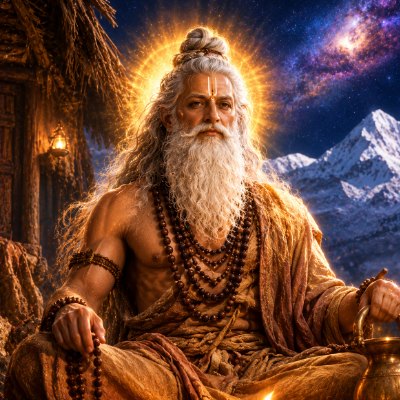
Sage Atri — Mind-Born Son of Brahma, Father of the Trinity's Incarnations
Atri · Attri · Manasaputra · Brahmarishi · Saptarishi · Prajapati · Atreyapita
Atri is one of the Saptarishis — the seven great sages — and one of the ten Manasaputras, the mind-born sons of Brahma. He is the sage most frequently mentioned in the Rigveda, and the fifth Mandala of the Rigveda — comprising eighty-seven hymns — is named the Atri Mandala in his honour. He is married to Anasuya, one of the seven celebrated pativratas (women of supreme chastity) of the Hindu tradition. Their three sons — Dattatreya, Durvasa, and Chandra — are partial incarnations of Vishnu, Shiva, and Brahma respectively. Among the Saptarishis, Atri is said to have emerged from the tongue of Brahma, symbolising wisdom, knowledge, and the power of sacred speech.
✦ The Name
The name Atri is derived from the Sanskrit root ad — to consume or devour — with the negative prefix suggesting one who is beyond the three qualities (gunas) of creation: rajas, tamas, and sattva. Some traditions interpret the name as one who has gone beyond the three — a sage who has transcended the binding qualities of material existence. His descendants and disciples are known collectively as the Atreyas.
✦ Lineage
- Father: Brahma — from whose mind Atri was directly born
- Wife: Anasuya — daughter of Kardama Prajapati and Devahuti (Bhagavata Purana); daughter of Daksha and Prasuti (most other Puranas)
- Son: Dattatreya — born as a partial incarnation of Vishnu; venerated across Hindu traditions as a deity embodying the aspects of the entire Trimurti
- Son: Durvasa — born as a partial incarnation of Shiva; celebrated across the tradition for his fierce austerities and his capacity for both terrible curses and profound blessings
- Son: Chandra — the moon god, born as a partial incarnation of Brahma
- Daughter (some traditions): Atreyi — recorded in some sources as a daughter of Atri and Anasuya
- Fellow Saptarishis: Marichi, Angiras, Pulastya, Pulaha, Kratu, and Vasishtha (First Manvantara list); Agastya, Bhardwaja, Gautama, Jamadagni, Vasishtha, and Vishvamitra (current Vaivasvata Manvantara list)
- Hermitage: Located at Chitrakuta, near the confluence of the Mandakini River, as recorded in the Ramayana
✦ The Birth of the Three Sons
The Bhagavata Purana records that when Brahma instructed Atri to contribute to creation, Atri and Anasuya performed severe austerities on the Riksha mountain range. Pleased by their devotion, the Trimurti — Brahma, Vishnu, and Shiva — appeared before them and granted boons. Atri asked all three to be born to him as sons. Chandra was born as a partial manifestation of Brahma, Dattatreya as a partial manifestation of Vishnu, and Durvasa as a partial manifestation of Shiva.
A second version of this legend centres on Anasuya. In it, the three gods arrived at Atri's hermitage in the guise of mendicants while Atri was absent, and made an unusual demand before accepting food from her. Through the power of her chastity, Anasuya transformed the three gods into infants. When Atri returned and recognised the three babies as Brahma, Vishnu, and Shiva through his divine vision, the gods assumed their true forms and granted the couple the boon that they would remain as their children. The three sons were born thereafter.
✦ Vedic Contributions
Atri is the most mentioned sage in the Rigveda. He and his descendants composed eighty-seven hymns in the fifth Mandala, addressed to Agni, Indra, the Maruts, the Vishvedevas, Mitra-Varuna, and the Ashvins. These hymns are noted for their melodic structure, their elegant presentation of natural phenomena through sacred verse, and their use of linguistic and philosophical riddles. Atri is also associated with the Atri Samhita and the Atri Smriti — textual works attributed to his lineage. The Vaikhanasas sub-tradition within South Indian Vaishnavism credits its theology to four sages: Atri, Marichi, Bhrigu, and Kashyapa.
✦ In the Ramayana
During their fourteen-year exile, Rama, Sita, and Lakshmana visited the hermitage of Atri and Anasuya at Chitrakuta. Atri received them with great honour and told them about the forest of Dandakaranya. Anasuya gave Sita divine ornaments and a heavenly robe, and taught her the duties of a devoted wife. The Shiva Purana also records that during a severe drought, Anasuya's austerities caused the river Ganga to manifest at Chitrakuta for the benefit of the region — a distinct, localised event from the more widely known story of Bhagiratha bringing the Ganga to earth.
✦ In the Mahabharata
In the Mahabharata, Atri appears at a critical moment on the Kurukshetra battlefield. When Dronacharya — grief-stricken and enraged upon hearing the false report of his son Ashvatthama's death — began indiscriminately slaughtering Pandava soldiers in a state of uncontrolled fury, Atri appeared on the battlefield alongside Rishi Gautama and personally counselled Drona to lay down his weapons. He reminded Drona that his actions were against dharma, that a Brahmin's path lay in knowledge and non-violence, and that a man of Vedantic learning should not persist in such destruction. Drona accepted this counsel, laid down his arms, and was subsequently killed. Atri also visited Bhishma alongside Narada as Bhishma lay on his bed of arrows, bearing witness to the final teachings of the Shanti Parva.
✦ In Astronomy
One of the seven stars of the Saptarishi constellation — identified with the Big Dipper or Ursa Major — is associated with Atri. Each of the seven stars of this constellation corresponds to one of the seven great sages, placing Atri permanently in the celestial record of the cosmos. The Brihadaranyaka Upanishad states that each of the seven sages symbolises one sense organ of Brahma; Atri symbolises the tongue.
✦ References
- Rigveda — Fifth Mandala (Atri Mandala): eighty-seven hymns attributed to Atri and his lineage, addressed to Agni, Indra, the Maruts, Mitra-Varuna, and the Ashvins; Atri is also credited with verses in Mandala 10
- Brihadaranyaka Upanishad — identifies Atri as symbolising the tongue among the seven senses of Brahma represented by the Saptarishis
- Mahabharata (Vyasa) — Drona Parva: Atri's appearance on the Kurukshetra battlefield and his counsel to Dronacharya; Shanti Parva: Atri's visit to Bhishma on the arrow bed alongside Narada
- Valmiki Ramayana — Ayodhya Kanda, Chapter 117: Rama, Sita, and Lakshmana's visit to Atri's hermitage at Chitrakuta; Anasuya's gift of divine garments and ornaments to Sita and her instruction in pativrata dharma
- Bhagavata Purana — Skandha 3 and 4: records Atri's austerities on the Riksha mountain, the appearance of the Trimurti, and the births of Dattatreya, Durvasa, and Chandra; records Anasuya's parentage as daughter of Kardama and Devahuti
- Shiva Purana — records Atri and Anasuya's role in bringing a form of the Ganga to Chitrakuta during a drought
- Atri Samhita and Atri Smriti — textual works attributed to the Atri lineage, preserved in fragmentary form
- Wikipedia — Atri; Bharatpedia — Atri: modern summaries drawing from the above primary sources