
About
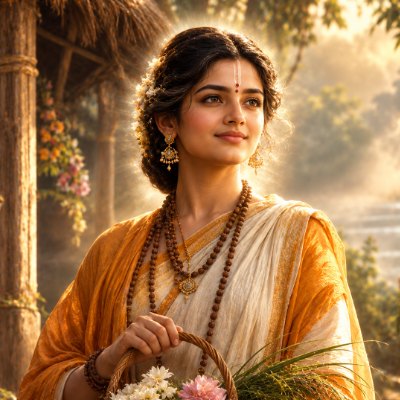
Anasuya — Wife of Atri, Mother of the Divine Triad's Incarnations, and Supreme Exemplar of Pativrata Virtue
Anasuya · Anasūyā · Atripatni · Pativrata-shiromani · Brahma-Vishnu-Shiva-janani · Kardama-putri · Triveni-mata · Sita-seva-kari
Anasuya is the wife of the sage Atri — one of the seven Saptarishis and a mind-born son of Brahma — and one of the most celebrated exemplars of pativrata virtue in the entire Sanskrit canonical tradition. Her name means "she who is free from jealousy" or "the non-envious one" — from the negative prefix an and asuya (envy, malicious jealousy) — and the tradition presents her life as the sustained embodiment of this quality: a woman of such complete freedom from envy and resentment, of such pure devotion to her husband and to the dharmic principles of the householder life, that her spiritual power exceeded that of many divine beings. She is the daughter of the sage Kardama — one of the Prajapatis, the son of Brahma, and the progenitor of several significant figures — and of Devahuti in the most widely attested account. She is the mother of three sons who are identified in the tradition as partial incarnations of Brahma, Vishnu, and Shiva respectively: Soma (or Chandra — the moon god) born of Brahma's amsha, Dattatreya born of Vishnu's amsha, and Durvasa born of Shiva's amsha. Each of these three sons is profiled separately in this series. She appears in the Mahabharata's Aranya Parva in the celebrated episode in which Rama and Sita visit her ashrama during their forest exile and she gives Sita the anointment that keeps the latter's beauty permanent; she appears in the Bhagavata Purana in the account of her husband Atri's austerities and the birth of her three divine sons; and she appears across the Puranic tradition as the paradigmatic pativrata — the devoted wife whose power of virtue gave her the strength to protect the world itself.
✦ The Name
The name Anasuya — "free from envy" or "the non-jealous one" — is both a biographical descriptor and a philosophical category in the tradition's ethical vocabulary. Asuya in Sanskrit designates not merely envy in the ordinary sense but a specific moral failing: the resentment of another's good fortune, the inability to take pleasure in another's prosperity, the corrosive quality of wanting to diminish what one cannot possess. Anasuya as "free from asuya" is thus a woman characterised by the complete absence of this failing — someone whose response to the good fortune of others is joy rather than resentment, whose devotion to her own path is so complete that she feels no need to compare herself to or diminish others. The tradition presents this freedom from envy as the specific spiritual quality that generated her extraordinary power — the tapas-shakti (power of austerity) that derived not from conventional ascetic practice but from the sustained purity of her domestic and conjugal life. The patronymic Kardama-putri means "daughter of Kardama." Atripatni means "wife of Atri." Pativrata-shiromani means "the crest-jewel of devoted wives." Brahma-Vishnu-Shiva-janani means "mother of Brahma, Vishnu, and Shiva" — understood in the tradition as the mother of their partial incarnations rather than of the supreme deities themselves.
✦ Lineage
- Father: Kardama — one of the Prajapatis, a son of Brahma, who performed austerities on the banks of the Sarasvati river for ten thousand years and was instructed by Brahma to produce offspring. He married Devahuti and from their union nine daughters were born — including Anasuya — and one son Kapila, the sage who founded the Samkhya philosophical school. The Bhagavata Purana's third book narrates Kardama's story in detail. As Brahma's son and a Prajapati, Kardama connects Anasuya to the primordial creative line.
- Mother: Devahuti — the daughter of Svayambhuva Manu (the first Manu) and Shatarupa, given in marriage to Kardama and the mother of the nine daughters and Kapila. The Bhagavata Purana gives Devahuti's biography with considerable detail, particularly in the context of Kapila's philosophical teachings to her. Anasuya as the daughter of Devahuti and Kardama is thus the granddaughter of the first Manu and great-granddaughter of Brahma.
- Husband: Atri — one of the seven Saptarishis, a mind-born son of Brahma, and one of the most revered sages of the Vedic tradition. He is the author of hymns in the Rigveda's fifth Mandala and the progenitor of the Atri gotra. His relationship with Anasuya is described across the tradition as one of the most harmonious and mutually supportive sage-couple relationships — they performed austerities together, they hosted divine guests with joint hospitality, and their combined spiritual power was the foundation of their extraordinary household. Atri's profile connects to the Chandra-Soma narrative given in the son's profiles below.
- Sons: Chandra-Soma born of Brahma's amsha; Dattatreya born of Vishnu's amsha; Durvasa born of Shiva's amsha.
- Sisters: Eight other daughters of Kardama and Devahuti — Kala, Anasuya, Shraddha, Havirbhu, Gati, Kriya, Khyati, Arundhati, and Shanti in the Bhagavata Purana's enumeration. These sisters were given in marriage to different sages — Kala to Marichi, Shraddha to Angiras, Havirbhu to Pulastya, Gati to Pulaha, Kriya to Kratu, Khyati to Bhrigu, Arundhati to Vasistha, and Shanti to Atharvan. Through these marriages the nine daughters of Kardama connected Brahma's son Kardama to all the major Vedic sage lineages simultaneously through a single generation of daughters.
✦ Anasuya's Spiritual Power and the Trial of the Three Gods
The most celebrated episode in Anasuya's biography — narrated across the Puranas with variations in detail but consistent in its essential form — is the trial of the three great gods: Brahma, Vishnu, and Shiva came to test the depth of her pativrata virtue by appearing at her ashrama in the guise of mendicant brahmins and making an impossible demand. They told her that they would accept food from her only if she served them naked. This demand was a deliberate test of the most extreme kind — it placed her before a choice between the sacred obligation of hospitality to brahmin guests (which required serving them whatever they asked) and the equally sacred obligation of modesty and fidelity to her husband. An ordinary woman would have had to refuse one obligation or the other.
Anasuya, rather than being disturbed or torn by the dilemma, resolved it through the power of her pativrata virtue. She meditated on her husband Atri and then, through the spiritual power accumulated through her completely pure and devoted conjugal life, transformed the three gods into infants. As infants they required no modesty before her — a mother's service to her infants involves exactly the kind of intimate attendance that the mendicants had demanded in their original form, but within the entirely pure and appropriate context of maternal care. She served the three divine infants with complete care and devotion, nursing them and tending to them with all the hospitality and love appropriate to both the occasion and the relationship. When the consorts of the three gods — Sarasvati, Lakshmi, and Parvati — came seeking their husbands and found them as infants in Anasuya's care, they pleaded with her to restore them. Anasuya consented and the three gods resumed their divine forms. Pleased and humbled by the completeness of her virtue, they offered her a boon. She asked that they be born as her sons — and from this request the three sons Chandra-Soma, Dattatreya, and Durvasa were born as partial incarnations of Brahma, Vishnu, and Shiva respectively.
✦ Anasuya and Sita — the Ramayana Episode
The Valmiki Ramayana's Aranya Parva narrates the episode of Rama, Sita, and Lakshmana visiting Anasuya's ashrama in the Chitrakuta region during their forest exile. Atri and Anasuya received the royal guests with great honour. Atri narrated to Rama the holy places of the forest and guided the party in their pilgrimage. Anasuya spoke privately with Sita and gave her a discourse on wifely duty and the dharma of the devoted wife — a teaching that the Ramayana presents as the appropriate exchange between the tradition's supreme exemplar of pativrata virtue and the figure who would become its supreme narrative embodiment. She also gave Sita gifts: a heavenly garment, divine ornaments, an unguent for her body that would preserve her beauty permanently through the hardships of forest life. This gift — the beauty-preserving anointment — is one of the practical expressions of Anasuya's power as a pativrata: her accumulated virtue manifested in a tangible gift that sustained and protected Sita through the remainder of the forest exile and the subsequent captivity.
✦ Textual Variants and Inconsistencies
The three sons as partial incarnations: The identification of Anasuya's three sons as partial incarnations (amshas) of Brahma, Vishnu, and Shiva respectively — Soma-Chandra from Brahma's amsha, Dattatreya from Vishnu's amsha, and Durvasa from Shiva's amsha — is the standard Puranic account. Different Puranic texts vary the specific assignment of which amsha produced which son, and some texts give different degrees of divine infusion for each son.
The mother of Anasuya: The Bhagavata Purana identifies Devahuti as Anasuya's mother. The Vishnu Purana's genealogical framework is broadly consistent with this. Some regional and secondary sources omit the maternal identification or give variant accounts of Kardama's family.
✦ Theological Significance
Anasuya is the tradition's most complete portrait of the pativrata as a figure of genuine spiritual power rather than of mere social compliance. The tradition does not present her devotion to her husband as a form of self-abnegation or as the absence of agency — it presents it as the concentrated and disciplined direction of her spiritual energy toward the specific form of practice that the householder stage of life requires. The result of this sustained direction was a spiritual power that could transform the three supreme deities into infants — a power greater than any conventional ascetic achievement could have produced. Her freedom from envy — the specific quality her name encodes — is presented as the psychological foundation of this power: only a being who truly wanted nothing for herself beyond the fulfilment of her dharmic role could accumulate the quality of spiritual energy that Anasuya possessed.
✦ References
Primary Sources
- Bhagavata Purana, Book 4, chapters 1–2: The genealogical account of Kardama's daughters including Anasuya and her marriage to Atri.
- Bhagavata Purana, Book 4, chapter 18–19: Atri's austerities and the birth of the three sons from the amshas of Brahma, Vishnu, and Shiva through Anasuya.
- Valmiki Ramayana, Aranya Kanda, sargas 8–11: The visit of Rama, Sita, and Lakshmana to Anasuya's ashrama; Anasuya's discourse to Sita on pativrata dharma; the gifts of garments, ornaments, and the beauty-preserving anointment.
- Brahma Vaivarta Purana and Skanda Purana: The episode of the three gods testing Anasuya's pativrata virtue by demanding she serve them naked; the transformation into infants; the consorts' appeal; the restoration; and the boon of the three sons.
Modern Reference Works
- Vettam Mani, Puranic Encyclopaedia (1975): Entry on Anasuya; comprehensive collation of primary references.
- Robert P. Goldman (translator), The Ramayana of Valmiki — Aranya Kanda (1994): Critical translation with notes on the Anasuya-Sita episode.