
About
Kardama — Prajapati, Father of Kapila, Husband of Devahuti
Kardama · Kardama Prajapati · Brahma-manasa-putra · Kapila-pita · Devahuti-pati
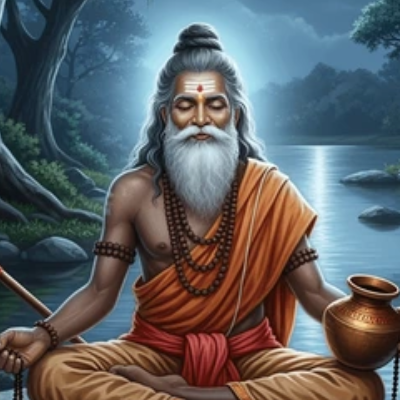
Kardama is one of the ancient Prajapatis — the progenitors of living beings — of the Puranic cosmological tradition. He is most extensively narrated in the Bhagavata Purana, particularly in its third skandha, where several chapters are devoted to his long austerities on the banks of the Sarasvati river, his vision of Vishnu, the god's promise that he will be born as Kardama's own son, his marriage to Devahuti — the daughter of the primordial sovereign Manu Svayambhuva and his queen Shatarupa — his fathering of nine daughters and one son with Devahuti, and his eventual renunciation of household life following the birth of that son. The son born to Kardama and Devahuti is Kapila, who is identified in the Bhagavata Purana and related texts as a direct avatara of Vishnu and as the founder or transmitter of the Samkhya system of philosophy. Kardama also appears in the Vishnu Purana, the Matsya Purana, the Markandeya Purana, and other Mahapuranas as a figure of the primordial creation. He is described in different sources as either a mind-born son of Brahma — one of the Brahma-manasa-putras who arise from the creator's will rather than from physical generation — or as one of the ten or fourteen Prajapatis of the first age, the categories overlapping in different Puranic systems. His narrative is significant not only for the genealogical links it establishes but for its theological content: the third skandha of the Bhagavata Purana uses the frame of Kardama's story to introduce the Kapila-Devahuti dialogue, one of the most important philosophical discourses in all of Puranic literature.
✦ The Name
The name Kardama is Sanskrit, derived from the root kardama meaning mud, mire, or the sediment at the bottom of a body of water. In the cosmological context of the Puranic creation narratives, mud and primordial sediment carry a generative and foundational significance — mud is the substance from which the earth is formed, the matrix of material existence, the ground of physical life. The name Kardama for a Prajapati — a lord of creatures and a progenitor of living beings — thus encodes his role as a foundational generative figure, one who participates in the material grounding of creation. The Bhagavata Purana explicitly connects Kardama's name to his function as a progenitor, situating him among the beings whose austerities and procreative activity populate the world in the earliest age. The title Prajapati, borne by Kardama and by other primordial figures of the same order, means lord of progeny or lord of creatures, and designates his role as one of the presiding figures over the process of creation and population of the world.
✦ Lineage
- Origin: Described in the Bhagavata Purana and Vishnu Purana as one of the mind-born sons of Brahma — the Brahma-manasa-putras — beings who arise from the creative will and mental power of Brahma rather than from physical procreation. In some Puranic lists he is named among the ten or fourteen Prajapatis generated by Brahma at the beginning of the current creation cycle.
- Father (in the mind-born sense): Brahma, the creator god, the first being of the current cycle of creation, born from the lotus that emerges from the navel of Vishnu at the beginning of the cosmic age.
- Wife: Devahuti, daughter of Manu Svayambhuva — the first Manu and primordial sovereign of humanity in the current cosmic cycle — and of Shatarupa, the first woman of the tradition, herself said to be born from Brahma. Devahuti is thus simultaneously the granddaughter of Brahma and the wife of one of Brahma's own mind-born sons, a genealogical proximity that the Puranic texts do not treat as problematic given the cosmological rather than biological nature of these relationships in the first creation.
- Son: Kapila, the most celebrated of Kardama's children, regarded in the Bhagavata Purana and related Vaishnava texts as a direct avatara of Vishnu who took birth as Kardama's son in fulfilment of a promise made to Kardama during his austerities. Kapila is the great sage who expounds the Samkhya system of philosophical analysis to his mother Devahuti after Kardama's departure from household life, and the dialogue between them forms the Kapila-Gita or Devahuti-Kapila samvada embedded in the third skandha of the Bhagavata Purana.
- Daughters: Nine daughters are named in the Bhagavata Purana as children of Kardama and Devahuti: Kala, Anasuya, Shraddha, Havirbhu, Gati, Kriya, Khyati, Arundhati, and Shanti. These nine daughters are given in marriage to nine of the great sages of the tradition, and through these marriages they become the mothers of important lineages and divine beings.
- Son-in-law Marichi: Kala, the eldest daughter of Kardama, is given to the sage Marichi, one of the seven great rishis and a mind-born son of Brahma; Marichi and Kala are the parents of Kashyapa, whose own progeny include the gods, the demons, and many other categories of being.
- Son-in-law Atri: Anasuya, the second daughter, is given to the sage Atri, another of the seven great rishis; Atri and Anasuya are celebrated in the tradition as a paradigmatic devoted couple, and their sons include the god Dattatreya.
- Son-in-law Angiras: Shraddha is given to the sage Angiras, progenitor of a major Vedic lineage.
- Son-in-law Pulastya: Havirbhu is given to the sage Pulastya, one of the seven great rishis and the grandfather of Ravana in the Ramayana tradition.
- Son-in-law Pulaha: Gati is given to the sage Pulaha.
- Son-in-law Kratu: Kriya is given to the sage Kratu.
- Son-in-law Bhrigu: Khyati is given to the sage Bhrigu, one of the seven great rishis and a pivotal figure in many Puranic narratives; Bhrigu and Khyati are the parents of the goddess Lakshmi in certain Puranic accounts, and also the parents of Shukracharya, the preceptor of the demons.
- Son-in-law Vasishtha: Arundhati is given to the sage Vasishtha, the royal preceptor of the Solar dynasty of Ayodhya and one of the seven great rishis; Arundhati herself becomes one of the most celebrated women of the tradition, held up as the paradigm of wifely devotion and used in the Vedic marriage ceremony as a model for the bride.
- Son-in-law Atharvan: Shanti is given to the sage Atharvan in some accounts, though the identification of the ninth son-in-law varies slightly across different Puranic recensions.
✦ Austerities on the Sarasvati and the Vision of Vishnu
The Bhagavata Purana's third skandha opens the narrative of Kardama with his performance of intense austerities on the banks of the Sarasvati river, the sacred river of the Vedic tradition, at a location called Bindu-sarovara — the lake of the drop. Kardama's austerities are directed toward Vishnu, and they extend over an immense period of time. The purpose of these austerities is the fulfilment of his function as a Prajapati — he seeks Vishnu's sanction and blessing for his role as a progenitor, wishing to take a wife and produce offspring in accordance with the dharmic order of creation, and specifically wishing for a son of the highest spiritual quality. At the culmination of his austerities, Vishnu appears before Kardama and grants him a vision. Vishnu makes two promises to Kardama: first, that he will be given a suitable wife who will serve him with complete devotion; and second, that Vishnu himself will take birth as Kardama's own son. The second promise is the theological centrepiece of the narrative — it establishes the avatara birth of Kapila as a direct divine act of grace toward the devoted Prajapati.
✦ The Marriage to Devahuti
In fulfilment of Vishnu's promise, Manu Svayambhuva — the first Manu, the primordial sovereign of humanity — travels with his wife Shatarupa and their daughter Devahuti to Bindu-sarovara to seek a suitable husband for Devahuti. The Bhagavata Purana describes Devahuti as a woman of great beauty, virtue, and devotion, who had herself expressed the wish to be given in marriage to a man of spiritual eminence. Manu and Shatarupa present Devahuti to Kardama and request the marriage. Kardama, recognising this as the fulfilment of Vishnu's promise, accepts. The marriage is described as a union of complete complementarity — Kardama the austere and spiritually accomplished sage, Devahuti the devoted and virtuous daughter of the first sovereign. Manu gives his blessing and departs, and Devahuti takes up residence at Bindu-sarovara in Kardama's hermitage.
✦ Household Life, the Aerial Palace, and the Birth of the Children
After many years of service to Kardama, during which Devahuti attends to his needs with complete dedication and undergoes physical diminishment through her austerities and labours, Kardama — moved by compassion and affection — uses his yogic powers to create for her an extraordinary aerial palace, a vimana, filled with every comfort and beauty, staffed by celestial attendants, and capable of travelling through the skies. He also uses his powers to restore Devahuti's physical form to its full beauty. The couple travel in this aerial palace through the heavens, visiting the sacred regions and celestial worlds. During this period Devahuti conceives, and she bears nine daughters in succession — Kala, Anasuya, Shraddha, Havirbhu, Gati, Kriya, Khyati, Arundhati, and Shanti. These nine daughters are given in marriage to the nine great sages as described in the lineage section above. Finally, in fulfilment of Vishnu's earlier promise to Kardama, Devahuti bears a son who is Kapila — the avatara of Vishnu himself born in human form as the child of this sage and this devoted woman.
✦ Renunciation and Departure
Following the birth of Kapila, Kardama understands that his function as a householder and Prajapati has been fulfilled — his daughters have been given in marriage and will produce the lineages that populate the world, and his son is none other than Vishnu himself in human form. Kardama therefore takes the path of renunciation, sannyasa, and departs from household life to wander and pursue the final liberation. Before departing he receives instruction and blessing from his son Kapila. The departure of Kardama leaves Devahuti alone with Kapila, and the philosophical discourse that Kapila then delivers to his grieving and spiritually seeking mother — the Kapila-Devahuti samvada — forms one of the most significant passages of the entire Bhagavata Purana, expounding the Samkhya analysis of material existence, the nature of the self, and the path to liberation through devotion.
✦ Textual Variants and Inconsistencies
The Bhagavata Purana is the primary and most detailed source for Kardama's narrative and provides the fullest account of his austerities, his marriage, his household life, and his renunciation. The Vishnu Purana includes Kardama in its account of the primordial sages and Prajapatis and names his marriage to Devahuti and his children, but with less narrative elaboration than the Bhagavata. The Matsya Purana and Markandeya Purana include Kardama in their lists of Prajapatis and mind-born sons of Brahma without extending his individual story significantly.
A point of variation concerns the list of Kardama's sons-in-law. The Bhagavata Purana provides the fullest and most consistent list of the nine daughters and their husbands. The Vishnu Purana's account of the same marriages assigns some daughters to different sages, and the name of the ninth son-in-law is not uniformly given across all recensions. These variations do not affect the core identity of Kardama or the main lines of his narrative but are noted here for completeness.
The identification of Kapila as an avatara of Vishnu is a specifically Vaishnava theological position most fully developed in the Bhagavata Purana. The Samkhya philosophical tradition itself does not universally accept this identification, and within the broader tradition Kapila is sometimes presented as a great sage and philosopher rather than specifically as a Vishnu avatara. The Bhagavata Purana's framing of Kardama's son as Vishnu incarnate is the Vaishnava theological interpretation of the figure and should be understood as such.
✦ Theological and Philosophical Significance
Kardama's narrative carries several distinct layers of theological significance in the Puranic tradition. As a Prajapati, he embodies the principle that the performance of austerity directed toward a divine purpose — here the dharmic population of the world — is itself a form of devotion and is met by divine grace. His willingness to undertake householder life after long austerity, and his subsequent creation of a life of extraordinary beauty and abundance for Devahuti, illustrates the Puranic teaching that renunciation and enjoyment are not inherently opposed — the householder stage of life, when undertaken with right intention and devotion, is itself a valid and honoured path.
His relationship to Kapila gives Kardama a unique theological position: he is the human father of a Vishnu avatara, and the Bhagavata Purana treats this relationship with great tenderness and reverence. The promise made by Vishnu to Kardama during his austerities — that Vishnu will be born as his son — is presented as an act of supreme divine condescension and grace, a reward for Kardama's long and pure devotion. Through Devahuti's subsequent instruction by Kapila, the soteriological fruit of Kardama's household life extends beyond his own renunciation to the liberation of his wife, giving the entire arc of the narrative a shape in which the Prajapati's dharmic function ultimately serves the highest spiritual end.
✦ Connection to the Wider Genealogy
Through his nine daughters and their marriages to the nine great sages, Kardama is a genealogical node of extraordinary importance in the Puranic tradition. His daughter Kala, married to the sage Marichi, is the mother of Kashyapa — the great progenitor whose wives bear the gods, the demons, the nagas, the birds, and many other classes of being. His daughter Khyati, married to the sage Bhrigu, is in certain Puranic accounts the mother of the goddess Lakshmi and also of Shukracharya, the preceptor of the asuras. His daughter Arundhati, married to Vasishtha, becomes the most celebrated exemplar of wifely devotion in the entire tradition and is invoked in every Vedic marriage ceremony. Through these daughters and their lineages, Kardama's descendants populate virtually every significant genealogical strand in the Puranic universe. His son Kapila stands outside dynastic genealogy in the conventional sense but is, as a Vishnu avatara, the most theologically significant of all his children.
✦ References
Primary Sources
- Bhagavata Purana, Skandha 3, Chapters 21–33: The principal and most detailed source for Kardama's narrative; covers his austerities at Bindu-sarovara, his vision of Vishnu and the two promises made to him, the arrival of Manu and Shatarupa with Devahuti, the marriage, the household years, the creation of the aerial palace, the birth of the nine daughters and their marriages to the nine sages, the birth of Kapila, and Kardama's renunciation and departure.
- Bhagavata Purana, Skandha 3, Chapters 25–33 (Kapila-Devahuti samvada): The philosophical discourse delivered by Kapila to Devahuti following Kardama's departure; while this section belongs primarily to Kapila's profile, it provides essential context for understanding the purpose and fruit of Kardama's household life.
- Vishnu Purana, Book 1, Chapters on the Prajapatis and primordial creation: Names Kardama among the Prajapatis, identifies his marriage to Devahuti, names his children, and places him in the cosmological genealogical framework of the first creation.
- Matsya Purana, sections on the Prajapatis: Lists Kardama among the mind-born sons of Brahma and the Prajapatis of the first age; provides genealogical context without extended narrative.
- Markandeya Purana, sections on the primordial sages: Includes Kardama in lists of the ancient Prajapatis; no extended individual narrative is provided.
Modern Reference Works
- Vettam Mani, Puranic Encyclopaedia (Motilal Banarsidass, 1975), entry on Kardama: Synthesises the Bhagavata and Vishnu Purana accounts and summarises the narrative of Kardama's austerities, marriage, children, and renunciation.
- Ganesh Vasudeo Tagare (trans.), Bhagavata Purana, Part 2 (Motilal Banarsidass, 1976): Critical translation of the third skandha including the Kardama chapters; the notes address the theological significance of the Kapila avatara birth and the structure of the Kapila-Devahuti dialogue.
- Wendy Doniger O'Flaherty, Women, Androgynes, and Other Mythical Beasts (University of Chicago Press, 1980): Addresses the Puranic narratives of the primordial creation including the Prajapati figures and their role in the cosmological genealogical systems; provides comparative analysis relevant to Kardama's position in the tradition.