
About
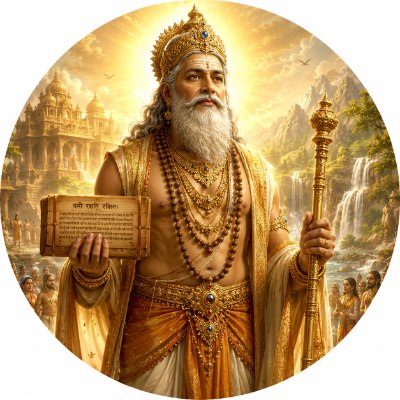
Svayambhuva Manu — The First Man, Progenitor of Humanity
Svayambhuva Manu · Manasaputra · Adi-Manu · Prajapati · Samrat · Viprarajarshi
Svayambhuva Manu is the first of the fourteen Manus — the progenitors who govern successive epochs of creation — and the first man in Hindu cosmogony. He was born directly from Brahma, either as a mind-born son or as the male half of Brahma's own divided form, alongside Shatarupa, the first woman. Brahma appointed him as the first Manu to rule over all subjects and govern creation according to dharma. He learned the Vedas from his father Brahma and is credited with dividing the Vedas into four sections. The Sanskrit word for human being — manushya or manava — derives from his name, meaning of Manu or children of Manu. He is regarded as the sixth of the eleven Mahajanas — the great devotees — in the Bhagavata Purana.
✦ The Name
Svayambhuva means he who is born of Svayambhu — Svayambhu being one of the names of Brahma, meaning the self-existent one. Manu's full name therefore declares his origin: the one born of the self-existent Brahma. The name Manu itself derives from the root man — to think — making him the thinking one or the man of mind, the archetype of conscious, reasoning humanity.
✦ Origin
The Puranas offer two closely related accounts of Svayambhuva Manu's origin. In the Bhagavata Purana's account, while Brahma was absorbed in cosmic contemplation, two forms emerged from his body — one male and one female. The male form became Svayambhuva Manu and the female became Shatarupa. In the Shiva Purana's account, Brahma split himself into two halves — one with the form of a woman and the other of a man — the man being Svayambhuva Manu. The Wisdomlib Puranic Encyclopaedia records that Svayambhuva then performed penance and acquired boons for ruling over subjects, after which Brahma formally appointed him as the first Manu. He then married Shatarupa — who had been born alongside him as the female counterpart of Brahma's divided form.
✦ Lineage
- Father: Brahma — from whose body or mind Svayambhuva Manu was directly born
- Wife: Shatarupa — the first woman, born alongside him from Brahma's form
- Sons: Priyavrata and Uttanapada
- Daughters: Akuti, Devahuti, and Prasuti (Bhagavata Purana); Akuti and Prasuti (Vishnu Purana and Wisdomlib Puranic Encyclopaedia)
- Daughter Akuti given in marriage to Prajapati Ruci; their twin children were Yajna and Dakshina
- Daughter Devahuti given in marriage to Prajapati Kardama; their son was Kapila — the fifth Mahajana, founder of the Samkhya philosophical school
- Daughter Prasuti given in marriage to Prajapati Daksha — who became the father of Sati, Aditi, Diti, and all the mothers of creation
- Grandson through Uttanapada: Dhruva — the boy-devotee whose penance secured him the Pole Star, the most celebrated descendant of Svayambhuva's line
- Capital: Brahmavartta, with Barhishmati as its principal city
✦ Role and Character
Brahma appointed Svayambhuva Manu to rule the earth, girded by seven seas, occupying the realm of Brahmavartta. He is described in the Shiva Purana as a Viprarajarshi — a sage of the royal class, combining the qualities of a Brahmin sage and a Kshatriya king. He ruled according to dharma as Brahma had instructed him. He is described across Puranic sources as a great devotee — the Bhagavata Purana states that Brahma mentioned Manu's name first among his sons because of his exceptional devotion to the Lord.
He met Kardama Prajapati on the banks of the Sarasvati River, spoke with him about the interdependence of the Kshatriya and Brahmin orders, and offered his daughter Devahuti in marriage to him. When his grandson Dhruva — consumed with grief and rage over the killing of his stepbrother Uttama — began slaughtering the entire Yaksha race indiscriminately, Svayambhuva Manu appeared and counselled him to stop, reminding him that dharma does not permit collective punishment for an individual's act. Dhruva was pacified and abandoned the battle. This episode is recorded in the Bhagavata Purana.
After fulfilling his royal duties, Svayambhuva Manu appointed his son Priyavrata in charge of the kingdom and retired with Shatarupa to perform austerities at the holy site of Naimisharanya on the banks of the Gomati River.
✦ The Great Flood
The Mahabharata records the story of the great deluge in connection with Manu — though in this account it is Vaivasvata Manu, the seventh Manu and the current one, rather than Svayambhuva. A fish — identified as Matsya, the first avatar of Vishnu — warned Manu of an impending flood that would destroy all life. Following the fish's guidance, Manu built a boat, saved himself, and preserved the seeds of all living creatures. After the flood receded, the boat came to rest on the peak of a mountain. Vaivasvata Manu is thus the Manu associated with the flood narrative and the re-establishment of humanity after the deluge.
✦ The Fourteen Manus
Hindu cosmology posits fourteen Manus governing fourteen successive Manvantaras within each Kalpa (day of Brahma). The lifespan of one Manu is 71 Mahayugas — each Mahayuga being 4,320,000 human years. The current universe is in its seventh Manvantara, governed by Vaivasvata Manu (also called Shraddhadeva), son of Vivasvan (the sun god). Svayambhuva Manu governed the first Manvantara at the very beginning of creation.
✦ Texts Attributed to His Lineage
The Manusmriti (Manava Dharmashastra) — the most celebrated text of the Dharmashastra tradition — is attributed to Svayambhuva Manu. The Manava Grihyasutra and the Manava Sulbasutra are also ascribed to him. These texts codified the social, moral, and ritual order of human civilisation as Brahma had entrusted their formulation to the first Manu.
✦ References
- Mahabharata (Vyasa) — Adi Parva: genealogical references to Svayambhuva Manu; the flood narrative associated with Vaivasvata Manu
- Bhagavata Purana — Skandha 3 (Chapters 12–13) and Skandha 4: birth of Manu and Shatarupa from Brahma's body; their five children; the marriages of the three daughters; the story of Dhruva and Svayambhuva's counsel
- Vishnu Purana — Part I: genealogy of Svayambhuva Manu; his two daughters Akuti and Prasuti (variant from Bhagavata Purana's three)
- Shiva Purana — Section 2.1, Chapter 16: Brahma splitting his form into Manu and Shatarupa; description of Manu as Viprarajarshi ruling Brahmavartta
- Brahma Purana — Chapter 1: Manu and Shatarupa as the foundational human couple, from whom all humans descend
- Wisdomlib — Puranic Encyclopaedia (Vettam Mani): records Manu's penance, boons, marriage to Shatarupa, children, and the Matsya Purana account of Brahma's four faces arising from Shatarupa turning away
- Wikipedia — Svayambhuva Manu: modern summary drawing from the above primary sources