
About
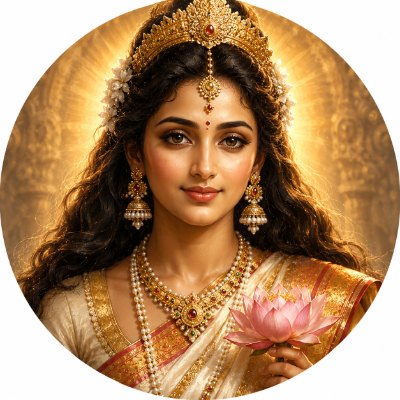
Shatarupa — The First Woman, Mother of Humanity
Shatarupa · Shatarupe · Brahmi · Savitri · Satarupa · Manu-patni · Adya-nari
Shatarupa is the first woman in Hindu cosmogony — born directly from Brahma as the female half of his divided form, alongside Svayambhuva Manu, the first man. She married Manu, and from their union descended all of humanity. She is described in the Brahma Purana as the first woman created by Brahma, and in the Bhagavata Purana as a Yogini and ascetic woman of supreme virtue — the embodiment of all virtues. The Sanskrit term for humankind — manushya — derives from Manu, making Shatarupa the co-mother of the entire human race.
✦ The Name
The name Shatarupa is composed of shata — one hundred — and rupa — form, appearance, beauty. It means she of a hundred forms — a name indicating that she possessed a multitude of forms and aspects, capable of manifesting in infinite ways. This name is directly connected to the Matsya Purana account in which, as Brahma gazed upon her with longing, she turned in four directions to avoid his gaze — and a new face of Brahma arose each time she turned, giving him his four heads. Her constant movement across forms gave rise to her name.
✦ Origin
The Bhagavata Purana records that while Brahma was absorbed in cosmic contemplation, two forms emerged from his body — one male, who became Svayambhuva Manu, and one female, who became Shatarupa. The Shiva Purana describes Brahma splitting himself into two halves, one with the form of a woman — Shatarupa — described there as a Yogini and ascetic. Brahma created Svayambhuva Manu within her as the pair to continue creation. The Matsya Purana gives a different version: Brahma created Shatarupa from his own body in Kashmir, and from his admiration and shame at gazing upon her, his four faces arose. In all accounts she emerges directly from Brahma as the first female form in creation.
✦ Lineage
- Father/Origin: Brahma — from whose body she emerged as the first woman
- Husband: Svayambhuva Manu — the first man, born alongside her from Brahma's form
- Sons: Priyavrata and Uttanapada
- Daughters: Akuti (given to Prajapati Ruci), Devahuti (given to Prajapati Kardama), and Prasuti (given to Prajapati Daksha) — per the Bhagavata Purana; Akuti and Prasuti only per the Vishnu Purana
- Notable grandchildren: Dhruva (through Uttanapada), Kapila (through Devahuti and Kardama), Yajna and Dakshina (through Akuti and Ruci), and — through Prasuti and Daksha — the entire order of created beings including all the Devas, Danavas, and Nagas
✦ Character and Austerities
The Shiva Purana describes Shatarupa specifically as a Yogini — a woman of deep yogic attainment — and as an ascetic woman of exceptional quality. The Bhagavata Purana calls her the embodiment of all virtues. After fulfilling their duties as the founding human couple — marrying their children to great sages and ensuring the continuation of creation — both Shatarupa and Manu retired from royal life and undertook severe austerities at the holy site of Naimisharanya on the banks of the Gomati River, where they worshipped the Supreme Lord together in the final phase of their earthly existence.
✦ The Brahma Episode and the Four Faces
The Matsya Purana records the most widely known episode connected to Shatarupa's name. When Brahma created her from his body, he felt an attraction toward her and gazed upon her with longing — at the same time feeling shame, since she was born of his own form. As Shatarupa moved to each side to avoid his gaze, a new face of Brahma arose on that side. When she moved in four directions, he acquired four faces; when she rose upward, he acquired a fifth — which Shiva subsequently destroyed, leaving him with four. This account of Brahma's four faces is directly linked to Shatarupa's movement in creation. A man then arose from Brahma when his desire subsided — and that man was Svayambhuva Manu. The episode is preserved in the Matsya Purana as narrated in the Wisdomlib Puranic Encyclopaedia.
✦ References
- Bhagavata Purana — Skandha 3, Chapter 12: birth of Shatarupa from Brahma's body alongside Svayambhuva Manu; description as Yogini and embodiment of all virtues; Skandha 3–4: their five children and the marriages of the three daughters; retirement to Naimisharanya
- Shiva Purana — Section 2.1, Chapter 16, Verses 10–12: Brahma splitting himself into male and female halves — the woman being Shatarupa, described as a Yogini and ascetic
- Brahma Purana — Chapter 1: Shatarupa as the first woman created by Brahma; the descent of humanity from her union with Manu
- Matsya Purana — the account of Brahma creating Shatarupa in Kashmir, his amorous gaze, her movement in four directions causing his four faces to arise, and the subsequent arising of Svayambhuva Manu
- Vishnu Purana — genealogical passages recording Shatarupa as Manu's wife and the mother of Akuti and Prasuti (two daughters, in this Purana's variant)
- Wisdomlib — Puranic Encyclopaedia (Vettam Mani): records both origin accounts and the Matsya Purana episode in full
- Wikipedia — Shatarupa: modern summary drawing from the above primary sources