
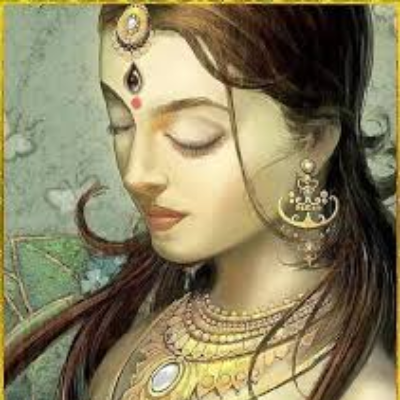
About
Prasuti — Daughter of Svayambhuva Manu, Consort of Daksha, Mother of the Twenty-Four Daughters, Mother of Sati
Prasuti · Prasūti · Manu-putri · Shatarupa-suta · Daksha-patni · Sati-mata · Svaha-mata · Svadha-mata · Khyati-mata · Sambhuti-mata · Murti-mata
Prasuti is the youngest of three daughters of Svayambhuva Manu — the first Manu, the primordial progenitor of humanity — and his wife Shatarupa; the wife of the Prajapati Daksha, son of Brahma; and the mother of between sixteen and twenty-four daughters — the exact number varying across the Bhagavata Purana (sixteen), the Vishnu Purana, Linga Purana, and Padma Purana (twenty-four) — whose marriages to Dharmadeva, Agni, the Pitrs, Bhrigu, Shiva, Marichi, Angiras, Pulastya, Pulaha, Kratu, Atri, and Vasishtha constitute one of the central generative events in the Puranic creation narrative. Her daughters are unusual in the tradition's genealogical record for being named after virtues and qualities of mind and body rather than after places, species, or cosmic principles: Shraddha (faith), Pushti (nourishment), Medha (intelligence), Buddhi (discernment), Shanti (peace), Siddhi (accomplishment), Kriya (action), Murti (form), and others — making Prasuti the mother not merely of women but of the interior qualities through which the cosmos sustains itself. Her most consequential daughter is Sati — who married Shiva, the god of destruction and liberation, against her father Daksha's wishes, and whose self-immolation at Daksha's grand yajna when she could not bear his public humiliation of her husband set in motion the most transformative sequence of events in the entire Shaiva tradition. Through Sati's subsequent rebirth as Parvati — the mountain goddess who won Shiva again through extraordinary tapas — Prasuti is the origin-point of the divine feminine's eternal relationship with Shiva. The Vishnu Purana describes Prasuti as a woman graced with loveliness and exalted merit. The marriage of Prasuti and Daksha is described in some sources as the first marriage in Hinduism.
✦ The Name
The Sanskrit name Prasuti — written Prasūti — derives from the prefix pra (forward, forth, abundantly) and the root su (to bring forth, to generate, to give birth). The compound means procreation, generation, birth, the act of bringing forth. As a proper name it means she who brings forth abundantly, the great generator, the mother of creation. The name positions her symbolically as a progenitor of creation — not merely a woman who bore daughters, but the personification of the generative act itself. The name is not incidental: through her daughters' marriages to the sages and gods who peopled the worlds, Prasuti's name and cosmic function became identical. She is the daughter of the first man, and her name is the first principle of life: bringing forth.
✦ Lineage
- Father: Svayambhuva Manu — the first Manu of the current creation cycle; born from Brahma's body; the progenitor of humanity; whose name means the self-born Manu; who with Shatarupa founded the human lineage at the beginning of the present cosmic age
- Mother: Shatarupa — the first woman; born simultaneously with Svayambhuva Manu from Brahma's body; whose name means she who can take a hundred forms; Brahma's first female creation
- Elder sisters: Akuti — the eldest daughter, given to the Prajapati Ruchi under the Putrikadharma convention, which stipulates that the first son born to the daughter shall be adopted back by the maternal grandfather; she bore the twins Yajna (an avatar of Vishnu who served as Indra of the Svayambhuva Manvantara) and Dakshina (who married Yajna); and Devahuti — the middle daughter, given to the sage Kardama; she bore nine daughters who were given in marriage to the nine Prajapatis, and one son named Kapila — the divine philosopher who founded the Samkhya school of thought and who is recognised in the tradition as an avatar of Vishnu
- Brothers: Priyavrata — the elder son of Svayambhuva Manu; a king of immense cosmic sovereignty who ruled seven continents; and Uttanapada — the younger son; whose son Dhruva performed intense tapas as a five-year-old child and was established as the Pole Star by Vishnu
- Paternal grandfather: Brahma — the Creator; Svayambhuva Manu is Brahma's son, making Prasuti Brahma's granddaughter
- Husband: Daksha — one of Brahma's ten mind-born sons (Prajapatis) tasked with aiding creation; whose name means able, expert, or skilful; who organised the famous yajna at which Sati died; who was beheaded by Virabhadra (Shiva's terrifying creation) as a result, and later revived with the head of a goat
✦ The Textual Variants — Sixteen or Twenty-Four Daughters
The number of daughters Prasuti bore to Daksha varies across the primary texts. The Bhagavata Purana (Skandha 4) records sixteen daughters — thirteen given to Dharmadeva, one to Agni, one to the Pitrs, and one to Shiva. The Vishnu Purana (Book 1, Chapter 7), Linga Purana, and Padma Purana record twenty-four daughters — thirteen to Dharmadeva, and one each to Bhrigu, Shiva, Marichi, Angiras, Pulastya, Pulaha, Kratu, Atri, Vasishtha, Agni, and the Pitrs. The Padma Purana adds that Daksha, feeling twenty-four daughters insufficient to populate the world, produced sixty more daughters — though these sixty are attributed to his wife Asikni in other Puranic texts. The most widely cited consensus, as the Wikipedia article on Prasuti records, is twenty-four daughters. The present profile follows the twenty-four daughter version of the Vishnu Purana as the primary canonical account.
✦ The Daughters — Virtues Personified
All of Prasuti's daughters represent the virtues and capacities of mind and body — a fact noted with emphasis in the Wikipedia article on Daksha's daughters. Unlike the sixty daughters attributed to Asikni who represent categories of species (gods, demons, serpents, birds, rivers, plants), Prasuti's daughters are the interior principles through which the beings who populate the cosmos can live with dignity, purpose, and wisdom. Their names are the names of the qualities that make conscious, moral existence possible.
Thirteen daughters given to Dharmadeva — the god of dharmic order: Shraddha (faith; mother of Kama — desire rightly directed), Maitri (friendship; mother of Prasada — grace), Daya (compassion; mother of Abhaya — fearlessness), Shanti (peace; mother of Sukha — happiness), Tushti (contentment; mother of Muda — joy), Pushti (nourishment; mother of Smaya — wonder), Kriya (action; mother of Yoga), Unnati (elevation; mother of Darpa — confident pride), Buddhi (intelligence; mother of Artha — meaning), Medha (wisdom; mother of Smriti — memory), Titiksha (endurance; mother of Kshema — welfare), Hri (modesty; mother of Prashraya — humility), and Murti (form; mother of the twin divine sages Nara and Narayana — the great rishis whose eternal penance at Badrikashrama in the Himalayas sustains the virtue of the world). From Murti and Dharmadeva came the two most celebrated sages of perpetual asceticism: Nara (who in later births became Arjuna) and Narayana (who is identified with Vishnu himself in his ascetic form). Their ashrama at Badrikashrama is the sacred site of present-day Badrinath in Uttarakhand.
One daughter given to Agni — the fire god: Svaha — the personification of the sacrificial offering-call; the word svaha is spoken at every Vedic fire ritual when an oblation is cast into the sacred flame. Svaha bore Agni three sons — Pavaka, Pavamana, and Shuchi — who were themselves embodiments of fire. From these three sons forty-five further types of fire descended. Together with the three sons and their grandfather (Agni himself), there are forty-nine fires in total — the forty-nine Agnis of the Vedic tradition, all of whose names are invoked during the Agneya Ishtis (fire sacrifices). Every act of Vedic ritual involving fire therefore passes through Prasuti's daughter.
One daughter given to the Pitrs — the ancestral spirits who receive the sraddha offerings of their descendants: Svadha — the personification of the ancestral offering-call; the word svadha is spoken when ancestral food offerings are made. Svadha bore the Pitrs two daughters — Vayuna and Dharini — both described as highly accomplished in Brahma-knowledge, women of profound spiritual attainment.
The remaining nine daughters given to the seven Saptarishis and others (Vishnu Purana twenty-four-daughter version): Khyati — given to the sage Bhrigu; she bore two sons Dhata and Vidhata, and a daughter named Sri (Lakshmi) — the goddess of fortune who is Vishnu's eternal consort, making Prasuti the maternal grandmother of Lakshmi. Sambhuti — given to the sage Marichi; she bore Paurnamasa. Smriti — given to Angiras; she bore the four daughters who personify the lunar phases: Sinivali, Kuhu, Raka, and Anumati. Priti — given to Pulastya; she bore Dattoli (who was reborn as the sage Agastya) and Vishrava (from whom Kubera, Ravana, Kumbhakarna, and Vibhishana were descended). Kshama — given to Pulaha; she bore the Kardamas. Sannati — given to Kratu; she bore the Valikhilyas — the sixty-thousand thumb-sized sages born of an egg. Anasuya — given to Atri; she bore three sons who were partial incarnations of the Trimurti: Dattatreya (an avatar of Vishnu in the tradition of Vishnu Purana, or Brahma's partial manifestation in the Dharamam source), Soma-Chandra (the moon god, as Brahma's partial manifestation), and Durvasa (as Shiva's partial manifestation). Urja — given to Vasishtha; she bore seven Brahmarishis including Chitraketu and Sudhama.
The last daughter — Sati — given to Shiva. She is the most consequential of all Prasuti's daughters in the tradition's subsequent mythology, and her story is told at length below.
✦ Sati — The Last and Most Consequential Daughter
Prasuti's youngest and most celebrated daughter was Sati — also called Dakshayani, the daughter of Daksha. From earliest childhood Sati was a devoted worshipper of Shiva, the god of destruction, asceticism, and liberation. Daksha opposed the match vigorously — Shiva was an unkempt ascetic who wore funeral ash, frequented cremation grounds, and kept the company of supernatural wild beings; he was not, in Daksha's view, a suitable husband for a Prajapati's daughter. Sati married Shiva nonetheless, and left her father's palace to live on Mount Kailasha. The tension between Daksha and Shiva — between the ordered Vedic sacrificial world and the ascetic who stood deliberately outside it — never resolved. Eventually Daksha organised a grand universal yajna — the Brihaspati Sarva Yajna — and invited every god, sage, and divine being except Shiva and Sati. Sati, despite Shiva's warnings, attended uninvited. Daksha, in the assembly of every divine being in creation, publicly denounced Shiva and refused to offer him the sacred portion due to a god. Unable to bear the public humiliation of her husband in her father's own house, Sati walked into the sacrificial fire. When news reached Shiva his grief was catastrophic. He retrieved Sati's body and wandered through the three worlds in deranged mourning, performing the Rudra Tandava. Vishnu followed behind and used the Sudarshana Chakra to cut the body piece by piece — fifty-one fragments fell across the subcontinent, each falling piece becoming a Shakti Peetha, a sacred seat of the divine feminine. Sati was subsequently reborn as Parvati — daughter of the Himalayan king Himavat — and performed extraordinary tapas to reunite with Shiva in her new body.
✦ Prasuti and the Daksha Yajna — The Mother's Loss
The Daksha Yajna is the defining catastrophe in Prasuti's story. The primary canonical texts focus on Daksha's pride, Sati's immolation, and Shiva's grief — Prasuti's own emotional experience is not narrated in detail. But the structure of the episode implies a double loss: she loses her youngest and most beloved daughter to the sacrificial fire, and she watches the greatest ritual event of her husband's life destroyed in consequence. Virabhadra — the terrifying being Shiva created from his own grief and fury — came to the yajna and destroyed it entirely: Daksha was beheaded, the assembled gods were wounded and scattered, the sacred fire was violated. Brahma and Vishnu eventually intervened; Daksha was restored to life with the head of a goat; the yajna was allowed to be completed. But the daughter who had been Prasuti's last-born was gone, and the familial harmony of the Daksha household was irreparably broken. The Grokipedia source notes that while the texts do not develop Prasuti's personal sorrow in detail, the event shattered familial harmony and marked the end of Sati's life in that form.
✦ The Cosmic Function of Prasuti's Daughters
The marriages of Prasuti's daughters constitute one of the most cosmologically consequential sets of unions in the entire Puranic tradition. Through Murti and Dharmadeva came Nara and Narayana — the twin sages whose eternal asceticism at Badrikashrama sustains the world's virtue. Through Svaha and Agni came the fire-taxonomy of the Vedic sacrifice — the entire system of forty-nine fires through which the ritual universe is maintained. Through Svadha and the Pitrs came the two women accomplished in Brahma-knowledge who represent the feminine side of the ancestral tradition. Through Khyati and Bhrigu came Lakshmi — Vishnu's eternal consort, the goddess of fortune on whose grace the sustaining of the cosmic order depends. Through Sambhuti and Marichi came Paurnamasa, whose son Kashyapa is the universal progenitor from whom gods, demons, Nagas, birds, cattle, and all living species descended. Through Anasuya and Atri came Dattatreya (the avatar of the Trimurti), Soma-Chandra (the moon god), and Durvasa (the most feared curse-giving sage of the tradition). Through Smriti and Angiras came the four lunar phases that govern the rhythms of agricultural and sacrificial life. Through Urja and Vasishtha came seven Brahmarishis. Through Priti and Pulastya came Vishrava — the father of Kubera (the lord of wealth), Ravana (the demon king of Lanka), Kumbhakarna, and Vibhishana — making Prasuti the ancestral grandmother of both the demon king whose war with Rama is the subject of the Valmiki Ramayana and the righteous Vibhishana who aided Rama in that war. Through Sati and Shiva the entire cycle of the divine feminine's relationship with the supreme ascetic god — the Sati-Parvati-Shakti Peetha tradition — was set in motion.
✦ Prasuti as Grandmother of Lakshmi
One of the least observed but most remarkable of the genealogical facts that emerges from Prasuti's daughter-list is her position as the maternal grandmother of Lakshmi — the goddess of fortune, beauty, and prosperity, and the eternal consort of Vishnu. Through her daughter Khyati, who married the sage Bhrigu, Prasuti became the grandmother of Dhata, Vidhata, and most significantly Sri — Lakshmi herself — who was born as Bhrigu and Khyati's daughter before her more famous birth from the churning of the cosmic ocean (Samudra Manthana). The Padma Purana and the Dharamam source both confirm this genealogy: Sri (Lakshmi) was born to Bhrigu's wife Khyati. The daughter of the first man Svayambhuva Manu is thus the grandmother of the goddess who sustains all of existence through her grace and fortune, and who is inseparable from Vishnu — the preserver of the cosmos.
✦ References
- Bhagavata Purana (Skandha 4, Chapters 1–8) — the foundational Vaishnava account: Prasuti as youngest daughter of Svayambhuva Manu and Shatarupa; given in marriage to Daksha; sixteen daughters listed with their marriages to Dharmadeva, Agni, the Pitrs, and Shiva; the daughters of Dharmadeva through Murti including Nara and Narayana; Svaha as wife of Agni; Svadha as wife of the Pitrs; Sati as wife of Shiva; the Daksha Yajna; Sati's death; Virabhadra's destruction of the sacrifice
- Vishnu Purana (Book 1, Chapter 7) — the most explicit twenty-four-daughter account: Svayambhuva Manu and Shatarupa as Prasuti's parents; Prasuti given to Daksha; the full list of twenty-four daughters named; their marriages to Dharmadeva, Agni, the Pitrs, Bhrigu, Shiva, Marichi, Angiras, Pulastya, Pulaha, Kratu, Atri, and Vasishtha; Khyati to Bhrigu as mother of Lakshmi
- Linga Purana — the sixteen-daughter version; the virtues-personified daughters married to Dharmadeva; Sati as the last daughter given to Shiva
- Padma Purana — the twenty-four-daughter account with the addition that Daksha felt these were insufficient and produced sixty more; those sixty attributed to Asikni in other texts; Lakshmi born to Bhrigu and Khyati
- Shiva Purana (Rudra Samhita) — Prasuti as mother of Sati in the first-Daksha birth tradition; Sati's birth as the last daughter; the Daksha Yajna; Sati's immolation; the cosmic aftermath
- Brahma Purana, Brahmanda Purana, Matsya Purana, Garuda Purana, Kurma Purana — parallel accounts of Prasuti as Manu's daughter and Daksha's wife; the daughter-lists with minor variations in names and assignments
- Wikipedia — Prasuti; Wikipedia — Daksha; Wikipedia — List of Daksha's daughters; Grokipedia — Prasuti; JKYog — Description of the Lineage of Manu's Daughters; Dharamam WordPress — Description of the Clans of Manu's Daughters (Bhagavata Purana Chapter 4); Manidvipa — Consorts Daughters and Female Characters; Wikipedia-on-IPFS — Prasuti; Astrojyoti — Matsya Purana Chapter 2: modern summaries drawing from the above primary sources