
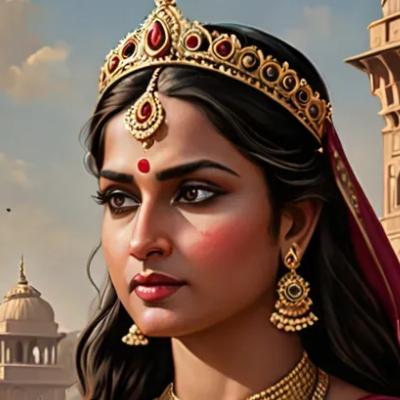
About
Kriya — Daughter of Kardama and Devahuti, Wife of the Sage Kratu
Kriya · Kardama-putri · Devahuti-putri · Kratu-patni
Kriya is one of the nine daughters of the Prajapati Kardama and his wife Devahuti, named in the Bhagavata Purana's third skandha among the daughters given in marriage to nine great sages of the primordial tradition. She is given in marriage to the sage Kratu — one of the ten mind-born sons of Brahma and a Prajapati of the first creation. The similarity of the names Kriya and Kratu — both derived from roots connected to action and ritual performance — gives this pairing a particular nominal resonance in the tradition. The Puranic sources associate children with Kratu, and in some lists these children are attributed to Kriya as their mother. Her individual characterisation in the primary sources is confined to her naming as Kratu's wife and to her position among the nine daughters of Kardama. She receives no individual narrative episode in any primary text consulted.
✦ The Name
The name Kriya is Sanskrit, derived from the root kri, meaning to do, to act, or to perform. Kriya means action, performance, activity, or ritual act — and in the philosophical and ritual vocabulary of the tradition it carries the specific sense of a sacred or prescribed action, a ritual performance, or a rite. In the Yoga tradition, kriya refers to a purificatory practice or disciplined action. In the ritual tradition, kriya denotes the performance of a prescribed ceremony. The name for a daughter of a Prajapati thus encodes the principle of sacred action itself — appropriate for a being born of the ascetic and ritually oriented lineage of Kardama. The pairing with the sage Kratu — whose name means a sacrifice, a rite, or the power of ritual action, from a related but distinct Sanskrit root — creates a nominal complementarity between husband and wife that the tradition would have regarded as auspicious and significant.
✦ Lineage
- Father: Kardama, Prajapati and mind-born son of Brahma, who performed long austerities at Bindu-sarovara on the Sarasvati river, received Vishnu's promise of the avatara birth, married Devahuti, fathered nine daughters and the sage Kapila, and thereafter renounced household life.
- Mother: Devahuti, daughter of Manu Svayambhuva and Shatarupa, who after Kardama's renunciation received the Samkhya philosophical teaching from her son Kapila and attained liberation.
- Brother: Kapila, the sage and Vishnu avatara, teacher of Samkhya, whose burning gaze destroyed the sixty thousand sons of King Sagara in the netherworld and initiated the chain of events that brought the Ganga to earth.
- Sisters: Eight other daughters of Kardama and Devahuti — Kala, Anasuya, Shraddha, Havirbhu, Gati, Khyati, Arundhati, and Shanti — given in marriage respectively to the sages Marichi, Atri, Angiras, Pulastya, Pulaha, Bhrigu, Vasishtha, and Atharvan.
- Husband: Kratu, one of the ten mind-born sons of Brahma and one of the seven great rishis of the primordial creation, a Prajapati whose name is directly connected to the Vedic sacrifice and the power of ritual action.
- Children: The Bhagavata Purana and Vishnu Purana name the Valakhilyas — a group of sixty thousand thumb-sized sages born of Kratu — as his offspring in certain accounts. The Valakhilyas are described as ascetics of extraordinary purity who accompany the sun's chariot and are celebrated for the intensity of their austerities. Whether Kriya is specifically named as their mother in the primary sources varies across recensions — some accounts name her in this role while others describe the Valakhilyas as arising directly from Kratu's austerities without specifying a mother.
✦ The Valakhilyas
The Valakhilyas — the sixty thousand thumb-sized sages associated with Kratu — are a celebrated group in the Puranic and epic tradition. They appear in the Mahabharata's Adi Parva in connection with the story of Garuda, where their extreme lightness and purity is contrasted with the power of the great eagle. They are described as perpetually engaged in austerity, moving through the air, and accompanying the chariot of the sun in its daily passage across the sky. Their association with Kratu gives Kriya's marital lineage a particular character — through her husband and potentially through her children, she is connected to one of the most distinctive groups of ascetic beings in the entire Puranic cosmological imagination. The attribution of the Valakhilyas specifically to Kriya as their mother is found in certain Puranic passages but is not uniformly stated across all major sources, and this uncertainty is recorded honestly here.
✦ References
Primary Sources
- Bhagavata Purana, Skandha 3, Chapters 24 and 33: Names Kriya as one of the nine daughters of Kardama and Devahuti and identifies Kratu as her husband; the primary source for her naming and marital placement.
- Vishnu Purana, Book 1, sections on the primordial sages and their wives: Names the daughters of Kardama and their sage-husbands including Kriya and Kratu; provides the genealogical context for Kratu's lineage and the Valakhilyas.
- Mahabharata, Adi Parva, sections on Garuda: References the Valakhilyas as the offspring of Kratu and describes their extraordinary nature; provides the most narratively developed account of the Valakhilyas in any primary source.
- Matsya Purana, sections on the Prajapatis and their descendants: Includes the marriages of Kardama's daughters among its genealogical registers.
Modern Reference Works
- Vettam Mani, Puranic Encyclopaedia (Motilal Banarsidass, 1975), entries on Kriya, Kratu, and Valakhilyas: Notes Kriya's identification as the daughter of Kardama and wife of Kratu; addresses the Valakhilyas and their association with Kratu's lineage.
- J. A. B. van Buitenen (trans.), The Mahabharata, Vol. 1: The Book of the Beginning (University of Chicago Press, 1973): Critical translation of the Adi Parva including the Garuda episode in which the Valakhilyas figure prominently; the notes address the nature and significance of this group of ascetic sages.