
About
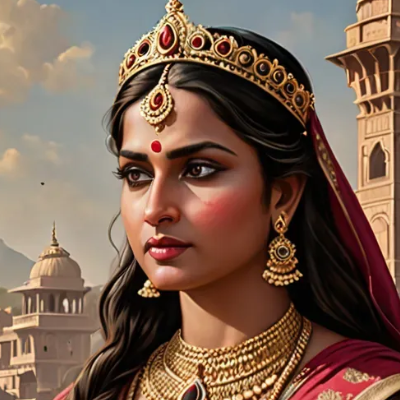
Svaha — Daughter of Daksha, Goddess of Sacrificial Oblation, Wife of Agni, and Mother of the Three Sacred Fires
Svaha · Svāhā · Manyanti · Dakshakanya · Agnipatni · Pavaka-Pavamana-Shuchi-mata · Havishmati · Prakriti-svarupa · Yajnashakti
Svaha is one of the most ritually significant goddesses in the entire Hindu tradition — not primarily through extended narrative biography but through her absolute pervasiveness in every fire ritual ever performed. She is the daughter of Daksha Prajapati and Prasuti, the wife of Agni the god of fire, and the mother of his three sons Pavaka, Pavamana, and Shuchi who are the three primary manifestations of sacred fire. Her name — pronounced at the moment of every oblation poured into the sacrificial fire, with every ladle of ghee, with every grain of rice, with every offering across every fire sacrifice performed in the Hindu tradition from the earliest Vedic period to the present — is simultaneously a divine name, a ritual exclamation, and a theological statement. The Brahmanda Purana, Vishnu Purana, Vayu Purana, Bhagavata Purana, Saurapurana, Mahabharata's Vana Parva, and the Devi Mahatmya all contain significant references to her. The Wikipedia article on Svaha gives her alternative name Manyanti. The Brahmavaivarta Purana identifies her as an aspect of Prakriti — the primordial feminine principle — without whom Agni cannot sustain his function. Her body is said in certain texts to consist of the four Vedas and her six limbs to be the six Vedangas — making her not merely the companion of the fire god but the embodiment of the entire sacred textual tradition that the fire ritual expresses.
✦ The Name
The name Svaha derives from the Sanskrit roots su — good, well, auspicious — and ah or aha — to call, to say, to speak — yielding the sense of "well spoken," "auspicious invocation," or "good calling." The Monier-Williams Sanskrit dictionary confirms this etymology. As a ritual exclamation Svaha functions as the sacred seal of the sacrificial offering — the utterance that marks the moment at which the oblation transitions from the human world to the divine world through the medium of fire. The Yajurveda contains numerous formulae of the structure "Agnaye svaha" — "to Agni, svaha" — and "Somaya svaha" — "to Soma, svaha" — establishing the pattern of the deity name in the dative case followed by the exclamation Svaha. In the Buddhist tradition the same exclamation — pronounced soha in Tibetan, sowaka in Japanese, sabaha in Korean — appears at the end of mantras, demonstrating the term's migration from Vedic ritual into the pan-Asian tantric and mantra tradition. As the goddess who is this exclamation personified, Svaha is present in every mantra recitation in which her name appears — which is virtually all of them involving fire or divine invocation.
✦ Lineage
- Father — primary account: Daksha Prajapati — one of the Prajapatis, the son of Brahma, and the father of sixty daughters whose marriages to the gods and sages structured the cosmic genealogy of the tradition. The Mahabharata's Vana Parva, the Wikipedia article on Svaha, the Bhagavata Purana, and the Saurapurana all consistently identify Svaha as Daksha's daughter. The JKYog source citing the Puranas gives her specifically as the daughter of Daksha and Prasuti — placing her in the same generation as Sati, the Nakshatras (Daksha's daughters who married Chandra), Rohini, and the other daughters of Daksha's principal wife Prasuti.
- Father — variant account: The Wikipedia article on Svaha notes that in some texts she is identified as the daughter of Brihaspati and Tara rather than of Daksha. This variant identification is a minority account not supported by the major Mahapuranic tradition and is noted as a textual variant without being adopted as the primary identification in this profile.
- Mother: Prasuti — the daughter of Svayambhuva Manu and Shatarupa, and the mother of Daksha's principal daughters. Through Prasuti, Svaha descends from the first Manu and through him from Brahma's creative line.
- Husband: Agni — the god of fire, profiled separately in this series. The marriage of Svaha to Agni is narrated in the Mahabharata's Vana Parva in Markandeya's account to the Pandavas — the story of how Svaha's love for Agni led her to impersonate the Saptarishi wives and through these successive unions produce the seed from which Skanda was born. The Mahabharata states that at Agni's recognition and acceptance of her, Svaha became his wife — receiving the eternal honour that her name would be uttered at every sacrifice, making her permanently present in every fire ritual.
- Sons: Pavaka, Pavamana, and Shuchi — who were embodiments of Agni. These three consume the offerings in sacrifices. From them arose forty-five types of Agnis."
- Daughter — Agneya: The Hindu Blog source and the ISVARA source both confirm that Svaha is also the mother of a daughter named Agneya — "the daughter of Agni" — whose further biography is not elaborated in the primary sources consulted.
✦ The Narrative of Svaha's Union with Agni
The Mahabharata's Vana Parva narrates Svaha's story in detail through Markandeya's account to the Pandavas. Svaha had fallen in love with Agni and had been pursuing him without success — Agni did not notice her. On one occasion Agni was presiding over the sacrificial rituals of the Saptarishis and became overwhelmed with desire for their wives — six of the seven, the exception being Arundhati the wife of Vasistha whose virtue was of such complete purity that no desire could attach to her. Unable to bear the guilt of desiring another man's wife, Agni went to the forest to perform austerities. Svaha followed him. Understanding his desire for the Saptarishi wives, she took the form of six of the seven — impersonating each one in turn — and approached Agni. After each union she took the seed Agni had discharged and carried it to the Sharavana forest — the bed of reeds in the Himalayas — and deposited it in a golden vessel. From this accumulated seed, nurtured in the vessel across six deposits, Skanda was born with six faces — one for each of the six Saptarishi wives whose forms Svaha had impersonated and whose seed deposits had contributed to his formation. When Agni realised the full pattern of what had happened he acknowledged Svaha, told her that through her act he had been able to fulfil his desire without violating the rules of marriage, and accepted her as his wife. At this moment the gods established that henceforth every oblation poured into the fire with the utterance of the word Svaha would reach them — making her name the permanent seal of every sacrificial offering.
✦ Svaha as Agni's Incarnation at Mahishmati
The Sculpturepedia source and the Wikipedia article on Agni both record a further Mahabharata episode in which Svaha incarnated as the foster-daughter of King Nila of Mahishmati — the only woman in the entire kingdom who could kindle fire. Agni, residing at Mahishmati, fell in love with this woman who was his wife's own incarnation. He came to King Nila in the guise of a brahmin and asked for her hand. The king refused and threatened Agni. Agni revealed his divine form and flamed up in glory to Svaha's incarnation — the king understood the divine identity of both parties and gave his daughter to Agni. Agni in return promised the permanent protection of Mahishmati from invasion. This episode gives Svaha a mortal incarnation story that connects the goddess of sacrificial oblation to a specific geographical and dynastic tradition.
✦ Svaha as Prakriti and the Shakti of Agni
The Brahmavaivarta Purana identifies Svaha as an aspect of Prakriti — the primordial feminine principle of the tradition's Samkhya and Shakta frameworks — without whom Agni cannot sustain his function as the carrier of oblations. This identification gives her a cosmic philosophical significance that transcends her biographical role as a Daksha-daughter and wife of Agni. As Prakriti she is the material principle that makes manifestation possible — without her the divine fire god cannot perform his essential function of mediation between the human and divine worlds. The India travel and culture guide source's theological statement captures this precisely: "she embodies the act of oblation and represents the divine energy that carries sacrificial offerings to the gods." The Rudrahridayopanishad's statement that "Shiva is same as Agni, and Parvati is same as Svaha" — cited in the Wikipedia Agni article — gives Svaha a further identification as the equivalent of Parvati in the Shaiva theological framework, placing her at the highest level of the divine feminine tradition.
✦ Textual Variants and Inconsistencies
Daughter of Daksha versus daughter of Brihaspati: The Wikipedia article notes the variant identification of Svaha as the daughter of Brihaspati and Tara in some texts. This is a minority tradition not supported by the major Mahapuranic consensus of Daksha-daughter identification. If Svaha were the daughter of Brihaspati and Tara, she would be the sister of Budha and therefore the aunt of Pururavas — a genealogical position that would make her Agni's wife and simultaneously the aunt of the first Chandravamsha king. This variant is noted without being adopted as the primary account.
✦ Theological Significance
Svaha's theological significance is of a unique and irreplaceable kind — she is the goddess whose name must be pronounced for any oblation to reach the divine world. The tradition explicitly states that the gods refuse offerings not accompanied by the utterance of Svaha. This makes her the necessary linguistic and ritual gate through which every sacrificial act passes — the word that seals the offering's transition from the material to the divine. Her body being the four Vedas and her limbs the six Vedangas places the entire textual tradition of sacred knowledge within her person — she is not merely associated with sacrifice but is constituted by the complete scriptural tradition that sacrifice expresses. As Agni's Shakti she is inseparable from him in the deepest sense — fire without the sacred word is not sacred fire, and the sacred word Svaha without the fire has no medium of expression. The couple represents the inseparability of the material and the verbal dimensions of the sacred act.
✦ References
- Mahabharata, Vana Parva — Markandeya's narration to the Pandavas: The primary narrative source for Svaha's biography — her love for Agni, the impersonation of the Saptarishi wives, the birth of Skanda, Agni's acceptance of her as his wife, and the establishment of her name as the sacrificial seal.
- Vishnu Purana, Book 1, chapter 10: Confirms Svaha as Agni's wife and the mother of Pavaka, Pavamana, and Shuchi.
- Bhagavata Purana, Book 4, chapter 1: Svaha as one of Daksha's daughters given to Agni in the genealogical enumeration of Daksha's family.
- Saurapurana: Names Svaha as one of twenty-four daughters of Daksha and Prasuti, given to Agni, who bore him Pavaka, Pavamana, and Vaidyuta-Pavaka.
- Brahmavaivarta Purana: Identifies Svaha as an aspect of Prakriti without whom Agni cannot sustain.
- Rudrahridayopanishad: "Parvati is same as Svaha" — the Shaiva theological identification of Svaha with the supreme goddess.
- Vettam Mani, Puranic Encyclopaedia (1975): Entry on Svaha; comprehensive collation of all primary references.