
About
Adi — Asura, Son of Andhaka, Slain by Shiva in Disguise
Adi · Aadi · Andhaka-putra · Shiva-vadha · Matsya-Puranika
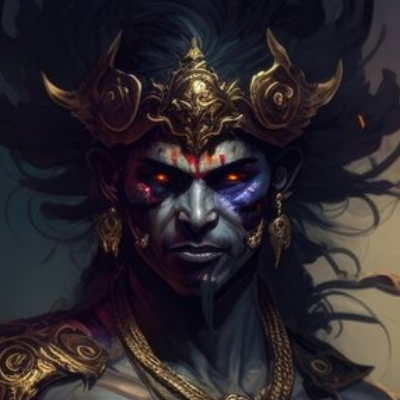
Adi is an Asura who appears in the Matsya Purana as the son of Andhaka — the blind demon king slain by Shiva after the war on Kailasha — and the grandson of Hiranyaksha. His story is brief and complete within a single episode: discovering that Parvati was performing tapasya in the forest, he recalled his father's death at Shiva's hands, resolved to avenge him by killing Shiva, obtained a shape-shifting boon from Brahma, entered Kailasha in disguise, attempted to approach Shiva in the form of Parvati, was identified and killed. Beyond his parentage, his penance, his boon, and his death at Kailasha, the surviving Puranic record records nothing further about him. His name means the first or the beginning — a cosmic irony given that his story is among the most compressed in the Asura lineage. He receives moksha at Shiva's hands in one of the two recorded versions of his death.
✦ The Name
The Sanskrit word Adi derives from the root ad — to begin — and means first, primal, at the beginning. It is the same root that gives rise to Aditi (the boundless, the first mother of the gods), Adi-purusha (the first cosmic being), Adi-shakti (the primal divine force), and the Vedic concept of the primordial as the source of all things. The Hinduwebsite source notes this etymology directly: the highest Brahman is the Adi — the First — and the demon who bears this name represents the inversion of that primacy: a being who takes the name of the origin and uses it in the service of destruction. Whether the name carries deliberate theological weight in the Matsya Purana's account or is incidental is not recorded.
✦ Lineage
- Father: Andhaka (Andhakasura) — blind Asura king, born of Shiva and Parvati's sweat, adopted by Hiranyaksha, slain by Shiva after his attempt to abduct Parvati; subsequently redeemed and made a gana-chief of Kailasha
- Grandfather (adoptive): Hiranyaksha — Daitya king, slain by Vishnu's Varaha avatar
- Adoptive great-grandmother: Rushabhanu — wife of Hiranyaksha
- Biological grandparents (per Shiva Purana): Shiva and Parvati — from whose sweat Andhaka was born; making Adi the biological grandson of Shiva and Parvati in this tradition, and thus the grandchild of the very deity who killed his father and whom he sought to kill in return
- Great-uncle (adoptive): Hiranyakashipu — elder brother of Hiranyaksha
- Cousin once removed: Prahlada — son of Hiranyakashipu
✦ The Motive — Vengeance for His Father
The Matsya Purana records that Adi discovered Parvati performing tapasya alone in a forest. The sight of Parvati in austerity — away from Kailasha, unguarded — reminded him of his father's death at Shiva's hands. The Wikipedia account records the precise structure of his motivation: after discovering that Parvati was practising tapasya in the forest, he recalled his father's death at the hands of Shiva and decided to avenge it by killing the god — despite knowing that he was no match for Shiva. This last detail — that Adi acted with full knowledge of his own inadequacy — is theologically significant: he was not deluded about his chances. He sought the boon of Brahma not from overconfidence but from the clarity of his purpose, determined to find some mechanism that might give him an opening against a being he knew he could not face directly.
✦ The Boon — Shape-Shifting and Its Hidden Condition
At the time of Andhaka's death, Adi performed tapasya to obtain a boon from Brahma. He asked for immortality — the same request his father and grandfather had made before him. Brahma, as with them, refused to grant immortality outright. Adi then clarified his request: he wished to die only when he had changed form. The Matsya Purana's account, as recorded by the Wikipedia and TheReaderWiki sources, notes that Brahma took advantage of the ambiguity of this formulation and granted Adi the power of transformation — the ability to assume any form at will. This was the opening Brahma embedded in the boon: Adi believed he would be invincible in his natural Asura form and would simply never change into another form while in danger. Brahma understood that the boon's condition — death upon changing form — would prove to be the mechanism of his destruction rather than the guarantee of his safety, since Adi's entire plan required him to change form in order to deceive Shiva. The Glorious Hinduism source records a variant: that Brahma granted him the boon that he would be invincible in his Asura form but vulnerable in any other disguise — making the condition explicit rather than implicit.
✦ The Attempt — Serpent and Parvati's Form
Armed with his boon, Adi made for Kailasha. The Wikipedia account records the primary version from the Matsya Purana (Chapter 156): he entered Shiva's private quarters in the guise of a snake, evading the watch of Shiva's attendant Virabhadra. Once inside, he transformed into the form of Parvati — assuming her precise appearance and manner — and approached Shiva as though returning to him. Shiva offered him an affectionate greeting. But he soon became suspicious and penetrated the disguise through his yogic perception — seeing through the exterior to the Asura within. Realising the true nature of the Asura, Shiva struck him on his genitals with the Vajra, killing him instantly. The choice of weapon and the point of attack are consistent with the logic of the boon: Adi had changed form — from snake to Parvati's appearance — and that change was the condition of his death; Shiva's strike sealed the boon's own hidden consequence.
✦ The Second Version — Training Under Shiva and Moksha
The Wikipedia article on Adi notes a second version of the story — explicitly flagged as not mentioned in the primary texts and therefore of uncertain textual authority. In this version, Brahma granted Adi a supplementary boon: that he could learn the arts of warfare directly under Shiva. Adi accordingly came to Kailasha as a student rather than an assassin, trained under Shiva for several years, and then began to trouble the residents of Kailasha. He eventually appeared before Shiva in the form of Parvati and asked for one more chance. Shiva recognised him and killed him with his trishula. In this version, Adi begged for forgiveness and Shiva granted him moksha — liberation — rather than simply killing him. This version mirrors the pattern of Andhaka's own story: the Asura antagonist whose assault on Kailasha ends not in damnation but in divine grace, the weapon that destroys also releasing. The Wikipedia source explicitly notes that this version lacks textual corroboration while the primary Matsya Purana version is well established.
✦ Significance in the Lineage
Adi is the terminal figure of the Hiranyaksha lineage in the Puranic record. The chain runs: Kashyapa and Diti → Hiranyaksha → Andhaka (adopted) → Adi. With Adi's death the direct male line of Hiranyaksha's household is extinguished in the Puranic narrative. His story also functions as a compressed recapitulation of his father Andhaka's story — the same Kailasha, the same Parvati, the same Shiva, the same outcome of defeat at Shiva's hands — compressed from a thousand-year war into a single episode of attempted disguise. Where Andhaka's story is the great Puranic drama of the Hiranyaksha lineage, Adi's is its short, inevitable coda: the son who could not learn what the father had to experience in full.
✦ References
- Matsya Purana — Chapter 156 (translated by A. Taluqdar of Oudh, 1917): the primary and sole canonical source for Adi's story in full — his parentage as son of Andhaka; the discovery of Parvati in the forest; the decision to avenge his father; the tapasya to Brahma; the boon of transformation with its embedded condition; entry into Kailasha as a serpent; assumption of Parvati's form; identification by Shiva through yoga; death by Vajra strike
- Linga Purana — records Andhaka's son as Adi in the context of Andhaka's lineage; no extended narrative of Adi's own story
- Kurma Purana — records Andhaka as natural son of Hiranyaksha; Adi's existence as Andhaka's son follows by implication in this genealogical tradition
- Wikipedia — Adi (asura); TheReaderWiki — Adi (mythology); Glorious Hinduism — Adi; Hinduwebsite — Adi, In the Beginning: modern summaries drawing from the Matsya Purana account