
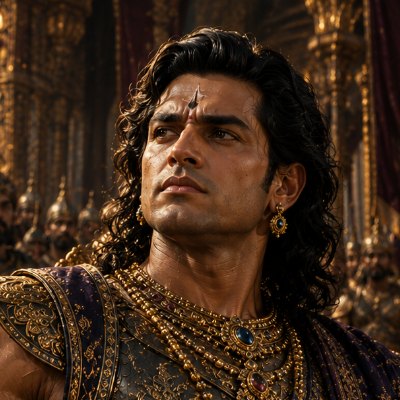
About
Duryodhana — Eldest Son of Dhritarashtra, Crown Prince of Hastinapura, Primary Antagonist of the Mahabharata
Duryodhana · Suyodhana · Dhartarashtra · Kauravya · Raja · Son of Gandhari · Son of Dhritarashtra · Incarnation of Kali
Duryodhana is the eldest son of King Dhritarashtra of the Kuru dynasty and his queen Gandhari, princess of the Gandhara kingdom. He is the crown prince of Hastinapura, leader of the Kaurava host, and the primary antagonist of the Mahabharata. His birth is accompanied by portentous omens, and the Adi Parva identifies him as a partial incarnation of the demon Kali — the presiding spirit of the Kali Yuga and of strife — who has descended into human form to fulfil the destruction of the Kshatriya order. His life is defined by a sustained and escalating enmity toward his Pandava cousins — the five sons of his paternal uncle Pandu — rooted in his conviction that the throne of Hastinapura belongs to him as the son of the eldest brother and the reigning king. This conviction drives him through a series of plots against the Pandavas in youth, through the manipulation of the dice game that sent them into exile, through his refusal of Krishna's peace embassy, and finally into the eighteen-day Kurukshetra war, at the end of which he is the last Kaurava standing — lying mortally wounded by Bhimasena's mace blow to his thighs at the Dvaipayana lake on the eighteenth day. He appears across virtually every major book of the Mahabharata, from the Adi Parva through the Sauptika Parva, and is among the most extensively narrated figures in the epic.
✦ The Names
The name Duryodhana is formed from the Sanskrit prefix dur and the noun yodhana, from the root yudh meaning to fight or make war. The prefix dur is ambiguous: it carries both a pejorative sense of badly or wickedly and a formidable or difficult-to sense, giving the full name the dual meaning of one who fights badly or wickedly and one who is exceedingly difficult to fight against. Both readings are operative in the Mahabharata's use of the name — the character is simultaneously a formidable warrior and one whose conduct in war and diplomacy is consistently condemned by the text. Wisdomlib cites the Vaishnava gloss as dur meaning bad and yodhana meaning fighter. The Vyasa Mahabharata online encyclopedia glosses it as extremely hard to fight.
The name Suyodhana — formed from su meaning well or good and yodhana — means one who fights well or a good fighter. This name, which carries no pejorative dimension, is the form by which some characters address him within the text itself, particularly those who respect or admire him. The tradition recorded in some secondary sources holds that the hundred Kaurava brothers were born with names beginning with the prefix su, denoting virtue, and that as their collective conduct became notorious, the prefix was replaced with dur. Whether this tradition is attested in the primary text or is a later interpretive gloss is unclear; it is not adopted here as a statement of historical fact. The patronymic Dhartarashtra simply means son of Dhritarashtra and appears frequently in the war narratives as an address. Kauravya designates his descent from the Kuru lineage.
✦ Lineage
- Father: Dhritarashtra — blind king of the Kuru dynasty at Hastinapura, born of the sage Vyasa by niyoga upon Ambika, widow of King Vichitravirya of the Kuru line; his blindness was held to disqualify him from kingship, which was exercised initially by his younger half-brother Pandu and later by Dhritarashtra himself after Pandu's retirement to the forest.
- Mother: Gandhari — princess of the Gandhara kingdom, daughter of King Subala and sister of Shakuni, devoted queen of Dhritarashtra; she wore a blindfold for life in solidarity with her husband's blindness and had obtained from Lord Shiva the boon of one hundred sons. She attempted, before the war, to look upon Duryodhana's body with uncovered eyes so that her sight — accumulated through years of austerity — would render him invulnerable; she was prevented from looking at his groin and thighs by Krishna's intervention, and it is precisely at the thigh that he was fatally struck.
- Paternal half-brother: Yuyutsu — son of Dhritarashtra by a Vaishya attendant named Sauvali; he defected to the Pandava side before the war and was the only son of Dhritarashtra to survive the conflict.
- Brothers: Dushasana — the second son, Duryodhana's closest and most unconditionally obedient ally, who carried out the dragging of Draupadi during the dice game and was killed by Bhima on Day 16; Vikarna — the one Kaurava brother who protested Draupadi's humiliation, killed by Bhima on Day 14; and ninety-seven other brothers born of Gandhari, all of whom died in the war.
- Sister: Duhsala — daughter of Dhritarashtra and Gandhari, married to Jayadratha, king of the Sindhu kingdom, who was killed by Arjuna on Day 14 of the war.
- Principal wife: The daughter of the king of Kalinga — she is the mother of Lakshmana Kumara, Duryodhana's son.
- Son: Lakshmana Kumara — killed by Abhimanyu on the thirteenth day of the Kurukshetra war.
- Daughter: Lakshmanaa — attested in Puranic sources; she does not feature in the primary Mahabharata war narrative.
- Paternal cousins: The five Pandavas — Yudhishthira, Bhimasena, Arjuna, Nakula, and Sahadeva — sons of Pandu, Dhritarashtra's younger half-brother, toward whom Duryodhana's entire life was oriented in enmity.
- Maternal uncle: Shakuni — king of Gandhara, brother of Gandhari, principal counsellor and agent of Duryodhana's schemes, designer of the dice game stratagem; killed by Sahadeva on Day 18.
✦ Birth and Cosmic Identity
Gandhari's pregnancy lasted over a year without delivery. When she heard that Kunti had given birth to Yudhishthira, she struck her womb in grief and frustration, causing a hardened mass of flesh to emerge. The sage Vyasa — Dhritarashtra's biological father — intervened and directed the mass to be divided into one hundred and one portions and each placed in a pot of clarified butter. From the first pot to be opened emerged Duryodhana.
The Adi Parva (Adhyaya 115) records the birth as accompanied by a sequence of terrible omens. As soon as Duryodhana was born, he cried and brayed with the voice of a donkey. Donkeys in the royal stables responded in kind. Jackals howled; vultures, crows, and other birds of ill omen shrieked. Violent winds arose and fires broke out in multiple directions. Dhritarashtra, alarmed, summoned Bhishma, Vidura, and the assembled Brahmanas and asked them whether this son or Yudhishthira, who was older by birth, should inherit the kingdom. The omens that accompanied the question were equally terrible — jackals and other carnivores howled in response to his words. Vidura and the Brahmanas answered plainly: the omens at this child's birth indicate that he will bring destruction to the Kuru dynasty; he should be abandoned. Vidura is recorded as urging that the family still had ninety-nine other sons to come. Dhritarashtra could not bring himself to comply, and the child lived.
The Adi Parva also records the cosmic dimension of Duryodhana's identity explicitly. The text states that the wicked-minded Duryodhana, destroyer of the Kuru line's good name, was born as a partial incarnation of the demon Kali — the being who presides over discord, strife, and the Kali Yuga. His brothers, beginning with Dushasana, are described as incarnations of the Rakshasas who were sons of Pulastya. The text names Durmukha, Duhsaha, and others in this connection, describing them collectively as wicked individuals who supported Duryodhana in all his schemes. This identification of Duryodhana with Kali is not presented as the characters' own knowledge within the narrative — it is the text's external, authorial framing of his significance.
✦ Childhood and Early Enmity with the Pandavas
Duryodhana and Bhimasena were born on the same day. As they grew up together with the other Kaurava brothers and Pandava cousins in Hastinapura, Duryodhana's jealousy of Bhima's physical strength became the seed of an enmity that would last the length of the epic. Bhima dominated the childhood games and physical contests between the two groups of cousins, consistently overpowering the Kauravas, and Duryodhana found this intolerable. The Adi Parva records that Duryodhana's hostility toward the Pandavas was also inflamed by his uncle Shakuni, who had come to live in Hastinapura and who consistently stoked the enmity between the cousins.
Two early plots against the Pandavas are recorded in the Adi Parva. In the first, Duryodhana mixed a virulent poison into food intended for Bhima. Yuyutsu — his own half-brother, sympathetic to the Pandavas — warned them of this. Despite consuming the poisoned food, Bhima survived; the primary account adds that he subsequently fell into the river Ganga and was taken to the Naga realm, where the Naga king administered an antidote and a draught that granted him the strength of ten thousand elephants. In the second, Duryodhana arranged for the Pandavas to be lodged in a palace at Varanavata — the city of lac — which had been constructed from highly flammable materials with the intention of setting it alight while the family slept. Vidura, perceiving the plot through Dhritarashtra's ministers' demeanour, warned Yudhishthira cryptically. The Pandavas had an escape tunnel built in secret. On the appointed night, the house was set ablaze; the Pandavas and Kunti escaped through the tunnel while a hunter woman and her five sons perished in the fire, giving the Kauravas reason to believe their cousins were dead. The Pandavas lived in disguise for a period after this episode.
✦ The Tournament and the Alliance with Karna
The Adi Parva records the graduation tournament at which Drona's students displayed their martial accomplishments before the assembled court and citizens of Hastinapura. Arjuna's preeminent skill dominated the display, and the crowd acclaimed him. At this point, a figure appeared who matched and exceeded Arjuna's performance in archery — Karna, whose origins as a Suta's adopted son drew the contempt of Drona and Kripacharya, who refused to allow him to compete formally with Arjuna on grounds of birth. Duryodhana, perceiving in Karna a potential counterweight to Arjuna and a warrior of extraordinary capability, immediately elevated him: he bestowed on Karna the kingdom of Anga, crowning him king on the spot, enabling him to stand as an equal to the Pandavas in social standing. This act cemented the friendship between Duryodhana and Karna — a friendship that would prove the most consequential personal relationship of the war, and the one whose dissolution by Karna's death on Day 17 the primary text describes as the only loss that caused Duryodhana to weep without restraint.
✦ The Kingdom Divided — Indraprastha and the Mayasabha
Following a period of political tension, the kingdom was partitioned between the Kauravas and the Pandavas by Dhritarashtra. The Pandavas received the Khandava region, an uncultivated tract, and founded there the city of Indraprastha. The architect demon Maya — whom Arjuna had spared in the burning of the Khandava forest — built for the Pandavas a magnificent assembly hall, the Mayasabha, whose construction displayed supernatural workmanship: floors of polished crystal appeared as water, and water appeared as polished floor. Yudhishthira subsequently performed the Rajasuya yajna — the imperial consecration ceremony — which recognised him as the paramount ruler among kings. Duryodhana attended as a guest. The Sabha Parva records two incidents that deepened his humiliation: he stepped into a pool that he mistook for polished floor, and he lifted his robes before a crystal-floored passage he mistook for water. Those present — including, in the popular tradition, Draupadi — laughed at him. The Mahabharata uses Duryodhana's burning sense of humiliation at the sight of the Pandavas' magnificence and at his own embarrassment in the Mayasabha as the immediate psychological trigger for the dice game that followed.
✦ The Dice Game and Its Consequences
The Sabha Parva records the dice game as the central mechanism through which Duryodhana, in collaboration with Shakuni and with Dhritarashtra's reluctant consent, brought about the Pandavas' ruin without open warfare. The plan was Shakuni's in conception — Shakuni was a master of dice and could not be beaten at the game — and Duryodhana's in sponsorship. Dhritarashtra, despite the protests of Vidura, Bhishma, Drona, Kripa, and eventually even Vikarna and Yuyutsu, sent the invitation to Yudhishthira. Yudhishthira, bound by Kshatriya custom not to refuse a challenge to dice, accepted.
The game proceeded through multiple rounds. Shakuni played on Duryodhana's behalf. Yudhishthira staked and lost his accumulated wealth, his kingdom, his brothers one by one, himself, and finally Draupadi — their common wife. The staking of Draupadi generated a legal and moral crisis: Vikarna argued her staking was unlawful; Karna argued it was valid and urged Dushasana to bring her in. Dushasana dragged Draupadi into the assembly by her hair. Duryodhana is recorded in the primary text as exposing his thigh to Draupadi — an obscene gesture of contempt — and inviting her to sit in his lap. This act is explicitly recalled by Bhima in his dying speech over Duryodhana and is part of the justification for the mace blow he delivers to that same thigh at the end of the war. Bhima's oath to break Duryodhana's thighs was sworn in direct response to this gesture.
Dhritarashtra, frightened by the omens that followed — jackals howling, a donkey braying in the assembly — granted Draupadi three boons, which she used to free Yudhishthira and his brothers. The Pandavas departed. Duryodhana, Shakuni, and Karna immediately approached Dhritarashtra and argued that allowing them to leave freely negated the game's outcome. Dhritarashtra acceded to a second game: one game, one stake, the losers to go to the forest for twelve years and live incognito for a thirteenth, forfeiting their kingdom if discovered. Yudhishthira, bound by the same Kshatriya custom, returned and played. He lost. The Pandavas went into exile for thirteen years.
✦ The Exile Period — Further Provocations
During the Pandavas' twelve years of forest exile, Duryodhana's enmity did not diminish. The Vana Parva records one significant episode: Duryodhana, Karna, and Shakuni led an expedition to a forest near where the Pandavas were living — ostensibly for the inspection of cattle but with the clear intent of displaying Kaurava power and humiliating their cousins. The encounter turned badly for Duryodhana: he was captured by the Gandharva king Chitrasena, who had fought him in the forest. It was Yudhishthira who sent Bhima and Arjuna to rescue him from the Gandharvas — an act of dignity and magnanimity that deepened Duryodhana's humiliation rather than relieving it, as he was beholden to his enemies for his release. The episode is known as the Ghoshayatra, or cattle-inspection journey.
During this period, Duryodhana is also recorded as having performed a Vaishnava yajna — an imperial sacrifice — which in the primary text's framework would have granted him divine blessings and military power. The yajna, conducted with significant assistance from Karna, demonstrated his continuing ambition during the exile years and his attempt to consolidate support from divine powers.
✦ Rejection of Peace — The Krishna Embassy
The Udyoga Parva records the final diplomatic effort to avert the war. After the Pandavas had completed their thirteen years and revealed themselves, they sent Krishna to Hastinapura as an ambassador. Krishna's terms — put to Dhritarashtra and Duryodhana in open court — were that the Pandavas would accept any five villages as their share of the kingdom, dropping their claim to Indraprastha and to their full inheritance, as a condition of peace. Duryodhana refused. His reply, recorded in the primary text, was that he would not yield to the Pandavas land sufficient for a needle's point. He also attempted to arrest Krishna — an act that the primary text treats as a supreme demonstration of arrogance and folly, since Krishna briefly manifested his divine form in the assembly in response. The refusal of the peace embassy made the war inevitable. The Udyoga Parva records that despite the counsel of Bhishma, Drona, Vidura, Gandhari, Dhritarashtra himself at moments of lucidity, and finally even of Kunti's meeting with Karna — all of whom urged peace or warned of certain catastrophe — Duryodhana held his course.
✦ The Kurukshetra War — Duryodhana as Commander-in-Chief's Principal
Duryodhana assembled an army of eleven Akshauhinis — the larger force — against the Pandavas' seven. The Bhishma Parva opens with Duryodhana's enumeration of his side's heroes to Drona before the first battle — the passage that opens the Bhagavad Gita. He is not himself the commander-in-chief in the early days of the war, ceding that role to Bhishma for the first ten days. His relationship with Bhishma during this period was tense: Duryodhana repeatedly complained that Bhishma was fighting with insufficient commitment or that he was partial to the Pandavas, while Bhishma insisted that his martial contribution was genuine. On the first day, Duryodhana is recorded as celebrating the death of Virata's son Shveta.
After Bhishma was struck down on Day 10 and laid on his bed of arrows, Duryodhana appointed Drona as commander-in-chief on Day 11, extracting from him the pledge to capture Yudhishthira alive — which Drona attempted repeatedly and failed to achieve. The war's middle days were a period of mounting losses for the Kaurava side: Abhimanyu's killing on Day 13 was a moment of Kaurava tactical success, but it was followed by Arjuna's terrible oath and the catastrophic losses of Day 14. Duryodhana's frustration with Drona mounted; the Drona Parva records him accusing Drona of deliberate favoritism toward the Pandavas, an accusation he made sharply on Day 15, which the primary text frames as one of the provocations that distracted Drona and rendered him vulnerable to the ruse of Ashvatthama's death. Drona was killed by Dhrishtadyumna on Day 15 while in a state of passive grief.
Duryodhana then appointed Karna as commander-in-chief for Days 16 and 17. The Karna Parva records that Duryodhana had desired Karna as commander from the beginning, but Bhishma had refused to serve alongside him, a constraint that prevented his earlier elevation. Under Karna, the Kauravas fought fiercely. Dushasana was killed by Bhima on Day 16. Karna was killed by Arjuna on Day 17. The primary text records that Duryodhana, who had not wept for any of his hundred brothers killed in the war, wept inconsolably at Karna's death — his closest friend, the one person whose gift of the Anga kingdom had converted into a lifelong personal loyalty.
On Day 18, Duryodhana appointed Shalya — the king of Madra, who had been tricked into serving as Karna's charioteer against his will — as the final commander-in-chief. Shalya was killed by Yudhishthira. Shakuni was killed by Sahadeva. The Kaurava army was routed. Duryodhana was left alone on the field.
✦ The Dvaipayana Lake — Final Refuge and the Mace Duel
Following the rout of the Kaurava forces on Day 18, Duryodhana fled the battlefield. The Shalya Parva records that he used a mantra of illusion to conceal himself within the waters of the Dvaipayana lake, whose presiding deity granted him refuge. He lay submerged while the battlefield was cleared, sending Sanjaya to carry his final message of farewell to his father Dhritarashtra and mother Gandhari. His message to Gandhari — recorded in a modern rendering that paraphrases the primary text — expressed the regret of a son who acknowledged the grief he had caused his parents and who could not bring himself to seek forgiveness in person.
Hunters who had overheard Duryodhana's message to Sanjaya reported his location to the Pandavas. The Pandavas came to the lake. Yudhishthira taunted Duryodhana, reminding him that he had refused the Pandavas even a needlepoint of land, and that now he generously offered them the whole earth — an offer he could no longer make. Duryodhana emerged from the water, armed with his mace. He offered to fight any one of the five Pandavas in single mace combat, winner to take all; he was still confident in his skill with the mace. Yudhishthira accepted this offer and invited him to choose his opponent. Duryodhana chose Bhimasena.
The Shalya Parva records that the duel was fierce and that Duryodhana displayed supreme skill with the mace — performing wheeling manoeuvres and counter-strikes that had the assembled warriors admiring him. Balarama, who had remained neutral throughout the war and had spent the eighteen days on pilgrimage, arrived at the lake at the moment of the duel. He had taught both Duryodhana and Bhimasena the art of mace combat and had a particular affection for Duryodhana, whom he regarded as the superior student. The primary text records that at a decisive moment, Krishna — perceiving that Bhima could not defeat Duryodhana by fair means — slapped his own thigh and caught Bhima's attention. Bhima understood: he struck Duryodhana below the waist, shattering both his thighs with his mace. Duryodhana fell.
Balarama was outraged at the below-the-waist blow, which violated the customary rules of mace combat, and raised his plough-weapon to kill Bhima. Krishna restrained him, reminding him of Bhima's oath — sworn in the assembly hall when Duryodhana had exposed his thigh to Draupadi — and arguing that the blow was therefore the fulfilment of a righteous vow, not a violation of dharma. Balarama remained bitterly unhappy with the argument but withdrew. Bhima placed his foot on Duryodhana's head; Yudhishthira stopped him from further humiliation, saying that Duryodhana was still a king and a cousin and deserved to die with dignity. Duryodhana, lying with his thighs broken, addressed Krishna with bitter words — accusing him of engineering the violations of dharma that had defined the war: the deaths of Drona, Bhishma, Karna, and now himself, all achieved through deception or violation of the rules of combat.
✦ Death and Final Words
Duryodhana lay at the Dvaipayana lake through the night following the mace duel. Ashvatthama, Kripacharya, and Kritavarma — the three survivors of the Kaurava side — came to him. Duryodhana, with his thighs shattered and life ebbing, appointed Ashvatthama as the final commander-in-chief of the Kaurava army. In his last recorded words in the primary text, as preserved in the Sauptika Parva, Duryodhana stated that he did not grieve for himself — that he had observed the proper conduct of a king, had never turned his back in battle, and died with all his friends and kinsmen around him. He acknowledged the glory of Krishna and stated that he now understood Krishna to be the supreme God of all, through whose invisible power the entire annihilation had been caused. With this meditation, the text records, he prepared to ascend to the higher regions.
Ashvatthama subsequently conducted his night raid on the Pandava camp, killing Dhrishtadyumna, the Upapandavas, and many others as they slept. He returned before dawn and reported his actions to the dying Duryodhana. The primary text records that Duryodhana, hearing the news, died rejoicing. The Sauptika Parva closes the arc of his life with this final detail — that he died in satisfaction at the last act of vengeance performed in his name.
✦ Martial Profile and Weapons
Duryodhana is classified in the Adi Parva among the eleven Maharathis produced by Dhritarashtra's sons. His weapon of choice is the gada — the mace — in which he trained under Balarama and was regarded as one of the foremost practitioners of his generation. Balarama himself, a legendary master of mace combat, is recorded in the Shalya Parva as acknowledging Duryodhana's mastery. His chariot carried the symbol of a serpent on its flagstaff and a white parasol. He also maintained a war elephant bearing a white parasol. His training in general weaponry was received from Drona, Bhishma, and Kripacharya, as were all the Kuru princes of his generation.
✦ Textual Variants and Inconsistencies
The tradition that Gandhari attempted to make Duryodhana's body invulnerable by looking upon it with uncovered eyes, and that Krishna intervened by wrapping his waist in a plantain leaf so that her sight did not cover his thighs — thereby creating the vulnerable point at which Bhima's blow landed — is widely attested in secondary literature and in the popular tradition of the epic. It is also present in the Wisdomlib summary of the Puranic Encyclopaedia for Duryodhana. However, it is worth noting that the Gandhari boon tradition's relationship to the specific passage in the critical edition is not always clearly established in the sources consulted; its absence from the direct sacred-texts.com Ganguli passages cited in this profile is noted. The tradition is included here as it appears consistently across multiple secondary accounts drawing on primary material.
The question of whether Draupadi laughed at Duryodhana's mishap in the Mayasabha — calling him the blind son of a blind father — is handled differently across textual traditions. The critical edition accounts do not confirm this attribution as clearly as the popular television tradition does. The primary text records that Duryodhana was laughed at by those present; the specific attribution to Draupadi, and the specific phrase about the blind father, appears more strongly in certain recensions and in the popular tradition than in the critical edition. This profile does not adopt the attribution to Draupadi as a confirmed textual fact.
The naming tradition — that the Kaurava brothers were born with su-prefixed names and had the prefix changed to dur as their moral reputations deteriorated — is attested in some secondary accounts and regional traditions but is not clearly established as a statement within the primary Mahabharata text. It is noted as a tradition but not adopted as a historical claim in this profile.
✦ Theological and Narrative Significance
Duryodhana is the engine of the Mahabharata's narrative. Every major event in the epic from the Adi Parva onward either originates in his decisions or is shaped by the consequences of them: the jealousy of Bhima's strength, the plots against the Pandavas in youth, the tournament and the gift of Anga to Karna, the Khandava burning and the founding of Indraprastha, the humiliation at the Mayasabha, the dice game and the exile, the Ghoshayatra, the rejection of Krishna's peace embassy, the selection of commanders across eighteen days, and the final mace duel at the lake. He is also the last human opponent standing at the war's close — the figure around whom the war was ultimately organised.
The Mahabharata's treatment of Duryodhana is notably complex. He is the text's antagonist and is consistently framed as an agent of adharma. But the same text records his extraordinary loyalty to Karna, his courage in the face of defeat, his grace in defeat at the mace duel, and his explicit acknowledgment of Krishna's divinity in his dying speech. The Shalya Parva records that even Krishna, after the mace duel, spoke a brief word in praise of Duryodhana's extraordinary skill and courage as a warrior. The tradition that Duryodhana ascended to the Swarga — the realm of the warrior heroes — and was received there with honour by Indra, while the victorious Pandavas passed through a period of hardship before ascending, is attested in the Swargarohana Parva, the final book of the Mahabharata. This tradition reflects the epic's recognition that Duryodhana, whatever his moral failures, died as a warrior of the highest order.
✦ Connection to the Wider Genealogy
Duryodhana belongs to the Kuru dynasty through his father Dhritarashtra, who was fathered by the sage Vyasa on Ambika, widow of King Vichitravirya, a descendant of the lunar lineage through Kuru, Shantanu, and Vichitravirya. Through his mother Gandhari he descends from the Gandhara royal house and is nephew to Shakuni. He is a paternal half-cousin of the five Pandavas — Yudhishthira, Bhimasena, Arjuna, Nakula, and Sahadeva — sons of Pandu, Dhritarashtra's younger half-brother. His son Lakshmana Kumara was killed by Abhimanyu on Day 13 of the war, leaving Duryodhana without a male heir. His daughter Lakshmanaa appears in Puranic accounts. The Kaurava line ends with Duryodhana's death, as the only surviving son of Dhritarashtra — Yuyutsu — was born of a different mother and represents a separate line.
✦ References
- Mahabharata, Adi Parva, Adhyaya 115 (Ganguli translation, Sacred Texts Archive): Records the omens at Duryodhana's birth, Dhritarashtra's consultation with Bhishma and Vidura, and Vidura's advice to abandon the child; the primary source for the birth narrative.
- Mahabharata, Adi Parva, Amshavatarana section (Ganguli translation): Identifies Duryodhana as a partial incarnation of the demon Kali and his brothers as incarnations of Pulastya's sons; the cosmic framing of his significance in the text.
- Mahabharata, Adi Parva, Adhyaya 63 (Ganguli translation): Lists Duryodhana among the eleven Maharathis of the Kaurava side.
- Mahabharata, Adi Parva, Adhyayas 128–143 (Ganguli translation, Wisdomlib summary): Records Duryodhana's childhood plots — the poisoning of Bhima, the lac house at Varanavata — as well as the tournament episode and the gift of Anga to Karna.
- Mahabharata, Sabha Parva, Dyuta and Anudyuta sections (Ganguli translation, Sacred Texts Archive): The primary source for the Mayasabha episode, the dice game in all its stages, Duryodhana's role in the humiliation of Draupadi including the exposure of his thigh, and the second dice game sending the Pandavas into exile.
- Mahabharata, Vana Parva, Ghoshayatra section (Ganguli translation): Records the cattle-inspection expedition, Duryodhana's capture by the Gandharvas, and his rescue by the Pandavas.
- Mahabharata, Udyoga Parva (Ganguli translation): Records Krishna's peace embassy to Hastinapura and Duryodhana's refusal of the minimal terms offered; the attempt to arrest Krishna and Krishna's manifestation of his divine form in the assembly.
- Mahabharata, Bhishma Parva, Chapter 1 (Bhagavad Gita 1.1–11) (Ganguli translation, Sacred Texts Archive): Duryodhana's enumeration of the Kaurava heroes to Drona before the first day of battle; his characterisation of the two armies at the war's opening.
- Mahabharata, Bhishma Parva through Drona Parva (Ganguli translation, Vyasa Online, Greenmesg summary): Duryodhana's role across Days 1–15; his successive appointment of commanders — Bhishma, Drona, Karna; his frustration with Drona; his grief at Karna's death.
- Mahabharata, Karna Parva (Ganguli translation): Days 16–17; appointment of Karna as commander; Karna's death and Duryodhana's grief.
- Mahabharata, Shalya Parva, Sections 31 and 61 (Ganguli translation, Sacred Texts Archive): The Dvaipayana lake episode, the challenge, the mace duel with Bhima, the below-waist blow, Balarama's anger, Duryodhana's bitter final words to Krishna, and Krishna's brief acknowledgment of his warrior skill.
- Mahabharata, Sauptika Parva, Sections 8–9 (Ganguli translation, Sacred Texts Archive and Wisdomlib): Ashvatthama's appointment as final commander by the dying Duryodhana; Duryodhana's dying speech acknowledging Krishna's divinity; his death upon hearing the news of Ashvatthama's nocturnal raid.
- Mahabharata, Swargarohana Parva (Ganguli translation): The tradition of Duryodhana's reception in the Swarga after death.
- Vettam Mani, Puranic Encyclopaedia (Motilal Banarsidass, 1975): Comprehensive secondary reference for cross-checking chapter and parva attributions across the entire arc of Duryodhana's narrative; also the source for the Gandhari boon tradition.
- Wisdomlib, Duryodhana: 21 definitions: Secondary reference for name etymology and cross-parva attestation.
- Vyasa Online, Duryodhana encyclopedia entry: Secondary reference for war-period engagements and for the confirmation that Duryodhana wept only for Karna among all those killed in the war.