
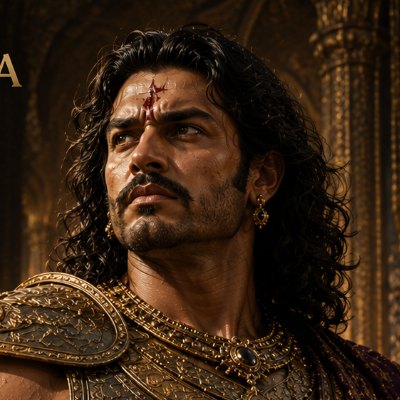
About
Dushasana — Second Son of Dhritarashtra, Chief Agent of Draupadi's Humiliation
Dushasana · Duhshasana · Dussasana · Duhsasana · son of Dhritarashtra · son of Gandhari
Dushasana is the second son of King Dhritarashtra of the Kuru dynasty and his queen Gandhari, and the most devoted and compliant of Duryodhana's brothers. He is listed among the eleven Maharathis — foremost car-warriors — produced by Dhritarashtra's sons, and appears throughout the Mahabharata as Duryodhana's closest instrument: executing his brother's commands, fighting at his side across the eighteen days of the Kurukshetra war, and serving as the immediate agent of the most grievous act committed by the Kaurava side in the Sabha Parva — the dragging and attempted disrobing of Draupadi in the royal assembly. That act earned him the sworn vengeance of both Bhimasena and Draupadi. On the sixteenth day of the war, Bhimasena fulfilled his oath by killing Dushasana in one of the most violent deaths recorded in the epic. His son Drumasena also appears briefly in the war narrative. Dushasana is a principal figure in the Sabha Parva, the Bhishma Parva, the Drona Parva, and the Karna Parva of the Mahabharata.
✦ The Name
The name Dushasana is composed of two Sanskrit elements: duh (or dus), a prefix meaning bad, difficult, or atrocious, and shasana, meaning governance, rule, command, or ordinance. The compound thus carries the sense of one who governs badly, or an atrocious ruler, or hard to govern. The name is transparently evaluative, consistent with the Mahabharata's practice of giving many of Dhritarashtra's sons names prefixed with dur or duh that carry negative or difficult connotations. The spelling varies across manuscripts and translations — Duhshasana, Dussasana, and Duhsasana are all attested — reflecting differing conventions for rendering the Sanskrit conjunct dh into Roman script.
✦ Lineage
- Father: Dhritarashtra — blind king of the Kuru dynasty at Hastinapura, born by niyoga of the sage Vyasa upon Ambika, widow of King Vichitravirya of the lunar Kuru line.
- Mother: Gandhari — princess of the Gandhara kingdom, daughter of King Subala, queen of Dhritarashtra, who wore a blindfold throughout her married life. She bore all one hundred Kaurava brothers and their sister Duhsala.
- Elder brother: Duryodhana — the eldest of Gandhari's sons, crown prince of Hastinapura, and the central antagonist of the Mahabharata. Dushasana's relationship to Duryodhana is one of absolute personal loyalty throughout the epic.
- Brothers: The remaining ninety-eight sons of Gandhari and Dhritarashtra, including Vikarna — the nineteenth son, notable for protesting the injustice done to Draupadi at the dice game — and Yuyutsu, the half-brother born of a Vaishya attendant, who defected to the Pandava side before the war.
- Sister: Duhsala — the only daughter of Dhritarashtra and Gandhari, married to Jayadratha, king of the Sindhu kingdom.
- Son: Drumasena — attested in the war books as a warrior on the Kaurava side; he is named among those who participated in killing Abhimanyu on the thirteenth day of the war. Drumasena was subsequently slain by Prativindya, the eldest son of Draupadi and Yudhishthira, in single combat.
✦ Character and Role in the Epic
The Mahabharata presents Dushasana consistently as Duryodhana's most willing executor. Where Duryodhana conceived schemes and issued commands, Dushasana was the one who carried them out without hesitation or apparent reservation. The epic gives him no independent moral voice — he registers neither protest nor reluctance at any point in the narrative, in marked contrast to his brothers Vikarna, who publicly opposed the disrobing of Draupadi, and Yuyutsu, who defected to the Pandavas. Dushasana's character is defined almost entirely by his devotion to Duryodhana and by the act he committed in the assembly hall.
✦ The Sabha Parva — The Dragging of Draupadi
The act for which Dushasana is primarily known and remembered in the tradition is his role in the dice game episode, narrated in the Sabha Parva. After Yudhishthira lost his kingdom, his brothers, himself, and finally Draupadi to Shakuni's dice, Duryodhana commanded that Draupadi be brought into the assembly. Dushasana went to Draupadi's inner chamber, seized her by the hair, and dragged her into the hall of kings — the primary text of the Sabha Parva specifies that she was in her menstrual period at the time and was dressed in a single garment. He brought her before the assembly and, at the urging of Karna, proceeded to attempt to strip her of her clothing.
The Sabha Parva records that as Dushasana pulled at Draupadi's garment, it extended without limit, until a vast pile of robes had accumulated and Dushasana himself collapsed from exhaustion, unable to complete the act. The assembled kings looked on in astonishment and censured Dhritarashtra's sons. The text records that Bhimasena, watching this, vowed in the hearing of all present that he would tear open Dushasana's chest in battle and drink his blood. Draupadi herself, her humiliation public and irremediable, vowed that she would leave her hair unbound until it could be bathed in Dushasana's blood. Both oaths are presented in the primary text as among the most consequential vows sworn in the epic — binding commitments that the entire subsequent narrative moves toward fulfilling.
The primary text records that after the miracle of the inexhaustible garment, Dhritarashtra — alarmed by the evil omens surrounding the event — granted Draupadi two boons, by which she secured the freedom of Yudhishthira and the other Pandavas. Duryodhana subsequently prevailed upon his father to invite the Pandavas to a second dice game, with the result that the Pandavas were sent into thirteen years of exile. Dushasana is among those specifically remembered throughout the Pandavas' exile as the one who performed the physical act of humiliation against Draupadi.
✦ The Kurukshetra War — Engagements by Day
Dushasana was a Maharathi and an active warrior throughout the Kurukshetra war, consistently fighting alongside Duryodhana or acting in defence of key Kaurava commanders. His engagements across the war days, as recorded in the primary text, are as follows.
Day 1: Dushasana is among the first to engage in combat on the opening day. He opposed Arjuna's advance, and the Bhishma Parva records that he resisted Arjuna's attempt to reach Bhishma, temporarily checking Arjuna's progress in defence of the Kuru patriarch. He also fought Nakula and Yudhishthira on this day, and was defeated by both.
Day 2: Dushasana killed Nakula's bodyguards. Nakula, enraged, engaged him directly in sword combat and came close to killing him.
Day 10: Dushasana attacked and wounded Shikhandi — the Pandava warrior who had been a woman in a prior life and whom Bhishma had sworn not to fight — in an attempt to protect Bhishma. On this day Duryodhana assigned Dushasana specific command responsibility for the protection of Bhishma, making him the leader of Bhishma's immediate guard.
Day 13: Dushasana is named among the warriors who participated in the killing of Abhimanyu, son of Arjuna, in the chakravyuha formation on the thirteenth day. The text records that multiple Kaurava and allied warriors together deprived Abhimanyu of his weapons, chariot, and horses before killing him. Abhimanyu injured Dushasana in the course of this battle before succumbing. Dushasana's son Drumasena is also recorded as a participant in the killing of Abhimanyu.
Day 14: Dushasana attempted to stop Arjuna's advance toward Jayadratha, but was overcome by Arjuna in archery and driven from his path. During the night battle of the fourteenth day, Dushasana fought actively, killing warriors of Virata's forces.
Day 16: On the morning of the sixteenth day, Dushasana fought the forces of Magadha and is recorded as killing their minister Vrihanta. He then engaged Bhimasena directly. The Karna Parva (Sections 83–84, Ganguli translation) records this final encounter in detail. Dushasana fought fiercely with arrows, cutting Bhima's bow at one point with a single shaft. Bhimasena, inflamed by his memory of the dice game, took up his mace and hurled it at Dushasana. The mace struck Dushasana on the head and threw him from his chariot to the ground at the distance of ten bow-lengths. His chariot was shattered, his horses killed, and his armour, ornaments, and garlands displaced. Dushasana lay on the ground writhing in agony.
The primary text then records that Bhimasena, standing over Dushasana on the battlefield and recalling the seizure of Draupadi's hair and her disrobing, tore open Dushasana's chest with his bare hands and drank a portion of his blood. He addressed the fallen man by reference to his past mockery of the Pandavas and announced his fulfilment of his oath before the assembled warriors. The Karna Parva records that soldiers watching this scene fell unconscious or fled in terror. Karna, observing the death of his ally, was seized with fear at Bhima's ferocity. Duryodhana, upon hearing of his brother's death, was struck numb with grief.
Following Dushasana's death, ten of his brothers immediately rushed at Bhimasena to avenge him. The Karna Parva records that Arjuna killed all ten of them with ten broad-headed arrows, driving the Kaurava army into flight. Dushasana's blood was subsequently brought to Draupadi, who bathed her hair in it, thus fulfilling the vow she had sworn thirteen years earlier in the assembly hall.
✦ Textual Variants and Inconsistencies
The Sabha Parva episode of Draupadi's disrobing presents a textual complexity that scholars have noted. The primary text of the Sabha Parva records that Dushasana pulled Draupadi's garment and that it extended without limit, resulting in a great pile of robes but not in any actual removal of her clothing — the text is explicit that Draupadi's honour was protected by this miracle. Some popular traditions and later retellings describe a successful disrobing with divine intervention maintaining her modesty, but the primary text as transmitted in the Ganguli translation does not support this reading. The distinction is relevant because the primary text presents the miracle as preventing the act, not as occurring after it. The Jaiminiya Ashvamedha Parva, a separate recension of part of the Mahabharata, does reference the disrobing incident, attesting the episode's presence across multiple textual traditions.
The manner of Dushasana's death presents a minor inconsistency between accounts. The primary text of the Karna Parva (Section 83) describes Bhima knocking Dushasana from his chariot with his mace, then tearing open his chest to drink his blood. Some secondary retellings also include the tearing off of Dushasana's right arm as a separate act preceding the chest-rending — a detail that appears in post-primary popular tradition and is consistent with the emotional logic of the oath but is not foregrounded in the Ganguli translation of the primary passage consulted. The beheading of Dushasana after the blood-drinking is mentioned in some secondary accounts and not in others.
✦ Narrative and Moral Significance
Dushasana's narrative function in the Mahabharata is inseparable from the structure of oath and fulfilment that drives the war. His act in the assembly creates the two most charged personal vows in the epic — Bhima's and Draupadi's — and the entire arc of the Kurukshetra war is coloured by the knowledge that these oaths must eventually be discharged. The ferocity with which Bhima kills Dushasana, and the deliberate fulfilment of the blood-oath in the most visceral possible form, is the primary text's way of marking that the wrongs of the Sabha Parva have been answered in full measure.
At the same time, the Karna Parva records the horrified reaction of onlookers to Bhima's blood-drinking — soldiers who witnessed it fell unconscious, and Karna himself is described as gripped by fear not only at the outcome but at what he had seen of human capacity for vengeance. This framing prevents the scene from being read as straightforwardly triumphant: the fulfilment of the oath is necessary but terrible, and the war that produced it has extracted a cost that extends beyond the combatants.
✦ Connection to the Wider Genealogy
Dushasana belongs to the Kuru dynasty through his father Dhritarashtra, son of the sage Vyasa by Ambika, widow of King Vichitravirya of the lunar lineage. Through his mother Gandhari he descends from the Gandhara royal house. He is a paternal half-cousin of the five Pandavas — Yudhishthira, Bhimasena, Arjuna, Nakula, and Sahadeva — sons of Dhritarashtra's half-brother Pandu. His son Drumasena died in the Kurukshetra war, killed by Prativindya, eldest son of Yudhishthira and Draupadi. Dushasana himself died on Day 16, making him the last of the individually profiled Kaurava brothers to fall before the war's final day.
✦ References
- Mahabharata, Adi Parva, Adhyaya 63 and 117 (Ganguli translation): Lists Dushasana among the eleven Maharathis among Dhritarashtra's sons; places him third in the birth-order list of Gandhari's sons.
- Mahabharata, Sabha Parva, Adhyayas 66–68 (Ganguli translation, Sacred Texts Archive): The primary source for the dice game episode — Dushasana's dragging of Draupadi by the hair, his attempt to strip her clothing, the miracle of the inexhaustible garment, his collapse from exhaustion, and the vows sworn by Bhima and Draupadi in response. The most narratively consequential passage in Dushasana's entire arc.
- Mahabharata, Bhishma Parva, multiple adhyayas (Ganguli translation and Vyasa Online): Records Dushasana's engagements on Days 1, 2, and 10, including his resistance of Arjuna's advance toward Bhishma, his defeat by Nakula, and his wounding of Shikhandi on Day 10 in defence of Bhishma.
- Mahabharata, Drona Parva (Ganguli translation and Bharatpedia): Records Dushasana's participation in the killing of Abhimanyu on Day 13, Abhimanyu's counter-wounding of Dushasana, and the role of Dushasana's son Drumasena. Records Dushasana's encounter with Arjuna and defeat on Day 14.
- Mahabharata, Karna Parva, Sections 83–84 (Ganguli translation, Sacred Texts Archive): The primary source for the death of Dushasana on Day 16 — his mace duel with Bhimasena, his fall from his chariot, Bhima's tearing open of his chest and drinking of his blood, the reaction of onlookers and of Karna, the grief of Duryodhana, and the subsequent killing by Arjuna of the ten brothers who rushed to avenge Dushasana.
- Mahabharata, Stri Parva (Ganguli translation): Gandhari's lament over her fallen sons includes reference to Dushasana, providing a secondary corroboration of his death.
- Vettam Mani, Puranic Encyclopaedia (Motilal Banarsidass, 1975): Secondary reference for cross-checking appearances and genealogical detail.
- Wikipedia, Dushasana article: Secondary reference for name etymology and summary of war engagements, used only for cross-checking against primary sources.