
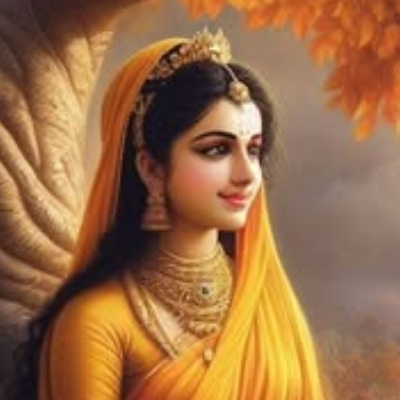
About
Dhriti — Wife of Kapila Deva in the Devi Bhagavata Purana
Dhriti · Dhriti Devi
Dhriti is named in the Devi Bhagavata Purana as the wife of Kapila Deva, appearing within a sequence of personified qualities described as portions, or Kalas, of Mula Prakriti, the primordial cosmic substance identified in this text with the Goddess herself. In this passage she personifies dhriti, fortitude or steadfastness, and is paired with Kapila Deva as her husband in the same way that other qualities such as contentment, prosperity, and truthfulness are paired with their own corresponding male principles. Her significance is primarily theological rather than narrative: she belongs to a structured list of complementary couples through which the text explains how various sustaining virtues operate in the world.
✦ The Name
Dhriti derives from the Sanskrit root dhri, to hold or sustain, and denotes fortitude, steadiness, patience, or constancy. The Devi Bhagavata Purana makes this meaning explicit, stating that without her, people in the world would become impatient, directly linking the figure to the abstract quality her name carries.
✦ Lineage
- Husband: Kapila Deva. The Devi Bhagavata Purana's Ninth Skandha gives no parentage for Dhriti in this passage; she is introduced as a Kala, or portion, of Mula Prakriti rather than as a daughter within a standard genealogical line.
✦ Theological Significance
The passage in which Dhriti appears forms part of the Devi Bhagavata Purana's explanation of Prakriti's manifold forms. Each personified quality in the list, including contentment as the wife of Ananta Deva, prosperity as the wife of Ishana Deva, and truthfulness as the wife of Satya Deva, is presented as a sustaining force without which a corresponding social or moral good would collapse. Dhriti's pairing with Kapila Deva fits this pattern: her presence is said to prevent impatience among people, framing fortitude as a quality actively maintained in the world rather than a passive trait, and placing her within the Shakta theological framework in which the Goddess as Mula Prakriti pervades existence through such complementary couples.
✦ Textual Variants and Inconsistencies
The identification of Dhriti as Kapila's wife is specific to this passage of the Devi Bhagavata Purana and does not appear in the principal narrative tradition surrounding Kapila found in the Bhagavata Purana and the Brahmanda Purana, where Kapila is described as the only son of the sage Kardama and his wife Devahuti, a partial incarnation of Vishnu who taught the Sankhya philosophy to his mother and then departed for ascetic life at the hermitage of Pulaha. No wife is mentioned anywhere in that strand of his story. Separately, the name Dhriti is also attested in the Vishnu Purana's list of the twenty-four daughters born to Daksha and his wife Prasuti, where she is one of thirteen daughters married to Dharma, the personification of righteousness, rather than to Kapila. The Devi Bhagavata Purana passage does not identify its Dhriti with Daksha's daughter of the same name, nor does it draw any connection to the Kardama-Devahuti narrative of Kapila. These appear to be two separate textual traditions assigning the same name to different husbands, and this profile does not attempt to resolve them into a single figure.
✦ Connection to the Wider Genealogy
If Kapila Deva in this passage is identified with the Kapila of the Bhagavata and Brahmanda Puranas, he is the son of the sage Kardama and Devahuti, daughter of Svayambhuva Manu, and brother to nine sisters married to sages including Marichi, Atri, and Angiras. On that identification, Dhriti would stand within the genealogical orbit of the Manu-Kardama-Devahuti line by marriage. The Devi Bhagavata Purana itself does not draw this connection, and the Kardama-Devahuti narrative elsewhere makes no mention of a wife for Kapila, so this link remains an inference rather than an attested textual fact.
✦ References
- Primary sources:
- Devi Bhagavata Purana, Ninth Skandha, Chapter 1: Names Dhriti as the wife of Kapila Deva within a list of personified qualities paired with their corresponding deities; the verified textual basis for this profile.
- Bhagavata Purana, Third Canto: Narrates Kapila's birth to Kardama and Devahuti and his teaching of Sankhya philosophy to his mother before his renunciation, with no wife mentioned.
- Vishnu Purana: Lists a Dhriti among the daughters of Daksha and Prasuti married to Dharma, representing a separate tradition assigning the same name to a different husband.
- Secondary and reference works:
- Puranic Encyclopaedia by Vettam Mani: Entry on Kapila, confirming that the principal narrative tradition of his life records no wife.