
About
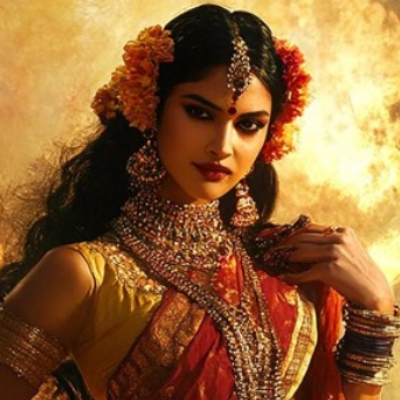
Dussala — Only Daughter of Dhritarashtra and Gandhari, Sister of the Kauravas
Dussala · Duhsala · Dushala · Duhshala · Dushshala · daughter of Dhritarashtra · sister of the Kauravas · queen of Sindhu
Dussala is the only daughter of King Dhritarashtra of the Kuru dynasty and his queen Gandhari, princess of the Gandhara kingdom. She is the sole sister of the hundred Kaurava brothers and of her half-brother Yuyutsu, and is regarded by the five Pandavas — sons of Dhritarashtra's younger half-brother Pandu — as their own cousin-sister. She was given in marriage to Jayadratha, king of the Sindhu and Sauvira kingdoms, a close ally of Duryodhana. Her life is defined by a succession of losses that the Mahabharata does not stage dramatically but allows to accumulate across several parvas: her husband's humiliation and subsequent vendetta against the Pandavas, his death at Arjuna's hands on the fourteenth day of the Kurukshetra war, the destruction of all her brothers in the same war, the death of her son Suratha, and finally her appearance in the Ashvamedha Parva — widowed, bereft, carrying her infant grandson before Arjuna on a battlefield — as the last surviving voice of the Kaurava generation. She appears in the Adi Parva, the Vana Parva, the Drona Parva, and the Ashvamedha Parva, and is attested in Vettam Mani's Puranic Encyclopaedia and the Wisdomlib corpus.
✦ The Name
The name Dussala, like the names of her brothers, is formed with the Sanskrit prefix dus, conveying difficulty, hardship, or ill quality. The noun element sala derives from a root meaning strength, prowess, or a weapon of a particular type, though in compound personal names it functions more broadly as a marker of distinction. The overall sense of the name is therefore one who is hard to overcome or difficult in strength. Several of her brothers bear similarly constructed names — Dushasana, Durmukha, Durmarshana — suggesting that the naming convention was applied uniformly across Gandhari's children. Alternate spellings found across manuscripts and translations — Duhsala, Dushala, Duhshala — all represent the same name with varying degrees of phonetic precision in transliteration.
✦ Lineage
- Father: Dhritarashtra — blind king of the Kuru dynasty at Hastinapura, born of the sage Vyasa by niyoga upon Ambika, widow of King Vichitravirya of the Kuru line.
- Mother: Gandhari — princess of the Gandhara kingdom, daughter of King Subala and sister of Shakuni; she wore a blindfold for life in solidarity with her husband's blindness and had obtained the boon of one hundred sons from the sage Vyasa.
- Brothers: The hundred sons of Dhritarashtra and Gandhari, including Duryodhana the eldest, Dushasana the second, and Vikarna the nineteenth; all died in the Kurukshetra war.
- Half-brother: Yuyutsu — son of Dhritarashtra by a Vaishya attendant named Sauvali; he defected to the Pandava side before the war and was the only son of Dhritarashtra to survive the conflict.
- Husband: Jayadratha — king of the Sindhu and Sauvira kingdoms, son of Vriddhakshatra; a close ally and personal friend of Duryodhana; killed by Arjuna on the fourteenth day of the Kurukshetra war.
- Son: Suratha — who ruled the Sindhu kingdom after Jayadratha's death; he died of fright upon hearing that Arjuna's army was approaching during the Ashvamedha expedition.
- Grandson: Unnamed in the primary text; the infant son of Suratha, whom Dussala carried in her arms to Arjuna on the battlefield, and for whose sake Arjuna withdrew from the Sindhu kingdom without further fighting, installing the child as its king.
✦ Birth
Dussala's birth is described in the Adi Parva as part of the same miraculous process that produced her hundred brothers. The sage Vyasa, intervening after Gandhari's frustrated blow to her womb produced a hardened mass of flesh rather than a child, directed the mass to be divided into one hundred and one portions and each placed in a sealed pot of clarified butter to develop. The first pot yielded Duryodhana; the remaining pots followed in sequence, producing the hundred sons and finally Dussala from the hundred and first. She is thus the last-born of Gandhari's children and the only daughter among them. The Adi Parva records that she was named Duhsala in the birth-order list of Dhritarashtra's children.
✦ Marriage to Jayadratha
Dussala was given in marriage to Jayadratha, king of the Sindhu and Sauvira kingdoms. Jayadratha was a close personal friend of Duryodhana, and his alliance with the Kaurava side through this marriage was politically as well as personally significant. The primary sources record that with Dussala, Jayadratha fathered multiple sons, of whom Suratha is the one named. The Puranic Encyclopaedia notes that Jayadratha had other wives as well, from the Gandhara and Kamboja royal houses. The Mahabharata does not narrate Dussala's own experience of this marriage in any direct fashion; her perspective emerges only obliquely, through the episodes in which her husband's conduct necessitates the intervention of the Pandavas.
✦ The Vana Parva — Jayadratha's Abduction of Draupadi
The Vana Parva records the episode that most directly involves Dussala's marriage in the wider narrative. During the Pandavas' twelve years of forest exile, Jayadratha was travelling through the forest region near the Pandava hermitage with his retinue, on his way to marry a princess from Shalva. He encountered Draupadi — the common wife of the five Pandavas — alone at the hermitage and, overcome by desire, attempted to abduct her. Draupadi resisted and was forcibly taken. The Pandavas, returning to their hermitage and finding her gone, pursued Jayadratha and his forces. After a fierce chase and battle in which the Pandavas destroyed his escort, Bhimasena caught Jayadratha and beat him severely, wishing to kill him outright.
At this point Dussala enters the narrative indirectly but decisively. Draupadi herself intervened to stop Bhima from killing Jayadratha, stating plainly that he was the husband of their cousin-sister Dussala and that killing him would make Dussala a widow. Yudhishthira concurred. Bhima, overruled, released Jayadratha after inflicting a specific humiliation: he shaved Jayadratha's head, leaving only five tufts of hair — a mark of dishonour among Kshatriyas. Jayadratha was then released under a public pledge of fealty to the Pandavas and allowed to return to his kingdom. The Vana Parva records that the explicit reason for Jayadratha's survival on this occasion was Dussala's position as his wife and the Pandavas' consideration for her as their own kin.
Jayadratha, shamed and vengeful, subsequently performed severe penance addressed to Lord Shiva and obtained the boon of being able to check any four of the Pandavas — excluding Arjuna — in battle for a single day. Armed with this boon, he joined the Kaurava forces for the Kurukshetra war.
✦ The Kurukshetra War — Deaths of Husband and Brothers
The Drona Parva records that on the thirteenth day of the war, Jayadratha used his Shiva-granted boon to seal the breach in the Chakravyuha formation through which Abhimanyu — son of Arjuna and Subhadra — had entered. He held back the four Pandavas who attempted to follow Abhimanyu, leaving the young warrior isolated inside the formation. Abhimanyu was killed. Arjuna, returning in the evening to find his son dead and learning of Jayadratha's role, swore a terrible oath: he would kill Jayadratha before the following sunset or enter fire himself. On the fourteenth day, after a day of continuous warfare extending past sunset by Krishna's divine intervention, Arjuna killed Jayadratha with a precisely aimed arrow that also fulfilled a prophetic condition — the arrow carried Jayadratha's severed head to fall directly into the lap of his father Vriddhakshatra, who was performing austerities at that moment. When the head fell on the ground from his father's startled hands, Vriddhakshatra died instantly, his own head shattering — fulfilling a curse that had been placed on Jayadratha's father.
Dussala thus lost her husband on the fourteenth day of the war. The war continued for four more days. The Puranic Encyclopaedia records that all the sons Dussala had borne Jayadratha also perished in the war, leaving only Suratha — who did not participate in the fighting — and the infant grandson. The eighteen-day war destroyed the entire Kaurava male generation, including all one hundred of her brothers. At its end Dussala was a widow in the Sindhu kingdom, with one surviving son and one infant grandchild.
✦ The Ashvamedha Parva — Final Appearance
Dussala's last and most fully narrated appearance in the Mahabharata occurs in the Ashvamedha Parva, and is directly attested in the Ganguli translation (Adhyaya 78 of that Parva). After the Kurukshetra war, Yudhishthira performed the Ashvamedha yajna — the horse sacrifice — to establish his sovereignty. The consecrated horse was released to roam freely, followed by Arjuna and an army to subjugate any kingdom that detained it. When the horse entered the territory of the Sindhu kingdom, Arjuna's forces engaged the Saindhavas — the warriors of that kingdom — in battle. Suratha, Dussala's son and the current ruler of Sindhu, was among those who faced the approaching army. Overcome with fear — described in the text as dying of grief and terror upon hearing of Arjuna's arrival — Suratha died before the battle was fully joined.
The Ganguli translation of the Ashvamedha Parva (Adhyaya 78, sacred-texts.com) records what followed. Dussala, queen of the Sindhu kingdom and daughter of Dhritarashtra, took her grandson — the infant son of Suratha — in her arms and went out to meet Arjuna on the field. The text describes her coming to Arjuna in grief. Arjuna, upon seeing her, cast down his bow. He received her as a sister and asked what he could do for her. Dussala, weeping, identified the infant as the son of Suratha, who was himself the son of Jayadratha. She appealed to Arjuna's sense of duty and compassion, invoking both his relationship to her as a cousin-sister and his role as a Kshatriya bound to protect the defenseless. The child addressed Arjuna as his maternal uncle — for Dussala, as Duryodhana's sister, was the Pandavas' cousin and thus stood in a sisterly relationship to them, making her grandson Arjuna's great-nephew by courtesy.
Arjuna, moved by sorrow, installed the infant as the new king of Sindhu. He withdrew his forces from the Sindhu kingdom without further fighting or demand for tribute. The episode as recorded in the primary text is the Mahabharata's final account of any child of Dhritarashtra and Gandhari — and it ends not with victory or defeat but with an old woman in widow's garments, holding an infant, silently accepted as kin by the cousin who had killed her husband, her son, and all her brothers.
✦ Textual Variants and Inconsistencies
The Wisdomlib entry for Dussala (citing Vettam Mani's Puranic Encyclopaedia) records that Jayadratha fathered many sons with her and that all these sons died in the Kurukshetra war. This detail — the loss of multiple sons in the war, not just one — is not contradicted by the Ashvamedha Parva narrative but is not elaborated there either; the Ashvamedha Parva focuses on Suratha and the infant grandson without specifying how many sons Dussala had in total. The two accounts are consistent: Suratha, who did not fight in the war, survived it, while any other sons who fought on the Kaurava side perished. The profile accepts this reading.
A minor inconsistency exists across secondary accounts regarding the manner of Suratha's death. Some sources describe him as dying of fright or grief upon hearing of Arjuna's approach; at least one Quora account states that Suratha was killed by Arjuna's arrows in the fighting before Dussala's intervention. The Ganguli translation of the Ashvamedha Parva, the primary source for this episode, does not clearly describe the specific manner of Suratha's death in the passage consulted. The profile follows the most widely attested secondary reading — death from fear or grief before the battle was fully joined — while noting this uncertainty.
Some secondary sources describe Jayadratha as having two additional wives from the Gandhara and Kamboja royal houses. If accurate, this would further complicate the account of which sons were Dussala's by birth. The primary text does not individuate Jayadratha's sons by mother, and this profile confines itself to what is attested.
✦ Narrative Significance
Dussala occupies a structurally unique position in the Mahabharata as the only daughter of Dhritarashtra and Gandhari, the only female member of the Kaurava generation who appears in the narrative as an active moral presence. Her function is not martial or political but relational: she is the point of connection between two warring lineages that otherwise have no ground for compassion. The Pandavas' sparing of Jayadratha in the Vana Parva — which will prove catastrophic, since Jayadratha's boon is directly responsible for Abhimanyu's entrapment and death — is entirely a consequence of their regard for her. The narrative thus uses Dussala's person as the mechanism by which an act of Pandava generosity becomes the cause of their worst grief.
In the Ashvamedha Parva, she functions as the figure in whom the war's aftermath is made visible in its most concentrated form. Widowed, her sons dead, her brothers dead, she appears carrying a child who represents the only surviving Kaurava lineage. Arjuna's response — laying down his bow, receiving her as a sister, installing the infant king — is one of the few moments in the post-war books in which a Pandava warrior acknowledges the full human cost of the war on those who were neither its architects nor its combatants.
✦ Connection to the Wider Genealogy
Dussala belongs to the Kuru dynasty through her father Dhritarashtra, who was fathered by the sage Vyasa on Ambika, widow of King Vichitravirya, a descendant of the lunar lineage through Kuru, Shantanu, and Vichitravirya. Through her mother Gandhari she descends from the Gandhara royal house. Through her marriage to Jayadratha she enters the Sindhu lineage and becomes the mother of the Saindhavas' royal line. Her son Suratha and his unnamed son — the infant installed by Arjuna as king of Sindhu — represent the continuation of that line beyond the war. The infant grandson is thus the only individual of Dussala's direct lineage to survive into the post-war world with a functioning political identity.
✦ References
- Mahabharata, Adi Parva, Adhyaya 117 (Ganguli translation): Lists Dussala in the birth-order enumeration of Dhritarashtra's children as the daughter born from the hundred and first portion; the primary source for her birth and her place in the family.
- Mahabharata, Vana Parva, Adhyaya 271, Verse 43 (Ganguli translation, confirmed via Wisdomlib): Records the episode of Jayadratha's abduction of Draupadi, the Pandavas' pursuit and capture of Jayadratha, and the explicit statement by Draupadi and Yudhishthira that Jayadratha must be spared because he is the husband of Dussala. The primary source for the Vana Parva episode.
- Mahabharata, Drona Parva, Jayadratha-vadha section (Ganguli translation): Records Jayadratha's use of his Shiva-granted boon to seal the Chakravyuha breach on Day 13, his role in Abhimanyu's entrapment and death, Arjuna's oath, and the circumstances of Jayadratha's death on Day 14 including the severed head falling into Vriddhakshatra's hands.
- Mahabharata, Ashvamedha Parva, Adhyaya 78 (Ganguli translation, Sacred Texts Archive, m14/m14078.htm): The primary source for Dussala's final appearance — her carrying of the infant grandson to Arjuna, her identification of the child as Suratha's son, her appeal for mercy, and Arjuna's installation of the child as king of Sindhu. The most fully narrated passage involving Dussala in the entire Mahabharata.
- Mahabharata, Ashvamedha Parva, Adhyaya 89 (Ganguli translation, cited in Wisdomlib): A supplementary passage in the same parva providing additional detail on the Sindhu episode during the Ashvamedha expedition.
- Vettam Mani, Puranic Encyclopaedia (Motilal Banarsidass, 1975), p. 263: Records that Jayadratha married Dussala the youngest sister of Duryodhana; notes that all the sons Dussala bore Jayadratha died in the Kurukshetra war; provides chapter and verse references for the Vana Parva and Ashvamedha Parva episodes.
- Wisdomlib, Duhshala: 11 definitions: Secondary reference compiling references to Dussala across Mahabharata parvas, including the Vana Parva verse citation and the Ashvamedha Parva chapter references; used for cross-checking the account of multiple sons lost in the war.