
About
Shakuni — Prince and King of Gandhara, Architect of the Kurukshetra War
Shakuni · Saubala · Suvala-putra · Kitava · Parvatiya · Gandhararaja · Son of Subala
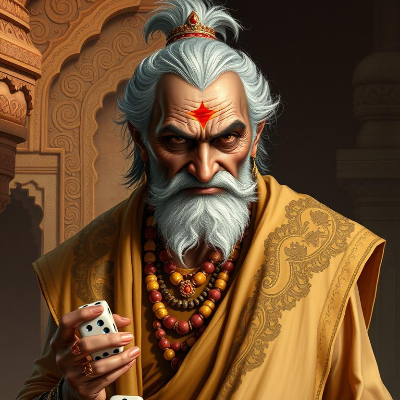
Shakuni was the prince and later king of Gandhara, son of King Subala and his wife Sudharma, and the brother of Gandhari who became queen of the Kuru kingdom at Hastinapura. He is one of the principal antagonists of the Mahabharata, identified in the Adi Parva as an incarnation of Dvapara Yuga — the personified third cosmic epoch whose nature is characterised by deception and the erosion of righteousness. His defining role in the epic is as the master strategist and dice-player who engineered the ruin of the Pandavas through the infamous gambling match, and as the chief counsellor of his nephew Duryodhana throughout the events leading to the Kurukshetra War. He was killed on the eighteenth day of that war by the Pandava Sahadeva. Shakuni appears across the full span of the Mahabharata from the Adi Parva through the Shalya Parva, and is attested in the Bhagavata Purana and secondary reference works.
✦ The Names
The name Shakuni derives from the Sanskrit shakuna, meaning a large bird, frequently used to denote a vulture or bird of ill omen — a name that in the tradition carries the connotation of one who presages disaster. The patronymic Saubala — son of Subala — is used throughout the Mahabharata as his most consistent epithet alongside his personal name, as is the variant Suvala-putra. The epithet Kitava means gambler or dice-player, reflecting his most notorious skill, while Parvatiya means one from the mountains, a geographical designation for his Gandhara origins. As king of Gandhara after Subala's death he bore the title Gandhararaja.
✦ Lineage
- Father: Subala, king of Gandhara, a descendant of Turvasu in the Lunar Dynasty
- Mother: Sudharma, queen of Gandhara
- Sister: Gandhari, queen of Hastinapura, wife of Dhritarashtra, mother of the hundred Kauravas and of Duhsala
- Brothers: Achala, Vrishaka, Gaya, Gavaksha, Vrishava, Charmavat, Arjava, Suka, and Vrihadvala — all named in the Mahabharata as Gandhara princes who fought in the Kurukshetra War
- Brother-in-law: Dhritarashtra, blind king of the Kuru dynasty at Hastinapura
- Wife: Unnamed in the critical edition of the Mahabharata; some secondary sources give the name Arshi
- Sons: Uluka, his eldest son, who served as a messenger to the Pandavas before the war and fought at Kurukshetra; a second unnamed son who survived the war and subsequently ruled Gandhara according to the Ashvamedhika Parva
✦ Cosmic Identity
The Adi Parva of the Mahabharata (Chapter 63) identifies Shakuni as an incarnation of Dvapara, the personified third cosmic age, whose essential nature is characterised by the diminishment of truth, righteousness, and order. This cosmological framing situates Shakuni not merely as a human antagonist but as the embodiment of the degenerative forces of the age itself — a figure whose deceptions and manipulations are expressions of the cosmic quality of the era rather than purely individual moral failures. This identification distinguishes him from most other human characters in the epic and provides the theological framework within which his otherwise inexplicable persistence in destructive counsel is understood by the tradition.
✦ Arrival at Hastinapura
When Bhishma, the patriarch of the Kuru dynasty, arranged the marriage of Gandhari to Dhritarashtra, Subala sent Shakuni to accompany his sister to Hastinapura. Shakuni remained in the Kaurava court permanently thereafter, becoming the closest personal adviser to Duryodhana. The Mahabharata depicts his relationship with Duryodhana as one of active cultivation — Shakuni nurtured Duryodhana's resentment of the Pandavas from childhood, advised him on strategies to weaken or destroy them, and designed the specific mechanisms — including the dice match — through which Duryodhana's plans were executed. The Adi Parva records that Shakuni was expert in statecraft and economics as well as in illusion and gambling, reflecting the broader culture of the Gandhara kingdom which was renowned in the tradition for learning, music, and political sophistication.
✦ The Dice Match
The Sabha Parva of the Mahabharata records the dice match as Shakuni's most consequential act. Acting on his counsel, Duryodhana arranged for Yudhishthira — whose weakness for gambling was known — to be invited to Hastinapura for a game. Shakuni played on Duryodhana's behalf against Yudhishthira, deploying his mastery of dice to win every round. In successive throws, Yudhishthira wagered and lost his kingdom, his brothers, himself, and finally Draupadi. The public humiliation of Draupadi that followed in the assembly hall — when Dushasana attempted to disrobe her before the assembled Kuru elders — became the central act of injustice that made the Kurukshetra War morally inevitable. A second dice match, engineered again by Shakuni, resulted in the Pandavas' twelve-year forest exile followed by one year of incognito living. Both matches are attributed in the text directly to Shakuni's skill and design.
✦ Role in the Kurukshetra War
Shakuni fought throughout the Kurukshetra War as a commander of the Kaurava forces and as a practitioner of illusion in battle. On the eighth day of the war he fought alongside his brothers Gaya, Gavaksha, Vrishava, Charmavat, Arjava, and Suka against Iravan — Arjuna's son by his Naga wife Ulupi — and after Iravan slew five of those brothers, Shakuni responded by creating powerful battlefield illusions to confound the Pandava forces. The Shalya Parva records that his brothers Achala and Vrishaka, the most prominent of his surviving brothers, were killed by Arjuna, and that Shakuni witnessed these deaths. On the eighteenth and final day of the war, Shakuni was challenged and killed by Sahadeva, the youngest of the five Pandavas, fulfilling the vow Sahadeva had made to kill the dice-player who had been the architect of the Pandavas' humiliation.
✦ Textual Variants and Inconsistencies
A widely circulated account — originating in Jain texts and popular regional tradition rather than in the critical edition of the Mahabharata — holds that Bhishma or Dhritarashtra imprisoned Subala and all his sons on account of Gandhari having been previously married to a goat to neutralise an inauspicious horoscope, and that Subala sacrificed all his other sons' food portions to keep Shakuni alone alive so that he could take revenge on Hastinapura. This narrative is explicitly absent from the critical edition of the Mahabharata, and its inauthenticity is confirmed by the fact that the text records Shakuni's brothers fighting — and dying — in the Kurukshetra War, which would be impossible if they had starved to death in a Kaurava prison before the war began.
✦ Connection to the Wider Genealogy
Shakuni connects the Gandhara royal house of the Lunar Dynasty — through the Turvasu branch of Yayati's descendants — to the heart of the Kuru dynastic narrative through his permanent residence at Hastinapura and his role as maternal uncle to the hundred Kauravas. His son Uluka fought at Kurukshetra and survived; a second son inherited the Gandhara throne after the war. The Ashvamedhika Parva records that Gandhara was subsequently conquered by Arjuna during Yudhishthira's Ashvamedha campaigns, completing the subjugation of the last remnant of Shakuni's kingdom.
✦ References
- Mahabharata, Adi Parva, Chapter 63: Identifies Shakuni as an incarnation of Dvapara Yuga; records his expertise in statecraft, economics, and illusion
- Mahabharata, Adi Parva, Chapters 109–111: Records Shakuni accompanying Gandhari to Hastinapura following her marriage to Dhritarashtra
- Mahabharata, Sabha Parva: Primary source for the dice match; records Shakuni's role as player on Duryodhana's behalf and the successive losses of Yudhishthira culminating in Draupadi's humiliation
- Mahabharata, Bhishma Parva, Chapter 89, verse 12: Names Gaya, Gavaksha, Vrishava, Charmavat, Arjava, and Suka as Shakuni's brothers fighting on Day 8
- Mahabharata, Shalya Parva: Records the deaths of Achala and Vrishaka at Arjuna's hands; records Shakuni's death at Sahadeva's hands on Day 18
- Mahabharata, Ashvamedhika Parva: Records that a descendant of Shakuni ruled Gandhara after the war and that Arjuna subsequently conquered the kingdom
- Wikipedia, "Shakuni" article: Secondary source confirming the Dvapara identification, the dice match, his death by Sahadeva, and noting the prison episode's Jain origin and absence from the critical edition
- Puranic Encyclopaedia (Vettam Mani), "Shakuni" entry: Secondary source providing consolidated narrative and genealogical details