
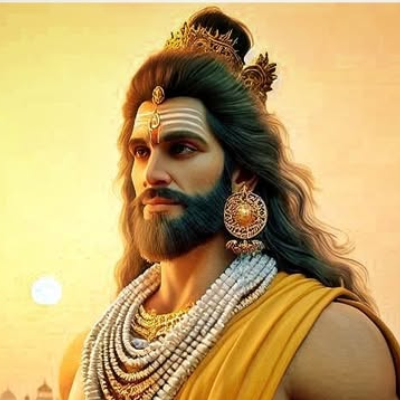
About
Shantanu — King of Hastinapura, Father of Bhishma, and Patriarch of the Kuru Line
Shantanu · Shantanava · Kurukulapati · Mahabhishaja · Gangaputrapita · Kauravapitamaha
Shantanu is a king of Hastinapura and one of the most significant figures in the genealogical architecture of the Mahabharata — not for any martial achievement of his own but because his two marriages and the consequences that flowed from each of them set in motion the chain of events that produced the Kuru-Pandava conflict at the heart of the epic. He is a descendant of the Lunar dynasty through the Paurava line — specifically the Kuru branch — and a direct ancestor of all the principal figures of the Mahabharata. His first marriage to Ganga, the goddess of the sacred river, produced Devavrata — the figure who became the incomparable hero Bhishma, whose terrible vow of lifelong celibacy in service of Shantanu's second marriage is the defining act of the Mahabharata's entire generational drama. His second marriage to Satyavati — the daughter of a fisherman king and, secretly, the mother of the sage Vyasa — produced two sons, Chitrangada and Vichitravirya, through whose line the Pandavas and Kauravas are born. Shantanu appears extensively in the Mahabharata's Adi Parva, the Harivamsa, the Vishnu Purana, and the Bhagavata Purana.
✦ The Names
The name Shantanu derives from the Sanskrit shanta — peaceful, tranquil, calm — combined with a suffix indicating the state or quality of that peace, yielding the sense of "the peaceful one," "the one who brings peace," or "he by whose touch everything becomes whole and tranquil." The Mahabharata's Adi Parva offers an internal etymology: Shantanu received this name because whoever he touched — the aged, the sick, the weakened — was restored to health and wholeness by the contact of his hand, as though his very touch carried a healing power. The patronymic Shantanava identifies him as the son of Pratipa. The epithet Mahabhishaja is a variant name used in a specific narrative context: in the Bhagavata Purana's account of the previous life of the figure who became Shantanu, he was a king named Mahabhisha who gazed upon the goddess Ganga at Brahma's assembly in a manner that was improper, and both were cursed to be reborn on earth — she as the river-goddess and he as the king who would be her husband — an episode that explains the supernatural character of Shantanu's first marriage. Kauravapitamaha means "the patriarch of the Kauravas."
✦ Lineage
- Father: Pratipa — a king of Hastinapura in the Kuru line, himself a descendant of the Paurava lineage. Pratipa is the figure in whose court the sage Ganga — in her human form — appeared and sat upon the king's right thigh in a gesture of desire, requesting him to accept her as his wife. Pratipa explained that the right thigh was the seat for a son or daughter-in-law rather than a wife, and directed Ganga to seek his son Shantanu as a husband instead. This episode, narrated in the Mahabharata's Adi Parva, explains the origin of Shantanu's union with Ganga as something anticipated and prepared by the generation before him.
- Paternal ancestry: Through Pratipa, Shantanu descends from the Paurava branch of the Chandravamsha — the Lunar dynasty — through the line of Kuru, from whom the Kuru kingdom and the Kaurava and Pandava families derive their dynastic name. The full Paurava-Kuru line descends from Pururavas and Ila through Ayu, Nahusha, Yayati, Puru, and many subsequent kings including Dushyanta, Bharata, Kuru, and further ancestors before reaching Pratipa and Shantanu.
- First wife: Ganga — the goddess of the sacred river Ganga, the most holy river of the subcontinent, daughter of Himavat the mountain king in the Puranic tradition, and a being of cosmic divine standing. The circumstances of her marriage to Shantanu, the extraordinary conditions she imposed, and their consequences are narrated in full below.
- Son by Ganga: Devavrata — later known as Bhishma, and before his vow as Gangaputra (son of Ganga). Devavrata is the eighth child born of Ganga and Shantanu. The first seven were drowned by Ganga at birth in fulfilment of a prior karmic obligation; Shantanu prevented the drowning of the eighth, and this child — Devavrata — was taken by Ganga to be educated by the gods and sages before being returned to Shantanu. Devavrata grew to become the greatest warrior and most honourable figure of the Mahabharata's world, whose lifelong vow of celibacy — pronounced to enable Shantanu's marriage to Satyavati — earned him the name Bhishma, meaning "the one of terrible vow." Bhishma is one of the most central figures of the entire Mahabharata.
- Second wife: Satyavati — the daughter of the fisherman king Dasharaja, born through unusual supernatural circumstances as the daughter of the Chedi princess Adrika in her fish-form and of King Uparichara Vasu. Satyavati had before her marriage to Shantanu already borne a son — the sage Vyasa, also called Krishna Dvaipayana — through an encounter with the sage Parashara. The circumstances of Shantanu's pursuit of Satyavati and the conditions set by her father are narrated below.
- Sons by Satyavati: Chitrangada and Vichitravirya — two sons who became kings of Hastinapura after Shantanu's death. Their stories are profiled separately in this series. Through Vichitravirya's wives Ambika and Ambalika — and through the extraordinary intervention of the sage Vyasa — the blind king Dhritarashtra, the pale king Pandu, and the wise Vidura were born, from whom the Kauravas and Pandavas respectively descended.
✦ The Previous Life as Mahabhisha and the Curse
The Mahabharata's Adi Parva provides a narrative of the events in a previous existence that explain why Shantanu and Ganga came together as husband and wife in this life. A king named Mahabhisha — a righteous and powerful monarch of an earlier era who had ascended to the heaven of Brahma through the performance of great sacrifices — was present in Brahma's assembly when the goddess Ganga also came to pay her respects. A wind disturbed Ganga's clothing, and the assembled gods averted their eyes out of propriety. Mahabhisha, however, looked upon her with unconcealed desire. Brahma, observing this, was displeased by Mahabhisha's failure of self-control in the presence of the divine assembly and cursed him to be reborn on earth. Ganga, who had returned Mahabhisha's gaze with a smile, was included in the curse and was directed also to be reborn in the human world. The Vasus — the group of eight divine beings who were also at that time suffering under a curse pronounced by the sage Vasistha for a transgression in which one of them had stolen the sage's divine cow — petitioned Ganga as she descended toward earthly birth to take them as her sons and release them from their mortal state by drowning them at birth. Ganga agreed to this. The entire arrangement — Ganga's birth as a woman, the Vasus as her sons, and their release through death at birth — was thus set in motion by Mahabhisha's improper gaze at Brahma's assembly.
✦ The Marriage to Ganga and the Drowning of the Seven Sons
Shantanu, hunting by the banks of the Ganga, encountered a woman of extraordinary beauty and was immediately overcome by desire for her. He approached her and asked her to become his wife. The woman — who was Ganga in her human form — agreed, but on one absolute condition: that Shantanu never question her actions, never reproach her, never express displeasure at anything she did, and that the moment he questioned or reproved her, she would immediately leave him forever. Shantanu, captivated by her beauty, accepted this condition without reservation.
The couple lived together in great happiness. Ganga bore Shantanu seven sons in succession, and each time, immediately after birth, she carried the infant to the river and drowned it, returning to Shantanu with perfect composure. Shantanu, bound by his promise and unwilling to lose Ganga, said nothing through the drowning of seven sons, though his grief was extreme. When the eighth son was born, Shantanu could no longer restrain himself. As Ganga moved toward the river with the infant, he cried out and forbade her to drown the child. Ganga, acknowledging that his question had broken the condition of their marriage, told him the full truth of her identity, the nature of the Vasus' curse, and the agreement by which she had agreed to release seven of them through death at birth — the eighth being destined to live a long and exceptional life on earth as the fruit of the one Vasu whose transgression had been the greatest. She gave the surviving child to Shantanu, told him the child's name was Devavrata, and departed. Devavrata was later taken to the celestial realm for education by the gods and sages and was returned to Shantanu as a young man already trained in every sacred and martial science.
✦ The Pursuit of Satyavati and Bhishma's Vow
Many years after Ganga's departure, Shantanu was again hunting by the banks of a river when he perceived an extraordinarily sweet fragrance drifting from upstream. Following its source, he found Satyavati — a young woman of exceptional beauty who ferried passengers across the river in her boat and who carried about her a natural fragrance of remarkable quality, one of the distinctive marks of her unusual birth. Shantanu was immediately captivated and sought her hand in marriage. He went to her father Dasharaja — the fisherman king who had adopted and raised her — and made his request.
Dasharaja was willing to give his daughter to the king, but he set a condition: that any son born of Satyavati would inherit the throne of Hastinapura rather than Devavrata, Shantanu's existing heir. Shantanu, unable to make this promise — since Devavrata was his legitimate and beloved heir and the ablest prince in the world — returned home consumed by grief. He neither ate nor slept and fell into a visible decline. Devavrata, observing his father's condition and learning its cause, went to Dasharaja himself without Shantanu's knowledge and agreed to renounce all claim to the throne in Satyavati's future sons' favour. Dasharaja was not fully satisfied: he pointed out that Devavrata might in future have sons of his own who would dispute the succession. Devavrata, to remove this concern entirely, then made his terrible vow — that he would never marry, never father children, and remain celibate for his entire life. This vow was so extreme and so publicly witnessed that the gods rained down flowers from the sky and called him Bhishma — the one of terrible vow. Shantanu, hearing of his son's sacrifice, granted Devavrata-Bhishma the boon of iccha mrityu — death only at his own chosen moment, the power to determine the time of his own death. Shantanu then married Satyavati.
✦ Textual Variants and Inconsistencies
The previous life account: The Mahabharata's Adi Parva gives the Mahabhisha narrative as the explanation for Shantanu's prior connection to Ganga. The Bhagavata Purana's ninth book gives a somewhat different genealogical account of the Kuru kings including Shantanu without the same elaboration of the Mahabhisha previous-life story. The Mahabhisha episode is primarily a Mahabharata tradition.
The Vasus episode: The account of which of the eight Vasus was whose incarnation — specifically which Vasu became Bhishma — varies slightly between different passages of the Mahabharata itself. The Adi Parva identifies the eighth Vasu as Prabhasa or Dyaus in different sections of the narrative, and these identifications are not entirely consistent within the text.
Shantanu's genealogical position in different Puranas: The Vishnu Purana and Bhagavata Purana give the Paurava-Kuru genealogy leading to Shantanu with some variation in the number and names of intermediate generations between Kuru and Shantanu. The Mahabharata's own genealogical sections are the primary source for the detailed Kuru royal line and are generally treated as authoritative for this lineage in the scholarly tradition.
✦ Theological and Narrative Significance
Shantanu's significance in the tradition is almost entirely structural and generative rather than individually heroic. He is not celebrated for martial achievement, philosophical depth, or personal virtue of an extraordinary kind — the tradition presents him as a man of good qualities who was twice overcome by desire for remarkable women, and whose accommodations of those desires set in motion consequences far beyond anything he could have foreseen. His marriage to Ganga produced Bhishma — the greatest figure of the Mahabharata's world, whose vow in service of Shantanu's personal happiness was the single act that ensured there would be no direct heir from Shantanu's most capable son, creating the succession vacuum that Satyavati's sons and their descendants would fill with such catastrophic results. His pursuit of Satyavati directly caused Bhishma's vow. In this sense, Shantanu's personal decisions — each arising from desire rather than from dynastic calculation — are the remote causes of the Mahabharata war itself.
✦ Connection to the Wider Genealogy
Through his father Pratipa and the long Paurava-Kuru line, Shantanu descends from Puru, from Yayati, from Pururavas, from Budha, and from Chandra — the moon god — placing him in the Chandravamsha at a remove of many generations from the lunar divine source. Through his son Bhishma he connects to the divine maternal line of Ganga, the sacred river goddess. Through his sons Chitrangada and Vichitravirya by Satyavati he connects to the line that produces Dhritarashtra and Pandu — and through Pandu's sons the five Pandavas, and through Dhritarashtra's sons the hundred Kauravas. Satyavati's pre-marital son Vyasa — the sage who composed the Mahabharata — is Shantanu's stepson, and Vyasa's biological intervention in the levirate arrangement after Vichitravirya's death without heirs produces Dhritarashtra, Pandu, and Vidura directly. Shantanu is thus the patriarch whose household generates every major figure of the Mahabharata's Kuru branch.
✦ References
Primary Sources
- Mahabharata, Adi Parva, sections 91–100: The primary epic source for the full narrative of Shantanu's life — the Mahabhisha previous-life account, Pratipa's encounter with Ganga, Shantanu's marriage to Ganga, the drowning of the seven sons, Devavrata's birth and return, the encounter with Satyavati, Bhishma's vow, and the grant of iccha mrityu. Indispensable for this profile.
- Vishnu Purana, Book 4, chapters 20–21: The Paurava-Kuru genealogy from Puru through the intermediate kings to Pratipa and Shantanu; confirms the dynastic lineage within which Shantanu is positioned.
- Bhagavata Purana, Book 9, chapters 22–23: The Kuru royal lineage through Pratipa and Shantanu within the Bhagavata Purana's dynastic genealogy.
- Harivamsa, chapters 30–32: Contains additional genealogical and narrative material on Shantanu and the Kuru royal line.
- Matsya Purana, chapter 50: The Paurava-Kuru genealogy confirming Shantanu's position in the Solar-Lunar dynastic framework.
Modern Reference Works
- Vettam Mani, Puranic Encyclopaedia (1975): Entry on Shantanu; collates primary references across the Mahabharata, Puranas, and Harivamsa and summarises the principal episodes of his life.
- J. A. B. van Buitenen (translator), The Mahabharata, Volume 1 (1973): Critical translation of the Adi Parva with scholarly notes on the Shantanu-Ganga and Shantanu-Satyavati episodes; the most authoritative scholarly translation of the primary source for this profile.
- F. E. Pargiter, Ancient Indian Historical Tradition (1922): Critical analysis of the Kuru genealogy from Puru to Shantanu across multiple Puranic sources.
- Alf Hiltebeitel, The Ritual of Battle: Krishna in the Mahabharata (1990): Contains discussion of Bhishma's vow and its structural consequences for the Mahabharata's generational drama, directly relevant to understanding Shantanu's role as the catalyst of those consequences.