
About
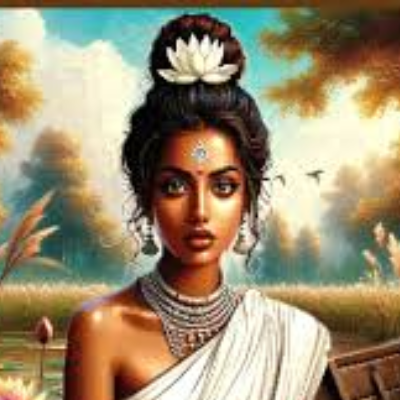
Satyavati — Queen of Hastinapura, Mother of Vyasa, and Matriarch of the Kuru Line
Satyavati · Matsyagandha · Yojanagandha · Gandhavati · Kali · Dasharajaputri · Shantanupatni · Vyasajananai
Satyavati is one of the most consequential female figures in the Mahabharata — a woman of unusual birth, extraordinary fragrance, and formidable personal agency whose two unions, separated by years, together produced the sage Vyasa and the kings Chitrangada and Vichitravirya, and whose decisions as the queen mother of Hastinapura after Shantanu's death directly shaped the circumstances from which the Pandavas and Kauravas were born. She is the daughter — in the circumstances of her adoption — of Dasharaja, the fisherman king who raised her, but her biological parentage is of entirely different and more august origin, as narrated in the primary texts. Before her marriage to Shantanu, she had already given birth to the sage Krishna Dvaipayana — known to the world as Vyasa, the composer of the Mahabharata itself — through an encounter with the sage Parashara. After Shantanu's death and the deaths of her two sons, it was Satyavati who authorised the levirate arrangement through which Vyasa fathered Dhritarashtra, Pandu, and Vidura on the widows of Vichitravirya — the act that directly produced the entire generation of Kuru-Pandava protagonists. Satyavati appears extensively in the Mahabharata's Adi Parva and is referenced in the Vishnu Purana, the Bhagavata Purana, and the Harivamsa.
✦ The Names
The name Satyavati is a compound of satya — truth, the true — and the feminine suffix vati, meaning "she who possesses" or "she who is characterised by," yielding the sense of "the truthful one" or "she who possesses truth." This is the name she bears as queen and by which she is principally known in the tradition. The name Matsyagandha — meaning "she who smells of fish" — was her name in early life, referring to the strong fishy odour she carried from her birth and her life on the river, attributed to her origin from or association with a fish. The name Yojanagandha — "she whose fragrance extends for a yojana" (a unit of distance) — is the name she received after the sage Parashara transformed her odour into an extraordinary sweet fragrance during their encounter, an odour of such power that it could be perceived at a distance of a full yojana in every direction. Gandhavati simply means "the fragrant one." Kali is an earlier name in some accounts, referring either to her dark complexion or to a quality of her early identity. Dasharajaputri means "daughter of Dasharaja." The epithets Vyasajananai and Shantanupatni mean "mother of Vyasa" and "wife of Shantanu" respectively.
✦ Lineage and Origins
- Biological father: Uparichara Vasu — a great king of the Chedi dynasty, a devotee of Vishnu, and a figure of immense royal power. The Mahabharata's Adi Parva narrates that Uparichara Vasu, while on a hunting expedition, was overcome by desire for his wife who was not present, and his seed fell into a river. The seed was swallowed by a fish — who was in truth an Apsara named Adrika, cursed to live as a fish. From Adrika the fish, in due course, two children were born: a boy and a girl. The boy became a king; the girl — Satyavati — was given to the fisherman Dasharaja who had caught the fish, and he raised her as his own daughter.
- Biological mother: Adrika — an Apsara under a curse who lived in the form of a fish in the river; she bore Satyavati from the seed of Uparichara Vasu. When she gave birth to Satyavati and her twin brother, the curse was lifted and Adrika resumed her Apsara form. The fish-origin of Satyavati is the explanation for the fishy odour of her early years and for the name Matsyagandha.
- Adoptive father: Dasharaja — the fisherman king or chief of the fishermen who caught the fish and took the child Satyavati to raise as his daughter. He is the figure who set the condition for her marriage to Shantanu and whose demand for the succession of Satyavati's sons prompted Bhishma's vow.
- Son before marriage: Vyasa — also called Krishna Dvaipayana (the dark-complexioned island-born one), the sage who composed or compiled the Mahabharata, the eighteen Mahapuranas, the Brahma Sutras, and who arranged the Vedas into their four divisions. Vyasa was born of Satyavati's union with the sage Parashara on an island in the Yamuna river. The circumstances of this birth are described below. Vyasa is one of the seven Chiranjivis — immortal beings who remain alive through the entire cosmic cycle — and is a figure of supreme importance in the tradition.
- Husband: Shantanu — the king of Hastinapura and a descendant of the Paurava-Kuru branch of the Lunar dynasty, whose marriage to Satyavati was made possible only through Bhishma's vow of celibacy.
- Sons by Shantanu: Chitrangada and Vichitravirya — the two sons who became successive kings of Hastinapura after Shantanu's death and who both died without producing heirs by conventional means, necessitating the extraordinary levirate arrangement through Vyasa.
✦ The Encounter with Parashara and the Birth of Vyasa
The Mahabharata's Adi Parva narrates that Satyavati, before her marriage to Shantanu, worked as a ferryman on the Yamuna river at the direction of her adoptive father Dasharaja. The sage Parashara — a great ascetic of immense spiritual power, grandson of Vasistha and father of the sage Vyasa — came to the river to cross it and was ferried by Satyavati. During the crossing, Parashara was overcome by desire for the young woman. Satyavati reminded him that they were in plain sight of the other sages on both banks. Parashara, using his yogic power, created a fog that enveloped the boat so that they were hidden from sight. He offered Satyavati a boon in exchange for her assent. Satyavati set her conditions: that her virginity be preserved and that the fishy odour she carried be transformed into a beautiful fragrance. Parashara granted both: he transformed her odour into the extraordinary sweet fragrance that could be perceived from a great distance — giving her the name Yojanagandha — and by his yogic power ensured that her physical virginity was restored after their union. From this union, on the island in the Yamuna — which gave the child the name Dvaipayana, island-born — the sage Vyasa was born on the same day. Vyasa grew to maturity instantly, promised his mother that he would come whenever she called upon him in need, and departed to perform austerities.
✦ Satyavati's Role as Queen Mother
After Shantanu's death, Satyavati became the effective power behind the throne of Hastinapura during the reigns of her two sons, both of whom died young. Chitrangada was killed in combat with a Gandharva of the same name shortly after becoming king. Vichitravirya married the two princesses of Kashi — Ambika and Ambalika, who had been won for him by Bhishma at their svayamvara — but died of consumption after a brief reign without fathering any children. The Kuru royal line faced extinction.
Satyavati now exercised decisive authority. She first approached Bhishma and urged him to renounce his vow of celibacy for the sake of the dynasty's continuity — he refused absolutely, bound by the vow he had made on her behalf. She then revealed to Bhishma and the household that she had a son from before her marriage — Vyasa — and proposed that Vyasa be asked to perform niyoga, the practice of levirate appointment, with the widows of Vichitravirya to produce heirs. Bhishma agreed to this arrangement. Satyavati called upon Vyasa, who appeared at once in fulfilment of his promise to her, and Satyavati asked him to father children on Ambika and Ambalika and on a maidservant in order to continue the Kuru line. Vyasa agreed. The three children born of this arrangement were Dhritarashtra, Pandu, and Vidura — the patriarchs of the Kauravas, the Pandavas, and the wise counsellor of the Kuru court respectively. Through Satyavati's initiative and Vyasa's compliance, the entire subsequent generation of the Mahabharata was produced.
✦ Satyavati's Departure from Hastinapura
The Mahabharata records that after the birth of the third generation — Dhritarashtra, Pandu, and Vidura — Satyavati lived to see the growing conflict between the Pandavas and Kauravas begin to take shape. The Adi Parva records that Satyavati, perceiving the direction of events and foreseeing the destruction that was to come, eventually withdrew from the world along with Ambika and Ambalika — the mothers of Dhritarashtra and Pandu. The three women retired to the forest and ended their lives through ascetic practice. This withdrawal is narrated briefly and without detailed elaboration in the primary text; the Mahabharata does not provide an extended account of Satyavati's final years.
✦ Textual Variants and Inconsistencies
The account of Satyavati's biological origin: The Mahabharata's Adi Parva gives the account of Uparichara Vasu, Adrika the Apsara-fish, and the two children born from the fish as the explanation of Satyavati's biological origin. The Vishnu Purana and Bhagavata Purana give the genealogical facts of Satyavati's association with a fisherman household without elaborating the Adrika-Uparichara origin story in the same terms. The Mahabharata version is the most elaborated and is the standard account.
Satyavati's restored virginity: The Mahabharata's account of Parashara's boon restoring Satyavati's virginity after their union is a detail specific to that text and reflects the tradition's concern with ensuring that Satyavati could later marry Shantanu without the prior union being an impediment. The mechanism by which this restoration is accomplished — ascribed to Parashara's yogic power — is stated without further elaboration.
The niyoga arrangement: The Mahabharata presents the levirate arrangement through Vyasa as Satyavati's initiative, authorised with Bhishma's consent. Some later devotional texts and regional traditions present the arrangement somewhat differently in terms of who takes the lead in proposing it and the degree of the widows' willing participation. The Mahabharata's account is the primary authoritative source for the episode.
✦ Theological and Narrative Significance
Satyavati is among the most actively consequential female figures in the Mahabharata — a woman who exercises genuine agency at several crucial turning points in the narrative. Her conditions for marriage to Shantanu were the direct cause of Bhishma's vow; her identification of Vyasa as the solution to the dynasty's extinction crisis was an act of practical intelligence and maternal authority; her management of the niyoga arrangement produced the entire next generation of the Kuru line. Unlike many female figures in the tradition who are defined by their suffering, their beauty, or their divine identity, Satyavati is defined by her decisions — decisions made in conditions of extraordinary difficulty and with consequences that extended beyond anything she or anyone else fully anticipated.
✦ Connection to the Wider Genealogy
Through her biological father Uparichara Vasu and the Chedi dynasty, Satyavati connects to the broader Chandravamsha. Through her son Vyasa she is the mother of the composer of the Mahabharata and of the father of Dhritarashtra, Pandu, and Vidura — making her the biological grandmother of the Pandavas and Kauravas through Vyasa, and simultaneously the grandmother through marriage of the entire Kuru generation through her sons Chitrangada and Vichitravirya. The dual genealogical claim — grandmother both as the queen mother of Vichitravirya, whose wives were the vessels for Vyasa's biological fatherhood, and as Vyasa's own mother — makes Satyavati the single matriarchal figure from whom the entire subsequent Kuru-Pandava-Kaurava world biologically descends.
✦ References
Primary Sources
- Mahabharata, Adi Parva, sections 57, 63, 91–100, and 101–106: The primary source for Satyavati's origin from Uparichara Vasu and Adrika, the Parashara episode and the birth of Vyasa, her marriage to Shantanu, the death of her sons, and the levirate arrangement through Vyasa producing Dhritarashtra, Pandu, and Vidura.
- Vishnu Purana, Book 4, chapters 20–21: Confirms Satyavati's place in the Kuru royal genealogy and the production of Dhritarashtra and Pandu through the niyoga arrangement.
- Bhagavata Purana, Book 9, chapters 22–23: The Kuru genealogy including Satyavati's position as Shantanu's wife and the mother of Vichitravirya.
- Harivamsa, chapters 30–35: Contains additional material on Satyavati and the Kuru royal line.
- Devi Bhagavata Purana: Contains a devotional account of Satyavati that expands certain aspects of her biography in the register of the goddess tradition.
Modern Reference Works
- Vettam Mani, Puranic Encyclopaedia (1975): Entry on Satyavati; comprehensive collation of all primary references and summary of the principal episodes.
- J. A. B. van Buitenen (translator), The Mahabharata, Volume 1 (1973): Critical translation of the Adi Parva with scholarly notes on the Satyavati episodes.
- Wendy Doniger O'Flaherty, Women, Androgynes, and Other Mythical Beasts (1980): Contains analysis of the Satyavati narrative within the broader study of female agency and unusual births in the Sanskrit tradition.
- Irawati Karve, Yuganta: The End of an Epoch (1969): Contains an important analysis of Satyavati as a figure of personal agency within the Mahabharata's social and political world, examining her decisions and their consequences from a humanistic rather than purely theological perspective.