
About
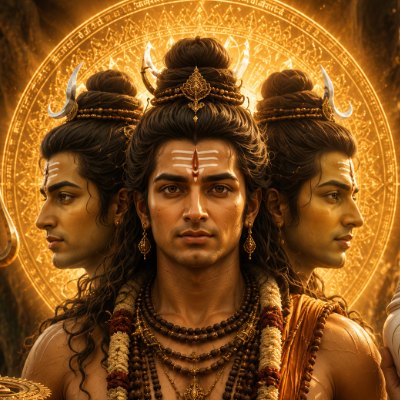
Dattatreya — Son of Atri and Anasuya, Avatar of the Trimurti, Supreme Guru of the Tradition, and the Wandering Ascetic
Dattatreya · Datta · Anagha · Atriputra · Vishnu-amsha-sambhuta · Trimurti-avatara · Digambara · Avadhoota · Guru-charitra-nayaka · Sahastrarjuna-guru
Dattatreya is one of the most revered and theologically significant figures in the Hindu tradition — the divine guru par excellence, the master of all spiritual traditions simultaneously, the avadhoota who wanders the world in complete renunciation while remaining completely present to all beings, and the figure whose teaching of twenty-four gurus from nature is one of the tradition's most celebrated philosophical passages. He is the son of Atri and Anasuya, born as a partial incarnation — specifically the amsha or portion — of Vishnu in response to Atri's extraordinary austerities. His name is a compound of Datta — "given" — and Atreya — "son of Atri" — meaning "the given one of Atri's lineage" or "the one gifted to Atri." He is described in the Puranas as having three heads — representing Brahma, Vishnu, and Shiva — four arms holding the symbols of all three deities, and four dogs accompanying him who represent the four Vedas. He is revered as the original guru of the Nath tradition, as the teacher of Parashurama, as the teacher of the Yadava king Sahasrarjuna (Kartavirya Arjuna), as the author of the Avadhuta Gita, and as the deity whose living presence continues in the present age through the line of his devotees. He appears in the Bhagavata Purana's fourth book, the Markandeya Purana, the Skanda Purana, the Brahma Purana, the Dattatreya Purana, and the Guru Charitra.
✦ The Names
The name Dattatreya is a compound of datta — given, gifted, donated — and Atreya — of the Atri lineage, son of Atri. The name thus means "the one given to Atri" or "the gifted son of Atri" — encoding both the narrative of his birth as a divine gift granted to Atri's austerities and his genealogical identity as Atri's son. The alternative name Datta — "the given one" — is used in devotional contexts as an intimate single-word invocation. Anagha means "the sinless one" or "he who is without blemish" — one of the standard divine epithets given to figures of complete spiritual purity. Digambara means "sky-clad" or "clothed in the directions" — the ascetic who wears nothing, whose clothing is the open sky, a term associated with complete renunciation. Avadhoota means "the one who has shaken off all worldly attachments" — from ava (down, away) and dhuta (shaken) — designating the supreme renunciant who has cast away all conventional categories of identity and social role. Vishnu-amsha-sambhuta means "born of Vishnu's portion."
✦ Lineage
- Father: Atri — one of the seven Saptarishis, a mind-born son of Brahma, author of Rigvedic hymns. His austerities generated the heat that brought the three gods and produced the boon of the three sons.
- Mother: Anasuya — the tradition presents Anasuya's pativrata power as the specific maternal quality that made her womb capable of bearing a portion of each supreme deity.
- Brothers: Chandra-Soma (born of Brahma's amsha) and Durvasa (born of Shiva's amsha).
- Divine identity: Dattatreya is most commonly identified as an amsha of Vishnu — the Bhagavata Purana specifically gives him as the Vishnu-amsha son. However because all three gods contributed to his birth, the tradition also regards him as simultaneously representing all three — hence his iconographic form with three faces and the combined symbols of Brahma, Vishnu, and Shiva. The Dattatreya Upanishad identifies him specifically as a form of Vishnu. The Nath tradition regards him as the guru of all gurus.
✦ Consorts and Their Traditions
Two distinct figures are named as Dattatreya's consort in the textual and devotional tradition, and these belong to substantially different streams of the tradition with different theological understandings of what the consort represents.
Anagha Devi is the consort recognised in the mainstream Dattatreya devotional tradition, particularly as attested in the Dattatreya Purana and in the devotional literature of the Datta sampradayas of Maharashtra, Karnataka, Andhra Pradesh, and Gujarat. The narrative of her origin is given in the Dattatreya Purana: when Dattatreya had remained in a state of deep samadhi submerged in a pond for a hundred years, he emerged and projected his own yogic energy outward through the brahmarandhra — a subtle aperture described in the yogic tradition as located at the crown of the skull. This projected energy took the form of a radiant young woman. Dattatreya then tested the assembled sages by observing their reactions to her; some, seeing her drink wine and dance, called her Madhumati (intoxicated one), while others who grasped her nature as his own divine energy were blessed. Dattatreya named her Anagha — meaning sinless, or she who removes sin and sorrow — and declared her his consort. In this tradition Anagha Devi is understood not as an independent person separate from Dattatreya but as his own shakti — his divine energy — given feminine form. She is specifically identified with Mahalakshmi, the goddess of prosperity, in her role as Dattatreya's consort, and the divine couple in this form are known together as Anagha Swami and Anagha Devi. The eight supernatural powers known as the Ashta Siddhis are described in the tradition as the progeny of this divine couple. The worship of the couple on the eighth day of the dark fortnight of the month of Margashirsha — known as Anaghashtami — is a formal vrata practice attested in the tradition's ritual literature. Dattatreya is said to have first initiated King Kartavirya Arjuna (Sahasrarjuna) into the Anagha puja in the Krita Yuga.
Leela is the consort named in the specifically regional tradition of the Ayyappa cult centred on the Sabarimala temple in Kerala, attested in the Sanskrit text known as the Bhutanatha Upakhyanam. In this tradition, when the Trimurti took human form as Dattatreya, the three great goddesses — Saraswati, Lakshmi, and Parvati — simultaneously took birth as the daughter of the sage Galava (the celebrated disciple and son of Vishwamitra known from the Mahabharata), who named her Leela and gave her in marriage to Dattatreya. The couple lived as householders for a long period. When Dattatreya resolved to return to ascetic life, Leela refused to permit the separation. Their dispute culminated in Dattatreya cursing Leela to be reborn as the demoness Mahishi, and Leela cursing Dattatreya to take the form of the buffalo Sundara Mahisha. These rebirths set in motion the chain of events leading to the birth of Lord Ayyappa (Dharmasastha, Manikandan) as the son of Shiva and Mohini — the only being capable of slaying Mahishi under the terms of her boon from Brahma. Upon Mahishi's death at Ayyappa's hands, Leela was liberated from her cursed form and, unable to become Ayyappa's consort because of his celibacy, was installed in an adjacent temple at Sabarimala, where she is venerated as Malikapurathamma, also called Manchambika. The scholar Paul Younger, cited by Wikipedia's Ayyappan article, characterises the Leela-Dattatreya backstory as a syncretic narrative of late medieval origin that integrates Shaivite, Vaishnavite, and Shakta elements into the Sabarimala cult's theology.
These two traditions do not contradict each other in the same textual stream: the Anagha Devi tradition is rooted in the Dattatreya Purana and the Datta sampradayas of the Deccan, while the Leela tradition is specific to the Bhutanatha Upakhyanam and the Sabarimala-Ayyappa cult of Kerala. They represent distinct regional and theological expressions, each operating within its own narrative and ritual context.
✦ The Twenty-Four Gurus — Teaching from Nature
The most celebrated philosophical episode associated with Dattatreya is his account of the twenty-four teachers — the beings and phenomena of the natural world from each of whom he drew a specific teaching about how to live and what to understand. This teaching is given in the Bhagavata Purana's eleventh book in the context of Dattatreya's conversation with King Yadu — the ancestor of the Yadavas. Yadu, seeing a wandering sage of extraordinary peace and equanimity, asked him the source of his wisdom. Dattatreya replied that he had taken wisdom from twenty-four teachers, naming each one: the earth, the air, the sky, the water, fire, the moon, the sun, the pigeon, the python, the sea, the moth, the bumblebee, the honeybee, the elephant, the deer, the fish, the prostitute Pingala, the osprey, the child, the maiden, the arrow-maker, the serpent, the spider, and the wasp. From each teacher he had extracted a specific philosophical principle — from the earth, patience and forbearance; from the water, purity and the tendency to flow toward the lower and help others; from fire, the transformation of everything it accepts into itself; from the child, its state of joy without ego. The twenty-four gurus passage is one of the Bhagavata Purana's most widely cited philosophical passages and is a foundational text of the tradition's teaching that wisdom is available in all phenomena for one who looks with pure attention.
✦ Dattatreya as Teacher of Parashurama
The Tripura Rahasya and several Puranic texts record that Dattatreya was the guru of Parashurama — the sixth avatar of Vishnu, the brahmin warrior who destroyed the kshatriya race twenty-one times. After his martial campaigns Parashurama came to Dattatreya seeking the highest knowledge and received from him the teaching of the Tripura Rahasya — a text of Advaita Vedanta dealing with the nature of the supreme consciousness. This teacher-student relationship connects Dattatreya to Parashurama and through Parashurama to the tradition's account of the avatar who preceded Rama.
✦ Dattatreya as Teacher of Sahasrarjuna
The Bhagavata Purana and the Markandeya Purana record that Dattatreya taught the Yadava king Kartavirya Arjuna — also called Sahasrarjuna or Arjuna of the thousand arms — the knowledge that gave him his extraordinary power. Kartavirya Arjuna became the most powerful king of his age, eventually conquering even Ravana and binding him. The tradition presents Dattatreya's teaching to Sahasrarjuna as an ambiguous gift — the power given was genuine but the use made of it led eventually to Parashurama's campaigns of destruction against the kshatriya class as a consequence of Sahasrarjuna's theft of the divine cow from Jamadagni's ashrama.
✦ The Avadhuta Gita
The Avadhuta Gita — a text of non-dual Vedanta presented as the song of the avadhuta, the complete renunciant — is attributed to Dattatreya. The text presents the teaching of Advaita Vedanta from the perspective of the being who has realised the identity of the individual consciousness with Brahman completely and lives in that realisation continuously. The Avadhuta Gita is regarded by the Dattatreya devotional tradition as one of the most direct and uncompromising statements of non-dual experience in the Sanskrit literary canon.
✦ Dattatreya Jayanti and Living Worship
Dattatreya Jayanti — the full moon day of the month of Margashirsha — is celebrated as Dattatreya's birth anniversary across the tradition, particularly in Maharashtra, Karnataka, Andhra Pradesh, and Gujarat where the Dattatreya devotional tradition has the deepest roots. The Guru Charitra — the biography of the Dattatreya tradition's saints Shri Narasimha Saraswati and Shri Swami Samartha — is one of the most widely read devotional texts of the Marathi tradition and is considered by its devotees as effective as the Vedas themselves in its transformative power.
✦ References
- Primary Sources
- Bhagavata Purana, Book 4, chapters 18–19 (birth); Book 11, chapters 7–9 (twenty-four gurus teaching to Yadu): The primary Bhagavata Purana sources for Dattatreya's birth account and his most celebrated philosophical teaching.
- Markandeya Purana: Contains significant Dattatreya narrative material including his teaching of Sahasrarjuna.
- Dattatreya Purana: The principal source for the narrative of Anagha Devi's origin as Dattatreya's projected yogic energy, the episode of the pond, and the theological account of the Anagha Swami-Anagha Devi divine couple; also the source for the Anaghashtami vrata tradition and its initiation to Kartavirya Arjuna.
- Dattatreya Upanishad: Identifies Dattatreya specifically as a form of Vishnu and gives his philosophical teaching.
- Avadhuta Gita (attributed to Dattatreya): The text of non-dual Vedanta presented as Dattatreya's teaching.
- Tripura Rahasya: Contains the account of Dattatreya's teaching to Parashurama.
- Bhutanatha Upakhyanam (Sanskrit text, Ayyappa tradition): The principal source for the narrative of Leela as Dattatreya's consort, their dispute and mutual curse, and the chain of events leading to Mahishi's destruction by Ayyappa and Leela's liberation as Malikapurathamma.
- Secondary Sources
- Vettam Mani, Puranic Encyclopaedia (1975): Entry on Dattatreya; comprehensive collation of all primary references.
- Wikipedia, Dattatreya: Notes that Dattatreya is accompanied by his consort Anagha Devi as an incarnation of Lakshmi; summarises the major variant birth narratives.
- Wikipedia, Ayyappan (citing Paul Younger): Places the Leela-Dattatreya backstory as a syncretic narrative of late medieval origin; notes the theological linking of Shaivite, Vaishnavite, and Shakta elements in the Sabarimala tradition.
- Mydattatreya.com and Sreedattavaibhavam.org: Reproduce the Dattatreya Purana account of Anagha Devi's origin and the Anagha vrata tradition; identify Anagha Devi as the Mahalakshmi-shakti of Dattatreya and the Ashta Siddhis as the progeny of the divine couple.