
About
Chitrangada — Elder Son of Shantanu and Satyavati, First Successor King of Hastinapura
Chitrangada · Shantanuputra · Satyavatiputra · Gandharvanihata · Kururajakumara
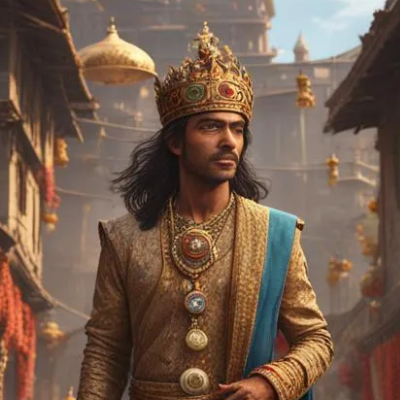
Chitrangada is the elder of the two sons born of Shantanu — the king of Hastinapura and a descendant of the Paurava-Kuru branch of the Lunar dynasty — and of Satyavati, the daughter of the fisherman king Dasharaja and the mother of the sage Vyasa from her prior union with the sage Parashara. Chitrangada succeeded his father Shantanu as king of Hastinapura and is described in the Mahabharata as a figure of extraordinary personal beauty, physical power, and martial skill — a prince whose qualities matched his name's promise. His reign was cut short by his death in a prolonged and inconclusive combat with a Gandharva who bore the same name — Chitrangada — a conflict whose cause the primary texts do not elaborate beyond identifying the coincidence of names as its occasion. Chitrangada died without having fathered any heirs, making his younger brother Vichitravirya the next king and necessitating the chain of events — Vichitravirya's childless death and the subsequent niyoga arrangement through Vyasa — that produced Dhritarashtra and Pandu. Chitrangada appears briefly in the Mahabharata's Adi Parva and is referenced in the Vishnu Purana, the Bhagavata Purana, and the Harivamsa.
✦ The Name
The name Chitrangada is a compound of chitra — wonderful, variegated, bright, or of many kinds — and anga — limb, body, or part — combined with the suffix da, meaning giving or endowed with, yielding the sense of "he who is endowed with a wonderful body," "the one whose limbs are remarkable," or "he of variegated and brilliant form." The name is thus an epithet of physical beauty and splendour, consistent with the Mahabharata's description of this prince as exceptionally handsome and powerful. The same name — Chitrangada — was borne by the Gandharva who killed him, which the Mahabharata presents as the immediate cause of the conflict between the two: the Gandharva was unwilling to share his name with a mortal and challenged the prince on this basis. The patronymics Shantanuputra and Satyavatiputra identify him as the son of his parents. The epithet Gandharvanihata means "killed by a Gandharva." It should be noted that the tradition also contains a separate figure named Chitrangada — the princess of Manipura who was the wife of Arjuna and the mother of Babhruvahana — who is an entirely different person from this Chitrangada son of Shantanu; the two share only the name.
✦ Lineage
- Father: Shantanu — the king of Hastinapura, descendant of the Paurava-Kuru branch of the Chandravamsha, whose two marriages and the consequences flowing from each set in motion the genealogical chain that produced the Mahabharata's principal figures.
- Mother: Satyavati — the daughter of the fisherman king Dasharaja, biologically of the royal Uparichara Vasu and the Apsara Adrika; previously the mother of the sage Vyasa through the sage Parashara; queen of Hastinapura and the decisive matriarchal authority of the Kuru household after Shantanu's death.
- Younger brother: Vichitravirya — the second son of Shantanu and Satyavati who became king of Hastinapura after Chitrangada's death, married Ambika and Ambalika, and died of consumption without heirs. Profiled separately in this series.
- Half-brother: Bhishma — born Devavrata, the son of Shantanu and the goddess Ganga, who served as regent and protector of both Chitrangada and Vichitravirya and of the Kuru throne throughout their reigns.
- Half-brother: Vyasa — born Krishna Dvaipayana, the son of Satyavati and the sage Parashara, the composer of the Mahabharata.
- The primary texts do not record a wife or children of Chitrangada. His death in battle with the Gandharva occurred before he had married or fathered heirs.
✦ The Reign and Death of Chitrangada
The Mahabharata's Adi Parva narrates Chitrangada's story in a remarkably compressed fashion. After Shantanu's death, Chitrangada — still young but already possessed of extraordinary martial ability — became king of Hastinapura. The text describes him as a warrior who was unrivalled among men of his time, of such power and splendour that he appeared equal in his heroic qualities to a Gandharva rather than a mortal king.
A Gandharva king who also bore the name Chitrangada — a being of the celestial realm — was unwilling to share his name with a mortal. He challenged the young king to combat on the Kurukshetra plain, which is near the Sarasvati river. The two Chitrangadas — the mortal king and the celestial Gandharva — fought for three years in a battle of extraordinary duration and intensity. Neither could defeat the other decisively, so evenly matched were their powers. In the end, the Gandharva's superior supernatural strength prevailed: Chitrangada the king was killed. The Mahabharata narrates this outcome without elaborating the details of the final combat or providing a detailed account of either combatant's tactics. After Chitrangada's death, his younger brother Vichitravirya was placed on the throne of Hastinapura under Bhishma's guardianship.
✦ The Gandharva Chitrangada
The Gandharva who killed Chitrangada bears the same name and is described in the Mahabharata as a king of the Gandharvas — the celestial musicians and beings of the intermediate heavenly realms. The Adi Parva does not elaborate the Gandharva Chitrangada's own biography, parentage, or further significance beyond his role as the killer of the Kuru prince. The coincidence of names is presented as the primary provocation for the conflict — the Gandharva considered it an affront to his identity and status that a mortal bore the same name — a narrative logic that reflects the tradition's understanding of names as markers of cosmic status that could not be shared between beings of different hierarchical levels without generating conflict.
✦ The Separate Figure of Chitrangada — Arjuna's Wife
As noted in the Names section, a completely separate figure named Chitrangada appears elsewhere in the Mahabharata — the princess of Manipura, daughter of the Manipura king Chitravahana, who became one of the wives of Arjuna during his twelve-year exile and who is the mother of Babhruvahana. This Chitrangada is a figure of entirely distinct identity, biography, and narrative context from Shantanu's son. The tradition offers no connection between the two figures beyond the shared name, and this profile concerns exclusively Shantanu's son.
✦ Textual Variants and Inconsistencies
The Mahabharata's account of Chitrangada's death is brief and does not vary significantly between the critical edition and the various regional recensions of the text. The Vishnu Purana and Bhagavata Purana confirm his position as Shantanu's elder son by Satyavati and his death without heirs but do not elaborate the Gandharva conflict. The Harivamsa is consistent with the Mahabharata's account. The brevity of the narrative across all primary sources reflects the tradition's assessment of Chitrangada as a transitional figure whose significance is entirely structural — his death without heirs is the fact that matters for the genealogy — rather than as a figure of independent narrative development. No significant inconsistency exists across the primary sources regarding Chitrangada's story, which is too briefly told to admit of major variation.
✦ Theological and Narrative Significance
Chitrangada's significance in the tradition is structural and negative — he is the figure whose death without heirs creates the necessity for Vichitravirya's accession, whose subsequent childless death in turn creates the necessity for Vyasa's niyoga arrangement and thus for the entire generation of Dhritarashtra, Pandu, and Vidura. The three-year combat between two bearers of the same name — one celestial and one mortal — reflects the tradition's broader preoccupation with the proper ordering of names, identities, and cosmic hierarchies: the Gandharva's refusal to share his name with a mortal encodes the principle that names carry cosmic status and cannot be duplicated across hierarchical levels without disorder and conflict. Chitrangada the mortal king is thus a figure destroyed by the collision of his earthly excellence — his warrior's splendour, which made him appear Gandharva-like — with the actual celestial being whose identity he inadvertently paralleled.
✦ Connection to the Wider Genealogy
Through his father Shantanu and the Paurava-Kuru line, Chitrangada descends from the Chandravamsha through Kuru, Puru, Yayati, Nahusha, Ayu, Pururavas, Budha, Chandra, and Atri to Brahma. His death without heirs means that he contributes no further genealogical line to the tradition — unlike his younger brother Vichitravirya, whose nominal descendants through the niyoga arrangement include the Kauravas and Pandavas. Chitrangada is thus a terminal branch in the genealogical tree rather than a generative one, and his significance in the wider genealogical scheme is precisely this termination — which forced the succession to pass through Vichitravirya and thereby to Vyasa's biological intervention, generating the specific conditions under which the Mahabharata's central generation came into being.
✦ References
Primary Sources
- Mahabharata, Adi Parva, sections 95–96: The primary and most detailed source for Chitrangada's brief biography — his accession to the throne of Hastinapura, his combat with the Gandharva of the same name, the three-year duration of the fight, and his death. The foundational text for this profile.
- Vishnu Purana, Book 4, chapters 20–21: Confirms Chitrangada's position as Shantanu's elder son by Satyavati and his death without heirs within the Kuru genealogy.
- Bhagavata Purana, Book 9, chapters 22–23: The Kuru genealogy confirming Chitrangada's position before Vichitravirya in the succession.
- Harivamsa, chapters 30–32: Contains genealogical material on Chitrangada within the broader account of the Kuru royal line.
- Matsya Purana, chapter 50: The Kuru genealogy confirming Chitrangada's position in the Solar-Lunar dynastic framework.
Modern Reference Works
- Vettam Mani, Puranic Encyclopaedia (1975): Entry on Chitrangada (son of Shantanu); distinguishes this figure from Chitrangada the princess of Manipura and collates the primary references to both. Essential for disambiguation.
- J. A. B. van Buitenen (translator), The Mahabharata, Volume 1 (1973): Critical translation of the Adi Parva with notes on the Chitrangada episode and its place in the Kuru dynastic narrative.
- F. E. Pargiter, Ancient Indian Historical Tradition (1922): Discussion of the Kuru royal succession from Shantanu through Chitrangada and Vichitravirya; critical analysis of the genealogical lists across Puranic sources.