
About
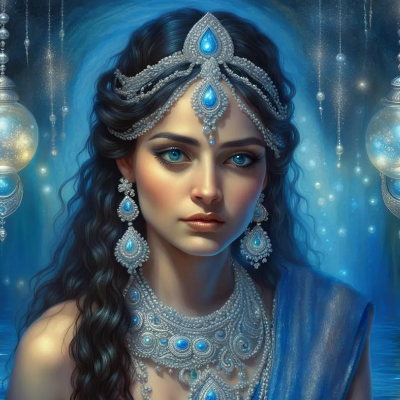
Ganga — River Goddess, Purifier of Worlds, Mother of Bhishma, Daughter of the Himalayas
Ganga · Gangā · Bhagirathi · Jahnavi · Jahnusta · Tripathaga · Mandakini · Vishnupadi · Bhagavat-padi · Surasari · Devnadi · Sursari · Gangadhara-vallabha · Himavat-putri · Shantanu-patni · Bhishma-mata
Ganga is the personification of the river Ganges — the most sacred river in the Hindu tradition — and one of the most ancient, most widely venerated, and most theologically complex goddesses in the entire Puranic and epic canon. She is worshipped as the goddess of purification, forgiveness, and liberation — the divine force that cleanses accumulated sin and grants moksha to those who bathe in her waters, die on her banks, or carry her name on their lips. She flows simultaneously in the three worlds — heaven, earth, and the netherworld — and is thus called Tripathaga: she who travels the three paths. She is the firstborn daughter of Himavat (the king of the Himalayas) and Mena in the Valmiki Ramayana tradition — and thus the elder sister of Parvati, the consort of Shiva. She originated from the toe of Vishnu in the Vishnu Purana and Bhagavata Purana traditions, flowed through the heavens, and descended to earth only after the extraordinary penance of the sage-king Bhagiratha, whose ancestors the sixty thousand sons of King Sagara — burned to ash by the sage Kapila's gaze in the netherworld — could only be liberated by her touch. Her descent from heaven was so forceful that only Shiva could absorb it, receiving her in the coils of his matted hair before releasing her as seven streams to the earth below. She married the Kuru king Shantanu in her human form and became the mother of the eight Vasus reborn as mortal children, seven of whom she released into the river at birth as they had requested, and one of whom — Devavrata, later named Bhishma — she raised in the celestial world and returned to his father at the age of ten fully trained in war, governance, and dharma. The Bhagavata Purana connects her directly to the Vamana-Mahabali episode already profiled in this series: when Vishnu as Vamana took his cosmic stride and pierced the shell of the universe with his toe, the waters of the outer ocean flowed in through that hole and became the river Ganga — making her origin inseparable from the very episode in which Mahabali was subdued.
✦ The Names
The name Ganga is of uncertain ultimate etymology — it is one of the oldest river names in the subcontinent, present in the Rigveda and likely pre-Vedic in origin. The most common Sanskrit derivation associates it with the root gam — to go, to flow — making Ganga simply the going one, the flowing one. She is called Bhagirathi in honour of King Bhagiratha, through whose penance she was brought to earth. She is called Jahnavi and Jahnusta — daughter of Jahnu — after the episode in which the sage Jahnu drank the entire river in anger when she flooded his hermitage, and then released her from his thigh or ear at Bhagiratha's entreaty, making her symbolically his daughter. She is called Tripathaga — traveller of the three worlds — because she flows in heaven as the Mandakini, on earth as the Ganga, and in the underworld as the Bhogavati or the Patala Ganga. She is called Vishnupadi and Bhagavat-padi — she who flows from the feet of Vishnu — recording her origin from the cosmic toe of Vamana. She is called Surasuri, Devnadi, and Sursari — river of the gods — for her celestial origin. Shiva in his aspect of bearing her on his head is called Gangadhara — bearer of the Ganga — and the Skanda Purana records the war-god Skanda describing Ganga as the supreme Shakti of Shiva himself, taken in the form of water.
✦ Origin — Multiple Traditions
The tradition records several distinct and partially incompatible accounts of Ganga's origin, each belonging to a different textual stratum and theological emphasis. In the Valmiki Ramayana tradition — the oldest and most geographically grounded account — Ganga is the firstborn daughter of Himavat, the personification of the Himalayan mountain range, and his wife Mena (also called Menaka or Menavati). Her younger sister in this tradition is Parvati, who later marries Shiva. When Ganga reached youth, the devas took her to Svarga — heaven — where she took the form of a river and flowed. Menaka, not finding her daughter in the house, cursed her to become water permanently. From that time Ganga lived in Brahmaloka, in Brahma's water-vessel, until Bhagiratha's penance brought her down to earth. In this tradition she is a mountain goddess, a daughter of the most ancient terrestrial feature of the subcontinent, before she becomes a river. In the Vishnu Purana and Bhagavata Purana tradition — the most theologically developed Vaishnava account — Ganga originated from the left toe of Vishnu. In the cosmic stride of the Vamana avatar, as Trivikrama measured the universe in three steps and pierced the shell of creation with his toe, the waters of the causal ocean outside the universe poured through the hole and became Ganga. She flowed first through the celestial realms, was received by the Pole Star Dhruva, flowed around the orbit of the moon, illuminating it, and then flowed to the summit of Mount Meru before branching into four streams for the purification of the four directions. In this tradition she is a cosmic emanation of Vishnu's own body — a river born from the divine foot that measured all of creation. Because she touched Vishnu's feet before descending, she is called Vishnupadi — and her waters carry the liberating quality of contact with the divine foot that rules the universe. In the Devi Bhagavata Purana tradition — the most complex and theologically nuanced account — Ganga was originally one of three wives of Vishnu, alongside Lakshmi and Saraswati. Tension arose among the three wives. Saraswati cursed Ganga to become a river on earth. Vishnu, to restore peace, declared Lakshmi his only wife and sent Saraswati to Brahma and Ganga to Shiva. In this tradition Ganga is both a consort of Vishnu and subsequently a consort of Shiva — she is the only goddess who holds intimate relationship with all three of the Trimurti. The earthstoriez.com source citing the Skanda Purana records Shiva himself being addressed as Uma-Ganga-Patisvara — lord and husband of both Uma (Parvati) and Ganga — and that in the Kashi Khanda of the Skanda Purana, the war-god Skanda describes Ganga as the supreme Shakti of Shiva taken in the form of water. In the Brahma tradition — recorded in multiple subsidiary sources — Ganga came to reside in Brahma's kamandalu (water vessel) and always travels with Brahma in this form. As Brahma's wife she is present wherever Brahma is; she is the sacred water with which Brahma washes Vishnu's feet and the water he poured from his kamandalu at the moment of creation.
✦ Lineage
- Father (Ramayana tradition): Himavat — the personification of the Himalayas; son of Brahma in the cosmic genealogy; lord of the mountain world; who also gave his daughter Parvati to Shiva and whose household was already profiled in this series
- Mother (Ramayana tradition): Mena — also called Menaka or Menavati; daughter of Meru; whose curse transformed Ganga permanently into water; who also bore Parvati and in some texts Vindhyavali (making Ganga, Parvati, and Vindhyavali — Mahabali's wife — sisters in this tradition)
- Elder sister status: Ganga is described as the firstborn of Himavat and Mena, making her older than Parvati; in the Vindhyavali profile in this series, Vindhyavali is recorded as Himavat's daughter and Parvati's sister — establishing Vindhyavali, Parvati, and Ganga as sisters in the Ramayana-Puranic tradition
- Consort relationships (across textual traditions): wife of Vishnu (Devi Bhagavata Purana); consort of Shiva and resident of his matted hair (Shaiva tradition and Skanda Purana); wife of Shantanu (Mahabharata); received by Brahma in his kamandalu (Brahma tradition)
- Foster mother: of Kartikeya (Skanda/Murugan) — the Skanda Purana records Ganga as foster mother to Kartikeya, who is Shiva and Parvati's son; when Shiva's seed fell to earth, Agni received it and passed it to Ganga, who carried it to the Shara-vana (reed-forest) where it was born as Kartikeya, nursed by the six Krittikas, and later acknowledged by both Parvati and Ganga as mother
- Husband (Mahabharata): Shantanu — king of Hastinapur; son of Pratipa; descendant of Bharata; previously the celestial king Mahabhisha who had stared at Ganga in Brahma's court and been cursed to be reborn as mortal
- Son (Mahabharata): Devavrata, later named Bhishma — the eighth Vasu reborn; pitamaha (grandsire) of both the Pandavas and the Kauravas; the most celebrated warrior and moral anchor of the Kuru dynasty; raised by Ganga in the celestial world for his first ten years; trained by Parashurama, Vasishtha, and the divine teachers; returned to Shantanu fully formed; who took the terrible vow of celibacy (Bhishma-pratigya) to secure his father's second marriage; who lived to guide the Kuru dynasty through its entire crisis; who fell on the tenth day of the Kurukshetra war; and who remained alive on a bed of arrows until the winter solstice, teaching Yudhishthira on dharma, governance, and the Vishnu Sahasranama before choosing his death
- The seven other sons drowned: the seven Vasus reborn — Dhara, Dhruva, Soma, Aha, Anila, Anala, and Pratyusha — all of whom Ganga drowned at birth as they had requested, releasing them from their curse of mortal life back to the celestial realm
✦ The Descent to Earth — The Bhagiratha Episode
The story of Ganga's descent from heaven to earth — told in the Valmiki Ramayana, the Mahabharata's Adi Parva, and across multiple Puranas — is one of the most celebrated narratives in the entire tradition. The occasion was the liberation of the sixty thousand sons of King Sagara, a ruler of the Solar Dynasty of Ayodhya. Sagara performed an Ashvamedha — a horse sacrifice that would establish him as supreme king — but Indra, fearing the ritual's success, stole the sacrificial horse and concealed it in the ashrama of the meditating sage Kapila in the underworld. Sagara's sixty thousand sons descended into the earth searching for the horse. Finding it in Kapila's presence, they mistook the sage for the thief and disturbed his meditation with abuse. Kapila opened his eyes in anger — and the concentrated power of his accumulated tapas burned the sixty thousand princes to ash in an instant. Their souls, improperly buried and unritually departed, were unable to reach the next world and remained trapped in the netherworld as uneasy shades. Sagara sent his grandson Amshuman to Kapila to ask what could be done. Kapila, pleased by Amshuman's respectful approach, granted that the sixty thousand sons could be liberated — but only by the waters of Ganga, the celestial river, which flowed only in heaven and had never touched the earth. Neither Sagara, nor Amshuman, nor Amshuman's son Dilipa, in three generations of earnest penance, could persuade Ganga to descend. Dilipa's son Bhagiratha performed tapas of extraordinary intensity — standing on one toe in the summer heat, standing in water in the cold season, surrounded by fires in the rainy season — for thousands of years. Brahma was pleased and granted the boon: Ganga would descend. But Brahma warned Bhagiratha that the force of Ganga's fall from heaven would shatter the earth — only Shiva could absorb it. Bhagiratha then performed penance to Shiva for another year. Shiva agreed to receive Ganga in his matted locks. Ganga herself — proud of her celestial power and resentful at being ordered to descend to the mortal world — rushed down with full destructive force, intending to sweep everything away. Shiva received her in his hair. She tried to escape; she tried to drown him; she could not escape the coils of the divine Gangadhara. Shiva held her in his locks for some time. When Bhagiratha's penance continued earnestly, Shiva released her as seven streams — three flowing east, three flowing west, and one following Bhagiratha southward to the sea and then to the netherworld. As Ganga followed Bhagiratha on earth, she flooded the hermitage of the sage Jahnu, who drank her in his anger. Bhagiratha pleaded; Jahnu released her from his ear or thigh; she earned the epithet Jahnavi. Eventually she reached the sea, descended to the underworld, and her touch liberated the ashes of Sagara's sixty thousand sons, releasing their souls to heaven. The act of bringing Ganga to earth — the years of penance, the intercessions with Brahma and Shiva, the guiding of the river — is called Bhagiratha Prayatna, and the name Bhagirathi, by which the Ganga is called at its source, honours that effort perpetually.
✦ Pratipa, Mahabhisha, and the Prelude to the Shantanu Marriage
The Mahabharata narrates the celestial event that set in motion Ganga's human incarnation and marriage to Shantanu. A celestial king named Mahabhisha — who had performed a thousand Ashvamedha yagnas and a hundred Rajasuya yagnas and attained Svarga — was once present in Brahma's court when all the devas were assembled in worship. A wind blew and displaced Ganga's garments. Every celestial being averted their eyes — except Mahabhisha, who stared at her. Brahma, seeing this, was displeased and cursed Mahabhisha to be reborn as a mortal king. Ganga too was cursed for not maintaining her composure — or in the alternate framing, she chose to be reborn on earth so she could join the man who had so openly admired her. Mahabhisha was reborn as Shantanu, son of Pratipa. Ganga herself visited Pratipa — Shantanu's father — while he sat in meditation on a riverbank. She took the form of a beautiful woman, approached him, and sat on his right thigh, expressing her wish to marry him. Pratipa declined — the right thigh is for daughters and daughters-in-law, not wives; she had sat on the wrong side. He proposed instead that she marry his son. She agreed and waited. When Shantanu was born and grew to kingship, the stage was set for their meeting on the riverbank.
✦ Marriage to Shantanu — The Condition and the Vasus
The eight Vasus — the elemental attendant deities of Indra — had once wandered with their wives through the forest and come upon the ashrama of the sage Vasishtha. The sage's divine wish-fulfilling cow Nandini grazed outside. The wife of the Vasu Prabhasa, desiring the cow for a mortal friend, prevailed upon her husband to take it. Prabhasa stole Nandini; the other seven Vasus supported him and helped carry it away. When Vasishtha emerged from meditation and discovered the theft, he cursed all eight Vasus to be born as mortal human beings. The Vasus pleaded for forgiveness. Vasishtha reduced the curse: seven of them — who had only supported the theft — would be released from mortal life immediately upon birth; Prabhasa, who had actually committed the theft, must live a full mortal life, but would live a life of supreme greatness and virtue. The Vasus then went to Ganga and asked her to be their mother on earth and to release them from mortal existence at birth. Ganga agreed. When Shantanu met Ganga on the banks of the river — a radiantly beautiful woman whose identity he did not know — he immediately asked her to marry him. She accepted on one condition: he must never question any of her actions, good or bad, and if he ever did, she would leave him immediately. Shantanu, in love, agreed. They lived together as husband and wife. One by one Ganga bore seven sons and drowned each in the river at birth, releasing the seven Vasus from their brief mortal existence back to the celestial realm. Shantanu, bound by his promise, watched in silent anguish. When Ganga went to drown the eighth child — the Vasu Prabhasa, who must live his full mortal life — Shantanu could no longer restrain himself and cried out in protest. The condition was broken. Ganga explained everything: who she was, who the children were, why she had drowned them, and what the eighth child's destiny was. She then left Shantanu, taking the eighth child with her to raise in the celestial world.
✦ Devavrata — Bhishma — The Return of the Eighth Son
Ganga raised the eighth son — named Devavrata — in the celestial world, providing him with the finest education and training available in any of the three worlds. The sage Vasishtha taught him the Vedas and sacred knowledge. The divine teacher Brihaspati taught him statecraft and governance. The celestial archer Parashurama — the sixth avatar of Vishnu — taught him warfare. Devavrata was trained in every art and science appropriate to a king of cosmic destiny. When he was ten years old and fully accomplished in every discipline, Ganga brought him to the banks of the Ganga and presented him to Shantanu, who had been pining for both wife and son through the intervening years. She appeared before Shantanu, showed him the young man who had stopped the river's flow with divine prowess to attract his father's attention, and declared Devavrata's identity and qualifications. Shantanu embraced his son with joy. Devavrata was named crown prince of Hastinapur. Years later, when Shantanu became enamoured of Satyavati — the fisher chief's daughter — and Satyavati's father demanded that only her children inherit the throne, Devavrata surrendered his birthright, pledged lifelong celibacy to eliminate any future contest from his own descendants, and secured his father's happiness. The gods, moved by the extremity of the vow, renamed him Bhishma — he of the terrible vow. Ganga does not appear again in the primary narrative after this — but her son's life, spanning the entire arc of the Mahabharata from its opening generation to the final battlefield, is her lasting presence in the epic.
✦ Foster Mother of Kartikeya
The Skanda Purana records Ganga as the foster mother of Kartikeya — the son of Shiva and Parvati, the war-god, the commander of the divine army. When the gods, needing a divine commander to defeat the demon Tarakasura, interrupted Shiva and Parvati's union at the precise moment of Shiva's seed emerging, the seed fell to earth. Agni — the fire god — received it in the form of a dove. The seed was so intensely powerful that even Agni found it difficult to carry. He passed it to Ganga. Ganga carried it in her waters to the Shara-vana — the forest of reeds — where it was deposited and from which Kartikeya was born, nursed by the six Krittikas, and subsequently claimed by both Parvati (as his divine mother) and Ganga (as his foster-mother). Kartikeya addresses Ganga as mother in the tradition; the Skanda Purana's sacred account places Ganga at the heart of Kartikeya's birth as the carrier of the divine seed from the fire god to the earth.
✦ Theological Significance — Purification, Liberation, and the Three Worlds
Ganga occupies a unique position in the tradition as the one goddess with no destructive or fearsome aspect in her theological character — however destructive she may be as a physical river in nature, she is described in the texts as entirely defined by her quality of forgiveness and purification. The Bhavishya Purana records the tradition that a devoted beholder of the Ganges receives the same merit as beholding the Supreme Lord himself. The Brahmanda Purana records that a single faithful bath in Ganga's waters protects the bather's descendants for hundreds of thousands of generations. The Skanda Purana records that a handful of Ganga water drunk gives the merit of performing an entire Ashvamedha sacrifice, and that those who willingly drink from the Ganges are considered liberated souls. The Srimad Bhagavatam records that the waters of the Ganga, having touched Vishnu's divine feet, purify the entire universe including Shiva himself — and that Brahma collected this water from Krishna's lotus feet to reverently offer to Shiva as a welcoming gesture. She is the only river that flows through all three worlds. She is the only goddess who holds intimate consort relationships with all three members of the Trimurti across different textual traditions. She is the mother of the most celebrated celibate in the tradition — Bhishma — whose very celibacy was made possible only because his mother was a river goddess who could never be his permanent wife. And she is the water through which sixty thousand souls, burned to ash in the netherworld, were ultimately liberated — the supreme act of purification that required three generations of extraordinary penance to accomplish, and that her own arrogance initially resisted. Her story is the tradition's most complete statement about the nature of divine grace: it is immensely powerful, inherently purifying, and can be brought to earth — but only through extraordinary human effort, divine cooperation, and the willingness of the cosmic force herself to be humbled.
✦ Iconography, Worship, and Sacred Sites
Ganga is depicted as a fair, beautiful woman riding a makara — a divine crocodile-like aquatic creature — or sometimes standing within flowing water. She carries a water pot (kumbha) in one hand and a lotus in another; her other hands may hold a rosary and a fly-whisk. She is depicted alongside Yamuna, Saraswati, and Lakshmi in many temple gateway carvings across India. The river itself — flowing 2,525 kilometres from its glacial source at Gaumukh in the Gangotri glacier in the Uttarkashi district of Uttarakhand to the Bay of Bengal through northern India and Bangladesh — is the most sacred river in the Hindu tradition. Its principal pilgrimage sites include Gaumukh and Gangotri at its source; Uttarkashi, Rishikesh, and Haridwar in the upper plains; Prayagraj (the Triveni Sangam — confluence of Ganga, Yamuna, and the underground Saraswati) — site of the Kumbh Mela; Varanasi (Kashi) — the most sacred city in the tradition, where dying on Ganga's banks is believed to grant moksha regardless of past deeds; Patna; and the Ganga Sagar island at the mouth of the river in West Bengal where Kapila's ashrama is believed to have stood. Ganga Jayanti falls on the seventh day of the bright fortnight of Vaishakha (April-May) — celebrated as the day the Ganga descended to earth. Ganga Dussehra falls on the tenth of the bright fortnight of Jyeshtha. The Ganga Aarti performed each evening at the ghats of Haridwar and Varanasi — where dozens of priests simultaneously raise fire-lamps before the river in a choreographed ceremony — is the most visually celebrated ritual of her ongoing worship.
✦ Connection to This Genealogical Series
Multiple threads in this genealogical series converge in Ganga's profile. As a daughter of Himavat and sister of Parvati and Vindhyavali (Mahabali's wife), she is a sister-in-law of both Shiva and Mahabali — simultaneously connected to the Shaiva tradition and to the Daitya-devotional lineage of Prahlada. As the wife of Shantanu and mother of Bhishma — the pitamaha of the Pandavas — she is the divine great-grandmother of Arjuna himself, who received the Bhagavad Gita, and thus a figure in the human genealogy of the Mahabharata's principal heroes. As the river through which Vishnu's Vamana step pierced the universe and through whom the Sagara cycle connects the Solar Dynasty to the Lunar Dynasty via the liberation of Sagara's sons and the penance of Bhagiratha — she is the cosmic crossroads at which the Solar Dynasty, the Lunar Dynasty, the Shaiva tradition, the Vaishnava tradition, and the Daitya lineage all meet.
✦ References
- Rigveda (Mandala 10, Hymn 75 — the Nadi Stuti hymn) — the earliest mention of Ganga as the holiest of rivers, listed first among the rivers of the subcontinent
- Valmiki Ramayana (Bala Kanda, Chapters 37–44) — the fullest canonical account of Ganga's origin as daughter of Himavat and Mena; the Sagara episode; the penance of Bhagiratha; the descent from heaven; Shiva receiving Ganga in his matted locks; the Jahnu episode; the liberation of the sixty thousand sons of Sagara; the epithet Bhagirathi; the first canonical account of Tripathaga
- Mahabharata (Adi Parva, Chapters 91–100) — the Mahabhisha curse and the prelude to the Shantanu marriage; Ganga visiting Pratipa; the Vasus cursed by Vasishtha requesting Ganga as their mother; Ganga's condition for marriage to Shantanu; the seven sons drowned; the confrontation over the eighth son; Ganga's explanation of the Vasu curse; Devavrata raised in heaven; his return to Shantanu as Bhishma; the Bhagiratha episode retold in summary
- Vishnu Purana (Book 2, Chapter 2) — Ganga originating from Vishnu's left toe; received by Dhruva (Pole Star); flowing around the moon's orbit; descending to Mount Meru; branching to the four directions
- Bhagavata Purana (Canto 5, Chapter 17; Canto 8, Chapter 21) — Ganga as Vishnupadi; origin from Vamana's cosmic stride piercing the universe; descent through Brahmaloka to earth; the Bhagiratha episode; Ganga's sacred glories
- Devi Bhagavata Purana — Ganga as originally one of three wives of Vishnu alongside Lakshmi and Saraswati; the conflict among the three wives; Ganga sent to Shiva; the theological framework of Ganga as consort of all three Trimurti members across traditions
- Skanda Purana (Kashi Khanda and other sections) — Ganga as Supreme Shakti of Shiva in water form; as foster mother of Kartikeya carrying Shiva's seed in her waters; the Gangadhara tradition; the Jahnu episode; the seven streams of the Ganga named
- Shiva Purana — the Kartikeya birth episode involving Agni carrying Shiva's seed to Ganga; the Gangadhara manifestation; Ganga in Shiva's hair as perpetual divine consort
- Brahmanda Purana, Bhavishya Purana, Matsya Purana, Kurma Purana — individual references to Ganga's glories, her purificatory powers, and her place in the Puranic genealogical tradition
- Kritibassi Ramayana — the Bengali tradition that devas took Ganga to Shiva to marry him; Menaka's curse transforming her into water
- Wikipedia — Ganga (goddess); Wikipedia — Shantanu; Wikipedia — Bhishma; Hindu American Foundation — Ganga River Goddess; Dolls of India — Ganga River and Goddess; Lotus Sculpture Blog — Hindu Goddess Ganga Birth and Descent; Gaudiya Treasures of Bengal — Mother Ganga; Earthstoriez — Mythology of Mother Ganga; Exotic India Art — Goddess Ganga Waters of Devotion; Bhakti Marg — Origin of Goddess Ganga from Mahadev's Head; Sriram Raghavan Mahabharata Chapter 3 — Story of Shantanu and Ganga; Goddess Gift — Ganga; Glorious Hinduism — Ultimate Mahabharata Family Tree: modern summaries drawing from the above primary sources