
About
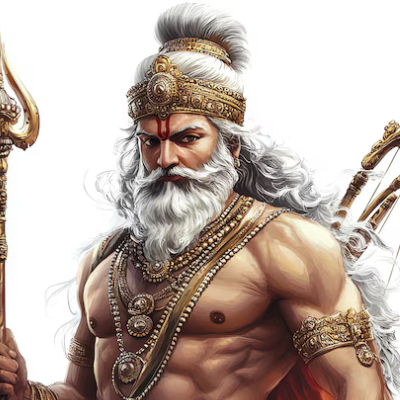
Bhishma — Son of Shantanu and Ganga, Guardian of the Kuru Throne, and the Grandsire of the Mahabharata
Bhishma · Devavrata · Gangaputra · Shantanava · Pitamaha · Gangadatta · Kurukulabhushana · Dyau · Icchhamrityu · Sharadwatajit · Talbhrita
Bhishma — born Devavrata — is the son of Shantanu, king of Hastinapura and a descendant of the Paurava-Kuru branch of the Lunar dynasty, and of Ganga, the goddess of the sacred river who took human form as Shantanu's first wife. He is the eighth and only surviving child of that union, the previous seven having been drowned by Ganga at birth in fulfilment of a prior cosmic obligation to release the seven Vasus from their earthly incarnation. Bhishma is one of the most dominant, complex, and morally significant figures in the entire Mahabharata — a warrior of supreme skill, a man of uncompromising personal honour, a keeper of terrible vows, and a figure whose very greatness became the instrument of the Kuru dynasty's eventual catastrophe. He renounced his claim to the throne of Hastinapura and took an irrevocable vow of lifelong celibacy to enable his father Shantanu's marriage to Satyavati, and from that vow — which earned him the name Bhishma, the one of terrible vow — the entire tragic genealogical structure of the Mahabharata flowed. He served as regent, guardian, and protector of the Kuru throne through four successive generations, participated as the supreme commander of the Kaurava forces in the first ten days of the Kurukshetra war, was brought down by Arjuna's arrows acting through Shikhandi, and spent the final months of his life lying on a bed of arrows until the sun's northward turning allowed him to choose his moment of death. He is a recipient of the boon of iccha mrityu — death only at his own chosen moment — and his final discourse to Yudhishthira from the bed of arrows, encompassing the Shanti Parva and Anushasana Parva of the Mahabharata, constitutes the most comprehensive single statement of dharmic philosophy and royal governance in the entire epic. Bhishma appears across virtually every book of the Mahabharata, in the Harivamsa, and in the Vishnu Purana, Bhagavata Purana, and numerous other texts.
✦ The Names
The birth name Devavrata is a compound of deva — divine being, god — and vrata — vow, observance, sacred practice — meaning "he whose vow is divine" or "he who is devoted to the divine through his vow." This name was given to reflect his extraordinary qualities from birth and his divine maternal lineage through Ganga. The name Bhishma — by which he is universally known in the tradition — derives from bhishma, meaning terrible, dreadful, or awe-inspiring, and was conferred upon him when the gods themselves rained flowers from the sky and declared his celibacy vow a bhishma pratidnya — a terrible and awe-inspiring pledge — of unprecedented severity. The name Gangaputra means "son of Ganga." Shantanava identifies him as the son of Shantanu. Pitamaha means "grandfather" or more loosely "the grand old one" — the name by which the Pandavas and Kauravas addressed and revered him, connoting his position as the patriarch of the Kuru household across multiple generations. Gangadatta means "given by Ganga." The name Dyau — meaning the sky or the heavenly realm — refers to his identity as the partial incarnation of the Vasu Dyau, the sky deity, one of the eight Vasus who were cursed by Vasistha to be born as mortals. Icchhamrityu means "one who has the power of chosen death." Talbhrita means "the palm-tree holder" — a martial epithet referring to his banner.
✦ Lineage
- Father: Shantanu — the king of Hastinapura, a descendant of the Paurava-Kuru branch of the Chandravamsha through many generations from Puru, Yayati, Nahusha, Ayu, Pururavas, Budha, and Chandra. Shantanu is described in the Mahabharata as a righteous and powerful king whose healing touch was legendary, and whose two marriages — to Ganga and to Satyavati — shaped the entire genealogical structure of the Mahabharata's world.
- Mother: Ganga — the goddess of the sacred river Ganga, revered as one of the most holy rivers of the subcontinent and as a divine being of cosmic purifying power, daughter of Himavat the mountain king in the Puranic tradition. Ganga took human form at Brahma's direction following the episode of her mutual transgression with Mahabhisha — the previous birth of Shantanu — in Brahma's assembly. She agreed before descending to human birth to serve as the mother of the seven Vasus cursed by Vasistha, releasing them from mortal existence by drowning them at birth. The eighth Vasu — whose transgression was the greatest of the group — was required to live a full mortal life of great suffering and eventual liberation: this was the being who became Devavrata-Bhishma.
- Divine identity — Vasu Dyau: The Mahabharata's Adi Parva narrates the story of the Vasus' curse in detail. The eight Vasus — a class of luminous divine beings — were visiting the hermitage of the sage Vasistha when one of them, Dyau, at the instigation of his wife, stole Vasistha's divine cow Nandini — the daughter of the wish-fulfilling cow Surabhi. Vasistha, discovering the theft, cursed all eight Vasus to be born as mortals. The seven Vasus who had merely assisted or consented without themselves initiating the theft pleaded for mitigation; Vasistha reduced their sentence to a single year of mortal life. Dyau — who had directly perpetrated the theft — was sentenced to a full mortal life, though Vasistha added that he would be a man of extraordinary virtue and power. It is Dyau who was born as Devavrata. This divine identity as the Vasu Dyau is the explanation for Bhishma's superhuman qualities — his invincibility in battle, his incomparable learning, and his cosmic stature among mortals — and for the extraordinary suffering of his final existence.
- Half-brothers: Chitrangada and Vichitravirya — the sons of Shantanu by his second wife Satyavati. Bhishma served as their guardian, regent, and protector throughout their reigns. He won the princesses of Kashi — Amba, Ambika, and Ambalika — for Vichitravirya's marriage by his celebrated feat at their svayamvara.
- Half-brother: Vyasa — born Krishna Dvaipayana, the son of Satyavati and the sage Parashara, and thus Bhishma's half-brother through their shared mother Satyavati. Vyasa composed the Mahabharata and was the biological father of Dhritarashtra, Pandu, and Vidura through the levirate arrangement that Satyavati authorised and to which Bhishma consented after his refusal to break his own vow.
- Teacher: Parashurama — the sixth avatar of Vishnu, the brahmin-warrior of unparalleled martial skill who wielded the axe and who taught Bhishma the entire science of arms. Bhishma's education under Parashurama made him the foremost warrior of his age, a student whose skills grew to match and in some respects surpass those of his teacher — a fact made apparent in their later conflict over Amba, described below.
✦ Birth, Education, and Return to Shantanu
The Mahabharata's Adi Parva narrates that when Shantanu prevented Ganga from drowning their eighth child, Ganga revealed her true identity, explained the entire story of the Vasus' curse and her agreement to release them, and told Shantanu that the surviving child — Devavrata — was the Vasu Dyau condemned to live a full mortal life. She then took the infant to the celestial realm to be educated. Devavrata was educated by Brihaspati in the sacred sciences, by Indra in the use of divine weapons, by Vasistha in the Vedic learning, and most significantly by Parashurama in the complete science of arms and warfare. He was trained also in statecraft, jurisprudence, and the full range of knowledge appropriate to a crown prince and future king of the highest calibre. He was returned to Shantanu as a young man of such extraordinary accomplishment that his father, on first seeing him again after the long separation, was struck dumb by his son's magnificence.
Shantanu acknowledged Devavrata publicly as his heir and invested him with all the honours due to the crown prince of Hastinapura. For some years the two lived together in great happiness and mutual admiration. The citizens of Hastinapura and the court regarded Devavrata as already a figure of exceptional promise — a prince who combined unrivalled martial skill with deep knowledge of the sacred texts, whose personal conduct was irreproachable, and whose devotion to his father was absolute.
✦ The Terrible Vow and the Acquisition of the Name Bhishma
The central defining event of Bhishma's biography — the event from which everything that follows flows — is his renunciation of the throne of Hastinapura and his vow of lifelong celibacy. The Mahabharata's Adi Parva narrates the episode in full. Shantanu, having encountered the beautiful Satyavati on the banks of the Yamuna and having fallen deeply in love with her, went to her adoptive father Dasharaja to ask for her hand in marriage. Dasharaja agreed in principle but set the condition that any son born of Satyavati would inherit the throne — meaning that Devavrata, Shantanu's existing heir, would be displaced. Shantanu could not make this promise while Devavrata lived, and returned home in grief.
Devavrata, observing his father's decline and learning its cause from Shantanu's charioteer, went directly to Dasharaja without Shantanu's knowledge. He formally renounced his claim to the throne of Hastinapura in front of Dasharaja and the assembled members of Dasharaja's household. Dasharaja, while gratified, was not yet fully satisfied: he pointed out that Devavrata might in future father sons of his own who would dispute the succession on their father's behalf, making the renunciation hollow in practical terms. Devavrata then pronounced the vow that would define the remainder of his existence: that he would never marry, never seek a wife, never approach a woman for sensual purposes, and would live and die in absolute celibacy. He stated this vow in a voice that rang through the three worlds. The Mahabharata narrates that the assembled gods rained down flowers from the sky, celestial voices declared the act extraordinary, and the gods and sages who heard the vow cried out that this man should be called Bhishma — for his vow was bhishma, terrible beyond precedent.
Shantanu, informed of his son's sacrifice, went to Devavrata with tears and granted him the boon of iccha mrityu — the power to choose the moment of his own death, so that death could come to him only when he himself willed it. This boon, combined with his invincibility in battle, made Bhishma effectively immortal until he chose to die, and it is the boon whose fulfilment is the climactic act of the Mahabharata's final phase when Bhishma lies on the bed of arrows and waits for the sun to turn north before departing.
✦ The Abduction of the Kashi Princesses
After Shantanu's death, Bhishma became the regent and guardian of the young Chitrangada and subsequently of Vichitravirya. When Vichitravirya came of marriageable age, Bhishma learned that the king of Kashi was holding a svayamvara at which his three daughters — Amba, Ambika, and Ambalika — would choose their husbands from the assembled kings and princes. Bhishma, deciding that these princesses were suitable wives for Vichitravirya, went to the svayamvara uninvited and announced that he was taking all three women for his brother. He challenged the assembled kings to stop him if they could, stated his name so that they would know the nature of the opposition they faced, and drove away with all three in his chariot.
The assembled kings pursued him. Bhishma defeated them all in a prolonged battle, fighting against a coalition of the most powerful rulers of the age single-handedly and routing every force that came against him. On the road back to Hastinapura, the king Shalva — to whom Amba had privately given her heart before the svayamvara — also challenged Bhishma. Bhishma defeated him as well. He brought all three women to Hastinapura. When Amba told him that she had already chosen Shalva in her heart, Bhishma released her and sent her to seek Shalva, keeping only Ambika and Ambalika for Vichitravirya. Amba's subsequent rejection by Shalva and her long campaign of vengeance against Bhishma form one of the Mahabharata's most important sub-narratives, as described below.
✦ The Episode of Amba and the Conflict with Parashurama
Amba, released by Bhishma to seek Shalva, was refused by Shalva on the grounds that she had been taken by force by another man and was therefore no longer his. Rejected by Shalva and unable to return to her father's house in honour, she came back to Bhishma and demanded that he marry her, since he had been the cause of her ruined prospects. Bhishma refused absolutely, citing his vow of celibacy, which he had made irrevocably and from which he could not deviate. He offered to arrange her marriage to someone else, or to return her to her father, but would not marry her himself.
Amba, consumed by anger and injustice at a situation for which she held Bhishma entirely responsible — since his abduction had caused her ruin without his being willing to repair it — undertook severe austerities to obtain the power to destroy Bhishma. She eventually obtained the favour of the god Kartikeya, who gave her a garland of undying lotuses and told her that whoever wore it would become Bhishma's destroyer. She went to Parashurama — Bhishma's own teacher — and implored him to compel Bhishma to either marry her or be killed. Parashurama, sympathetic to Amba's case and regarding Bhishma's abduction as the root cause of her suffering, summoned Bhishma and ordered him to marry Amba.
Bhishma refused even the command of his own teacher, on the grounds that his vow was absolute and irrevocable — it had been made publicly, before the gods, and its integrity could not be compromised under any pressure, even the pressure of his revered preceptor's direct command. Parashurama, furious, challenged Bhishma to combat. The battle that followed between teacher and student lasted many days — described in the Mahabharata as one of the most extraordinary combats in the tradition, in which two warriors of effectively equal cosmic stature fought to a standstill. Neither could defeat the other. Eventually the ancestral spirits — the Pitrs — and other divine beings intervened and persuaded Parashurama to desist, acknowledging that Bhishma could not be forced to break a righteous vow even by his guru. Parashurama told Amba honestly that he could not defeat Bhishma and that she must seek her revenge by other means. Amba continued her austerities and eventually obtained the boon from Shiva that she would be reborn as the cause of Bhishma's death. She took her own life and was reborn as Shikhandi — the son of King Drupada of Panchala — who would stand before Arjuna's chariot on the tenth day of the Kurukshetra war so that Bhishma, unwilling to fight one he perceived as a woman in a previous birth, would lower his bow and allow Arjuna's arrows to strike him.
✦ Bhishma as Regent and Guardian of the Kuru Throne
Following the deaths of Chitrangada and Vichitravirya without heirs, Bhishma remained the effective authority of the Kuru household. He consented to — and supported — Satyavati's proposal of the niyoga arrangement through Vyasa, which produced Dhritarashtra, Pandu, and Vidura. He subsequently watched over these three as they grew to adulthood and took their places in the Kuru political order. Through the entire childhood and education of Dhritarashtra's hundred sons — the Kauravas — and Pandu's five sons — the Pandavas — Bhishma was the presiding senior figure of the household, revered by all as Pitamaha, the grandfather. His authority was moral and personal rather than political — he held no throne and exercised no formal power — but his standing was such that no decision of the Kuru household could be made without reference to his judgment.
The Mahabharata records numerous occasions on which Bhishma attempted to prevent the conflict between the Pandavas and Kauravas from escalating to war — at the dice game, at the assembly, and in the diplomatic missions that preceded the Kurukshetra war. He consistently advised Duryodhana against the course of injustice and repeatedly stated his view that the Pandavas' cause was just and that war would result in the Kauravas' destruction. Duryodhana consistently ignored this counsel. Bhishma's position — bound by his vow to serve the Kuru throne and thus unable to take the Pandavas' side even when he believed them right, while also unable to prevent the injustices that precipitated the war — is one of the Mahabharata's most searching explorations of the conflict between personal virtue and institutional loyalty.
✦ Bhishma's Vow to Fight for the Kauravas
When the Kurukshetra war became inevitable and the armies assembled, Bhishma took the field on the Kaurava side — not because he supported Duryodhana's cause, which he explicitly stated he regarded as unjust, but because his vow bound him to the service of the Kuru throne and Duryodhana was the occupant of that throne. Before the battle began, Bhishma stated clearly to Duryodhana that he would fight the Pandavas' forces but would not kill any of the five Pandavas themselves — they were his grandsons and men of righteousness whom he could not bring himself to slay. He further stated that he regarded Arjuna as the greatest archer in the world and that the Pandavas could not be defeated. He was appointed supreme commander of the Kaurava forces for the war's first phase.
Bhishma also informed Duryodhana at this stage that Shikhandi — the son of Drupada who had been born female in a previous life as Amba — would be on the Pandava side, and that he would not raise his bow against Shikhandi, whom he perceived as a woman despite the male birth. Duryodhana pressed Bhishma repeatedly during the ten days of battle to kill the Pandavas, and each time Bhishma refused to slay them while fighting with devastating effect against their armies.
✦ The Ten Days of Battle and the Fall on the Bed of Arrows
The Bhishma Parva of the Mahabharata is devoted to the ten days of Bhishma's command of the Kaurava forces and to his eventual fall. Bhishma fought with terrible effectiveness — day after day he slaughtered vast numbers of the Pandava forces, creating havoc with his bow from his chariot. The Pandavas and their allies found it almost impossible to make any decisive impression on him. The Bhishma Parva also contains the Bhagavad Gita — the dialogue between Krishna and Arjuna that takes place before the battle's first day — which is embedded within the larger narrative of Bhishma's command.
As the days of battle continued and the Kaurava cause advanced under Bhishma's command, the Pandavas became increasingly desperate. Krishna — who had vowed not to take up arms in the battle — on two occasions came close to breaking his own vow out of fury at Bhishma's destruction, charging toward Bhishma with his Sudarshana disc and his chariot wheel. Bhishma, on both occasions, welcomed Krishna's approach and declared that death at Krishna's hands would be the most blessed end he could imagine — a declaration that stopped Krishna both times, since killing a man who welcomes death with such devotion would have served no strategic purpose.
The Pandavas, unable to defeat Bhishma in direct combat, went to him at night — a gesture that the Mahabharata presents as remarkable in itself, demonstrating both their respect for Bhishma and the depth of their desperation — and asked him directly how he could be killed. Bhishma told them: he would not fight Shikhandi. If Shikhandi stood before him on the field of battle, he would lower his bow, and in that moment Arjuna could shoot him with arrows he could not defend against. This intelligence — volunteered by Bhishma himself — was the key to his fall.
On the tenth day, Shikhandi was placed in Arjuna's chariot before Bhishma's position. Bhishma, seeing Shikhandi, lowered his bow as he had said he would. Arjuna, firing from behind Shikhandi, pierced Bhishma with arrows in such number and from such precision that Bhishma's body was entirely covered. He fell from his chariot — but did not touch the ground. His body, held up by the density of arrows transfixing it, rested on a bed of arrows that formed a cradle for him above the earth. He lay there, suspended, choosing not to exercise his boon of chosen death — for the sun was in its southern phase, and he had determined that he would not die until the sun turned north, the auspicious period of Uttarayana.
✦ The Bed of Arrows and the Discourses of the Shanti and Anushasana Parvas
Bhishma lay on the bed of arrows for fifty-eight nights — the period from the tenth day of the battle through the conclusion of the war, the coronation of Yudhishthira, and the months that followed until the sun's turning north. Kings, sages, and divine beings came to pay their respects to the fallen grandsire. Krishna came and addressed him with reverence. The Pandavas came, their war won but their grief immense.
The Shanti Parva and Anushasana Parva of the Mahabharata record Bhishma's discourses to Yudhishthira from the bed of arrows — the most comprehensive statement of dharmic philosophy, political theory, ethics, cosmology, and religious teaching in the entire epic. Yudhishthira, tormented by grief and guilt at the destruction the war had caused, came to Bhishma at Krishna's urging. Bhishma spoke to him for days, addressing the nature of royal dharma, the proper conduct of a king in every circumstance, the nature of truth and the obligations of caste and station, the paths to liberation, the qualities of virtue and vice, the nature of time and cosmic order, and the devotional paths available to the human soul. The Vishnu Sahasranama — the thousand names of Vishnu, one of the most celebrated devotional texts in the Hindu tradition — is embedded in the Anushasana Parva as Bhishma's answer to Yudhishthira's question about the highest object of devotion.
When the sun finally turned north, signalling the auspicious period of Uttarayana, Bhishma chose his moment. He dismissed the body — withdrawing his life-breath through his yoga and releasing his consciousness — and departed from the world. His departure is described in the Mahabharata as attended by cosmic signs of mourning and celebration simultaneously: grief for the loss of the greatest man of his age and joy for the liberation of the divine being who had lived that life.
✦ Bhishma and Krishna
The relationship between Bhishma and Krishna is one of the most theologically rich in the Mahabharata. Bhishma recognised Krishna as the supreme deity — as Vishnu in his mortal form — from early in their acquaintance and revered him with absolute devotion even while fighting on the opposite side of the war in which Krishna served as Arjuna's charioteer. At the Rajasuya sacrifice of Yudhishthira, it was Bhishma who proposed that Krishna receive the arghya — the first and most honoured offering — over all the assembled kings and sages. Shishupala's furious objection to this honour — and his subsequent killing by Krishna's Sudarshana disc — was the occasion of Bhishma's most extended statement of Krishna's divine nature in the Mahabharata. Bhishma's recognition of Krishna as the supreme deity while fighting in the army arrayed against Krishna's chosen side captures the Mahabharata's central theological tension with extraordinary precision: the greatest human warrior of the age, whose dharmic judgment was impeccable in all things, was on the opposing side not because he disbelieved in Krishna's divinity or the justice of the Pandavas' cause, but because the structure of his own irrevocable commitment to the Kuru throne left him no other choice.
✦ Bhishma's Views on Women and the Episode of Amba
The Mahabharata does not present Bhishma as a figure of simple unambiguous virtue. The episode of Amba — the princess of Kashi who was ruined by his abduction, refused his offer of redress, and spent her subsequent existence in pursuit of his destruction — is one of the tradition's most searching critiques of the limits of dharmic reasoning when applied without sufficient attention to its consequences for individuals. Bhishma's position — that he could not marry Amba because his vow was absolute, and that therefore he bore no further responsibility for her situation — is presented in the Mahabharata with full acknowledgement that it left an innocent woman in an impossible condition. The tradition does not resolve this tension cleanly: it presents Bhishma's vow as genuinely inviolable and his personal conduct as genuinely honourable, while simultaneously allowing the full force of Amba's grievance to be felt. The Amba narrative is precisely the kind of moral complexity that the Mahabharata generates from the collision of multiple righteous positions, and Bhishma stands at its centre.
✦ Textual Variants and Inconsistencies
The identity of the eighth Vasu: The Mahabharata identifies the eighth Vasu — the one condemned to a full mortal life — as Dyau in most passages of the Adi Parva's Vasus episode. Some passages and some recensions of the text identify him differently, using the name Prabhasa for the transgressing Vasu rather than Dyau. The majority of the Mahabharata's textual tradition supports the Dyau identification and it is treated as the principal account here.
The Amba-Shikhandi connection: The Mahabharata's Udyoga Parva contains the full account of Amba's austerities, her boon from Shiva, her death, and her rebirth as Shikhandi. Some regional and devotional traditions present this rebirth differently — in some accounts Shikhandi is presented as born female and later transformed to male through the exchange of gender with a Yaksha, in addition to being Amba's rebirth. These variant accounts are not irreconcilable: the Mahabharata's own narrative of Shikhandi's gender complexity is layered and involves multiple dimensions of identity that different parts of the tradition emphasise differently.
The duration of Bhishma's sojourn on the bed of arrows: Different recensions and calculations within the Mahabharata give slightly different numbers for the days Bhishma lay on the bed of arrows before the sun's northward turning. The figure of fifty-eight nights is widely accepted but not universal across all manuscript traditions. The theological significance of waiting for Uttarayana is consistent across all versions.
The Vishnu Sahasranama's provenance: The Vishnu Sahasranama as embedded in the Anushasana Parva is treated in the tradition as Bhishma's direct utterance — his answer to Yudhishthira's question about the highest devotional practice. The authenticity and original extent of the passage within the critical edition of the Mahabharata has been a subject of scholarly discussion, though its attribution to Bhishma and its placement in the Anushasana Parva is consistent across the major manuscript traditions.
✦ Iconography and Worship
Bhishma is not a deity in the strict sense and does not have a widespread independent cult of worship in the mainstream tradition. He is, however, revered with great respect as a figure of supreme dharmic virtue and is the subject of devotion in certain Vaishnava and Shaiva contexts where the Mahabharata's heroes are venerated. The day of Bhishma Ashtami — the eighth day of the bright fortnight of the month of Magha, traditionally identified as the day of Bhishma's death — is observed in the tradition as a day of ancestral offerings and reverence for the departed, with Bhishma's own death used as the occasion for reflecting on the duty of offering to the ancestors. The Bhishma Panchaka — the last five days of the Kartika month — is a period of fasting and Vishnu-devotion associated with Bhishma in certain regional traditions. Bhishma is depicted in artistic representations lying on his bed of arrows with serene composure, surrounded by the assembled kings and sages, a bow sometimes placed in his hand and his body transfixed by arrows whose tips rest on the earth.
✦ Theological and Philosophical Significance
Bhishma's theological significance in the tradition is of the very highest order and operates at multiple levels simultaneously. As the repository of the Mahabharata's most extended and authoritative dharmic teaching — the Shanti and Anushasana Parvas — he is the tradition's foremost teacher of royal ethics, statecraft, cosmology, and devotional practice. The Vishnu Sahasranama, the Bhishma Stuti, and the extended discourses of the Shanti Parva are among the most cited and revered passages in the entire Hindu canon, and all of them flow from Bhishma's lying on the bed of arrows as their occasion and speaker.
At the philosophical level, Bhishma embodies one of the Mahabharata's central and most anguishing moral questions: the conflict between institutional loyalty and personal moral judgment. He knew the Pandavas were right. He knew the war was unjust. He fought on the other side anyway. The tradition does not resolve this tension by condemning Bhishma — it presents his conduct as a consequence of a vow that was itself an act of supreme sacrifice — but it does not shield him from its consequences either. He dies on the winning side's arrows. The greatest warrior and wisest counsellor of the age ends his life having served the cause he knew to be wrong — and the tradition's meditation on why this happened, and what it means, is one of the richest and most unresolved ethical explorations in the Sanskrit canon.
In the Vaishnava theological tradition, Bhishma's devotion to Krishna — expressed most fully in the Bhishma Stuti, his final hymn of praise to Krishna from the bed of arrows — is celebrated as a model of the devotion that transcends circumstance. Bhishma praises Krishna while lying wounded by arrows that Krishna's chosen devotee Arjuna fired, fighting in the army that opposed Krishna's cause, and the purity of his devotion in those circumstances is regarded in the bhakti tradition as extraordinary. His last breath as an utterance of Krishna's name is one of the Mahabharata's most celebrated deaths.
✦ Connection to the Wider Genealogy
Through his father Shantanu and the Paurava-Kuru line, Bhishma descends from the Chandravamsha through Kuru, Puru, Yayati, Nahusha, Ayu, Pururavas, Budha, Chandra, and Atri to Brahma. Through his mother Ganga, the cosmic river goddess, he connects to the divine natural order that the tradition associates with Himalaya, Brahma, and the cosmic waters. Through his divine identity as the Vasu Dyau, he is a member of the class of eight luminous divine beings whose cosmic functions span from Agni to the sky. He himself fathers no children — his vow of celibacy was kept absolutely — and therefore generates no line of descent. His genealogical significance is entirely that of a transmitter and guardian of the Kuru line rather than a progenitor. The entire subsequent generation of Dhritarashtra, Pandu, Vidura, the Kauravas, and the Pandavas existed within a household that Bhishma protected, sustained, and presided over without being able to prevent its catastrophe — a genealogical situation whose pathos is one of the Mahabharata's deepest sources of moral weight.
✦ References
Primary Sources
- Mahabharata, Adi Parva, sections 91–100: The foundational account of Bhishma's birth as Devavrata, his education, return to Shantanu, Satyavati episode, the terrible vow, the naming as Bhishma, and the grant of iccha mrityu. The primary biographical source for his early life.
- Mahabharata, Adi Parva, sections 101–102: The abduction of the Kashi princesses — Amba, Ambika, and Ambalika — for Vichitravirya's marriage; the battle against the assembled kings; and Amba's release.
- Mahabharata, Udyoga Parva, sections 170–197 (the Amba sub-narrative): The complete account of Amba's rejection by Shalva, her return to Bhishma, his refusal, her appeal to Parashurama, the battle between Bhishma and Parashurama, and Amba's eventual boon from Shiva and her vow to be reborn as Bhishma's destroyer. One of the most extended and dramatically rich sub-narratives in the Mahabharata.
- Mahabharata, Udyoga Parva, sections 12–40 (Bhishma's counsel against war): Bhishma's diplomatic role in the prewar period; his advice to Duryodhana that the Pandavas' cause is just and that war will bring destruction; the failure of his counsel.
- Mahabharata, Bhishma Parva (Book 6) in its entirety: The ten days of Bhishma's command of the Kaurava forces; the Bhagavad Gita embedded within this book as Krishna's discourse to Arjuna before battle; Bhishma's prowess on the battlefield; his fall on the tenth day pierced by Arjuna's arrows through Shikhandi; the description of his bed of arrows.
- Mahabharata, Shanti Parva (Book 12) in its entirety: Bhishma's discourses to Yudhishthira from the bed of arrows on the nature of royal dharma, statecraft, ethics, liberation, and cosmology. The most comprehensive single statement of dharmic philosophy in the Mahabharata and one of the longest books of the epic.
- Mahabharata, Anushasana Parva (Book 13) in its entirety: Continuation of Bhishma's discourses on ethics, dharma, gift-giving, and devotional practice; contains the Vishnu Sahasranama — the thousand names of Vishnu — as Bhishma's answer to Yudhishthira's question about the supreme object of devotion.
- Mahabharata, Anushasana Parva, final sections — Bhishma's death: The account of Bhishma's departure from the world on the occasion of the sun's northward turning; his final hymn to Krishna — the Bhishma Stuti; his yogic withdrawal of the life-breath; and the cosmic signs accompanying his death.
- Mahabharata, Sabha Parva, sections 37–38: Bhishma's proposal that Krishna receive the arghya — the first honour — at the Rajasuya sacrifice; his extended statement of Krishna's divine nature; Shishupala's challenge and killing.
- Vishnu Purana, Book 4, chapters 20–21: The Kuru genealogy confirming Bhishma's position as the son of Shantanu and Ganga and his role as guardian of the Kuru household.
- Bhagavata Purana, Book 1, chapters 9–10: The account of Bhishma's death from the Bhagavata Purana's perspective, with emphasis on his Vishnu-devotion and his final utterances as a model of dying in consciousness of the supreme deity. One of the most devotionally significant passages in the entire Bhagavata Purana.
- Harivamsa, chapters 30–35: Genealogical and narrative material on Bhishma within the broader Kuru royal line.
Modern Reference Works
- Vettam Mani, Puranic Encyclopaedia (1975): Entry on Bhishma; the most comprehensive single-volume collation of primary references to Bhishma across the Mahabharata, Puranas, and Harivamsa; essential reference for cross-checking variant accounts.
- J. A. B. van Buitenen (translator), The Mahabharata, Volumes 1–3 (1973–1978): Critical translations of the Adi, Sabha, and Vana Parvas with scholarly notes; the most authoritative English-language translation of the primary source material for Bhishma's early biography and his role in the Sabha and Vana Parvas.
- Bimal Krishna Matilal (editor), Moral Dilemmas in the Mahabharata (1989): Contains essays by multiple scholars on the ethical dimensions of Bhishma's situation — his vow, his service to an unjust cause, the Amba episode — from the perspectives of both classical Indian moral philosophy and comparative ethics. Essential for the philosophical dimension of Bhishma's significance.
- Alf Hiltebeitel, The Ritual of Battle: Krishna in the Mahabharata (1990): Contains extensive analysis of Bhishma's role in the cosmic structure of the Kurukshetra war, his relationship with Krishna, and the theological dimensions of his fall and lying on the bed of arrows.
- Irawati Karve, Yuganta: The End of an Epoch (1969): Contains a celebrated humanistic analysis of Bhishma's character and the consequences of his vow, examining his conduct across the epic from a critical rather than purely reverential perspective. One of the most widely read modern discussions of Bhishma as a moral figure.
- Wendy Doniger O'Flaherty, Women, Androgynes, and Other Mythical Beasts (1980): Contains analysis of the Amba narrative and the Shikhandi figure as a paradigm of gender transformation and vengeance within the Sanskrit tradition; directly relevant to the Bhishma-Amba-Shikhandi axis of the profile.
- Georg von Simson, "The Mahabharata and its Religious Content" in The Mahabharata Revisited (1990): Scholarly analysis of the Shanti and Anushasana Parvas as the Mahabharata's central philosophical statement and Bhishma's role as their speaker.
- S. K. Belvalkar (general editor), The Mahabharata Critical Edition (Bhandarkar Oriental Research Institute, 1933–1966): The critical edition of the Mahabharata establishing the received text from manuscript evidence; the scholarly foundation for all serious primary source work on Bhishma's biography across the full epic.