
About
Anagha Devi — Shakti of Dattatreya, Combined Incarnation of the Tridevi, and Remover of All Sorrow
Anagha Devi · Anagha Lakshmi · Anagha · Madhumati · Nadhi · Dattatreya-shakti · Tridevi-svarupa · Anagha-swami-patni · Ashta-siddhi-mata
Anagha Devi — also called Anagha Lakshmi — is the divine Shakti of Dattatreya, the consort of his householder form known as Anagha Swami, and the combined incarnation of the Tridevi — Sarasvati, Lakshmi, and Parvati simultaneously — in the same way that Dattatreya himself is the combined incarnation of the Trimurti — Brahma, Vishnu, and Shiva. She was not born of a separate womb or of a different divine source — she was brought forth from Dattatreya's own yogic energy, projected through his Brahma Randhra — the astral aperture at the crown of the skull through which realised yogis may project consciousness — at a moment when he wished to demonstrate to gathered sages the nature of divine energy and the principle that the highest reality transcends gender. She is thus simultaneously Dattatreya's female form, his consort, his Shakti, and his teaching made visible in feminine shape. Her name Anagha means "sinless" and "the remover of sorrow" — agha being both sin and the suffering it causes, and an-agha being the negation of both. The primary textual sources for Anagha Devi are the Dattatreya Purana — identified in the sources as a portion of the Bhavishyottara Purana compiled by Vyasa — and the Datta Purana. She is the subject of the Anagha Vratam, the Anaghashtami puja observed on the eighth day of the dark fortnight of the month of Margashirsha, and the Anagha Yantra whose eight-petalled lotus design encodes the eight divine beings invoked in her worship. The Ashta Siddhis — the eight supernatural accomplishments — are described as the sons born of Anagha Devi and Anagha Swami, making her the divine mother of all accomplished spiritual powers.
✦ The Names
The name Anagha means "sinless," "pure," "without blemish," or "the remover of agha" — from the negative prefix an and agha. The Sanskrit word agha carries two primary meanings in the tradition: sin — the act of transgression that binds the soul to future suffering — and sorrow — the experience of suffering that sin and ignorance produce. Anagha as the negation of both meanings thus designates a being who is herself completely free from sin and who removes both sin and sorrow from those who approach her. Two etymological analyses of the name are given in the primary sources. The first: agha is that which the doer of actions experiences — the pain and pleasure produced by the feeling of being the agent — and Anagha is the one who removes this feeling of doership and its consequences, leading the seeker toward liberation. The second: agha is that which causes sorrow to remain permanently — poverty, disease, fear of enemies, greed, and ignorance — and Anagha is the one who removes these by bestowing prosperity, health, love, contentment, and wisdom. The alternative name Madhumati — "she who is intoxicated with honey" or "the honey-sweet one" — was applied to her by sages who saw her emerge from Dattatreya's pond in a dancing, wine-drinking form and misidentified the divine energy as a sinful woman indulging in intoxication. The alternative name Nadhi or Nadi — "the river" — was applied by others who saw the flowing, river-like quality of her dancing. Both these names — Madhumati and Nadhi — are explicitly rejected in the primary texts as misidentifications arising from the inability to see beyond the external form to the divine energy within it. The designation Anagha-Lakshmi emphasises her identification as a form of Lakshmi — the goddess of prosperity. Ashta-siddhi-mata means "mother of the eight supernatural powers."
✦ Divine Identity and Theological Position
The Dattatreya Purana and the broader tradition of the Anagha Devi teaching establish her theological position with remarkable precision. She is not a figure who is simply Dattatreya's wife in any ordinary biographical sense — she is his Shakti, which in the Shakta tradition means she is the power through which he manifests and acts, the energy that is inseparable from the consciousness he embodies. The MyDattatreya source gives the theological statement most clearly: Anagha Lakshmi "is the divine Shakti supporting the three forms of Maha Sarasvati, Maha Lakshmi, and Maha Kali in their integrated state and is superior to all of them" — she is not a subdivision of any one of the Tridevi but the integrated state of all three, just as Dattatreya is the integrated state of all three gods of the Trimurti.
The tradition further states that "there is no difference between Anagha Deva and Anagha Devi" — that those who see Anagha Devi as Dattatreya and see Dattatreya as Anagha Devi attain divine benefits, while those who insist on the duality of the divine form as irreducibly male or female miss the teaching that the highest reality transcends and encompasses both. The Dattatreya tradition uses the Anagha Devi narrative as one of its most concentrated theological demonstrations of the principle of non-dual divine identity — the one who is beyond gender appearing in gendered form to teach precisely this lesson.
✦ The Principal Narrative — the Pond Episode
The Dattatreya Purana narrates the origin of Anagha Devi through the celebrated pond episode, which is the primary canonical narrative for her appearance. When Dattatreya was five years old, many sages recognised his extraordinary greatness and began pressing him to show them the path of yoga. Dattatreya wished to test the depth of their understanding and their ability to recognise the divine in unexpected and unconventional forms. He entered a pond and remained submerged in samadhi for one hundred years. Some of the sages gave up and departed; the more devoted ones remained by the pond's bank throughout the entire period, waiting in faith for the return of the child sage.
After one hundred years of samadhi at the bottom of the pond, Dattatreya — now 105 years old in apparent age though infinitely beyond ordinary aging — came out of the water. Even after emerging he continued to test the waiting sages. From his Brahma Randhra — the astral aperture at the crown of the skull — he drew out his concentrated yogic energy and gave it the form of a beautiful woman. She emerged before the assembled sages dancing and drinking wine — an unconventional, apparently transgressive form that was designed to test whether the sages could look past the surface appearance to the divine reality within it. The sages responded differently according to their level of realisation. Those who saw only a woman drinking wine called her Madhumati. Those who saw the river-like fluidity of her dance called her Nadhi. Those who recognised her as the divine energy of Dattatreya himself — as the Lord's own Shakti made visible — fell into reverence and worshipped her appropriately. These latter sages were liberated; the former were not.
When Dattatreya himself emerged from samadhi — ascending from the pond's bottom — the woman appeared in her ascetic form, the wine and dance giving way to the stillness of a practitioner of yoga. Dattatreya named her Anagha and declared her his consort. Those who had misidentified her as a sinful woman discovered their error; the demons who had seen only the transgressive surface form were annihilated. The sages who had remained through the hundred years with sufficient faith and openness received the teaching in its fullness.
✦ The Householder Form of Dattatreya — Anagha Swami and Anagha Devi
Dattatreya is most widely known as an avadhuta — a complete renunciant who wanders the world without possessions, without fixed home, without social identity, in the state of liberated being that has shaken off all conventional categories of existence. This is his most celebrated form — the sage of the wandering path, the master of all yogas, the Digambara clothed in sky. However the tradition preserves alongside this ascetic form a lesser-known but complete householder form — Anagha Swami — who lives with a consort, Anagha Devi, in the full participation of domestic life, and who demonstrates that the highest spiritual realisation is compatible with and can be expressed through the householder's path as fully as through the renunciant's path. The Datta Purana section of the Bhavishyottara Purana describes the Anagha Swami and Anagha Devi couple as living a life of joint penance (tapas) from which they shower blessings and spiritual boons on their devotees. Together they represent the integrated path — neither exclusively the renunciant way of the avadhuta nor the ordinary householder life, but the householder life lived in the spirit of complete non-attachment and spiritual dedication.
✦ The Ashta Siddhis — Sons of Anagha Swami and Anagha Devi
The tradition describes the Ashta Siddhis — the eight supernatural powers or accomplishments — as the children born of the union of Anagha Swami and Anagha Devi. The eight siddhis in the standard Puranic enumeration are Anima (the power to become infinitely small), Mahima (the power to become infinitely large), Garima (the power to become infinitely heavy), Laghima (the power to become infinitely light), Prapti (the power to reach anything anywhere), Prakamya (the power to achieve any desire), Ishatva (the power to control all), and Vashitva (the power to attract and influence all). The identification of these eight powers as the children of the Anagha couple encodes in genealogical metaphor the theological principle that spiritual accomplishment — the attainment of supernatural power — is the fruit of the union of divine consciousness and divine energy in their integrated householder form. The couple's children are not beings of flesh but principles of spiritual capability, born of the complete and pure union of the divine masculine and feminine in their non-dual expression.
✦ The Anagha Vratam and Its Transmission
The Datta Purana records that Dattatreya himself transmitted the procedure of the Anagha Puja to his most beloved disciple Kartavirya Arjuna — the thousand-armed king who was also Dattatreya's primary royal student — in the Krita Yuga. The teaching was given specifically in response to Kartavirya Arjuna's questions about the householder path and the means by which ordinary people who cannot follow the renunciant way of the avadhuta might still attain divine grace and spiritual progress. Dattatreya designated the eighth day of the dark fortnight of the month of Margashirsha as the most auspicious day for the Anagha puja — this day came to be known as Anaghashtami (the eighth day of Anagha). He further instructed that the puja could be performed every month on the eighth day of the dark fortnight for devotees who wished to observe it regularly.
The tradition records the successive transmission of the Anagha puja through the cosmic ages: in the Treta Yuga King Dasharatha and Rama performed it; in the Dvapara Yuga Krishna transmitted it to Yudhishthira; in the Kali Yuga it was revived and popularised through the Dattatreya devotional tradition, particularly through the great modern saint Jagadguru Sri Ganapathi Sachidananda Swamiji whose publication of the Anagha Vratam procedure made it accessible to contemporary devotees. This cross-age transmission narrative gives the Anagha Vratam a cosmic continuity — it is not a recently invented ritual but an eternally available teaching that reappears in each age through the appropriate divine agency.
✦ Iconography
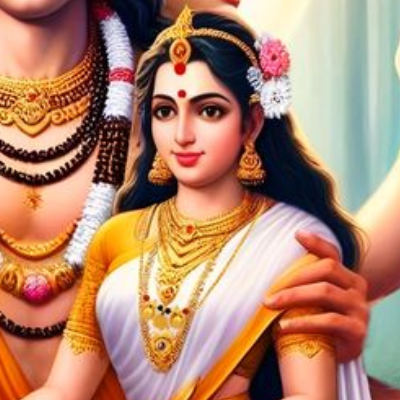
Anagha Devi is depicted as a beautiful woman of radiant complexion, seated in a lotus position, wearing an anklet embroidered with bells, carrying a lotus in one hand, and displaying the gesture of protection with the other hand — her eyes half-closed in the state of yogic awareness that encodes her dual nature as both fully present to the devotee and continuously merged with the divine. The lotus she carries is the symbol of spiritual purity arising from the waters of existence — the same symbolism that connects her to Lakshmi, whose most characteristic symbol is also the lotus. The anklet with bells — unusual in the iconographic tradition of goddesses — reflects the dancing form she took when she first emerged from the pond, integrating into her permanent iconography the specific mode of her first appearance. In temples and puja arrangements she is depicted alongside Anagha Swami — Dattatreya in his householder form — as a couple whose combined worship is the practice of the Anagha Vratam.
✦ Textual Variants and Inconsistencies
Anagha Devi as Lakshmi versus as combined Tridevi: Some sources — including the Sree Datta Vaibhavam and the Anagha Vratha sources — identify Anagha Devi specifically as an incarnation of Mahalakshmi, the goddess of prosperity. Other sources — including the MyDattatreya theological statement — identify her as the combined avatar of Sarasvati, Lakshmi, and Parvati simultaneously, superior to each individually. The Vedicfeed source gives the most nuanced position: she is "the combined avatar of Divine Mother Lakshmi, Parvati, and Sarasvati." These three positions — Lakshmi specifically, all three Tridevi equally, or all three in integrated state with Lakshmi's quality most prominent — reflect the tradition's internal diversity rather than contradictory accounts. The dominant popular and devotional tradition emphasises the Lakshmi identification; the more philosophically developed account emphasises the Tridevi integration.
The source text — Dattatreya Purana versus Bhavishyottara Purana: The Anagha Vratam sources consistently identify the Dattatreya Purana as the primary source while simultaneously noting that it is a section of the Bhavishyottara Purana compiled by Vyasa. The Dattatreya Purana is not one of the eighteen Mahapuranas or Upapuranas of the standard canonical lists — it belongs to the broader category of texts associated with specific deity traditions rather than to the pan-canonical collection. This does not diminish its authority within the Dattatreya devotional tradition, where it is treated as the foundational text, but it places it in a different canonical category from the Bhagavata Purana or Vishnu Purana.
✦ Theological Significance
Anagha Devi's theological significance is concentrated in three interconnected teachings that the tradition presents through her narrative and her nature. The first is the teaching about perception and recognition — the pond episode is explicitly a demonstration that the divine can appear in forms that conventional religious categories would identify as transgressive (the dancing, wine-drinking woman) and that the capacity to recognise the divine in such forms is the measure of the depth of one's realisation. Those who could see past the form to the energy within were liberated; those who could not were not. This teaching places the responsibility for spiritual recognition on the perceiver's own clarity rather than on the convenient conformity of the divine to expected forms.
The second is the teaching about gender and the divine — the identification of Anagha Devi with Dattatreya himself, as his female form and his Shakti simultaneously, is the Dattatreya tradition's most concentrated statement of the principle that the divine transcends gender and encompasses both without being limited to either. She is not a separate being from him but his own energy given female form to demonstrate the completeness of divine reality.
The third is the teaching about the householder path — the Anagha Swami and Anagha Devi couple demonstrates that the highest spiritual realisation is not the exclusive property of the renunciant way but is equally available to and expressed through the householder who lives the domestic life in the spirit of complete spiritual dedication. The children of this divine couple are the eight siddhis — supernatural powers — suggesting that the properly lived householder life produces extraordinary spiritual accomplishment rather than spiritual limitation.
✦ Connection to the Wider Genealogy
Through her identification with Dattatreya — as his Shakti, his consort, and his female form — Anagha Devi is connected to the full genealogical tradition of the Dattatreya biography: through Dattatreya's parents Atri and Anasuya, through Anasuya's father Kardama and mother Devahuti, and through Atri's identity as a Saptarishi and mind-born son of Brahma. Through her identification as Lakshmi or as the combined Tridevi, she is connected to the deepest level of the tradition's divine feminine theology — the Shakti that pervades and sustains all creation. Through the Anagha Vratam's transmission to Kartavirya Arjuna, she is connected to the Dattatreya-Kartavirya narrative thread that runs through both the Mahabharata's story of Parashurama and the broader tradition of the thousand-armed king. Through the Ashta Siddhis as her children, she is the divine mother of the eight accomplishments that the tradition regards as the highest spiritual powers available to embodied beings — making her lineage not a genealogy of human or divine persons but a genealogy of spiritual capabilities.
✦ References
Primary Sources
- Dattatreya Purana (section of the Bhavishyottara Purana, compiled by Vyasa): The primary canonical source for the entire Anagha Devi narrative — the pond episode, the emergence of the female energy from Dattatreya's Brahma Randhra, the sages' varied responses, the naming of Anagha, and Dattatreya's declaration of her as his consort. The foundational text of the Anagha devotional tradition.
- Datta Purana (also identified as a section of the Bhavishyottara Purana): The source for the Anagha Swami householder form, the Ashta Siddhis as the children of the Anagha couple, and the transmission of the Anagha Puja to Kartavirya Arjuna in the Krita Yuga.
- Sri Datta Darshanam (by Jagadguru Sri Ganapathi Sachidananda Swamiji): The modern devotional commentary on the Anagha Devi tradition that gives the most detailed account of the pond episode and its theological significance for contemporary devotees; cited across multiple sources as the authoritative modern exposition of the primary source narrative.
Modern Reference Works
- Vettam Mani, Puranic Encyclopaedia (1975): Entry on Dattatreya; includes reference to Anagha Devi as his consort in the householder form.
- Jagadguru Sri Ganapathi Sachidananda Swamiji, Anagha Vratam (published by Avadhoota Datta Peetham): The modern publication that contains the complete procedure for the Anagha Vratam, the primary source texts translated and explained, and the three paradigmatic stories from the Bhavishyottara Purana tradition that illuminate the teaching of Anagha Devi; the most practically authoritative modern source for the living practice of the Anagha tradition.