
About
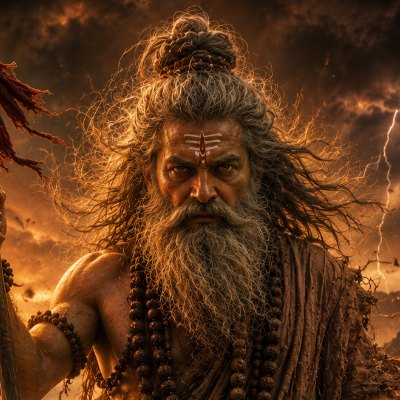
Durvasa — Son of Atri and Anasuya, Born of Shiva's Amsha, Sage of the Terrible Curse, and Figure of Cosmic Consequence
Durvasa · Durvasas · Atriputra · Shiva-amsha-sambhuta · Krodhapravara · Munivarishtha · Shakuntala-shaptika · Ambarisha-pratikula · Kunti-mantra-data
Durvasa is the son of Atri and Anasuya, born as the partial incarnation — the amsha — of Shiva in response to Atri's austerities, and one of the most narratively consequential figures in the entire Sanskrit canonical tradition precisely because his curses and his gifts shaped the fate of figures across both epics and multiple Puranas. He is celebrated for being the most irascible of all the tradition's great sages — a figure of supreme spiritual power whose anger, when ignited by a perceived slight, produced curses of devastating consequence, and whose gifts, when he was pleased, bestowed extraordinary boons of equal magnitude. His name encodes his defining characteristic directly: Durvasa is a compound of dus (bad, difficult, terrible) and vasa (dwelling, abode, residence) — yielding the sense of "the one who is difficult to live with," "the terrible resident," or "he whose dwelling is a difficult matter." This name was given specifically because even the gods and sages found it difficult to live near him due to his terrifying anger. As Shiva's amsha he carries within him the cosmic destructive and regenerative power of the Rudra aspect — the same cosmic energy that incinerated Kamadeva and that provides the tradition's ultimate model of the relationship between fury and spiritual power. His curses include the one that began the deterioration of the gods' prosperity before the churning of the milk ocean (he cursed Indra for disrespecting a garland of flowers, giving the garland to Indra's elephant who trampled it), the one given to Shakuntala that caused Dushyanta to forget her, the one that required Kunti to test the mantra given to her — indirectly producing Karna — and the celebrated episode with King Ambarisha in which Vishnu's Sudarshana Chakra chased Durvasa across the three worlds. He appears in the Mahabharata's Adi Parva, the Bhagavata Purana, the Ramayana, the Vishnu Purana, the Brahma Vaivarta Purana, and many other texts.
✦ The Names
As described above the name Durvasa directly encodes the quality for which the sage is most known — the terrible difficulty of living near him. The Bhagavata Purana's account of his birth states that when Shiva's amsha entered Anasuya's womb, "owing to the will of Lord Shiva, the sage Durvasa was born, endowed with the quality of terrible anger and cursing power." The name was thus given because the divine portion of Shiva that animated this birth was specifically the Rudra aspect — the furious, destructive, cosmic anger that is one of Shiva's defining qualities. The epithet Krodhapravara means "foremost in wrath." Munivarishtha means "greatest of the sages." Ambarisha-pratikula means "the one opposed by Ambarisha" — a reference to the episode in which Durvasa's attempt to curse the devotee of Vishnu was turned against him. Shakuntala-shaptika means "he who cursed Shakuntala." Kunti-mantra-data means "the one who gave the mantra to Kunti."
✦ Lineage
- Father: Atri — one of the seven Saptarishis.
- Mother: Anasuya — profiled above.
- Brothers: Chandra-Soma (Brahma's amsha) and Dattatreya (Vishnu's amsha).
- Divine identity: Born specifically of Shiva's amsha — the Rudra aspect of the cosmic destructive and regenerative power. His anger is not a personal failing but the expression of the cosmic quality of Rudra that he carries within him. The tradition presents Durvasa's curses not as the acts of a petty or easily offended man but as the expressions of a cosmic principle — when the being who embodies Rudra's power is disrespected, the response is the equivalent of a cosmic energy discharge rather than of a personal slight's retaliation.
✦ The Curse on Indra and the Loss of the Gods' Prosperity
The Bhagavata Purana and the Vishnu Purana narrate the episode in which Durvasa's curse precipitated the loss of the gods' divine prosperity and eventually necessitated the churning of the milk ocean. Durvasa was wandering and encountered a divine woman — in some accounts an Apsara, in others the goddess Lakshmi herself in a transformed form — carrying a garland of divine flowers whose fragrance and beauty were extraordinarily auspicious. He took the garland and gave it to Indra, who was mounted on his elephant Airavata. Indra received the garland casually — without proper reverence for the sage's gift and its sacred character — and placed it on his elephant's head. The elephant, annoyed by the fragrance, threw the garland to the ground and trampled it. Durvasa's rage at this casual disrespect for his gift — which was effectively a disrespect for him and for the divine power the garland represented — exploded into a curse: that the gods would lose all their prosperity, their divine radiance, and their sovereignty over the three worlds. The curse took effect immediately, and it was the resulting weakening of the gods and strengthening of the demons that eventually forced the gods and demons into the joint enterprise of churning the milk ocean — which produced Lakshmi, the divine physician Dhanvantari, the nectar of immortality, and the other divine gifts that restored the gods' power.
✦ The Gift of the Mantra to Kunti
The Mahabharata's Adi Parva narrates that Durvasa visited the household of Kuntibhoja — Kunti's adoptive father — and Kunti was appointed to serve the sage with complete care and attention. Kunti served Durvasa with such complete attentiveness, skill, and equanimity throughout his stay that when he was about to depart he gave her a mantra as a gift — a formula by which she could invoke any divine being and that divine being would come to her and give her a child. The consequences of this gift — Kunti's impulsive testing of the mantra on Surya which produced Karna, and her subsequent use of the mantra after her marriage to Pandu to produce Yudhishthira, Bhima, and Arjuna — are among the most consequential acts in the entire Mahabharata's genealogical world. Durvasa's gift to Kunti was the single most genealogically consequential act attributed to him — it produced the three elder Pandavas and the unacknowledged Karna, and through them the entire narrative of the Mahabharata's central conflict. The Kunti profile in this series narrates the full consequences. Durvasa's role here was characteristically his own — a gift given in pleased response to excellent service, whose consequences exceeded anything the giver could have anticipated.
✦ The Curse on Shakuntala
Kalidasa's celebrated Sanskrit play Abhijnanashakuntalam — one of the greatest works of Sanskrit literature — narrates the story of Shakuntala, the daughter of the sage Vishvamitra and the Apsara Menaka, raised by the sage Kanva in his ashrama. Shakuntala was so absorbed in the memory of her new husband King Dushyanta — whom she had secretly married in the gandharva form in the forest — that when Durvasa arrived at the ashrama she failed to hear him and did not offer him the customary hospitality. Durvasa, enraged at the slight, cursed her: that the person whose memory was absorbing her so completely that she could not attend to her duties would forget her entirely. Shakuntala later persuaded Durvasa to mitigate the curse — he modified it so that the king would remember her when shown a token he had given her. The loss and eventual recovery of the ring that was the recognition token, the king's amnesia and Shakuntala's rejection when she appeared at court, and the eventual reunion — all of this flows from Durvasa's curse and its mitigation. The episode gives Durvasa a role in one of the most celebrated love stories in Sanskrit literature.
✦ The Episode with King Ambarisha and the Sudarshana Chakra
The Bhagavata Purana's ninth book narrates the celebrated episode of Durvasa's conflict with King Ambarisha — one of the Bhagavata Purana's most theologically pointed narratives about the relationship between a devotee's protection and a sage's power. King Ambarisha was one of Vishnu's most devoted bhaktas — a king who had offered his entire kingdom to Vishnu and whose daily practice of devotion was complete and unwavering. Durvasa came to Ambarisha's palace on a day of ekadashi — the eleventh day of the lunar fortnight, the most sacred day of Vishnu's calendar — and accepted the king's invitation to eat after breaking fast. He went to bathe and was away for a very long time. The prescribed hour for breaking the fast was passing, and Ambarisha — not wishing to be disrespectful to his guest by eating before him but also not wishing to violate the ekadashi observance by waiting past the prescribed hour — broke his fast by drinking water alone, a technical compliance that fulfilled the obligation to break the fast at the right moment without consuming food before his guest. Durvasa, returning and discovering what Ambarisha had done, considered it an insult — the king had eaten (in the technical sense of drinking water) before his guest. His rage exploded and he tore a lock of his matted hair and created from it a being of terrible power — a demon of fire — to destroy Ambarisha. Vishnu's Sudarshana Chakra, which perpetually guards Vishnu's devotees, immediately flew toward the demon and incinerated it. It then turned toward Durvasa himself and began to pursue him across the three worlds. Durvasa fled to Brahma, who said he could not help against Vishnu's weapon. He fled to Shiva, who said the same. He finally went to Vishnu himself and pleaded for protection. Vishnu told him — in one of the Bhagavata Purana's most celebrated theological passages — that he himself was bound by the love of his devotees and could not overrule the Sudarshana's protection of Ambarisha; that the only way Durvasa could be freed from the Chakra's pursuit was to return to Ambarisha and beg his pardon. Durvasa returned to Ambarisha and asked forgiveness. Ambarisha — who had been standing in fasting and prayer for the entire year of Durvasa's flight, refusing to eat or sleep while the Chakra was in pursuit of his guest — immediately forgave Durvasa and called off the Sudarshana. The episode is the Bhagavata Purana's most direct statement that the devotee's protection transcends even the sage's accumulated spiritual power.
✦ Textual Variants and Inconsistencies
The specific amsha: The Bhagavata Purana consistently identifies Durvasa as born of Shiva's amsha. Some regional devotional traditions give a slightly different account of the proportion of Shiva's quality transmitted — whether the full force of Rudra or a partial portion — but the Shiva-amsha identification is universal across the major Mahapuranic sources.
The Shakuntala curse's source: The Mahabharata's Adi Parva gives an account of Shakuntala's story in which the curse's specific cause differs slightly from Kalidasa's literary version. The Mahabharata's account does not feature the Durvasa curse as prominently as the central mechanism of the story — the ring plays a more incidental role and the king's forgetting is explained differently. Kalidasa's celebrated literary version — in which Durvasa's curse and the ring's loss are the central plot mechanisms — is a literary elaboration of the Mahabharata's simpler account.
✦ Theological Significance
Durvasa's theological significance operates through a consistent structural principle across all his major episodes: the cosmic power of the Shiva-Rudra amsha that he embodies produces consequences — through both his curses and his gifts — that are disproportionate to the apparent scale of the triggering events. A casual disrespect of a garland produces the loss of the gods' entire cosmic prosperity. A young woman's inattention produces a curse that shapes the entire Shakuntala-Dushyanta story. A sage's pleased response to a young woman's service produces the mantra that generates the five Pandavas' divine paternities and Karna's birth. An attempt to curse a devotee produces a year-long cosmic pursuit by Vishnu's weapon. The theological point that Durvasa's entire biography demonstrates is that the consequences of spiritual power — whether deployed in anger or in generosity — are always of an order of magnitude that the ordinary human scale cannot anticipate or contain.
✦ References
Primary Sources
- Bhagavata Purana, Book 4, chapters 18–19 (birth): The account of Durvasa's birth from Shiva's amsha through Anasuya.
- Bhagavata Purana, Book 9, chapters 4–5 (Ambarisha episode): The full account of Durvasa's conflict with King Ambarisha, the Sudarshana Chakra's pursuit, the flight through the three worlds, and Vishnu's response. The primary source for Durvasa's most theologically concentrated episode.
- Vishnu Purana and Bhagavata Purana (the cursing of Indra and the garland episode): The account of Durvasa's curse on Indra that caused the loss of divine prosperity and necessitated the churning of the milk ocean.
- Mahabharata, Adi Parva, sections 57–70 (the mantra given to Kunti): The account of Durvasa's visit to Kuntibhoja's household, Kunti's exemplary service, and the gift of the mantra whose consequences included the births of Karna and the three elder Pandavas.
- Kalidasa, Abhijnanashakuntalam: The literary elaboration of the Shakuntala curse episode; not a primary source in the same category as the Mahabharata and Puranas but the most celebrated literary treatment of one of Durvasa's most famous acts.
Modern Reference Works
- Vettam Mani, Puranic Encyclopaedia (1975): Entry on Durvasa; comprehensive collation of all primary references across the Mahabharata, Ramayana, and the full range of Puranas.
- Wendy Doniger O'Flaherty, Shiva: The Erotic Ascetic (1973): Contains analysis relevant to the Rudra-Shiva quality of transformative anger and its relationship to the tradition's understanding of Durvasa as Shiva's amsha.