
About
Kandali — Daughter of Aurva, Born from His Knee, Wife of Durvasa, the Quarrelsome Bride
Kandali · Kandalī · Aurva-putri · Janu-sambhava · Ayoni-sambhava · Durvasa-patni · Banana-tree-janma · Bhargava-kanya · Trailokya-mohini
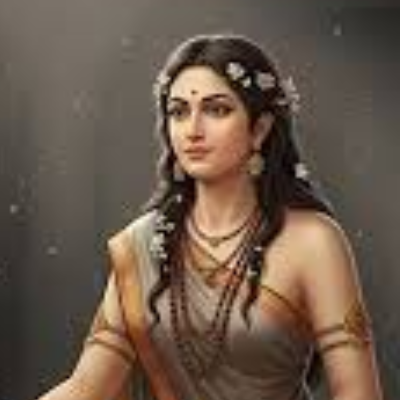
Kandali is the daughter of the sage Aurva — the thigh-born Bhargava rishi, creator of the Vadavagni submarine fire, protector of the king Sagara — and the wife of Durvasa, the famously irascible sage who is a partial avatar of Shiva, son of Atri and Anasuya. Her story is narrated in the Brahma Vaivarta Purana (Ganapati Khanda, the section on the Wedding of Durvasa and Kandali) and confirmed briefly in the Wikipedia article on Durvasa. She was not born of a mother's womb — the Brahma Vaivarta Purana's verse is explicit on this point: she was born from Aurva's knee (janu), and was therefore ayoni-sambhava — not womb-born. This parallels her father's own extraordinary birth from his mother's thigh (uru). Like father, like daughter — the Bhargava lineage's tradition of body-part births continued in her. She possessed all beauty and all virtues, the power to enchant the three worlds, and had only one fault: she was excessively quarrelsome and spoke harsh words in anger. She fell in love with Durvasa — the most irascible sage in the tradition, who cursed gods and kings and ordinary humans with equal readiness — before ever meeting him, having heard of him from a messenger. When her father Aurva approached Durvasa to give her in marriage, Durvasa accepted and the two lived together happily for a time. Their marriage eventually ended when Durvasa cursed her to burn to ashes for excessive quarrelling. Krishna — in the form of a Brahmin boy — intervened, instructed Durvasa on restraint, and decreed that Kandali would be reborn as a banana tree on earth and in a future kalpa would again become Durvasa's wife.
✦ The Name
The Sanskrit name Kandali — written Kandalī — derives from kandala (a sprout, a shoot, new growth, the budding of a plant; also an arrow or missile) with the feminine suffix. The name means the sprouting one, the new shoot, she who is like a fresh budding plant. In the context of her birth from Aurva's knee — like a sprout pushing through soil — the name is precisely apt. The banana tree she becomes after Durvasa's curse is itself a plant known for its prolific sprouting and lateral shoots (called kanda or kandali in botanical Sanskrit). Her name thus connects her birth (the knee-sprout), her character (sharp and new, like a shoot), and her rebirth (the sprouting banana tree) in a single etymological thread.
✦ Lineage
- Father: Aurva — son of Apnavana and Ruchi; grandson of Chyavana and Sukanya; the thigh-born sage; creator of the Vadavagni; who wept when he gave Kandali in marriage; who fell unconscious from the grief of separation when she departed; the Brahma Vaivarta Purana records his grief with precision — the flood of grief born from separation from one's children will not spare even a self-satisfied sage
- Birth: from Aurva's knee (janu) — not from a mother's womb; ayoni-sambhava (not womb-born); the precise Brahma Vaivarta Purana verse: tasya janudbhavo kanya kandali nama visruta — from Aurva's knee was born a daughter named Kandali, widely celebrated
- Husband: Durvasa — son of the sage Atri and his wife Anasuya (one of the five celebrated pativratas); a partial avatar of Shiva; famous throughout the tradition for his uncontrollable anger and his ready curses; who cursed Indra, Shakuntala, Bhanumati, Ambarisha, and many others; who gave Kunti the mantra with which she invoked the divine beings to father the Pandavas; who received Kandali as his wife with pleasure and sported with her happily until her quarrelsomeness finally exhausted him
✦ The Marriage — An Irascible Sage and a Quarrelsome Wife
The Brahma Vaivarta Purana's account of the marriage has a theological precision that its surface-level comedy does not obscure. Aurva approached Durvasa with Kandali, who had been longing for the sage since first hearing of him. Aurva told Durvasa everything honestly — her beauty, her virtue, her power to enchant the three worlds, and her single fault: she was excessively quarrelsome and spoke harsh, bitter words in anger. He urged Durvasa not to reject a thing of many virtues on account of a single fault. Durvasa — who was himself defined by the tradition as the person whose fault was uncontrolled anger — accepted a wife whose fault was uncontrolled quarrelsomeness. The two most irascible personalities in the tradition were joined in one household. Aurva, weeping from separation grief, gave his daughter with a proper dowry and fell unconscious. Kandali also wept at leaving her father. Once married, however, the Brahma Vaivarta Purana records that the marriage was genuinely happy — for a time. The text is explicit: Durvasa, who had known nothing of sensory pleasure from his birth, became expert in its enjoyment. He and Kandali were absorbed in each other. He did not know whether it was day or night. The text records his contentment with an almost gentle precision: Durvasa became like an unhappy man experiencing his first taste of happiness. He was filled with desire. Every day he enjoyed with his wife. The couple became expert in the art of love. Eventually their similar natures came into conflict. Kandali's sharp tongue and angry speech — which Aurva had warned Durvasa about — collided with Durvasa's own hair-trigger temper. The quarrelling escalated. Finally Durvasa, pushed beyond his tolerance, cursed Kandali: she would burn to ash.
✦ Krishna's Intervention, the Curse's Consequence, and the Banana Tree
After Durvasa's curse reduced Kandali to ash, a young Brahmin boy appeared before Durvasa — described in the Brahma Vaivarta Purana as Krishna in disguise. The divine child gently but precisely pointed out the irony of the situation: the sage who had cursed so many others for failures of self-control had himself failed in self-control over his own wife. He instructed Durvasa to perform penance and restraint. He then decreed the consequence for Kandali: she would take birth as a banana tree on the earth. In another kalpa — a future cosmic age — she would again be Durvasa's beautiful, auspicious, and exalted wife. The Wikipedia article on Durvasa confirms this account directly: Kandali was his wife whom he cursed to be reduced to a heap of dust for excessively quarrelling with him. The Brahma Vaivarta Purana's own verse records the decree: in another kalpa she will again be your beautiful auspicious exalted wife. Kandali was born on the earth as a banana tree. The banana tree — the most domestic of all Indian plants, found in every kitchen garden, its leaves used in every ritual and meal, its fruit offered to every deity — is her current form. The tradition's assignment of the quarrelsome daughter of the Bhargava sage to the most gentle and nourishing of all domestic plants carries its own quiet commentary on transformation.
✦ References
- Brahma Vaivarta Purana (Ganapati Khanda — the Wedding of Durvasa and Kandali, Texts 5–87) — the primary canonical source: Aurva coming with Kandali to Durvasa's hermitage; her knee-birth (janudbhava); her beauty and quarrelsome character; Aurva's warning and honest disclosure; Durvasa's acceptance; the marriage; their happiness; the quarrelling; Durvasa's curse; Krishna's intervention as a Brahmin boy; Kandali reborn as a banana tree; the promise of reunion in a future kalpa
- Wikipedia — Durvasa — Kandali confirmed as Durvasa's wife who was cursed to be reduced to a heap of dust for excessive quarrelling; the confirmation of the Brahma Vaivarta Purana account
- Hindupedia — Aurva — the two children of Aurva confirmed as Richika (son) and Kandali (daughter)
- Talkingmyths.com — The Curious Case of Sage Durvasa; ISVARA.org — The Wedding of Durvasa and Kandali (Brahma Vaivarta Purana translation); Brahma-vaivarta-puranam.blogspot.com — Part IX: modern summaries drawing from the Brahma Vaivarta Purana as the primary source