
About
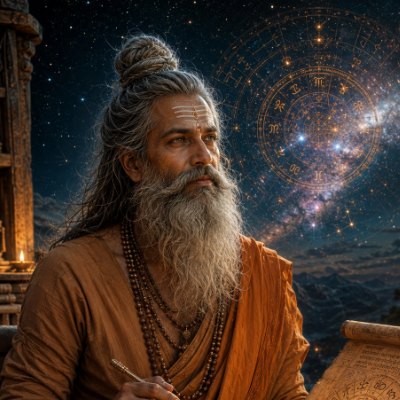
Parashara — Grandson of Vasishtha, Father of Vyasa, Narrator of the Vishnu Purana, Father of Vedic Astrology
Parashara · Parāśara · Parashara Maharshi · Parashara Shaktya · Shakti-putra · Vasishtha-pautra · Adrishyanti-suta · Satyavati-pati · Vyasa-pita · Vishnu Purana-vakta · Jyotish-pita
Parashara is a Maharishi — a great sage — and the son of Shakti (eldest son of Vasishtha) and Adrishyanti; the grandson of the Saptarishi Vasishtha and the great sage Arundhati; the father of Vyasa (Krishna Dvaipayana) — the compiler of the Vedas and author of the Mahabharata — through the fisherwoman Satyavati on a Yamuna island; and the narrator of the Vishnu Purana — the first of the eighteen Mahapuranas — to his student Maitreya. He is described in the tradition as having been born posthumously — his father Shakti was devoured by the cannibal king Kalmashapada before his birth, and Parashara was chanting the Vedas from inside his mother's womb for twelve years before he was born, the sound of that chanting recalling his grandfather Vasishtha from suicidal grief. He was raised by Vasishtha, who taught him the scriptures and spiritual knowledge. He grew up believing Vasishtha was his father until his mother Adrishyanti revealed the truth. Upon learning that his father had been destroyed through Vishvamitra's manipulation of Kalmashapada, the young Parashara performed a Rakshasa Satra — a sacrifice to destroy all Rakshasas — and nearly succeeded in burning the entire Rakshasa race to extinction before the sage Pulastya and his own grandfather Vasishtha intervened, teaching him that anger and revenge are inappropriate for the wise and that his father's death was the work of destiny. He abandoned the sacrifice. Pleased with his obedience, the sage Pulastya blessed him with the ability to know the past, present, and future and to become the author of the Puranas. He is one of the third members of the Advaita Guru Parampara. He is identified as the father of Vedic astrology — his Brihat Parashara Hora Shastra is the foundational text of Jyotish (Hindu astrology). He walked with a limp — wounded during a wolf attack on his ashrama in his old age. He died merging into the wolves as a renunciant leaving this world.
✦ The Name
The Sanskrit name Parashara — written Parāśara — is interpreted in the tradition as deriving from the root para (beyond, supreme, the other side) and shara (an arrow; destruction; or from the root sr — flowing, moving). One traditional derivation is para-shara — the destroyer of enemies from the other side, the one who destroys those on the opposing bank. His surname Parashara Shaktya — recording his descent from his father Shakti — appears in the Rigveda, where he is the seer of hymns 1.65–73 (in praise of Agni) and portions of 9.97 (in praise of Soma).
✦ Lineage
- Father: Shakti — eldest son of Vasishtha; who cursed king Kalmashapada and was subsequently devoured by the Rakshasa Kinkara acting through the cursed king at Vishvamitra's direction; who died before Parashara's birth
- Mother: Adrishyanti — wife of Shakti; who lived with Vasishtha after Shakti's death; who revealed to Vasishtha that the Vedic chanting he heard was coming from the child in her womb; who told Parashara, when he was grown, that Vasishtha was not his father but his grandfather
- Paternal grandfather: Vasishtha — one of the seven Saptarishis; who raised Parashara as his own son after Shakti's death; who stopped Parashara's Rakshasa Satra; who taught him the scriptures
- Paternal grandmother: Arundhati — the supreme exemplar of pativrata dharma; identified with the star Alcor in Ursa Major
- Teachers: Bashkal — under whom he completed his study of the Rigveda; and Yajnavalkya — the great sage of the Brihadaranyaka Upanishad from whom he received knowledge of the Yajurveda
- Student: Maitreya — to whom Parashara narrated the entire Vishnu Purana; the conversation between Parashara and Maitreya is the frame of the Vishnu Purana
- Son: Vyasa — born of Satyavati on a Yamuna island; who grew up immediately into a young man and left to perform penance after promising to return whenever his mother called; who is identified as an avatar of Vishnu; Chiranjivi; the compiler of the Vedas and author of the Mahabharata and the eighteen Puranas
✦ The Rakshasa Satra — Anger and Restraint
When Parashara was grown and learned the truth of his father's death — that Shakti had been devoured by a cannibal king through the machinations of Vishvamitra — he was consumed by fury. He began a Rakshasa Satra — a sacrifice specifically designed to destroy all Rakshasas in existence. The sacrifice was effective: Rakshasas from across all three worlds began to fall into the sacrificial fire and perish. Many blameless Rakshasas who had had no part in Shakti's death were also being consumed. Pulastya — the Prajapati sage and grandfather of Ravana — approached Parashara and described the injustice of destroying innocent beings for the fault of a few. He preached non-violence and the futility of anger as a response to destiny-ordained events. Vasishtha, Parashara's grandfather, reinforced the same message: his own father's death had been the work of destiny, not of enemies; punishing enemies would not change fate; anger is the passion of fools and does not befit a wise man. Parashara relented and stopped the sacrifice. Pleased with his obedience, Pulastya blessed him with the gift of omniscience — knowledge of past, present, and future — and told him he would compose the Puranas. It was from this prophesied composition that the Vishnu Purana emerged.
✦ The Encounter with Satyavati — Birth of Vyasa
One night during his travels Parashara stayed at the house of Dasharaja, the fisherman chief on the banks of the Yamuna. The next morning Dasharaja asked his daughter Satyavati — also called Matsyagandha because she smelled of fish — to ferry Parashara across the river. While crossing the Yamuna, Parashara was drawn to Satyavati and expressed his desire. She protested that people on both banks could see them. He created a dense fog around the boat with his ascetic power. She then protested that her smell of fish made the encounter unsuitable. He gave her the boon that a sweet fragrance would henceforth emanate from her person a full Yojana (several miles) in every direction. She then asked for three conditions: that the encounter remain secret; that her virginity be restored after the birth; and that the son born of them would be as celebrated as the great sage himself. Parashara granted all three. He then knew, through his divine foreknowledge, that this encounter would produce an incarnation of Vishnu. They came ashore at an island in the middle of the Yamuna. Satyavati conceived and gave birth the same day on that island. The child was dark-complexioned — called Krishna (the dark one) — and was born on an island — called Dvaipayana (island-born). He grew to young adulthood instantly, promised his mother he would come whenever she called, and departed. This child became Vyasa. Parashara bathed in the river and left on his journey, never meeting Satyavati again.
✦ Works Attributed to Parashara
Parashara is credited with the original composition of the Vishnu Purana — the first of the eighteen Mahapuranas — which was later compiled in its present form by his son Vyasa. The Vishnu Purana as known today is a dialogue between Parashara and his student Maitreya, in which Parashara narrates the cosmology, genealogy, theology, and history of the universe from Vishnu's perspective. He is also the author of the Parashara Smriti — a code of laws explicitly stated in the text to be the appropriate Dharmashastra for the Kali Yuga. His Brihat Parashara Hora Shastra is the foundational text of Vedic astrology, earning him the title of father of Jyotish. Additional texts attributed to him include the Vrikshayurveda (one of the earliest texts on botany), the Krishi Parashara (on agriculture and weeds), the Parashara Gita (a dialogue between Parashara and King Janaka of Mithila on action and religion, narrated by Bhishma to Yudhishthira in the Mahabharata's Shanti Parva), and hymns in the Rigveda (Mandala 1, verses 65–73, and portions of 9.97).
✦ References
- Mahabharata (Adi Parva, Vasishthopakhyana) — Parashara's birth; the Rakshasa Satra; Pulastya's intervention; Vasishtha's teaching on destiny; the birth of Vyasa; the full canonical genealogical account
- Rigveda (Mandala 1, Hymns 65–73; Mandala 9, Hymn 97 verses 31–44) — Parashara Shaktya named as the seer; the Vedic authority confirming his antiquity and lineage from Shakti
- Vishnu Purana — Parashara as the narrator speaking to Maitreya; the frame of the entire Purana; his genealogical statement confirming the Brahma-Vasishtha-Shakti-Parashara-Vyasa lineage
- Mahabharata (Shanti Parva — the Parashara Gita) — the dialogue between Parashara and King Janaka of Mithila on dharma and action; narrated by Bhishma to Yudhishthira
- Wikipedia — Parashara; VedicFeed — Maharishi Parashara; Glorious Hinduism — Parashara; Parashara Fandom — Religion Wiki; TropicalRashi — Maharishi Parashara; Devdutt Pattanaik — From Vasistha through Vyasa to Shuka: modern summaries drawing from the above primary sources