
About
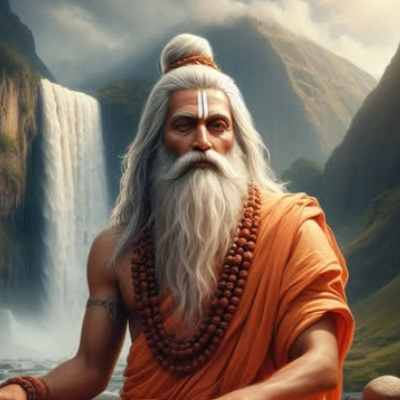
Aurva — Son of Apnavana and Ruchi, the Thigh-Born Sage, Creator of Vadavagni, Protector of Sagara
Aurva · Aurava · Aurva Bhargava · Uru-ja · Apnavana-putra · Ruchi-suta · Chyavana-pautra · Richika-pita · Jamadagni-pitamaha · Parashurama-prapitamaha · Vadavagni-srashtr · Sagara-palaka · Bhargava-kula-rakshaka
Aurva — also written Aurava — is a great sage of the Bhrigu-Bhargava lineage; the son of Apnavana (the Bhargava rishi, third of the five Srivatsa Gotra Pravara rishis) and Ruchi (the daughter of King Nahusha of the Chandravamsha); the grandson of Chyavana (the sage restored to youth by the Ashvini Kumaras) and his wife Sukanya (daughter of King Sharyati); the father of Richika; the grandfather of Jamadagni; and the great-grandfather of Parashurama — the sixth avatar of Vishnu, the axe-wielding warrior sage who exterminated the Kshatriya class twenty-one times. He is the fourth of the five rishis of the Srivatsa Gotra Pravara — Bhrigu, Chyavana, Apnavana, Aurva, Jamadagni — whose names are recited daily in Hindu ritual by all members of the Srivatsa and related Bhargava gotras. He was born during one of the most violent episodes in the Puranic tradition — the Kshatriya massacre of the entire Bhrigu clan — and the manner of his birth explains his name: his mother Arushi concealed him in her thigh while fleeing from the Kshatriyas, and when they found her and rushed to kill the child, he burst from her thigh with such blazing radiance that all the Kshatriyas present were instantly blinded. The Sanskrit word for thigh is uru — and the child born from the thigh was named Aurva. He grew up consumed by rage at the slaughter of his ancestors and performed such fierce tapas that it threatened to destroy the three worlds entirely. The Pitrs — his own ancestral spirits — descended from their realm to pacify him, revealing that they had chosen their own deaths as a cosmic strategy, not through helplessness. Aurva, persuaded but still unable to let the fire of his tapas simply dissipate, cast it into the ocean where it became the Vadavagni — the submarine fire that burns within the ocean's depths, controlled and catastrophic at once, the restrained form of the pralaya fire that will consume the cosmos at the end of the current age. His story is narrated in the Mahabharata's Adi Parva (Aurvopakhyana, Chapters 171–175) and elaborated in the Brahma Purana, the Bhagavata Purana (Canto 9), and the Harivamsa.
✦ The Name
The Sanskrit name Aurva — written Aurva — derives directly from ūru (thigh) with the suffix a forming the patronymic or origin-designating adjective. The name means simply of the thigh, the thigh-born, born from the thigh — a name that records the manner of his birth with complete precision. The Mahabharata's own text confirms this etymology directly: since the child was produced from the uru (thigh) of a woman he was called Aurva. The Grokipedia source records an alternate etymological connection to urvī (the earth, the wide one) — giving the sense of born from the earth, the one who emerged from the wide ground — a metaphorical reading that connects Aurva's thigh-birth to the archetypal earth-birth motif. Additionally, the name Aurvagni — the fire of Aurva — is derived from his name to describe the Vadavagni (the submarine fire); in this sense the name Aurva became synonymous with the cosmic fire he created, and the fire was named for him.
✦ Lineage
- Father: Apnavana (Apravana) — a rishi of the Bhrigu-Bhargava lineage; son of Chyavana and Sukanya; named in the Rigveda (Mandala 10, Hymn 19) as one of the Bhrigus who spread the sacred fire across the forests; third of the five rishis of the Srivatsa Gotra Pravara; profiled separately in this series
- Mother: Ruchi — daughter of King Nahusha (of the Chandravamsha, Lunar Dynasty) and his wife Viraja; whose marriage to Apnavana was one of the rare Aila-Bhrigu matrimonial alliances; profiled separately in this series
- Mother who concealed him in her thigh: the Wikipedia article names her Arushi (described as daughter of Manu) rather than Ruchi; the Bhrigu Wikipedia article and Grokipedia also use Arushi as the mother's name; the Mahabharata's Adi Parva (Aurvopakhyana) refers to her simply as the Brahmana lady without naming her; this inconsistency between Ruchi (daughter of Nahusha, per the Brahmanda Purana) and Arushi (daughter of Manu, per Wikipedia's synthesis) cannot be resolved from the available primary evidence and both names are recorded; the Brahmanda Purana's identification of Ruchi as Apnavana's wife and Aurva's mother is the primary canonical source, and this series follows it as the primary identification
- Paternal grandfather: Chyavana — son of Bhrigu and Puloma; the sage restored to youth by the Ashvini Kumaras; creator of Chyavanaprasham; who officiated at Sharyati's soma sacrifice; profiled separately in this series
- Paternal grandmother: Sukanya — daughter of King Sharyati (son of Vaivasvata Manu); the devoted wife who identified Chyavana among three identical divine youths; profiled separately in this series
- Son: Richika (Richika) — a sage of the Bhrigu lineage; who married Satyavati (daughter of King Gadhi of the Solar Dynasty in some traditions); whose son was Jamadagni
- Grandson: Jamadagni — the great sage; husband of Renuka; father of five sons of whom the youngest was Parashurama; who was killed by Kartavirya Arjuna's sons; whose death caused Parashurama to vow twenty-one rounds of Kshatriya extermination
- Great-grandson: Parashurama — the sixth avatar of Vishnu; the axe-wielding warrior sage; the only avatar described as a Chiranjivi; who vowed to exterminate the Kshatriya class twenty-one times in revenge for his father Jamadagni's murder
- Protected ward: Sagara — the great Solar Dynasty king who dug the ocean with his sixty thousand sons; who gave the ocean its name Sagara (after himself); whose sons were burned to ash by the sage Kapila and were liberated only when Bhagiratha brought the Ganga to earth; Aurva's connection to Sagara through the Subahu-Yadavi episode makes Aurva one of Sagara's formative influences
✦ The Birth — The Thigh, the Blinding, the Restoration
The background to Aurva's birth is the most sustained act of violence against a Brahmin clan in the Mahabharata's historical memory. King Kritavirya of the Haihaya dynasty was an extraordinarily generous patron of the Bhrigu sages — their chief priests — and during his reign the Bhrigu clan accumulated enormous wealth from his gifts. After Kritavirya's death his descendants fell into poverty. They came to the Bhrigus for help. The Bhrigus refused, arguing that what is once given to a Brahmin cannot be taken back. The Kshatriyas discovered that the Bhrigus had buried gold under their ashramas. Enraged at this hidden wealth that was being withheld from them, the Kshatriyas — descendants of Kritavirya — launched a systematic slaughter of the entire Bhrigu clan, killing men, women, children, and even embryos in their mothers' wombs. One woman — Arushi or Ruchi — was pregnant and fled. To protect her unborn child she placed the foetus inside her own thigh and concealed it there. The Vyasaonline source draws directly from the Mahabharata's Sanskrit: she held the child in her thigh for a hundred years. The Kshatriyas, learning of this, rushed at her to kill the hidden child. As they came upon her, the child burst from her thigh — not as a helpless infant but with a radiance so intense that all the Kshatriya pursuers were instantly blinded. The mother spoke to them: you children, you were destroying even the embryos of the Bhrigu race — this child was held by me in my thigh for a hundred years so the prosperity of Bhrigu's race might be restored; the entire Vedas with their branches came unto this one even while he was in the womb; it is by his celestial energy that your eyes have been scorched. She told them to pray to her thigh-born child. They addressed the child: be propitious. And the child became propitious and restored their sight. The Mahabharata records this act of immediate forgiveness in the very first moment of his life — the child born of massacre and hundred-year imprisonment in a thigh extended his first act to his enemies, not his allies. But the forgiveness was to the men present. The rage itself — the deeper, older rage on behalf of all the Bhrigus who had died — remained.
✦ The Penance and the Threatened Destruction — The Pitrs' Revelation
As Aurva grew and fully comprehended what had been done to his clan — the slaughter of every Bhrigu, the killing of embryos, his own hundred-year imprisonment in a thigh — his rage became cosmically dangerous. He resolved to destroy the entire universe in revenge for the killing of his ancestors. He began performing tapas of such extraordinary intensity that the three worlds with their celestials, Asuras, and human beings were being afflicted by the heat and power of his austerities. The world was beginning to come apart. At this point the Pitrs — his own ancestral spirits, the very Bhrigus who had been killed — descended from their realm and came before him. They spoke to him directly. They told him the truth behind the massacre: it was not from incapacity that the Bhrigus had been indifferent to their own destruction. They had wanted to die. They were bored of their long lives and sought the Svarga attainable through violent death. They could not commit suicide — suicide leads to Naraka, not Svarga. So they had buried their gold where the Kshatriyas would find it, specifically to enrage them into delivering the deaths the Bhrigus sought. After their deaths they had all attained Svarga as intended. Kubera, the treasurer of heaven, kept a large treasure waiting for them. They wanted nothing from Aurva's revenge — they asked him to restrain his mind and stop the destruction. The Mahabharata preserves their precise words to him: kill not the Kshatriyas nor the seven worlds; kill this wrath of yours that stains your ascetic energy. Aurva heard the Pitrs and was moved. But he faced a dilemma of dharmic logic: the vow he had made from anger for the destruction of all the worlds must not go in vain. He had committed to it. If he simply abandoned the vow the fire of his penance would have nowhere to go — it could not be held within him, it could not be simply released into the air, and allowing a sworn vow to fail was itself a dharmic violation. The Pitrs offered a solution: throw the fire into the ocean, where it could be contained without causing destruction. The fire of his vengeance would not be wasted — it would be stored, alive and burning, in the ocean's depths, waiting for the end of the cosmic cycle when its destructive potential could be expressed appropriately. Aurva accepted. He cast his fire into the ocean. It entered the water in the form of a horse's mouth — the Vadavamukha — and burned from within the ocean as the Vadavagni, the submarine fire.
✦ The Vadavagni — The Submarine Fire
The Vadavagni — the fire of Aurva, the submarine fire, the mare's fire — burns at the bottom of the ocean in the form of a horse's mouth, consuming the waters from within. It is the Mahabharata's and the Puranas' explanation for why the ocean does not overflow despite all the rivers of the world pouring into it continuously — the Vadavagni evaporates the incoming water as fast as it arrives, maintaining the ocean's equilibrium. It is simultaneously a cosmological fact (the ocean is stable because it burns from within), a scientific observation (the heat of deep ocean environments), a mythological origin story (the fire was Aurva's rage, transformed), and an eschatological statement (the same fire that the ocean currently contains will be released at the end of the current cosmic age to participate in the pralaya — the cosmic dissolution). The Grokipedia source records the theological precision of the Vadavagni's dual role: in the current era it is a perpetual yet non-destructive force stationed in the ocean's depths where it evaporates waters into mist, maintaining earthly stability without causing harm; at the end times it will be released to consume the world. The restrained anger that could have destroyed the world in Aurva's generation is held in the ocean — scheduled, not cancelled. The Harivamsa records a variant tradition in which Aurva himself — rather than his fire — produced progeny from his thigh; these progeny immediately declared they were hungry and would consume the world; the cosmos was about to be destroyed until Brahma intervened and gave them an abode at Vadavamukha (the mare's mouth at the ocean's floor) where they consume the world together at the end of each age. Both versions — the fire-from-penance and the progeny-from-thigh — record the same theological content through different narrative structures: Aurva's rage was real, cosmic, and stored rather than released.
✦ The Subahu-Yadavi Episode — Protector of Sagara's Mother
After the Vadavagni episode, Aurva is recorded in the Mahabharata and the Mahapurana.com source as having settled into the life of an ascetic at his forest hermitage. A significant secondary episode records his protection of the queen Yadavi and the birth of the great king Sagara. King Subahu (also called Bahuka) of the Ikshvaku Solar Dynasty was defeated in battle by the Haihaya king Talajangha — the same Haihaya clan descended from Kartavirya Arjuna whose ancestors had massacred the Bhrigus, a genealogical irony the tradition does not comment on. Subahu fled Ayodhya with his pregnant queen Yadavi. A co-wife of Yadavi had poisoned her, causing her pregnancy to last seven years. Subahu died during the flight. Yadavi, grief-stricken, resolved to enter her husband's funeral pyre. As she prepared to mount the flames, Aurva — who had observed the proceedings from his hermitage — stepped forward and stopped her, informing her she was pregnant. The same sage who had been born from a thigh-concealed pregnancy recognized another pregnancy that would otherwise be destroyed by fire. Aurva became the protector of Yadavi through the rest of her pregnancy. She eventually gave birth to the child who was given the name Sagara — the ocean — because he had been born under the influence of the ocean's poison (the word Sagara is connected to both sa-gara, with-poison, and the ocean itself). Aurva raised Sagara and taught him the Vedas, the Vedangas, and the art of warfare. He gave Sagara the Agneyastra — the divine fire weapon — and taught him the secrets of statecraft. Sagara later used the Agneyastra to defeat the Haihayas who had killed his father and reclaim Ayodhya. Sagara's sixty thousand sons would eventually dig the ocean floor searching for the sacrificial horse that had been stolen — and that ocean, dug by Sagara's sons, became the foundation for the story of Bhagiratha bringing the Ganga to earth to liberate those sons.
✦ In the Srivatsa Gotra Pravara — Daily Canonical Memory
Aurva is the fourth of the five rishis of the Srivatsa Gotra Pravara — Bhrigu, Chyavana, Apnavana, Aurva, Jamadagni — recited at every Hindu marriage, upanayana, yajna, and major ritual by members of the Srivatsa gotra and related Bhargava gotras. The Bharatpedia source confirms that the Vats/Vatsa gotra brahmins of the Hindi belt region — with surnames Dubey, Mishra, Jha, and others of Uttar Pradesh, Bihar, Jharkhand, and the Awadh-Purvanchal-Bundelkhand-Mithilanchal regions — use the same five-pravara recitation: Bhrigu, Chyavana, Apnavana, Aurva, and Jamadagni. The Mahabharata records fifteen occurrences of Aurva's name in the Kisari Mohan Ganguli translation — giving him a canonical presence in the primary text that his ancestor Apnavana entirely lacks.
✦ References
- Mahabharata (Adi Parva, Aurvopakhyana, Chapters 171–175) — the primary canonical source: the Kritavirya-Haihaya background; the Bhrigu clan massacre; Arushi concealing the child in her thigh for a hundred years; the bursting from the thigh with blinding radiance; the restoration of the Kshatriyas' sight; Aurva's resolution to destroy the universe; his tapas afflicting the three worlds; the Pitrs' descent; their revelation that they had chosen their own deaths to attain Svarga; Aurva's dilemma about the sworn vow; the Pitrs' suggestion to cast the fire into the ocean; Aurva casting the fire into the ocean through the Vadavamukha; the Vadavagni established at the ocean's floor
- Mahabharata (Adi Parva — the Subahu-Sagara episode) — Aurva stopping Yadavi's sati; protecting her through the seven-year pregnancy; naming the child Sagara; teaching him the Vedas and the Agneyastra
- Brahmanda Purana — the genealogical chain: Chyavana's son Apravana (Apnavana); Ruchi daughter of Nahusha married Apravana; their son was Aurva; the primary Puranic source for Aurva's parentage in this series
- Harivamsa — the variant tradition: Aurva's progeny produced from his thigh; their declaration of hunger and threatened world-consumption; Brahma's intervention; the abode at Vadavamukha; the end-of-age consumption
- Bhagavata Purana (Canto 9) — the genealogical confirmation of the Bhrigu-Chyavana-Aurva-Richika-Jamadagni-Parashurama chain
- Wikipedia — Aurva; Bharatpedia — Aurva; Grokipedia — Aurva; Mahapurana.com — Aurva the Fierce Sage; Mythfolklore.net — Aurva (Dowson's Classical Dictionary); Vyasaonline.com — Aurvopakhyana; Religion Fandom — Aurva: modern summaries drawing from the above primary sources