
About
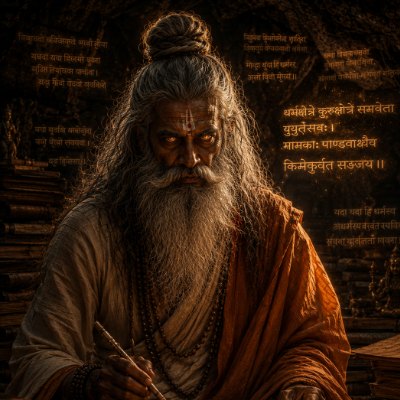
Vyasa (Krishna Dvaipayana) — Compiler of the Vedas, Author of the Mahabharata, Narrator of the Puranas, Avatar of Vishnu, Chiranjivi
Vyasa · Veda Vyasa · Krishna Dvaipayana · Krishnadvaipayan · Badarayana · Parashara-putra · Satyavati-suta · Dvaipayana · Veda-Vibhajaka · Mahabharata-karta · Brahmasutra-karta · Bhagavata-vaktri · Chiranjivi · Vishnu-amshavatara
Vyasa — whose full name is Krishna Dvaipayana and who is most commonly known as Veda Vyasa — is the son of the sage Parashara and the fisherwoman Satyavati; the grandson of Shakti and great-grandson of Vasishtha; one of the most consequential figures in the entire Hindu tradition; and one of the seven Chiranjivis — immortal beings who are still alive. He is regarded as a partial incarnation of Vishnu. He divided the primordial single Veda into four — Rigveda, Yajurveda, Samaveda, and Atharvaveda — earning the name Veda Vyasa (the splitter of the Vedas). He composed the Mahabharata — the longest epic in the world — in which he himself is both the author and a character. He is credited with the composition of the eighteen Mahapuranas (or their arrangement into present form) and the Brahma Sutras, the foundational text of the Vedanta philosophy. Through the practice of Niyoga — the ancient institution of levirate fathering — he fathered Dhritarashtra (through Ambika), Pandu (through Ambalika), and Vidura (through Ambalika's maidservant Parishrami) — making him the biological grandfather of both the Pandavas and the Kauravas. His son Shuka (born of his wife Pinjala, daughter of the sage Jabali) is the narrator of the Bhagavata Purana. He is a Chiranjivi — one of the immortals who lives through the entire Kali Yuga — and is believed in the tradition to still be alive and accessible to sincere devotees. The festival of Guru Purnima is celebrated in his honour, on the full moon of the month of Ashadha (June-July), which is believed to be both his birthday and the day on which he arranged the Vedas.
✦ The Names
The name Vyasa — from the Sanskrit root vi-as, to arrange, to classify, to separate, to expand upon — means the arranger, the compiler, the one who splits and classifies. The title Veda Vyasa — the arranger of the Vedas — is applied to him directly. The name Krishna records his dark complexion. The name Dvaipayana — from dvipa (island) — records the Yamuna island on which he was born. The name Badarayana — from badara, the Indian jujube or ber tree — records his hermitage at Badari (the site of present-day Badrinath in Uttarakhand), which was either covered with jujube trees or named for them. The Vishnu Purana records that in every Dvapara Yuga of the present Manvantara, Vishnu incarnates as a Vyasa to rearrange and teach the Vedas, and that this Krishna Dvaipayana is the twenty-eighth such Vyasa — making the name partly a title and partly a proper name.
✦ Lineage
- Father: Parashara — grandson of Vasishtha; narrator of the Vishnu Purana; who knew through divine foreknowledge that his encounter with Satyavati would produce a Vishnu incarnation; who took Vyasa with him and trained him in Vedic studies immediately after his birth
- Mother: Satyavati — the fisherwoman daughter of the fisherman chief Dasharaja and the adopted daughter (biological daughter of King Uparichara Vasu and the apsara Adrika who had been cursed to take the form of a fish); who smelled of fish before the encounter and of sweet fragrance afterward through Parashara's boon; who later married the Kuru king Shantanu and bore him Chitrangada and Vichitravirya; who summoned Vyasa to Hastinapura to continue the Kuru lineage through niyoga after Vichitravirya died childless
- Paternal grandfather: Shakti — eldest son of Vasishtha; devoured by the cursed Kalmashapada
- Paternal great-grandfather: Vasishtha — Saptarishi; divine preceptor of the Solar Dynasty
- Wife: Pinjala — also called Vatika; daughter of the sage Jabali; mother of Shuka
- Son (by Pinjala): Shuka — Vyasa's spiritual heir; born already liberated, not requiring any further spiritual effort; who narrated the entire Bhagavata Purana to the dying king Parikshit on the banks of the Ganga in seven days; regarded in the tradition as the supreme narrator of divine knowledge
- Son (by Ambika through Niyoga): Dhritarashtra — born blind because Ambika shut her eyes in fear at Vyasa's appearance; the Kuru king who was the father of the hundred Kauravas; who ruled Hastinapura as regent while unable to be crowned king himself; whose sons' war with the Pandavas is the central narrative of the Mahabharata
- Son (by Ambalika through Niyoga): Pandu — born pale because Ambalika turned white with fear; the formal king of Hastinapura who was cursed to die if he engaged in physical intimacy; the father of the five Pandavas through Kunti and Madri's invocation of divine beings; who retired to the forest and died there
- Son (by Parishrami through Niyoga): Vidura — born healthy and calm because the maidservant received Vyasa without fear; the wisest man of the three in the tradition's estimation — no one was his equal in virtue and knowledge of dharma; who is identified as the god of death Yama born in human form under the sage Mandavya's curse; whose political counsel throughout the Mahabharata's events consistently aligned with dharma; who resigned as prime minister when Duryodhana abused him; whose spirit merged into Yudhishthira's body at his death
- Disciples (the four Vedas assigned to four students): Paila (Rigveda), Vaishampayana (Yajurveda), Jaimini (Samaveda), and Sumantu (Atharvaveda); and his own son Shuka received the Mahabharata
- Narrator of the Mahabharata at the Sarpa Satra: Vaishampayana — who narrated the Mahabharata at Janamejaya's snake sacrifice on Vyasa's behalf at the request of the assembled sages
✦ Birth and the Immediate Departure
Vyasa was born on a Yamuna island, dark-complexioned, fully formed. He grew to young adulthood in an instant. He promised his mother Satyavati that he would come whenever she thought of him. Parashara took him with him and trained him in Vedic studies. Satyavati returned to her father's house and later married Shantanu. Years passed. When Vichitravirya died childless and the Kuru dynasty faced extinction, Satyavati thought of Vyasa. He appeared immediately. She asked him to father children on Vichitravirya's widows. He agreed, despite the unusual nature of the request.
✦ The Niyoga — Dhritarashtra, Pandu, and Vidura
Vyasa had spent months in meditation in the forest and arrived at Hastinapura unkempt — his appearance fierce and his spiritual radiance intense. Ambika, the first of Vichitravirya's widows, shut her eyes in terror during the encounter. The child born was Dhritarashtra — blind, because his mother's eyes were closed. Ambalika, the second widow, turned pale in fear. The child born was Pandu — pale-complexioned. Satyavati asked Vyasa to return to Ambika for a third encounter to produce a healthy child. Ambika, unwilling to face Vyasa again, sent her maidservant Parishrami in her place, dressed in Ambika's garments. The maidservant received Vyasa calmly and respectfully. The child born was Vidura — healthy, accomplished, the wisest of the three by any measure. Vyasa informed his mother of the maid's substitution and the circumstances of each birth, then disappeared. The three births together saved the Kuru dynasty from extinction and set in motion the entire chain of events that produced the Mahabharata's central conflict.
✦ The Composition of the Mahabharata — With Ganesha
The Mahabharata's own opening section records the tradition of its composition. Vyasa composed the Mahabharata in his mind and then sought a scribe who could write it down without interruption. Brahma directed him to Ganesha. Ganesha agreed on one condition: Vyasa must narrate without stopping. Vyasa agreed on his own condition: Ganesha must not write down anything he did not understand. Whenever Vyasa reached a verse of deliberately difficult formulation — a passage of deep or ambiguous meaning that required Ganesha to pause and comprehend — Vyasa would use those moments to compose the next passages in his mind. The result of this arrangement is the Mahabharata as it stands: a text of enormous complexity and depth in which the difficult verses and the straightforward verses alternate in a rhythm determined by the compositional requirements of this unusual dictation. The poem originally had eight thousand eight hundred verses and was called Jaya (victory). It grew through successive retellings to the present-day text of approximately one hundred thousand verses.
✦ The Division of the Vedas
The Vishnu Purana records Vyasa's role in the organisation of the Vedas with theological precision. In every Dvapara Yuga of the present Manvantara, Vishnu incarnates as a Vyasa to rearrange and expound the Vedas for the comprehension of humanity, whose capacity for knowledge diminishes with each cosmic age. The primordial Veda was a single undivided whole. Vyasa, observing the limited memory, endurance, and application of human beings in the Dvapara Yuga, divided it into four distinct collections — Rigveda, Yajurveda, Samaveda, and Atharvaveda — to make it comprehensible and learnable. He taught each Veda to one of his four principal disciples: the Rigveda to Paila, the Yajurveda to Vaishampayana, the Samaveda to Jaimini, and the Atharvaveda to Sumantu. He also composed the Mahabharata as the fifth Veda — accessible to all, including those not eligible for Vedic study — and taught it to his son Shuka. The Brahma Sutras — the foundational philosophical text of the Vedanta school, attributed to Badarayana — are also attributed to Vyasa in the tradition. His son Shuka narrated the Bhagavata Purana — composed by Vyasa — to the dying king Parikshit on the Ganga's banks.
✦ His Role in the Mahabharata as a Character
Unlike most authors, Vyasa is not merely the composer of the Mahabharata — he is an active participant in the events it describes, present at crucial moments throughout. He was present when Satyavati renounced the world. He visited the Pandavas during their forest exile and imparted teachings to Yudhishthira on philosophical and strategic matters. He granted Sanjaya the divine vision that allowed him to narrate the battle's progress to the blind Dhritarashtra — the vision that enabled the narration of the Bhagavad Gita itself. He intervened to prevent Gandhari from cursing the Pandavas in her grief after the war, pointing out the role of fate and Gandhari's own choices in the catastrophe. He was present after the war to counsel Yudhishthira on governance and statecraft. He was present at the end of the Pandava era when Krishna departed from the world. The Mahabharata is not merely a text Vyasa composed about his family — it is the story of a family of which he himself was the progenitor, witnessed by him from beginning to end.
✦ Chiranjivi and Guru Purnima
Vyasa is one of the seven Chiranjivis — immortal beings who are alive throughout the entire present Kali Yuga. He lives at Badri Kshetram — his ashrama at Badrikashrama in the Himalayas — and is believed by the tradition to be still accessible to sincere devotees and seekers of knowledge. The festival of Guru Purnima — observed on the full moon of the month of Ashadha (June-July) — is dedicated to Vyasa and to all teachers in his lineage. It is known also as Vyasa Purnima because the tradition identifies the day as both his birthday and the day on which he arranged the Vedas into their four-fold division. On this day devotees throughout the Hindu world offer reverence to their own teachers and to Vyasa as the root of the entire tradition of sacred knowledge transmission.
✦ References
- Mahabharata (Adi Parva — the full opening narrative including the circumstances of Vyasa's birth, his promise to Satyavati, and the composition of the Mahabharata with Ganesha); (Adi Parva, Sambhava Parva — the Niyoga episodes and the births of Dhritarashtra, Pandu, and Vidura); (Shanti Parva — the Parashara Gita context); (throughout the epic as an active character)
- Vishnu Purana (Book 3, Chapter 3) — the theory of the twenty-eight Vyasas across Dvapara Yugas; Vyasa as the twenty-eighth; the division of the Vedas and the assignment to four disciples; Parashara as the narrator confirming his own son's cosmic role
- Bhagavata Purana (Canto 1) — Vyasa's composition of the Bhagavata Purana; Shuka as the narrator to Parikshit; the frame of the entire Purana
- Skanda Purana — Vyasa's marriage to Vatika (Pinjala), daughter of Jabali; Shuka's birth as his spiritual heir
- Wikipedia — Vyasa; Wikipedia — Satyavati; Wikipedia — Vidura; Manavata — Vyasa; Dharmapedia — Vyasa; Devdutt Pattanaik — From Vasistha through Vyasa to Shuka; Vyasaonline.com — The Birth of Dhritarashtra Pandu and Vidura; Wisdomlib — The Birth and Marriage of Dhritarashtra Pandu and Vidura (Mahabharata summary); HinduFAQs — Seven Immortals Chiranjivi: modern summaries drawing from the above primary sources