
About
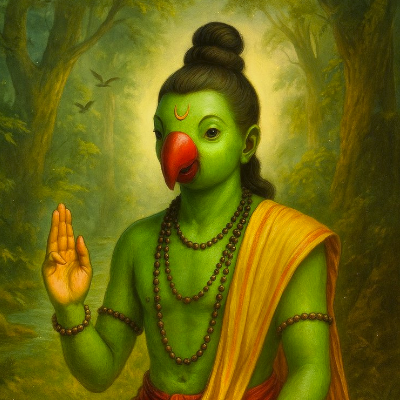
Shuka (Shukadeva) — Son of Vyasa, Narrator of the Bhagavata Purana, the Sage Born Already Liberated
Shuka · Śuka · Shukadeva · Śukadeva · Sukha · Brahmarshi · Vyasa-putra · Vatika-suta · Jabali-dautra · Parikshit-guru · Bhagavata-vakta · Jivanmukta · Avadhoota
Shuka — also known as Shukadeva — is the son of Vyasa (the compiler of the Vedas and author of the Mahabharata) and his wife Vatika (Pinjala, daughter of the sage Jabali); the grandson of the sage Parashara; the great-grandson of Vasishtha; the narrator of the Bhagavata Purana to the dying Kuru king Parikshit on the banks of the Ganga over seven days; and one of the most celebrated sages in the Hindu tradition as the supreme example of a Jivanmukta — a being who is liberated while still in the body. He is described as having been born already in a state of liberation — he did not require any spiritual practice, any teacher, or any process of purification to attain moksha because he entered the world already free of all bondage. He wandered naked through forests and hermitages without any body-consciousness, and was recognised by naked women bathing in a lake who covered themselves only when his father Vyasa followed him — because Vyasa, despite his supreme knowledge, still had the sense of distinction between male and female, whereas Shuka had no such consciousness at all. The Bhagavata Purana records that he narrated its twelve Cantos — eighteen thousand verses — to Parikshit in seven days, each day's narration proceeding from the king's questions and Shuka's answers in a structure of supreme philosophical and devotional depth. Three distinct accounts of his birth exist across the primary texts and all are recorded below.
✦ The Name
The Sanskrit name Shuka — written Śuka — means parrot. The name is explained differently across the three birth traditions. In the Skanda Purana's account his name derives from his habit of repeating everything he heard — like a parrot, memorising and reproducing perfectly. In the Mahabharata's account the name derives from the circumstances of his birth from a churning of fire-sticks: born from fire like a parrot emerges bright-coloured and sharp. In the Devi Bhagavata and related accounts involving Shiva and the parrot-soul, the name is entirely literal — he had been a parrot before entering the womb. The compound name Shukadeva — the divine parrot — is his most commonly used devotional designation. The name Sukha (happiness, contentment, bliss) is used in some texts as a variant spelling, though scholars distinguish this from the Shuka (parrot) form.
✦ Lineage
- Father: Vyasa — Krishna Dvaipayana; compiler of the Vedas; author of the Mahabharata and eighteen Puranas; son of Parashara and Satyavati; Chiranjivi; who regarded Shuka as his true spiritual heir above all other sons and disciples; whose pursuit of Shuka through the forest — and the celestial women covering themselves before Vyasa but not before Shuka — illustrated Shuka's supreme spiritual state
- Mother (Skanda Purana): Vatika (Pinjala) — daughter of the sage Jabali; in whose womb Shuka resided for twelve years; who bore twelve years of the unusual pregnancy with the parrot-soul growing inside her before Krishna's assurance induced the birth
- Paternal grandfather: Parashara — narrator of the Vishnu Purana; father of Vedic astrology; grandson of Vasishtha
- Paternal great-great-grandfather: Vasishtha — one of the seven Saptarishis
- Teacher: Janaka — the philosopher-king of Mithila; a Jivanmukta himself — one who was liberated while still performing his royal duties; to whom Vyasa sent Shuka for training, knowing that only a king who was fully liberated while living in the world could teach Shuka the philosophical framework of liberation-in-action; Shuka studied under Janaka and returned to his father
- Principal teaching: the Bhagavata Purana — eighteen thousand verses narrated to King Parikshit over seven days on the banks of the Ganga; the most comprehensive and celebrated of the Puranas; whose recitation is still performed in seven-day Saptaha formats across the tradition
- The student Parikshit: the last Kuru king of the Kurukshetra War generation; son of Abhimanyu and Uttara; grandson of Arjuna; who was cursed by the sage Shringi to die from a serpent's bite within seven days; who renounced all food and water, sat on the banks of the Ganga, and heard the Bhagavata Purana from Shuka; who attained liberation at death
✦ Birth — Three Distinct Traditions
Three incompatible accounts of Shuka's birth exist across the primary texts. In the Mahabharata's account — the oldest canonical layer — Vyasa performed one hundred years of austerity and Shuka was churned out of a stick of fire (aranya), born with ascetic power and the Vedas dwelling within him from birth, just like his father. This account makes Shuka a product of Vyasa's own tapas rather than of a biological union, and locates no mother in the narrative. In the Skanda Purana's account — the account that gives Vatika as his mother — Vyasa and Vatika (Pinjala, daughter of Jabali) produced a son who repeated everything he heard. The union was straightforward and the name Shuka derived from the child's parrot-like repetitive memory. This is the only account that names a mother and situates Shuka within a conventional family structure. It is the canonical authority for Vatika's existence. In the Devi Bhagavata Purana's account — the most elaborate and theologically distinctive — a parrot once flew into the forest where Shiva was narrating the secret of immortality (Amara Katha) to Parvati. Parvati fell asleep midway through Shiva's narration; the parrot, realising what was happening, began to make the sound of Parvati's attentive responses so Shiva would continue. Shiva completed the narration; then Parvati woke and he realised she had been asleep and another being had heard the secret. He chased the parrot to kill it. The parrot, fleeing Shiva, entered through Vatika's (Pinjala's) open mouth as she yawned and entered her womb. Shiva came to the hermitage demanding the parrot come out. Vyasa persuaded him: since the parrot now knew the secret of immortality, killing it was pointless — it would simply be immortal. Shiva withdrew. The parrot-soul refused to come out of the womb, unwilling to enter the world of attachment. It remained there for twelve years, the growing child causing Vatika increasing pain. Vyasa prayed to Vishnu. Krishna arrived and assured the parrot-soul that it would be incapable of attachment and eligible for moksha. Reassured, the parrot-soul came out as a full-grown human child named Shuka. This account is the most widely known popular version of Shuka's birth across the devotional tradition.
✦ Born Already Liberated — The Forest Women Episode
The Bhagavata Purana records the episode that most precisely illustrates Shuka's state of liberation at birth. Shuka, fully grown, left his father's hermitage immediately after his birth and wandered into the forest alone. Vyasa, grieving the departure of his son, followed him, calling his name. Shuka walked on without looking back. As Vyasa pursued him through the forest he came upon a group of celestial women — apsaras and siddha women — bathing naked in a lake. When Shuka had passed through, they remained undisturbed and did not cover themselves. When Vyasa came past, the same women immediately covered themselves. Vyasa, astonished, asked why they had covered themselves before him but not before his son. They replied that Shuka's gaze fell on them without any distinction of male and female — he perceived all forms as the same undivided awareness. Vyasa's gaze, though that of a great sage, still carried the subtle distinction of gender — and their covering was a response to that distinction. The episode is the tradition's most elegant illustration of the difference between theoretical knowledge of non-duality and the actual lived state of non-dual perception.
✦ The Janaka Episode — The Student Who Was Already Free
Vyasa sent Shuka to King Janaka of Mithila for instruction, knowing that Janaka — a Jivanmukta who maintained full liberation while performing all the duties of a king — could teach Shuka what no forest sage could: the integration of liberation with worldly function. When Shuka arrived at Janaka's palace, Janaka made him wait for three days and three nights in the outer courtyard without food, water, or acknowledgment. Shuka waited without complaint, without impatience, without any disturbance. Only then did Janaka admit him. The waiting itself was the teaching: a man who is truly liberated is not disturbed by waiting or by apparent neglect, because his wellbeing does not depend on external circumstances. Shuka had passed the test simply by being what he already was. Janaka then instructed him fully and sent him back to Vyasa.
✦ The Narration of the Bhagavata Purana to Parikshit
When Parikshit — the last Kuru king — was cursed by the young sage Shringi to die from a serpent's bite within seven days, he renounced all his royal possessions, sat on the banks of the Ganga at the sacred site of Shukartirtha, and resolved to spend his final seven days in devotion. Sages and seers gathered from across the world. At this assembly Shuka appeared — wandering, naked, without the external marks of a sage, carrying nothing. He was recognised by those assembled as Vyasa's son of supreme spiritual attainment. Parikshit asked him a single question: what is the best thing a dying man should do? Shuka's answer was the entire Bhagavata Purana — eighteen thousand verses narrated over seven days, moving from the nature of the universe to the genealogy of the royal dynasties to the childhood of Krishna to the nature of liberation and the glories of the Lord. On the seventh day Takshaka the serpent arrived in disguise, bit Parikshit, and the king died in liberation. Shuka departed. The Bhagavata Purana as known to this day is the record of those seven days.
✦ In the Mahabharata — Spiritual Guide to the Kuru Princes
In the Mahabharata itself Shuka appears occasionally as a spiritual guide to the young Kuru princes. His appearance in the text as a presence of pure wisdom — unattached, wandering, needing nothing — contrasts with the political intrigues and martial ambitions of the dynasty his grandfather had biologically founded. He studied under the guru of the gods Brihaspati and under his own father Vyasa. He is described in the Mahabharata as having surpassed his father in spiritual attainment — a statement that the tradition reads not as a criticism of Vyasa but as Vyasa's greatest achievement: the production of a son who had gone further than his teacher.
✦ References
- Mahabharata — Shuka churned from a fire-stick after Vyasa's hundred years of austerity; born with the Vedas and ascetic power from birth; his appearances as spiritual guide to the young Kuru princes; the forest women episode; his studying under Brihaspati and Vyasa
- Bhagavata Purana (Canto 1) — the frame narrative: Shuka arriving at Parikshit's gathering on the Ganga; the seven-day narration of the Bhagavata Purana; Parikshit's death and liberation; the whole Canto structured as Shuka's teaching in response to Parikshit's questions
- Devi Bhagavata Purana — the parrot-soul birth account: Shiva narrating the Amara Katha to Parvati; the parrot overhearing; the flight into Vatika's womb; the twelve-year womb residence; Krishna's assurance; Shuka's birth as a fully grown young man; this is the most widely known popular account of his birth
- Skanda Purana — Vyasa married Vatika (Pinjala) daughter of Jabali; their union produced Shuka who repeated everything he heard and was named the parrot; the canonical source for both Vatika's identity and for this version of Shuka's naming
- Wikipedia — Shuka; Wikipedia — Vyasa; Animated Water — Shukamuni son of Veda Vyasa; Devdutt Pattanaik — From Vasistha through Vyasa to Shuka; Suka Jayanti — Observance and Significance: modern summaries drawing from the above primary sources