
About
Arushi — Daughter of Vaivasvata Manu and Wife of Sage Chyavana
Arushi · Daughter of Manu · Wife of Chyavana · Bhargava-patni
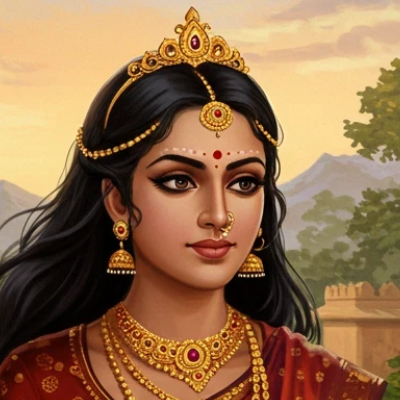
Arushi was a princess of the Solar dynasty (Suryavamsha), recorded in the Mahabharata as a daughter of Vaivasvata Manu, the progenitor of the present cosmic age and the founding king of the Solar line. She is principally significant as the wife of the great sage Chyavana, son of the primordial rishi Bhrigu and one of the most celebrated sages of the Vedic and Puranic tradition. Her marriage united the royal Solar lineage of Vaivasvata Manu with the immensely powerful priestly clan of the Bhrigus, also known as the Bhargavas. She appears in the genealogical records of the Mahabharata, specifically in the Adi Parva, and is referenced in the Bhagavata Purana in the context of the Bhrigu lineage.
✦ The Name
The name Arushi derives from the Sanskrit root associated with brightness, redness, and the light of dawn — akin to the word aruna, meaning the reddish glow of the rising sun. The name thus carries the connotation of one who is bright like the dawn or radiant as the first light. This solar quality in the name is consistent with her identity as a daughter of the Solar dynasty's progenitor, Vaivasvata Manu, himself the son of Vivasvat — the sun god.
✦ Lineage
- Dynasty: Suryavamsha (Solar dynasty) — daughter of Vaivasvata Manu, the progenitor of the present Manvantara and founding ancestor of the Solar royal line
- Father: Vaivasvata Manu — progenitor of the present cosmic age, son of Vivasvat the sun god, ancestor of all the Solar dynasty kings including Ikshvaku and his line
- Siblings: Her brothers include Ikshvaku — founder of the principal Solar royal line and ancestor of the dynasty of Ayodhya — Nabhaga, Dhrishta, Sharyati, Narishyanta, Nedishta, Karusha, Prishadhra, and Vasuman, all sons of Vaivasvata Manu recorded across the Vishnu Purana and Bhagavata Purana
- Husband: Chyavana — one of the most celebrated sages of the Vedic and Puranic tradition, son of the primordial rishi Bhrigu, renowned for his great austerities, his rejuvenation through the twin Ashvins, and his role in establishing the Ashvins' right to partake of the Soma offering
✦ The Union of Solar and Bhrigu Lines
Arushi's marriage to Chyavana represents a structurally significant junction in the Puranic genealogical record. Through her father Vaivasvata Manu she carried the full weight of the Solar royal lineage — the oldest and most prestigious of the Puranic dynastic lines, traced directly to Vivasvat the sun god and through him to the divine order itself. Through her husband Chyavana she entered the household of the Bhrigus, the priestly clan of supreme Vedic authority whose lineage traced back to the rishi Bhrigu, one of the Prajapatis and among the most powerful sages in the entire Puranic cosmos. The union of these two lines — Solar royalty and Bhrigu priesthood — through Arushi's marriage is noted in the genealogical sections of the Mahabharata as a foundational connection between the kshatriya and brahminical orders at the highest level of the tradition's sacred history.
✦ Textual Variants — Arushi and Sukanya
The primary sources preserve two distinct traditions regarding the identity of Chyavana's wife, and these traditions must be kept carefully separate.
The first tradition, found in the genealogical sections of the Mahabharata's Adi Parva, identifies Chyavana's wife as Arushi, a direct daughter of Vaivasvata Manu. This tradition places the Solar-Bhrigu union one generation closer to Manu himself and credits Arushi specifically as the mother of the sage Aurva in some recensions of this account.
The second tradition, found prominently in the Shatapatha Brahmana and elaborated in later Puranic narratives, identifies Chyavana's wife as Sukanya, the daughter of King Sharyati. Sharyati was himself a son of Vaivasvata Manu, making Sukanya Manu's granddaughter rather than his daughter. The Sukanya tradition is the more narratively developed of the two, preserving the well-known story of Sukanya's encounter with the aged Chyavana, his rejuvenation by the twin Ashvins, and his subsequent life with Sukanya as a restored young man.
Traditional commentators have attempted to harmonise these two accounts in several ways — treating Arushi and Sukanya as co-wives of Chyavana, or interpreting Arushi as an alternate name or epithet applied to Sukanya in certain genealogical verses. However, these harmonisations are the work of later commentarial tradition and are not established as fact in any single primary source. The two traditions are more accurately understood as distinct textual streams that reflect different aspects of Chyavana's biographical record in the sources that preserve them.
✦ Theological and Genealogical Significance
Arushi occupies a structurally important position in the Puranic genealogical record that her limited narrative profile might otherwise obscure. As a daughter of Vaivasvata Manu she belongs to the founding generation of the present cosmic age, the generation from which all the major Solar dynastic lines — Ikshvaku's Ayodhya line, Sharyati's line, Dishta's line, and the others — descend. Her marriage to Chyavana draws the Solar royal line into direct genealogical connection with the Bhrigu priestly tradition at this foundational level. In the Puranic understanding of cosmic and social order, such marriages between royal and priestly lineages at their most ancient and prestigious nodes carry a significance that extends beyond the individual figures involved, representing the interweaving of kshatriya and brahminical dharma at the root of the present age's sacred history.
✦ Connection to the Wider Genealogy
Arushi stands at the intersection of two of the most significant lineages in the Puranic tradition. Through her father Vaivasvata Manu she is the sister of Ikshvaku, whose Solar dynastic line produced the kings of Ayodhya including Rama; of Sharyati, whose daughter Sukanya also married Chyavana and whose line continues through Apnavana and Aurva; and of Dishta, whose line descended through Nabhanedishta, Bhalandana, and the successive kings down through Marutta, Narishyanta, and ultimately Trinabindu, Vishala, and the kings of Vaishali. Through her husband Chyavana she entered the Bhrigu lineage, one of the most powerful priestly clans of the Puranic cosmos, whose descendants include some of the tradition's most celebrated sages and whose influence on the sacred history of the present age is pervasive.
✦ References
- Primary Sources
- Mahabharata, Adi Parva — principal source for Arushi's identity as daughter of Vaivasvata Manu and wife of Chyavana; records her place in the genealogical account of the Bhrigu line
- Bhagavata Purana, Skandha 9 — provides the broader genealogical context of Vaivasvata Manu's children and the Solar dynastic lines descending from them
- Vishnu Purana, Book 4 — records the sons and daughters of Vaivasvata Manu and the Solar dynastic branches descending from them; context for Arushi's sibling relationships
- Shatapatha Brahmana — principal source for the Sukanya tradition, the second and more narratively developed account of Chyavana's wife; essential for understanding the textual variant addressed in this profile
- Mahabharata, Vana Parva — elaborated narrative of the Sukanya and Chyavana story, providing the fullest account of the second tradition discussed in the variants section
- Secondary Sources
- Vettam Mani, Puranic Encyclopaedia (1975), Motilal Banarsidass — reference entries for Arushi, Chyavana, and Sukanya; cross-referencing of the two wife traditions across primary sources
- Wisdomlib — concept entries on Arushi and Chyavana — secondary reference aggregating Puranic and epic textual material on the Arushi tradition and the harmonisation attempts by later commentators