
About
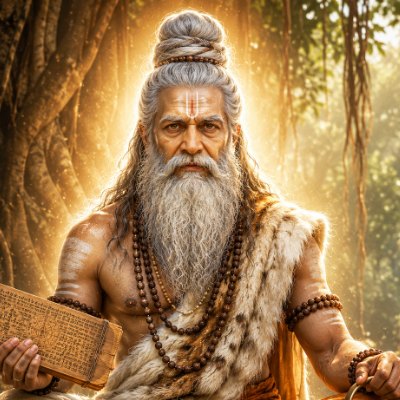
Sage Bhrigu — Saptarishi, Prajapati, Father of Astrology
Bhrigu · Bhargava · Manasaputra · Saptarishi · Prajapati · Brahmarishi · Kavyapita · Chyavanapita
Bhrigu is one of the Saptarishis — the seven great sages — and one of the ten Manasaputras, the mind-born sons of Brahma. He is one of the foremost Prajapatis, entrusted by Brahma with the facilitation and continuation of creation. He is the first compiler of predictive astrology and the author of the Bhrigu Samhita — an astrological classic said to contain horoscopes and predictions for every being in the universe. His descendants are known as the Bhargavas, a lineage that produced Shukracharya, Chyavana, Jamadagni, and Parashurama. In the Bhagavad Gita, Krishna identifies Bhrigu as one of his divine manifestations among the great sages. He is a contemporary of Svayambhuva Manu and, along with Manu, contributed to the composition of the Manusmriti.
✦ The Name
The name Bhrigu means radiant or shining in Sanskrit — connecting him to the symbolism of fire and the sun. The Rigveda credits Bhrigu as the first person to acquire Agni — fire — and bring it to humanity, a role that further reinforces his association with radiance. The adjectival form Bhargava denotes all descendants of his lineage and the school of thought he founded.
✦ Lineage
- Father: Brahma — from whose mind Bhrigu was directly born
- First wife: Khyati — daughter of Prajapati Daksha; described in the Bhagavata Purana as one of the nine daughters of Sage Kardama, more commonly identified as Daksha's daughter
- Second wife: Puloma (also called Kavyamata or Usana in some traditions)
- Son by Khyati: Dhata — associated with creation and destiny
- Son by Khyati: Vidhata — associated with fate and cosmic order
- Daughter by Khyati: Bhargavi (Sri, Lakshmi) — who became the consort of Vishnu; raised by Bhrigu and Khyati after being found on a lotus flower, hence also called Padmavati
- Son by Puloma/Kavyamata: Shukra (Shukracharya) — guru of the Asuras and the planet Venus, one of the Navagrahas
- Son by Puloma: Chyavana — renowned sage; his hermitage was at Dhosi Hill; Arushi, the daughter of Manu, became his wife; their son was Aurva, whose son was Richika, whose son was Jamadagni
- Son by Puloma (some traditions): Mrikanda — the folk sage
- Notable descendant through Chyavana: Jamadagni — father of Parashurama, avatar of Vishnu
- Hermitage: On the banks of the Vadhusar River, a tributary of the Drishadwati River, near Dhosi Hill in Brahmavarta — on the present-day border of Haryana and Rajasthan
- Father-in-law: Prajapati Daksha — whose daughter Khyati he married; Bhrigu and Daksha were thus connected by marriage even as Bhrigu aligned himself with Daksha during the yajna conflict with Shiva
✦ Character
The Puranic tradition characterises Bhrigu as a sage of extraordinary intellectual power combined with a fierce and uncompromising temperament — a man whose analytical mind and sharp judgment led him to test and challenge even the highest divine authorities without hesitation. He is described as proud, egoistic, and possessing a habit of cursing gods when displeased — qualities that the tradition presents not as simple flaws but as expressions of the fearless integrity that made him the one sage trusted to test the Trimurti. He is also credited with the knowledge of Sanjeevani Vidya — the science of restoring life — which he transmitted to his son Shukracharya.
✦ The Testing of the Trimurti
The Bhagavata Purana records that sages gathered on the banks of the Sarasvati River for a great yajna could not agree on which member of the Trimurti — Brahma, Vishnu, or Shiva — was the supreme deity and the rightful recipient of the yajna's honours. They deputed Bhrigu to determine the answer by testing all three.
Bhrigu visited Brahma at Satyaloka first. He deliberately refused to pay homage or sing Brahma's praises, testing his patience. Brahma grew angry, but restrained himself when he recognised his son's intent. Bhrigu then proceeded to Kailasha to test Shiva. Nandi stopped him at the entrance, as Shiva and Parvati were in private, and Shiva then came forward to embrace him. Bhrigu cursed Shiva that henceforth he would be worshipped only in the form of the Lingam. Finally, Bhrigu went to Vaikuntha and found Vishnu resting. When Vishnu did not respond, Bhrigu struck him on the chest with his foot, leaving an imprint — the mark known as Shri Vatsa — that Vishnu still bears. Rather than expressing anger, Vishnu rose, expressed concern for Bhrigu's foot, and apologised for not receiving him properly. Witnessing this supreme humility, Bhrigu declared Vishnu the most exalted of the three.
The tradition records that Lakshmi, who witnessed the incident from Vaikuntha, was angered by Bhrigu's disrespect toward Vishnu and cursed him that Brahmins would thereafter live in poverty. Bhrigu then explained the true purpose of his visit, and Lakshmi modified her curse — stating that Brahmins would be freed from poverty whenever they worshipped Vishnu. Because of being cursed for kicking Vishnu's chest, Bhrigu subsequently composed the Bhrigu Samhita to enable Brahmins to guide others and earn their livelihood through sacred knowledge.
✦ At the Daksha Yajna
The Shiva Purana and Vayu Purana record Bhrigu's presence at the Daksha Yajna — the great sacrifice at which Daksha excluded Shiva and at which Sati self-immolated. As Daksha's son-in-law, Bhrigu sided with Daksha and advised him to continue the yajna even after being warned that excluding Shiva would invite catastrophe. When Virabhadra subsequently destroyed the yajna, Bhrigu pleaded with Shiva for protection and was granted safe passage. The episode established his alignment with Daksha's side in the great conflict between his father-in-law and his son-in-law Shiva.
✦ In the Mahabharata
In the Mahabharata, Bhrigu appears in the Adi Parva as a foundational sage whose lineage produces several key figures of the epic. The Anushasana Parva (Chapter 85, Verse 127) names his seven sons as Chyavana, Vajrasila, Shuchi, Aurva, Shukra, Varenya, and Savana. He granted a boon for progeny to King Sagara of the solar dynasty, who performed austerities at Bhrigu Prasravana in the Himalayas — the event that eventually led to Bhagiratha's great mission to bring the Ganga to earth to liberate the sixty thousand sons of Sagara. He is also credited with giving the boon that led to the birth of Rishyashringa, the sage at the centre of the Balakanda of the Ramayana.
✦ The Bhrigu Samhita
Bhrigu is the father of Hindu astrology — the first compiler of predictive astrology. The Bhrigu Samhita is attributed to his authorship. It is said to contain over five million horoscopes recording the life details and predictions for every being in the universe based on planetary positions of the sun, moon, Mercury, Venus, Mars, Jupiter, Saturn, Rahu, and Ketu. According to tradition, only about one hundredth of these horoscopes have survived to the present age. The text forms the foundation of the Brihat Parasara Hora Shastra — the most celebrated classical text of Vedic astrology. The Bhrigu Samhita is consulted to this day by those seeking astrological guidance in the tradition of Vedic Jyotisha.
✦ In the Taittiriya Upanishad
The Taittiriya Upanishad contains a chapter called the Bhriguvalli — the teaching of Bhrigu — in which Bhrigu approaches his father Varuna and requests instruction in Brahman. Varuna responds with one of the most celebrated definitions of Brahman in the Upanishadic literature: that from which beings originate, through which they live, and into which they re-enter at death — explore that, for that is Brahman. Through successive meditations on food, life, mind, knowledge, and finally bliss, Bhrigu arrives at the realisation that Ananda — bliss — is Brahman.
✦ In the Bhagavad Gita
In the Bhagavad Gita (Chapter 10, Verse 25), Krishna names Bhrigu directly in his declaration of divine manifestations: among the great sages, he declares himself to be Bhrigu — placing the sage among the select cosmic entities through which Krishna identifies his own divine presence in the world.
✦ Associated Sacred Sites
The city of Bharuch in Gujarat bears his name — derived from Bhrigukaccha, where the Skanda Purana records that Bhrigu migrated and established himself on the banks of the Narmada River. A sacred tirtha — Bhrigu Tirtha — is associated with his name; the Padma Purana states that all sins are removed by merely sighting it and that those who bathe in its waters attain heaven. His son Chyavana's hermitage at Dhosi Hill adjoined his own, preserving the Bhargava lineage at this sacred site.
✦ References
- Rigveda — earliest references to Bhrigu as the first to acquire Agni and bring fire to humanity
- Taittiriya Upanishad — Bhriguvalli: the dialogue between Bhrigu and Varuna on the nature of Brahman
- Manusmriti (1.35) — names Bhrigu among the ten mind-born sons of Brahma entrusted with creation as Prajapatis; records his contribution to the Manusmriti alongside Manu
- Bhagavad Gita (10.25) — Krishna identifies himself as Bhrigu among the great sages
- Mahabharata (Vyasa) — Adi Parva (1.5): genealogy of Bhrigu and the Bhargava lineage; Anushasana Parva (85.127): names his seven sons; boon granted to King Sagara
- Bhagavata Purana — Skandha 6: Bhrigu's wives Khyati and Puloma; his children including Dhata, Vidhata, Lakshmi as Bhargavi, Shukra, and Chyavana; the testing of the Trimurti
- Shiva Purana and Vayu Purana — Bhrigu's presence at the Daksha Yajna; his curse upon Shiva; Shiva's assurance of safe passage
- Padma Purana — the sacred Bhrigu Tirtha and its spiritual significance
- Skanda Purana — Bhrigu's migration to Bhrigukaccha (modern Bharuch) on the Narmada
- Wikipedia — Bhrigu; Vyasa Online — Bhrigu; Hinduwebsite — Bhrigu: modern summaries drawing from the above primary sources