
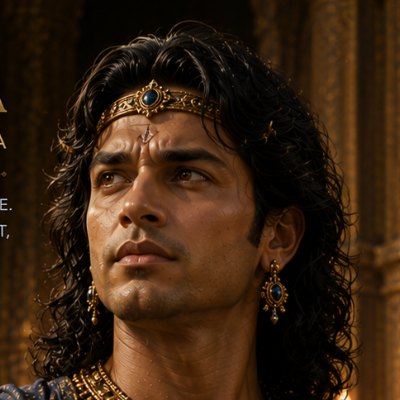
About
Vikarna — Son of Dhritarashtra, Voice of Conscience among the Kauravas
Vikarna · Vikarṇa · son of Dhritarashtra · son of Gandhari · Kaurava
Vikarna is a son of King Dhritarashtra of the Kuru dynasty and his queen Gandhari, princess of the Gandhara kingdom. He is ranked among the Kaurava brothers — the hundred sons of Gandhari — and is consistently placed third in seniority after Duryodhana and Dushasana, though some references treat him simply as one of the brothers without specifying his exact birth position beyond the first two. He is classified in the Adi Parva among the eleven Maharathis — great car-warriors — produced by Dhritarashtra's sons, and is named among the principal Kaurava warriors in the opening chapter of the Bhagavad Gita. His most significant narrative moment is his public protest during the dice game in the Sabha Parva, when he was the only member of the Kaurava assembly to argue that the staking of Draupadi was unlawful and that her humiliation should not proceed. Despite this moral stand, he remained loyal to his family and fought on the Kaurava side throughout the Kurukshetra war, dying on the fourteenth day at the hands of Bhimasena.
✦ The Name
The name Vikarna is formed from the Sanskrit prefix vi and the noun karna, meaning ear. The prefix vi has dual potential: it can function as a negation, giving the sense of without ears or earless, or it can convey the sense of separation or distinction, which in certain compounds is read as prominent or large. Ancient lexica attest both usages. The Cologne Digital Sanskrit Dictionaries cite attestations in the Atharvaveda for a form meaning having ears set apart or wide-eared as a characteristic of certain animals. In the context of a personal name, the two readings — one suggesting a person of remarkable hearing or wisdom, the other suggesting someone who does not listen — have both been proposed by commentators without consensus. The name is also attested in the Bhagavad Gita (1.8) in Duryodhana's enumeration of the Kaurava heroes before the battle, placing Vikarna in the first rank of Kaurava warriors alongside Drona, Bhishma, Karna, Kripa, Ashvatthama, and others.
✦ Lineage
- Father: Dhritarashtra — blind king of the Kuru dynasty at Hastinapura, son of the sage Vyasa by niyoga upon Ambika, widow of King Vichitravirya of the Kuru line.
- Mother: Gandhari — princess of the Gandhara kingdom, daughter of King Subala, devoted queen of Dhritarashtra, who wore a blindfold throughout her life in solidarity with her husband. She is the mother of all one hundred Kaurava brothers and of Duhsala.
- Elder brothers: Duryodhana — eldest of Gandhari's sons, crown prince and primary antagonist of the Mahabharata war; Dushasana — the second son, directly responsible for attempting to disrobe Draupadi in the assembly.
- Brothers: The remaining ninety-six sons of Gandhari and Dhritarashtra, collectively known as the Kaurava brothers; almost all were killed in the Kurukshetra war by Bhimasena.
- Half-brother: Yuyutsu — son of Dhritarashtra by a Vaishya attendant named Sauvali; he defected to the Pandava side before the war and was the only son of Dhritarashtra to survive the conflict.
- Sister: Duhsala — daughter of Dhritarashtra and Gandhari, married to Jayadratha, king of the Sindhu kingdom.
✦ Training and Early Appearances
The Adi Parva records Vikarna as one of the eleven Maharathis among the sons of Dhritarashtra, a classification denoting the highest grade of martial competence — the ability to contend simultaneously against a very large number of warriors. He trained under the royal preceptors Dronacharya, Bhishma, and Kripacharya alongside his brothers. The Adi Parva notes that among Drona's disciples who were sent against King Drupada of Panchala as guru-dakshina, Vikarna participated in the attack. The Kaurava assault on Drupada was initially repulsed, and Vikarna is among those who had to withdraw. Drona's own students, the Pandavas, subsequently succeeded where the Kauravas had failed. Vikarna is also noted as present at the svayamvara of Draupadi, the daughter of Drupada, where Arjuna eventually won her hand.
✦ The Sabha Parva — Protest at the Dice Game
The defining episode of Vikarna's narrative is his intervention during the dice game in the Sabha Parva, one of the most morally consequential scenes in the Mahabharata. After Yudhishthira, manipulated by Shakuni's loaded dice, had staked and lost his kingdom, his brothers, himself, and finally Draupadi, Dushasana dragged Draupadi into the assembly hall by her hair. Draupadi put a direct legal and moral question to the assembled kings and elders: whether Yudhishthira, having first lost himself and become a slave, had any right thereafter to stake her. The assembly fell silent. Bhishma, Drona, Kripa, and the other elders offered no answer. Duryodhana and Karna were actively complicit in the humiliation.
The primary text of the Sabha Parva records that Vikarna repeatedly called on the assembled kings to answer Draupadi's question, insisting that silence in the face of an injustice brought the entire assembly into sin. When no answer came, he spoke on his own authority. His argument rested on three points: first, that Yudhishthira had been drawn into gambling by deceitful players and was therefore acting under a form of compulsion, which diminished the validity of any stake made during that game; second, that Yudhishthira had already lost himself before staking Draupadi, and a man who is himself unfree has no legal standing to stake another person; and third, that Draupadi was the joint wife of all five Pandavas and could not be staked by one of them alone. On these grounds Vikarna declared that Draupadi had not been lawfully won. His speech drew approval from many present in the assembly.
Karna responded sharply, rebuking Vikarna by name as immature and ignorant of dharma. Karna argued that the game had been conducted properly, that Yudhishthira had staked Draupadi of his own free will, and that her polyandrous marriage disqualified her from the protections Vikarna was invoking. Karna then called for Draupadi's disrobing to proceed. The Sabha Parva thus places Vikarna in direct opposition to Karna within the Kaurava camp — an alignment that is noted in the text as further context for the bitterness between them. Vikarna's protest was ultimately overborne, but his stand is recorded in the text as the single voice of conscience among the hundred Kaurava brothers at the moment of the gravest injustice committed by their side.
The Sabha Parva also records Vikarna as one of those who opposed Duryodhana's subsequent plan to invite the Pandavas to a second dice game with the condition that the losers go into twelve years of forest exile. Along with Bhishma, Drona, Kripa, Vidura, Yuyutsu, and others, Vikarna is listed among those who objected. Dhritarashtra, however, acquiesced to Duryodhana's insistence.
✦ The Virata Parva — Encounter with Arjuna
The Virata Parva records Vikarna's participation in the Kaurava raid on King Virata's cattle during the thirteenth year of the Pandavas' exile. When Arjuna revealed himself and confronted the Kaurava forces single-handedly, Vikarna engaged him in combat. The primary text records that Vikarna was struck by Arjuna's arrows, wounded, and fell from his chariot, and subsequently fled the battlefield. This encounter is a moment of martial defeat without dishonour — Vikarna is described as having fought, not having refused or withdrawn without cause.
✦ The Kurukshetra War — Engagements and Death
Vikarna is named at the opening of the Bhagavad Gita (Bhishma Parva, Chapter 1) among the principal Kaurava heroes enumerated by Duryodhana before the first battle — placed in distinguished company alongside Drona, Bhishma, Karna, Kripa, and Ashvatthama. Throughout the war books he appears in multiple engagements as part of the Kaurava forces. On the second day, the Bhishma Parva records a direct exchange of arrows between Vikarna and Arjuna, with each striking the other with three shafts. On the third day, he is among those who advanced on Arjuna at Bhishma's command. On the sixth day, he is noted as fighting alongside other Kaurava princes; Abhimanyu is recorded as defeating him on this day. On the eighth day, he is struck in the shoulder joint by Ghatotkacha and forced to sit down in his chariot. On the tenth day, he is among ten Maharathis described as surrounding Bhima.
His death came on the fourteenth day of the war, during the phase of the battle in which Arjuna was cutting through the Kaurava formation in pursuit of Jayadratha. Vikarna, positioned as part of the defensive array, challenged Arjuna directly to single combat in archery. Arjuna, aware of Vikarna's moral stand at the dice game and unwilling himself to kill him, directed Bhimasena to take the encounter instead. Bhimasena was reluctant, moved by grief at the prospect of killing one who had spoken righteously in Draupadi's defence. The two brothers nonetheless engaged in combat with arrows. Bhimasena then killed Vikarna with his mace. The primary narrative records that Bhima wept after killing him, and Krishna reminded him that dharma, not personal sentiment, must govern such acts.
✦ Textual Variants and Inconsistencies
The question of Vikarna's precise birth order among the Kaurava brothers is handled inconsistently across sources. The Adi Parva birth-order list places him nineteenth. Wikipedia and several modern secondary accounts describe him as the third-born son. The designation "third Kaurava" appears in the Bharatpedia and Wikipedia entries and reflects a tradition that ranks him third in reputation or prominence rather than necessarily third by birth. The primary text itself does not, in the relevant battle passages, specify him as the third in birth sequence; his placement nineteenth in the Adi Parva list is the textual record. This profile treats "third in seniority" as a characterisation of his standing rather than a confirmed birth-order fact.
A minor inconsistency exists in the Bhishma Parva war accounts: the tenth-day passage listing ten Maharathis who surrounded Bhima includes Vikarna in that group, which places him as active and unwounded on Day 10, despite the Day 8 passage recording that he was struck in the shoulder and forced to sit in his chariot. Whether he recovered between Day 8 and Day 10 or whether this represents two independent textual strands is not resolvable from the primary sources.
✦ Theological and Narrative Significance
Vikarna occupies a structurally distinct position within the Mahabharata's moral framework. He is the one figure among all the Kaurava brothers who speaks from within the Kaurava assembly against the injustice perpetrated by that assembly — and who does so at personal cost, drawing Karna's public rebuke and the contempt of those supporting Duryodhana's course. Yet unlike his half-brother Yuyutsu, who acted on his convictions by defecting, Vikarna remained with his family and died fighting on their side. The text holds both figures up as morally distinct from the main Kaurava body: Yuyutsu as the one who followed dharma wherever it led him, and Vikarna as the one who understood dharma but was bound by loyalty to kin.
The detail that Bhimasena wept upon killing Vikarna, and that Krishna had to remind him of the priority of duty, is a significant moment in the war narrative. It is one of the few instances in the battle books where a Pandava warrior's grief at killing a Kaurava is directly expressed and then directly addressed by Krishna. The episode reinforces the Mahabharata's recurring theme that the war is a catastrophe that destroys the worthy and the unworthy together, and that personal virtue does not exempt a warrior from the consequences of the side he has chosen.
✦ Connection to the Wider Genealogy
Vikarna belongs to the Kuru dynasty through his father Dhritarashtra, who was fathered by the sage Vyasa on Ambika, widow of King Vichitravirya, a descendant of the lunar line through Kuru, Shantanu, and Vichitravirya. Through his mother Gandhari he is descended from the Gandhara royal house. He is a paternal half-cousin of the five Pandavas — Yudhishthira, Bhimasena, Arjuna, Nakula, and Sahadeva — sons of Pandu, Dhritarashtra's younger half-brother. No children of Vikarna are recorded in the primary sources consulted.
✦ References
- Mahabharata, Adi Parva, Adhyaya 63 (Ganguli translation, Sacred Texts Archive): Names Vikarna among the eleven Maharathis produced by Dhritarashtra's sons.
- Mahabharata, Adi Parva, Adhyaya 117 (Ganguli translation): Places Vikarna nineteenth in the birth-order list of Dhritarashtra's sons.
- Mahabharata, Adi Parva, Adhyaya 137 (Ganguli translation): Records Vikarna's participation with Drona's disciples in the attack on Drupada as guru-dakshina.
- Mahabharata, Adi Parva, Adhyaya 185 (Ganguli translation): Records Vikarna's presence at Draupadi's svayamvara.
- Mahabharata, Sabha Parva, Adhyaya 67–68 (Ganguli translation, Sacred Texts Archive): The primary source for Vikarna's protest during Draupadi's disrobing — his argument, his repeated appeals to the assembly, and Karna's rebuttal. The most narratively significant passage in Vikarna's entire arc.
- Mahabharata, Virata Parva, Adhyayas 51 and 54 (Ganguli translation): Records Vikarna's engagement with Arjuna during the Kaurava cattle raid, his wounding by Arjuna's arrow, his fall from his chariot, and his withdrawal from the field.
- Bhagavad Gita, Chapter 1, Verses 8–9 (Bhishma Parva): Vikarna is named by Duryodhana among the foremost Kaurava heroes arrayed for battle — one of the clearest attestations of his standing as a premier warrior.
- Mahabharata, Bhishma Parva, multiple adhyayas (Ganguli translation and Vyasa Online): Records Vikarna's engagements on Days 2, 3, 6, 8, and 10 of the war, including his exchange of arrows with Arjuna on Day 2, his defeat by Abhimanyu on Day 6, his wounding by Ghatotkacha on Day 8, and his presence among ten Maharathis surrounding Bhima on Day 10.
- Mahabharata, Drona Parva (Ganguli translation and Bharatpedia): Records Vikarna's challenge to Arjuna on Day 14, Arjuna's direction to Bhima to take the encounter, and Bhima's killing of Vikarna with his mace; also records Bhima's grief and Krishna's response.
- Vettam Mani, Puranic Encyclopaedia (Motilal Banarsidass, 1975): Comprehensive secondary reference compiling Vikarna's appearances across Mahabharata parvas with chapter and verse citations.
- Wisdomlib, Vikarna: 13 definitions: Secondary reference compiling etymological analysis and cross-parva attestation, including the Cologne Digital Sanskrit Dictionaries entry on the name's dual meanings.