
About
Yuyutsu — Son of Dhritarashtra, Sole Surviving Son of the Kuru King
Yuyutsu · Dhartarastra · Dhrtarastraja · Dhrtarastraputra · Karana · Kauravya · Vaisyaputra
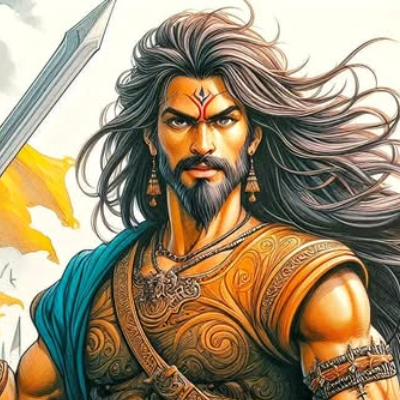
Yuyutsu is a son of King Dhritarashtra of the Kuru dynasty, born not of Dhritarashtra's queen Gandhari but of a Vaishya woman named Sauvali who served as an attendant in the royal household. He is therefore the paternal half-brother of Duryodhana and all one hundred of Gandhari's sons, as well as of Duhsala, Dhritarashtra's daughter. His mixed birth — from a Kshatriya king and a Vaishya woman — made him a figure of uncertain social standing at the Kuru court and exposed him to contempt from the full Kaurava brothers throughout his youth. Despite this, Yuyutsu consistently aligned himself with righteousness over family loyalty: he warned the Pandavas of Duryodhana's plots against them during their childhood, defected from the Kaurava side to the Pandava side on the eve of the Kurukshetra war, fought throughout the eighteen-day conflict, and survived it — the only son of Dhritarashtra to do so. In the war's aftermath he served the post-war Kuru kingdom as regent alongside the young king Parikshit. He appears across multiple books of the Mahabharata, from the Adi Parva through the Mahaprasthanika Parva, and is briefly attested in the Bhagavata Purana.
✦ The Name
The name Yuyutsu is formed from the desiderative stem of the Sanskrit verb root yudh, meaning to fight or wage war. The desiderative form conveys the sense of wishing or being eager to fight, giving the name the meaning of one who is desirous of battle or bellicose. The Mahabharata records several additional names and patronymics by which he is addressed: Dhartarastra and its variants Dhrtarastraja and Dhrtarastraputra all mean son of Dhritarashtra; Kauravya denotes his descent from the Kuru lineage; and Vaisyaputra, son of a Vaishya woman, references his maternal origin. The name Karana also appears as an alternative designation in the Adi Parva, though it is distinct from the celebrated warrior Karna, son of Kunti.
✦ Lineage
- Father: Dhritarashtra — blind king of the Kuru dynasty at Hastinapura, son of the sage Vyasa by Ambika, widow of King Vichitravirya; the father of both the hundred Kauravas and of Yuyutsu.
- Mother: Sauvali — a Vaishya woman who served as an attendant to Queen Gandhari in the royal household. She is named in the primary sources as the mother of Yuyutsu. Some secondary sources give her name as Sughada, but Sauvali is the form used in the Mahabharata text.
- Stepmother: Gandhari — princess of the Gandhara kingdom, devoted wife of Dhritarashtra, mother of the hundred Kaurava brothers and of Duhsala; she wore a blindfold throughout her life in solidarity with her husband's blindness.
- Half-brothers (paternal): The hundred sons of Dhritarashtra and Gandhari, including Duryodhana (eldest of Gandhari's sons), Dushasana (second), and Vikarna (nineteenth); Yuyutsu was born after Duryodhana and before the remaining ninety-nine Gandhari sons, making him the second-eldest of all Dhritarashtra's sons in order of birth.
- Half-sister (paternal): Duhsala — daughter of Dhritarashtra and Gandhari, married to Jayadratha, king of the Sindhu kingdom.
✦ Birth
The circumstances of Yuyutsu's birth are described in the Adi Parva. Gandhari's pregnancy had continued for over a year without delivery, causing Dhritarashtra great anxiety, particularly because Kunti had already given birth to Yudhishthira. Unwilling to wait further, Dhritarashtra fathered a child with Sauvali, the Vaishya attendant of Gandhari's household. This union produced Yuyutsu, who was born in close proximity to Duryodhana's birth and is consistently described as younger than Duryodhana but older than all of Gandhari's remaining ninety-nine sons. Because his mother was not of the Kshatriya class and was not Dhritarashtra's principal wife, Yuyutsu occupied an ambiguous position — acknowledged as a son of the king but regarded by the full Kaurava brothers as a dasiputra, a son born of a maidservant, and treated accordingly.
✦ Warning to the Pandavas — The Poison Plot
The Adi Parva records an early episode in which Yuyutsu's sympathies for the Pandavas manifested in direct action. Duryodhana, intent on eliminating Bhimasena, mixed a virulent poison into food intended for him. Yuyutsu, moved by his friendship toward the Pandavas, informed them of this plot. The text records that despite consuming the poisoned food, Bhima suffered no lasting harm. This episode established Yuyutsu's role as a conduit of information between the Kaurava court and the Pandavas and is the earliest recorded instance of his active moral alignment against Duryodhana's schemes.
✦ At the Dice Game
The Wisdomlib edition of the Mahabharata records that during the infamous dice game in the Sabha Parva, when Draupadi was dragged into the assembly and Dushasana attempted to disrobe her before the assembled court, Yuyutsu was among those who were unable to prevent the outrage but who bowed his head in shame and sorrow at what was being done. This gesture is noted in the text as distinguishing him from those who watched in silence or approval. The same quality of moral opposition to Duryodhana's conduct is shared by Vikarna, who openly protested, though Vikarna remained loyal to the family unto death while Yuyutsu ultimately chose a different course.
✦ Defection to the Pandava Side
On the eve of the Kurukshetra war, as the two armies assembled on the field, Yudhishthira publicly invited any warrior who wished to align with righteousness to cross over to the Pandava side, declaring that moral duty outweighed the bonds of prior allegiance. Yuyutsu responded to this call. He left the Kaurava ranks and presented himself to Yudhishthira, declaring his willingness to fight under him. Yudhishthira accepted him warmly, acknowledging him as one who would preserve the continuity of Dhritarashtra's line. This defection is narrated in the Bhishma Parva and marks the formal commencement of Yuyutsu's role as a Pandava-side warrior. The Pandavas and Krishna are recorded as receiving his crossing with approval. The act of defection is treated in the text not as treachery but as an exemplary choice of dharma over family, consistent with the Mahabharata's broader thematic concern with the tension between kin loyalty and moral obligation.
✦ Role in the Kurukshetra War
Yuyutsu fought on the Pandava side throughout the eighteen-day war. The war books record several specific engagements. On the seventh day, he received wounds in battle at the hands of Kripacharya. On the twelfth day, he is described as engaging Bhagadatta's elephant Supratika. On the sixteenth day, he fought Uluka, the son of Shakuni — the maternal uncle of the Kaurava brothers — but Uluka escaped the encounter. Yuyutsu is classified in the Mahabharata as an Atirathi, one capable of fighting an exceptionally large force of warriors simultaneously, placing him among the acknowledged great warriors of the age.
Crucially, Yuyutsu survived the war. On the eighteenth night, Ashvatthama conducted his devastating nocturnal assault on the Pandava camp, killing the Upapandavas and many others as they slept. Yuyutsu had already departed for Hastinapura before this massacre and was thus spared. He is named among the eleven warriors who survived the entire conflict — the five Pandavas, Krishna, Satyaki, Kritavarma, Ashvatthama, Kripacharya, and Yuyutsu — and he was the only son of Dhritarashtra among them.
✦ After the War — Regency and Final Role
Following the war, Yuyutsu's conduct continued in the same vein of conscientious service. The Shanti Parva records him as present at Yudhishthira's coronation at Hastinapura, riding immediately behind the royal chariot in the procession. He is also described attending the visit to the dying Bhishma on his bed of arrows, as part of Yudhishthira's train. The Ashramavasika Parva records that when Dhritarashtra, Gandhari, and Kunti retired to the forest in their final years and eventually died in a forest fire, Yuyutsu was the only remaining son of Dhritarashtra present to lead the funeral obsequies at Gangadwar.
The Mahaprasthanika Parva records that when the five Pandavas resolved to renounce the world and undertake their final journey, Yudhishthira entrusted the kingdom to Yuyutsu and installed Parikshit — grandson of Arjuna, son of Abhimanyu — as the new king of Hastinapura, with Kripacharya as preceptor. Yuyutsu thus served as regent and administrator for the young Parikshit, fulfilling the final civic function assigned to him by the Pandavas. The Bhagavata Purana also attests his presence in Hastinapura following the war, noting that he was present at the time of Krishna's departure and that he welcomed Vidura on his return to the city.
✦ Textual Variants and Inconsistencies
The Puranic Encyclopaedia of Vettam Mani notes a second figure named Yuyutsu mentioned in the Shanti Parva (Chapter 67, Verse 93) who is described as a son of Dhritarashtra by his wife Gandhari. This would make him a full Kaurava brother rather than the Vaishya-born Yuyutsu. Whether this represents a distinct figure, a scribal confusion, or an interpolation cannot be determined from the primary text. The two figures share the same name and the same father, and the variant is noted in the Wisdomlib reference corpus, but no separate narrative tradition exists for the Gandhari-born Yuyutsu.
A minor variant exists regarding the name of Yuyutsu's mother. The form Sauvali is the name given in the primary Mahabharata text. Some secondary sources, including certain popular retellings, give the name as Sughada or Sukhada. These are not attested in the primary sources consulted for this profile and are not adopted here.
The relative birth order of Yuyutsu presents a minor inconsistency across sources. The Adi Parva name-list places Yuyutsu second in the sequence of sons (immediately after Duryodhana), while certain secondary summaries describe him as contemporaneous in age with Duryodhana but younger by birth. The text's own statement that he was born after Duryodhana and before Dushasana and the remaining ninety-nine is consistent across the primary accounts consulted.
✦ Theological and Narrative Significance
Yuyutsu occupies a structurally significant position in the Mahabharata's moral architecture. His survival, alone among Dhritarashtra's sons, is the direct consequence of his choice to align with the Pandavas — and, in the text's framing, with dharma. His presence at the restoration of Hastinapura ensures the continuation of Dhritarashtra's paternal line into the post-war world, even as the full Kaurava line is extinguished. He thus serves a genealogical and symbolic function: the preservation of the Kuru house through its one member who chose righteousness.
His story is also the Mahabharata's clearest instance of a figure who crosses the boundary between the warring factions on grounds of conscience rather than compulsion. Unlike warriors such as Karna who remained on a side they privately questioned, or Bhishma who fought for the Kauravas despite opposing their actions, Yuyutsu acted on his convictions by physically crossing over. This is presented in the text not as desertion but as an exemplary act, welcomed and acknowledged by Yudhishthira and by Krishna.
✦ Connection to the Wider Genealogy
Yuyutsu belongs to the Kuru dynasty through his father Dhritarashtra, who was the son of the sage Vyasa by Ambika, widow of King Vichitravirya of the Kuru line. Through his mother Sauvali he descends from the Vaishya class. He is the paternal half-brother of Duryodhana, Dushasana, Vikarna, and all of the hundred Kaurava brothers born of Gandhari, as well as of Duhsala. He is a paternal half-cousin of the five Pandavas — Yudhishthira, Bhima, Arjuna, Nakula, and Sahadeva — sons of Pandu, Dhritarashtra's younger half-brother. Following the war, his role as regent under Parikshit places him in direct connection with the post-Pandava Kuru succession, bridging the generation of the war and the reign of the new king.
✦ References
- Mahabharata, Adi Parva, Adhyaya 115–117 (Ganguli translation): Records the birth of the Kaurava brothers, the circumstances of Yuyutsu's conception by Sauvali, and his placement second in the birth-order list of Dhritarashtra's sons.
- Mahabharata, Adi Parva, Adhyaya 129 (Ganguli translation): Records Yuyutsu's warning to the Pandavas about Duryodhana's second poison plot against Bhima, establishing his early alignment with the Pandava side.
- Mahabharata, Sabha Parva (Ganguli translation): Notes Yuyutsu's silent expression of shame during Draupadi's disrobing, distinguishing him from those who were indifferent.
- Mahabharata, Bhishma Parva (Ganguli translation): Narrates Yuyutsu's defection from the Kaurava side to the Pandavas on the eve of the war, in response to Yudhishthira's public invitation to warriors of conscience.
- Mahabharata, Bhishma Parva, Drona Parva, Karna Parva (Ganguli translation): Records Yuyutsu's participation in the war on the Pandava side, including his wounding by Kripacharya on Day 7, his engagement with Bhagadatta's elephant on Day 12, and his encounter with Uluka on Day 16.
- Mahabharata, Shanti Parva (Ganguli translation): Records Yuyutsu's presence at Yudhishthira's coronation and his role in the post-war restoration of Hastinapura, including riding in the royal procession.
- Mahabharata, Ashramavasika Parva (Ganguli translation): Notes Yuyutsu as the sole surviving son of Dhritarashtra who led the funeral obsequies for Dhritarashtra, Gandhari, and Kunti at Gangadwar.
- Mahabharata, Mahaprasthanika Parva, Section 1 (Ganguli translation, Sacred Texts Archive): Records Yudhishthira's transfer of the kingdom to Yuyutsu and the installation of Parikshit as king before the Pandavas' final departure, confirming Yuyutsu's role as regent.
- Bhagavata Purana, I.10.9; I.13.3; X.80 (Purana Index): Attests Yuyutsu's presence in Hastinapura after the war, his grief at Krishna's departure, and his welcoming of Vidura on his return to the city.
- Vettam Mani, Puranic Encyclopaedia (Motilal Banarsidass, 1975): Notes the two-Yuyutsu problem — one son of Sauvali and one son attributed to Gandhari in Shanti Parva — and provides the alternative name Karana from Adi Parva, Adhyaya 68.
- Wisdomlib, Yuyutsu: 16 definitions: Secondary reference compiling references to Yuyutsu across Mahabharata and Puranic sources, used for cross-checking parva locations and epithet attestation.