
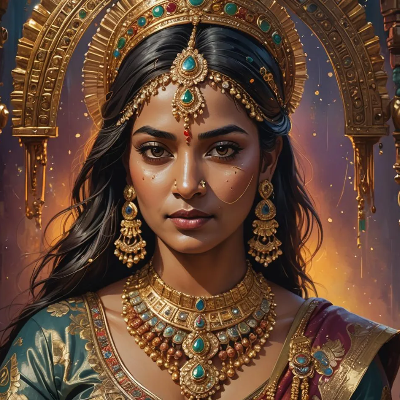
About
Sukanya — Daughter of Sharyati, Wife of Chyavana, the Princess Who Identified Her Husband Among Gods
Sukanya · Sukanyā · Sharyati-putri · Anarta-bhagini · Vaivasvata-prapautrī · Chyavana-patni · Apnavana-mata · Dadhicha-mata · Pativrata-shreshtha · Ashvini-mitra
Sukanya is the daughter of King Sharyati — a son of Vaivasvata Manu — and the twin sister of Anarta, the eponymous founder of the Anarta kingdom in Gujarat; the wife of the great sage Chyavana — son of Bhrigu and Puloma, the sage whose youth was restored by the Ashvini Kumaras; and the mother of Apnavana and Dadhicha in the primary Mahabharata tradition, and of Harita in some Puranic accounts. She is described in the Mahabharata (Vana Parva, Chapters 122–125) as one of the most celebrated exemplars of pativrata dharma — devoted wifehood as a spiritual practice — in the entire epic tradition. Her story, which spans the Shatapatha Brahmana (the earliest canonical version), the Mahabharata's Vana Parva (the most detailed narrative), and the Bhagavata and Padma Puranas (later elaborations), is simultaneously a story of inadvertent harm and lifelong devotion, of divine temptation resisted and divine reward given, and of a woman who identified her husband among three identical divine beings not through external observation alone but through the spiritual attunement that her devotion had produced. It was at Sukanya's suggestion — after Chyavana's youth was restored — that the Ashvini Kumaras were given their share of the soma sacrifice, making her indirectly responsible for one of the most significant changes in Vedic sacrificial protocol. The Mahabharata text itself introduces her story in the Vana Parva in the context of Yudhishthira asking the sage Markandeya for examples of devoted wives — a context that establishes her as one of the tradition's primary models of conjugal virtue.
✦ The Name
The Sanskrit name Sukanya — written Sukanyā — is a compound of su (good, beautiful, excellent, auspicious) and kanya (a girl, a young woman, a virgin, a daughter). The compound means the good girl, the excellent young woman, the beautiful maiden. As a name given at birth to a princess it records the family's high estimation of their daughter and the auspiciousness of her birth. The name's simplicity — beautiful young woman — stands in quiet contrast to the complexity of the life it names: the woman called the good girl inadvertently blinded a sage, married him in atonement, refused to leave him when gods offered her a better life, and identified him among divine beings through the power of her devotion.
✦ Lineage
- Father: Sharyati — son of Vaivasvata Manu (or of Pramshu, Manu's son, per one Harivamsa passage); king of the Solar Dynasty; described as a great scholar of the Vedas; who gave Sukanya in marriage to Chyavana without hesitation when the sage demanded restitution; who returned to visit her later and joyfully saw her husband transformed into a youth; who performed a soma sacrifice at which Chyavana officiated and offered the Ashvins their share of the sacred drink
- Twin brother: Anarta — eponymous founder of the Anarta kingdom in Gujarat; father of Revata; grandfather of Kakudmi (Raivata); great-grandfather of Revati who married Balarama
- Paternal grandfather: Vaivasvata Manu — the seventh Manu; son of Surya and Sanjna; survivor of the great flood; progenitor of all present-day humanity
- Husband: Chyavana — son of Bhrigu and Puloma; who was born prematurely from his mother's womb during her abduction; the premature birth burning the Rakshasa Puloman to ash; who performed such long and intense austerities at the lakeside that white ants built their mound over his entire body leaving only his eyes visible; who was restored to youth, sight, and health by the Ashvini Kumaras at the sacred pond Chandra Koop at Dhosi Hill; who created the demon Mada to compel Indra to accept the Ashvins' right to the soma; who officiated at Sharyati's soma sacrifice; already profiled separately in this series
- Sons (primary tradition — Mahabharata, Vishnu Purana): Apnavana — whose line continued the Bhrigu-Bhargava lineage through several generations; and Dadhicha — the great sage who gave his bones to the devas to make the Vajra (thunderbolt) with which Indra killed Vritra, one of the tradition's supreme examples of bodily sacrifice for cosmic good
- Son (alternate tradition): Harita — named in the Chyavana Wikipedia article as a son attributed to him in some texts
- Mother-in-law: Puloma — the wife of Bhrigu whose abduction by the Rakshasa Puloman during her pregnancy caused Chyavana's premature birth; whose tears on returning home created the river Vadhusara
- Father-in-law: Bhrigu — one of the seven Saptarishis
✦ The Piercing — The Inadvertent Harm
Two canonical versions of the event that led to Sukanya's marriage to Chyavana exist across the primary texts. In the Shatapatha Brahmana's account — the earliest version — it was not Sukanya alone who caused the harm but the sons of Sharyati (plural) who, finding Chyavana's anthill-covered body, pelted it with clods of earth. The disturbance infuriated Chyavana, whose curse created discord within Sharyati's camp. To appease him Sharyati yoked his chariot, brought his daughter Sukanya, and presented her to Chyavana in marriage. In this version Sukanya is not personally responsible for the harm — she is the appeasement gift for an offence committed by others. In the Mahabharata's Vana Parva account — the more celebrated and detailed version — Sukanya alone was wandering in the forest near the lake, plucking flowers, when she noticed two bright shining objects in what appeared to be an anthill overgrown with vines. Curious and not knowing it was a human being, she picked up a thorn or stick and poked at them. She had pierced Chyavana's eyes. The Mahabharata preserves her own words of confession to her father: roving in the forest she had lighted upon some brilliant substance in the anthill, taken it for a glow-worm, approached it, and pierced it with thorns. When the army was afflicted and her father came to Chyavana in distress, the sage said directly: your daughter has pierced my eyes, filled with pride, disregarding me. Sukanya herself stepped forward and told her father she was ready to go and serve Chyavana — it was her act and she accepted the consequence. Sharyati bestowed her in marriage without hesitation. Both versions agree on the marriage and on Sukanya's subsequent devotion. The difference is in the degree of her personal responsibility — the Shatapatha Brahmana minimises it, the Mahabharata places it squarely on her.
✦ Life with Chyavana — Devotion Freely Chosen
The Mahabharata records Sukanya's life after the marriage with quiet attention. When Sharyati left for his city, she remained at the ashrama. She renounced every comfort and luxury of the princess's life. When her father came to leave her at the sage's ashrama with saris and jewellery appropriate for a queen, she refused them all — telling him she was now the wife of an ascetic and would wear only the garments of a sage's wife. She served Chyavana — tending him, feeding him, maintaining the sacred fire, welcoming guests, observing the austere practices appropriate to the hermitage. She did this for an ancient, afflicted, blind sage whose body had been consumed by years of immobility and austerity — and she did it willingly, not under compulsion. The Mahabharata's own description of her service records: Sukanya having obtained that ascetic for her husband began to tend him, practising penances, and observing the ordinance. She worshipped Chyavana and also ministered unto guests and the sacred fire. There is one detail in the folk tradition — preserved in the Sanatanlok source — that adds a quietly precise dimension to Sukanya's character: when Chyavana provided her with queenly luxuries after his restoration to youth, she accepted them as his wife. But before the restoration — during the years of service to the old blind sage — she had already given up every claim to those luxuries voluntarily. The tradition does not record a single moment of regret, complaint, or ambivalence in her service. She had chosen to serve and she served completely.
✦ The Ashvini Kumaras — Temptation and the Test of Recognition
One day while Sukanya was bathing at the lake — the Mahabharata specifies she had just bathed and her person was bare — the Ashvini Kumaras saw her. They approached her and spoke words of beautiful flattery: whose daughter was this woman of excellent limbs, like the daughter of the lord of the celestials? What was she doing in the forest? She replied: she was Sharyati's daughter and Chyavana's wife. They proposed that she leave the old sage and take one of them as her husband — both were divine physicians of extraordinary beauty and power, and she deserved better than what she had. Sukanya refused absolutely. But the Ashvins then made a different offer: they would restore Chyavana's youth entirely so that she could make an unbiased choice among three equally beautiful men — her husband and both Ashvins — and then choose freely. This offer Sukanya brought to Chyavana. He saw the opportunity it represented for him — both the restoration of youth and the chance to repay the Ashvins with the soma offering — and agreed to accept their treatment. He instructed Sukanya to accept the Ashvins' proposal. The three — Chyavana and both Ashvini Kumaras — entered the sacred pond Chandra Koop. Specific herbal preparations had been placed in the water and applied externally as a paste; the preparation taken internally is what the tradition records as the origin of Chyavanaprasham. All three emerged from the water as identical young men of divine beauty — radiant, youthful, indistinguishable in appearance. Each stood before Sukanya and asked her to choose him as her husband. Sukanya looked at all three. The tradition records her recognition in two ways across different accounts. The Mahabharata account, drawing from the Vyasa Mahabharata text, implies she recognised Chyavana through the peaceful serenity of his eyes — a recognition rooted in spiritual attunement built across years of intimate service. The Cosmic Insights source records an alternate detail: the Ashvini Kumaras are divine beings and leave no footprints when they walk on earth, while Chyavana as a mortal — even a rejuvenated one — left footprints in the bank's mud as he emerged from the pond. Sukanya observed the footprints and identified her husband by his. She pointed to Chyavana. The Ashvins acknowledged her recognition, blessed the couple, and departed. Chyavana, restored and joyful, immediately promised that the Ashvins would receive their due share at the next soma sacrifice.
✦ Her Role in the Soma Sacrifice — The Ashvins' Right
The tradition records that it was at Sukanya's specific suggestion — made after the Ashvins had performed their service to Chyavana — that the Ashvins were offered their share of the soma at Sharyati's subsequent sacrifice. The Aitareya Brahmana confirms this detail directly: the Ashvins obtained their share in the sacrificial offerings on her suggestion. The Radha.name source records it clearly: in return for their ministrations, the Ashvins obtained a share in the sacrificial offerings in Kurukshetra, on Sukanya's suggestion. This makes Sukanya not merely a passive recipient of the Ashvins' generosity but an active agent in the resolution that followed — it was her recommendation that initiated the process by which a precedent was set and a dispute resolved. The woman who had refused the Ashvins' offer of a divine husband became the woman who secured them their divine right. The devotion that kept her faithful also produced the gratitude that produced the advocacy.
✦ Her Son Dadhicha — The Ultimate Sacrifice
Sukanya's son Dadhicha — also written Dadhichi — is one of the tradition's most celebrated figures for his supreme act of bodily sacrifice. When the demon Vritra — whose killing required a weapon made of bones harder than any other substance — threatened the cosmos, the devas went to Brahma for help. Brahma told them that only the bones of the sage Dadhicha could make a weapon capable of killing Vritra. Dadhicha agreed without hesitation — he offered his body willingly for the devas' cause, knowing it would end his life. He went to the Saraswati river, performed his final ablutions, sat in meditation, and released his life. The devas took his bones. The divine craftsman Vishvakarma fashioned from them the Vajra — the thunderbolt weapon with which Indra killed Vritra. Sukanya thus became the mother of the sage whose willing death made possible the weapon that secured cosmic order — the woman whose devotion to her husband and whose refusal to abandon him produced, through her son, one of the tradition's supreme examples of selfless service to the world.
✦ References
- Shatapatha Brahmana (Kanda IV, Adhyaya 1, Brahmana 5) — the earliest canonical account: Sharyati's sons pelting Chyavana's anthill-body; the curse; Sharyati offering Sukanya in appeasement; the Ashvins' intervention at Sukanya's behest; the rejuvenation in the pool; the soma offering
- Mahabharata (Vana Parva, Chapters 122–125) — the most detailed canonical narrative account: Sukanya wandering and piercing Chyavana's eyes with a thorn; her confession to her father; her offer to go to Chyavana's service; the marriage; her years of devoted service; the Ashvins' encounter and proposal; her refusal; their offer of youth-restoration; the triple immersion in Chandra Koop; the recognition of Chyavana; the soma sacrifice; the soma offered to the Ashvins; Indra's objection; Chyavana paralysing Indra's arm; the creation of Mada; Indra's surrender; Sharyati's visit and joy; the narrative introduced in context of Yudhishthira's question to Markandeya about devoted wives
- Aitareya Brahmana (VIII.21.4) — the Ashvins receiving their share of the sacrificial offerings on Sukanya's suggestion; the comparison of Sharyati's inauguration by Chyavana to Indra's coronation
- Bhagavata Purana (Canto 9) and Padma Purana (Patala Khanda, Chapter 8) — later Puranic versions of the Sukanya-Chyavana narrative
- Wikipedia — Chyavana; Vyasaonline.com — Sukanya; Apam Napat — Sukanya the Wife of Chyavana; Mythfolklore.net — Chyavana (Dowson's Classical Dictionary); Mahapurana.com — Tale of Sharyati; Grokipedia — Chyavana; Sanatanlok — Legend of the Marriage of Princess Sukanya and Chyavan Rishi; Radha.name — Chyavana Rishi; Cosmic Insights — The Story of Sage Chyavana: modern summaries drawing from the above primary sources