
About
Vivasvat (Surya) — Aditya, Sun God, Father of Manu, Yama, and the Ashvins, Progenitor of Both the Solar and Lunar Dynasties
Vivasvat · Vivasvan · Vivasvant · Surya · Martanda · Aditya · Savitr · Bhaskara · Dinakara · Lokachakshu · Dvadasha-Aditya · Kashyapa-putra · Aditi-suta · Vaivasvata-pita · Dharmaraja-janaka
Vivasvat — also known as Surya, Vivasvan, and Martanda — is the sun god of the Hindu tradition; the seventh of the twelve Adityas born to Kashyapa and Aditi; and the progenitor of humanity through his son Vaivasvata Manu, the seventh and current Manu who is the ancestor of all human beings living in the present cosmic age. He is the father of Yama — the god of death and cosmic justice — and of Yami — the goddess who became the river Yamuna — through his wife Sanjna (also called Saranyu); the father of Shani (Saturn), Savarni Manu, and Tapati through Sanjna's shadow-substitute Chhaya; and the father of the twin divine physicians Ashvini Kumaras (Nasatya and Dasra) and Revanta through his reunion with Sanjna in her mare form. Through Manu he is the founding ancestor of the Suryavamsha — the Solar Dynasty — from which Ikshvaku, the kings of Ayodhya, and ultimately Rama himself descend. The Bhagavad Gita (4.1) records Krishna's statement: I taught this imperishable yoga to Vivasvat, Vivasvat taught it to Manu, and Manu taught it to Ikshvaku — establishing Vivasvat as the first human recipient of the Bhagavad Gita's teaching and the founding link in the chain of its transmission to humanity. He appears in the Rigveda as one of the oldest named solar deities — already present in the earliest Vedic hymns — and in the post-Vedic tradition he is identified as a full Aditya, the son of Kashyapa and Aditi, radiant enough to burn the Asuras to death, whose very brightness was too intense for his wife to bear.
✦ The Names
The Sanskrit name Vivasvat — written Vivasvant — is formed from vi (intensifying prefix) and vasvat — shining, brilliant, radiant. Together: the intensely brilliant, the supremely radiant one. The Wisdomlib source records the name as meaning specifically the shining one in the context of the Puranic Encyclopaedia. His most common popular name Surya derives from the Sanskrit root svar — light, sky, heaven — and means the luminous one, the sun. His Vedic epithet Savitr — the nourisher, the impeller, the life-giver — is the name invoked in the Gayatri Mantra: Om tat savitur varenyam bhargo devasya dhimahi. His name Martanda — from mrit anda, born from a dead egg — records the tradition of his birth: Aditi's eighth son, whose embryo Kashyapa had previously discarded or set aside as lifeless before it became Vivasvat. Bhaskara means light-maker; Dinakara means day-maker; Lokachakshu means eye of the world. He is called Dvadasha-Aditya because he is one of the twelve Adityas — the twelve sons of Aditi — each of whom rules one month of the year. The World History Encyclopedia source records additional epithets: Graharaja (king of the constellations) and Sahasrakirana (of a thousand rays). He is cognate to the Avestan Vivanhvant — the Indo-Iranian ancestor of both Vivasvat and Vivanhvant — whose son Yima is the Avestan equivalent of Yama.
✦ Lineage
- Father: Kashyapa — the great Prajapati; son of Marichi; universal progenitor of all living beings; who performed a sacrifice and gave the southern quarter as dakshina to Vivasvat in the Mahabharata's Udyoga Parva
- Mother: Aditi — daughter of Daksha; boundless mother of the gods; mother of the twelve Adityas; whose Payovrata austerity later produced Vamana
- Brothers (co-Adityas): Vishnu, Indra (Shakra), Aryaman, Dhata, Tvashta, Pusha, Savita, Mitra, Varuna, Anshu, and Bhaga — the twelve Adityas in the order recorded by the Puranic Encyclopaedia
- First wife: Sanjna (also called Saranyu, Samjna, Sangya) — daughter of Tvashta (Vishvakarma); whose beauty, virtue, and inability to endure Vivasvat's radiance drives the central narrative of his family; per the Skanda Purana, Sanjna's mother was Virocanā — daughter of Prahlada and wife of Tvashta — making Sanjna a granddaughter of Prahlada and placing this genealogy in direct connection with the Hiranyakashipu-Prahlada-Mahabali lineage already profiled in this series
- Children by Sanjna: Vaivasvata Manu (eldest; progenitor of humanity; the current seventh Manu), Yama (twin; god of death and cosmic justice), Yami (twin; river goddess of the Yamuna), Revanta (chief of the Guhyakas; born after Sanjna became a mare), Nasatya and Dasra — the Ashvini Kumaras (twin divine physicians; born from Sanjna in mare-form; their birth is described differently across texts — some say from her nostrils, some from her womb)
- Shadow-substitute wife: Chhaya (also called Savarna) — created by Sanjna to replace herself during her absence; who Vivasvat believed was his true wife; who raised Sanjna's children but showed favouritism toward her own
- Children by Chhaya: Savarni Manu (the eighth Manu, who will rule in the next Manvantara; currently performing penance on Mount Meru), Shani (the planet Saturn; dark-complexioned; of cold and deliberate temperament), Tapati (the river Tapti of central India; who married King Samvarana)
- Additional wife (per some texts): Ragyi — a third wife mentioned in certain Puranic iconographic accounts alongside Sanjna and Prabha/Chhaya
- Son (attributed in some traditions): Sugriva — the monkey king of Kishkindha in the Ramayana; the World History Encyclopedia records Sugriva among the offspring sometimes attributed to Surya; Sugriva's mother is identified as Aruna's wife in the Valmiki Ramayana
- Daughter-in-law (through Manu): Shraddha — wife of Vaivasvata Manu; through whom the ten children of Manu — including Ikshvaku (progenitor of the Solar Dynasty) and Ila (progenitor of the Lunar Dynasty) — were born; through Ila and Pururavas the Lunar Dynasty begins, making Vivasvat the ultimate founding ancestor of both royal dynasties of the Mahabharata
- Charioteer: Aruna — the dawn; son of Kashyapa and Vinata; elder brother of Garuda; who rides ahead of Surya's chariot each morning as the reddening of the pre-dawn sky
- Chariot horses: seven horses named Harits — representing the seven colours of the solar spectrum and the seven days of the week
✦ Birth — The Discarded Eighth Son
The Bhagavata Purana and the Puranic Encyclopaedia record the cosmogonic tradition of Vivasvat's birth as the eighth son of Aditi. In a previous Manvantara Aditi had eight children — the Ashtavasus or the eight Adityas of that earlier age. When the present cosmic cycle began, Aditi once more conceived children by Kashyapa. Her first seven children were born normally and became the seven Adityas of the current age. The eighth embryo she carried was extraordinarily radiant — so intensely luminous in the womb that Aditi could not bear its full heat. She either miscarried it or set it aside. The Vishnu Purana records that the embryo was cast aside as an egg and lay dormant — hence the name Martanda, born from a dead egg. Eventually the embryo developed into Vivasvat — and his radiance, when he was finally born, was greater than all the other Adityas combined. The Rigveda (Mandala 10.72) encodes this myth in compressed form: Aditi's son who was born beyond measure and was set aside — and who became the sun.
✦ Among the Twelve Adityas
The Puranic Encyclopaedia records the twelve Adityas precisely: Vishnu, Shakra (Indra), Aryaman, Dhata, Tvashta, Pusha, Vivasvat, Savita, Mitra, Varuna, Anshu, and Bhaga. These twelve Adityas were, in the previous Manvantara — the era of Manu Chakshusha — twelve Devas called the Tushitas. The tradition records that Vivasvat holds the seventh position among the twelve — a number with obvious resonance: he himself is the father of the seventh Manu, the current Manvantara's human ancestor. Each Aditya rules one month of the solar year; Vivasvat rules the month of Bhadrapada (August-September) in the most widely cited assignment — the same month in which Vamana was born, in the same nakshatra (Shravana), at whose sacrifice Vivasvat's grand-descendant Mahabali was subdued by his own father's brother Vamana.
✦ The Sanjna Episode — Marriage, Abandonment, Reduction, and Reunion
The most elaborate narrative in Vivasvat's personal mythology is the story of his wife Sanjna's departure and their eventual reunion — told with its fullest detail in the Markandeya Purana and the Harivamsa, summarised in the Vishnu Purana and Bhagavata Purana, and also recorded in the Vamana Purana (Chapter 21) and Bhavishya Purana (Chapter 47). Vishvakarma gave his beautiful daughter Sanjna in marriage to Vivasvat. She bore him three children: Vaivasvata Manu (eldest), and the twins Yama and Yami. But Sanjna found her husband's solar radiance unbearable — it scorched her skin and overwhelmed her senses. Unable to continue living with him and unwilling to tell him the truth, she used her power of illusion to create a perfect duplicate of herself — Chhaya, her own shadow given independent form — and installed Chhaya in the household as a substitute wife. She commanded Chhaya: care for my children, do not reveal my identity, and maintain this deception as long as you can. She then went to her father's house. Vishvakarma was angered by his daughter's abandonment of her husband and rebuked her. Unwilling to return but unable to stay, Sanjna took the form of a mare and went to the forests of Uttara Kuru — the mythic land of the northern horizon — to live in peaceful, anonymous meditation. Meanwhile Vivasvat had no idea of the substitution. Chhaya managed the household. In time she bore Vivasvat three children of her own: Savarni Manu, Shani, and Tapati. She showed natural preference for her own children. Yama, noticing the difference in treatment, once raised his foot threateningly at Chhaya. Chhaya cursed him: your foot will fall off, be consumed by worms. Yama went to his father weeping and pointed out that a true mother never curses her own child even in anger — this woman was not his mother. Vivasvat confronted Chhaya; she resisted; eventually he pressed her; she admitted the truth. Vishvakarma, when approached by his son-in-law, agreed to reduce Vivasvat's solar radiance to a bearable level. He placed Vivasvat on his lathe and shaved off the excess luminosity — the material that fell away was fashioned by Vishvakarma into the divine weapons of the gods: Vishnu's Sudarshana Chakra, Shiva's Trishula, Kartikeya's Shakti spear, and Yama's staff. Reduced in intensity, Vivasvat went to Uttara Kuru and took the form of a stallion. He approached the mare — his wife — and recognised her. Their union in animal form produced the Ashvini Kumaras (Nasatya and Dasra) and Revanta. They then resumed their human forms and returned home together.
✦ Recipient of the Bhagavad Gita's Teaching
The Bhagavad Gita (4.1) records one of the most important statements in the Vaishnava tradition about Vivasvat's cosmic role: I taught this imperishable yoga to Vivasvat, Vivasvat taught it to Manu, and Manu taught it to Ikshvaku. The Puranic Encyclopaedia confirms this across multiple references: in the Mahabharata Shanti Parva (Chapter 348, Stanza 50) Krishna states that he learned Shatvatadharma from Mahavishnu and taught it to Vivasvat in the Treta Yuga; and in the Mahabharata Udyoga Parva (Chapter 109, Stanza 1) Vivasvat performed a great sacrifice and gave the southern quarter as dakshina to Kashyapa. The chain of transmission — Vishnu to Vivasvat to Manu to Ikshvaku — establishes Vivasvat as the first human-world link in the transmission of the Gita's teaching; the sun god is not merely a cosmological figure but a theological ancestor — the being through whom the most important text of the devotional tradition first entered the human world.
✦ Other Canonical Episodes
The Puranic Encyclopaedia records a series of canonical episodes involving Vivasvat across the Mahabharata. The Mahabharata Vana Parva (Chapter 3) records his 108 names. Vana Parva (Chapter 315, Stanza 19) states that Vivasvat defeated all his enemies and lived in this world. Udyoga Parva (Chapter 109, Stanza 1) records his sacrifice and the gift of the southern quarter to Kashyapa. Anushasana Parva (Chapter 150, Stanza 17) records that the Ashvini Kumaras were born through the nose of his wife Sanjna — a variant of the birth narrative. The World History Encyclopedia adds: Surya gave the White Yajurveda to the sage Yajnavalkya; he gave the magical Syamantaka gem to the nobleman Satrajit — the same gem that later became the occasion of Krishna's fight with Jambavan and his marriage to Jambavati, already profiled in this series. He is the father of Karnathrough his union with Kunti — the tradition records Kunti invoked Surya with a mantra she had received from Durvasa and Karna was born; Karna was thus an elder half-brother of Arjuna.
✦ Iconography and Worship
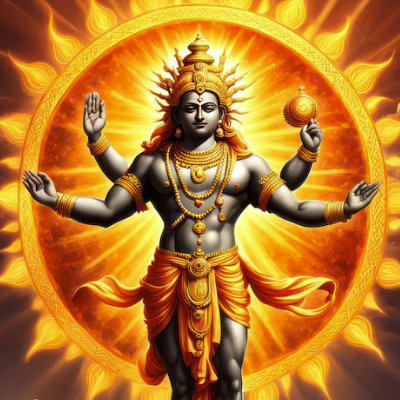
Surya is depicted as a golden-complexioned deity with four arms — holding a lotus in each of two hands, his other two hands in the varada (boon-giving) and abhaya (protection) mudras. He rides a chariot drawn by seven horses (the seven Harits), driven by his charioteer Aruna. He is flanked by two attendants — Danda and Pingala — and two archers Nanda and Sunanda. The Markandeya Purana prescribes that images should show Sanjna and Chhaya at his two sides. He wears northern boots — explained by the tradition as borrowed from the Scythian solar imagery that entered the post-Vedic iconographic tradition. He holds a golden wheel (chakra) and lotus and is surrounded by a halo of solar rays. The Konark Sun Temple (11th century, Odisha) and the Modhera Sun Temple (11th century, Gujarat) are the most celebrated surviving Surya temples. The festival of Makar Sankranti (the sun's entry into Capricorn) and Chhath Puja (celebrated along the Ganges and Yamuna) are the principal festivals of his worship.
✦ In the Vedic Tradition
Vivasvat appears in the Rigveda — particularly in Mandala 10 — as one of the oldest solar deity names, already present in the earliest layer of the text. The Rigveda (10.14) records Yama as the son of Vivasvat. The Shatapatha Brahmana and Taittiriya Brahmana develop the Martanda tradition. By the time of the Mahabharata and the Puranas, Vivasvat has become a fully personalised deity with a complete family mythology — the compressed Rigvedic solar figure expanded into the progenitor of both royal dynasties, the first recipient of the Gita's teaching, and the father of the god of death, the god of the physicians, the river of Vrindavan, and the planet of karma.
✦ References
- Rigveda — Mandala 10, Hymns 14, 17, 72: the earliest references to Vivasvat; Yama as his son; Saranyu as his wife; the compressed Martanda myth; the Indo-Iranian solar theology shared with the Avestan Vivanhvant
- Shatapatha Brahmana and Taittiriya Brahmana — the Martanda tradition; Aditi's eighth son; the birth from a discarded egg
- Bhagavad Gita (4.1) — Vishnu taught yoga to Vivasvat; Vivasvat to Manu; Manu to Ikshvaku; the transmission chain of Bhagavad Gita's teaching beginning with Vivasvat
- Mahabharata — Vana Parva, Chapter 3: the 108 names of Vivasvat; Chapter 315, Stanza 19: Vivasvat defeated all enemies; Udyoga Parva, Chapter 109, Stanza 1: the sacrifice and gift of the southern quarter to Kashyapa; Adi Parva, Chapter 171: the Sanjna-Chhaya episode; Anushasana Parva, Chapter 150, Stanza 17: the Ashvini Kumaras born through Sanjna's nose; Shanti Parva, Chapter 348, Stanza 50: Vivasvat taught Shatvatadharma by Mahavishnu
- Markandeya Purana (Cantos 107–108) — the most complete account of the Sanjna-Chhaya episode; Sanjna's inability to bear Surya's radiance; the creation of Chhaya; Yama's confrontation with Chhaya; Vishvakarma's reduction of Surya's radiance; the reunion of Vivasvat and Sanjna in mare-and-stallion form; the birth of the Ashvini Kumaras and Revanta
- Harivamsa (Vishnu Parva) — parallel account of the Sanjna episode; the weapons made from Surya's trimmed radiance
- Vishnu Purana (Book 3) — the twelve Adityas; Vivasvat's position among them; his family
- Bhagavata Purana — Skandha 6 (the twelve Adityas listed; Kashyapa and Aditi's children); Skandha 8 (Aditi's Payovrata producing Vamana, Vivasvat's brother)
- Vamana Purana (Chapter 21) and Bhavishya Purana (Chapter 47) — the Sanjna-Chhaya episode cited in the Puranic Encyclopaedia
- Skanda Purana — Sanjna's mother identified as Virocanā (daughter of Prahlada, wife of Tvashta) — connecting the Sanjna lineage directly to the Prahlada-Mahabali genealogy already profiled in this series; Sanjna identified with Rajni and Prabha
- Puranic Encyclopaedia (Vettam Mani, Wisdomlib) — the most comprehensive English-language synthesis of Vivasvat's canonical record across all Puranas and epics
- Wikipedia — Surya; Wikipedia — Sanjna; Wikipedia — Vaivasvata Manu; Wikipedia — Yama; Wisdomlib — Vivasvan (Puranic Encyclopaedia); World History Encyclopedia — Surya; Glorious Hinduism — Surya and Chhaya; Sacred Texts — Hindu Mythology, Vedic and Puranic (W.J. Wilkins, 1900): modern summaries drawing from the above primary sources