
About
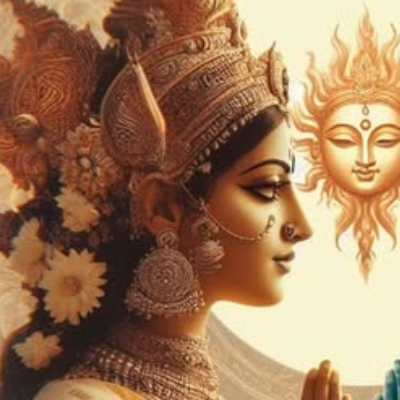
Sanjna (Saranyu) — Goddess of Clouds and Dusk, Chief Consort of Surya, Mother of Yama and Manu
Sanjna · Samjna · Saranyu · Sangya · Sandhya · Suvarchala · Rajni · Savarna · Surya-patni · Yama-mata · Manu-mata · Ashvin-janani · Vishvakarma-putri
Sanjna — known in the Rigveda as Saranyu — is the chief consort of Vivasvat (Surya), the sun god; the daughter of Vishvakarma (Tvashta), the divine architect; and the mother of Vaivasvata Manu (the seventh and current Manu, progenitor of all present humanity), Yama (the god of death and cosmic justice), Yami (the goddess of the river Yamuna), and the twin Ashvini Kumaras (the divine physicians Nasatya and Dasra), as well as Revanta (master of horses) in many texts. She is one of the most ancient named goddesses in the Hindu tradition — already present in the Rigveda — and her story is the tradition's most sustained exploration of the relationship between light in its overwhelming excess and the beings who must live in proximity to it. Unable to endure her husband's scorching solar radiance, she created her own shadow as a substitute wife, fled to the forests of Uttara Kuru in the form of a mare, and was eventually reunited with Surya only after Vishvakarma reduced the sun's intensity to a bearable level. The weapons forged from the excess radiance that was shaved away — including Vishnu's Sudarshana Chakra and Shiva's Trishula — gave her departure consequences that extended across the entire cosmic armoury. The Skanda Purana records her mother as Virocanā, the daughter of Prahlada and wife of Tvashta — which would make Sanjna a granddaughter of Prahlada, directly connecting her to the Daitya-devotional lineage already profiled in this series.
✦ The Names
The Vedic name Saranyu is the feminine form of the adjective meaning quick, fleet, nimble — used in the Rigveda for rivers and wind. She has been described in modern scholarship as the swift-speeding storm cloud — a name capturing both her association with clouds and dusk and her narrative character as a being of sudden movement, transformation, and flight. In the Harivamsa (circa 5th century CE) she is first renamed Sanjna — from the Sanskrit roots sam (complete) and jna (to know) — meaning knowledge, awareness, name, sign. This shift from speed to consciousness reflects her evolving theological role. Additional names in the Puranas include Sandhya — the twilight, the liminal moment between day and night; Suvarchala; Rajni; and Prabha — radiance. In the Vedic account the look-alike she creates is called Savarna — of the same appearance — a name that in the Puranic tradition became the name of Manu's line rather than of the shadow herself.
✦ Lineage
- Father: Vishvakarma — the divine architect; also called Tvashta; one of the twelve Adityas in the Tvashta position; craftsman of divine weapons; who arranged his daughter's svayamvara and later reduced Surya's radiance at Sanjna's indirect instigation
- Mother (Skanda Purana): Virocanā — daughter of Prahlada and wife of Tvashta; making Sanjna a granddaughter of Prahlada and connecting her directly to the Daitya-devotional lineage of Hiranyakashipu's household; the Bhagavata Purana (Skandha 5) records Virocanā as Tvashta's wife and mother of Viraja and Trishiras; not confirmed in the Harivamsa, Markandeya, or Vishnu Purana accounts of Sanjna's parentage
- Brother: Trisiras — the three-headed being; twin brother of Sanjna per the Rigveda and the Bharatpedia source
- Husband: Vivasvat (Surya) — seventh of the twelve Adityas; son of Kashyapa and Aditi; first recipient of the Bhagavad Gita's teaching in the human world
- Children by Vivasvat: Vaivasvata Manu (eldest; progenitor of current humanity); Yama and Yami (twins; god of death and river goddess of the Yamuna); Ashvini Kumaras — Nasatya and Dasra (twin divine physicians; born from her nostrils in mare-form per the Anushasana Parva, or from her womb per other accounts); Revanta (master of horses; per the Markandeya Purana and many texts); the Kurma Purana and Bhagavata Purana limit her children to three — Manu, Yama, and Yami only
- Shadow-creation: Chhaya — created from her own shadow before her departure; who replaced her in the solar household and bore Surya three more children of her own; in the Bhagavata Purana presented as Sanjna's biological sister rather than her creation
✦ In the Rigveda — The Earliest Account
Rigveda Mandala 10, Hymn 17 records the earliest layer of the myth in compressed, allusive form. Saranyu, daughter of Tvashtar, abandoned her husband Vivasvat and left a look-alike woman — Savarna — in her place before departing. Yama and Manu are her children. The twins Nasatya were born in this episode. Yaska's Nirukta (circa 500 BCE) provides the first prose explanation of the hymn. The Brihaddevata adds details of the Ashvins' birth. These three texts form the Vedic core of the narrative before the great Puranic expansion of the Harivamsa and Markandeya Purana. The Rigvedic account focuses entirely on the abandonment and the look-alike substitution — the emotional and psychological dimensions of the story are entirely a Puranic addition.
✦ Marriage and the Unbearable Radiance
Vishvakarma arranged a svayamvara for his daughter after she reached a marriageable age. Surya came as a suitor and Sanjna chose him. The marriage produced three children: Vaivasvata Manu, and the twins Yama and Yami. From the beginning, however, Sanjna's marital life was troubled. The Harivamsa records that Surya's overwhelming heat and power made him physically unpleasant to be near, while the Markandeya Purana frames it differently: Sanjna was simply unable to endure the intensity of his solar splendour. Her behaviour changed under the constant exposure to his radiance — and this change angered Surya, who cursed her next-born children. Despite this inauspicious development, she bore him the three children, and then reached the limit of what she could endure.
✦ The Creation of Chhaya — Flight to Uttara Kuru
Before leaving, Sanjna created a woman from her own shadow — bringing her reflection to life from a pond according to the Puranas Fandom account — and gave this being the identity of Chhaya. She instructed Chhaya to care for Yama, Yami, and Manu as her own children; to serve Surya faithfully; and to maintain the deception as long as possible, and if the secret ever became impossible to keep, not to reveal where Sanjna had gone. Having arranged this substitution she went first to her father Vishvakarma's house. He received her with displeasure — a daughter returning from her husband's home was not to be encouraged — and sent her back. Unable to return to Surya and unable to remain at her father's house, Sanjna transformed herself into a mare and retreated to the forests of Uttara Kuru — the mythic northern land beyond the horizon — where she lived in austere meditation. The Vishnu Purana presents a slightly different motivation: in that text Sanjna went to the forest specifically to perform tapas to gain the strength to endure Surya's heat — a more active framing in which her departure is a spiritual project rather than a flight from discomfort.
✦ Discovery — Yama's Confrontation with Chhaya
The substitution eventually unravelled through Yama's perception of unequal treatment. Chhaya was partial to her own children and treated Sanjna's children with less warmth. Yama challenged her — raising his foot to kick her in the Markandeya Purana account. Chhaya cursed him that his leg would be afflicted with worms and decay. Yama went to his father weeping and made the crucial observation: a true mother does not curse her own child, however provoked. This was not his mother. Surya confronted Chhaya. In the Markandeya Purana account she responded with a technically truthful formulation — she acknowledged being Surya's wife without confirming herself as Yama's mother — before eventually revealing the full truth of her origin and Sanjna's departure. Surya was distressed. He went to his father-in-law Vishvakarma.
✦ Vishvakarma's Reduction — The Weapons of the Gods
Vishvakarma placed Surya on his divine lathe and reduced his radiance — shaving off approximately one-eighth of his total luminosity, the Vishnu Purana records, as that was the maximum separable without destroying the solar essence itself. The material ground away was not discarded but transformed: in many Puranas Vishvakarma fashioned it into the most powerful weapons in the cosmic arsenal — Vishnu's Sudarshana Chakra, Shiva's Trishula, and Kartikeya's Shakti spear among them. The act of love — the sun god submitting to reduction for love of his wife — generated the instruments of cosmic justice and protection. Surya, now reduced to a bearable intensity, set out for Uttara Kuru to find Sanjna.
✦ Reunion — The Forest, the Stallion, the Ashvins
Surya located Sanjna in the forests of Uttara Kuru — still in the form of a mare, still in meditation. He transformed himself into a stallion and approached her. Their union in animal form in the forest produced the Ashvini Kumaras — Nasatya and Dasra, the twin divine physicians — born through Sanjna's nostrils per the Anushasana Parva, or through other means per different texts. The Markandeya Purana additionally records Revanta — the divine master of horses — as a third child of this forest reunion. After the births, Surya revealed his true form to Sanjna; she was pleased by the beauty of his reduced radiance; they were reconciled; and they returned together to the solar household where Chhaya and all the children were waiting.
✦ Genealogical Note — Granddaughter of Prahlada
The Skanda Purana's identification of Sanjna's mother as Virocanā — the daughter of Prahlada and wife of Tvashta — is an extraordinary genealogical convergence within this lineage series. If confirmed, it makes Sanjna a granddaughter of Prahlada; a niece of Virochana (father of Mahabali); a great-granddaughter of Hiranyakashipu; and through her marriage to Surya, the link connecting the Asura-devotional lineage of the Diti dynasty to the Solar Dynasty of Manu — from which the Ikshvaku kings, the Suryavamsha, and ultimately Rama himself descend. The connection is not confirmed in the Harivamsa, Markandeya Purana, or Vishnu Purana accounts of Sanjna's parentage and must be treated as a Skanda Purana specific tradition — but its presence in that text is noted in the Wikipedia article on Sanjna and is recorded here for the accuracy of this genealogical series.
✦ References
- Rigveda (Mandala 10, Hymn 17) — the earliest layer of the Saranyu myth; the abandonment of Vivasvat; the look-alike Savarna; Yama and Manu as children; the Nasatya twins
- Nirukta of Yaska (circa 500 BCE) — the first prose narration of the Rigvedic Saranyu story
- Brihaddevata — additional details on the Ashvins' birth from Saranyu
- Harivamsa (Vishnu Parva, circa 5th century CE) — the first major Puranic expansion; Saranyu renamed Sanjna; the shadow-creation of Chhaya; Yama's confrontation; Vishvakarma's reduction of Surya's radiance; the reunion; the weapons forged from the shaved radiance
- Markandeya Purana (Cantos 107–108) — the fullest Puranic account: Sanjna's inability to bear Surya's splendour; Chhaya created as shadow; Yama's kick; Chhaya's curse; the discovery; Vishvakarma reducing one-eighth of Surya's radiance; the celestial weapons; the reunion in mare-and-stallion form; the Ashvins born through Sanjna's nose; Revanta born from remaining seed; the return to the solar household
- Vishnu Purana (Book 3) — Parashara's narration; Sanjna performing tapas to endure Surya's heat; the mare-stallion reunion; three additional children Ashvins and Revanta; Vishvakarma's reduction by lathe
- Bhagavata Purana — Chhaya identified as Sanjna's biological sister; Sanjna assigned only three children — Manu, Yama, and Yami; Virocanā identified as Tvashta's wife in Skandha 5
- Kurma Purana — Sanjna assigned only three children — Manu, Yama, and Yami
- Skanda Purana — Sanjna's mother identified as Virocanā, daughter of Prahlada and wife of Tvashta
- Matsya Purana and Vamana Purana — parallel accounts of the Sanjna-Chhaya episode
- Wikipedia — Sanjna; Bharatpedia — Sanjna; Religion Fandom — Sanjna; Puranas Fandom — Sanjna Devi; SculpturePedia — Sanjana Goddess of Clouds and Twilight; Hindu Temple Talk — Sanjna the Chief Consort of Surya Deva: modern summaries drawing from the above primary sources