
About
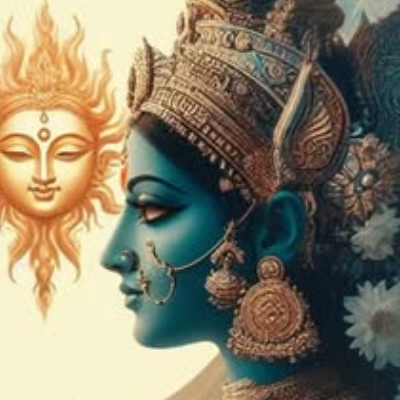
Chhaya — Goddess of Shadow, Second Consort of Surya, Mother of Shani and Savarni Manu
Chhaya · Chāyā · Savarna · Parthvi Sanjna · Surya-patni-dvitiya · Shani-mata · Savarni-Manu-janani · Tapati-mata · Vishti-mata
Chhaya — whose name means simply shadow or shade — is the personification of shadow in the Hindu tradition; the second consort of Vivasvat (Surya); and the mother of Shani (the planet Saturn; god of karma and patient consequence), Savarni Manu (the eighth and future Manu who will govern the next Manvantara), Tapati (the river Tapti of central India; ancestral mother of the Kuru lineage), and per the Matsya Purana also Vishti (a dark personification of Kala who dwells in the underworld). She was created from the shadow of Sanjna — or in the Bhagavata Purana's variant is Sanjna's biological sister — and was placed in the solar household as Sanjna's substitute during her absence. She maintained the deception for years, raised Sanjna's children alongside her own, and was eventually exposed through Yama's perception of unequal treatment. Her story is the tradition's theological statement about endurance as a form of power distinct from brilliance: where Sanjna could not sustain proximity to the solar absolute, Chhaya — being shadow by nature — could. Her son Shani embodies this quality in its most distilled form: the slow, patient, inexorable movement of karmic consequence that waits in shadow while the bright events of the world play out in light.
✦ The Names
The Sanskrit word Chhaya means shadow, shade, or reflection — both the shadow cast by a body blocking light and the image seen in water. In the Vedic accounts she is called Savarna — meaning of the same appearance, same colour, same form — a name recording her identity as a look-alike of her original. The name Parthvi Sanjna — earthly Sanjna, the terrestrial image of the heavenly original — appears in the Vishnu Purana and encodes the theological distinction between the two women: Chhaya is the earthly shadow of the divine original, the reflection of a light she did not herself generate. All three names encode the same essential identity: a being defined by her derivation from another, who nonetheless achieved an independent existence and bore children who shaped the cosmos.
✦ Origin — Three Accounts
The tradition records three distinct accounts of Chhaya's origin. In the most widely cited account — found in the Harivamsa and the Markandeya Purana — Chhaya was created directly from Sanjna's shadow before her departure: Sanjna gave life to her own shadow and named the resulting being Chhaya, instructing her to take her place. In the Puranas Fandom account Sanjna reached a pond, gave life to her reflection in the water, and named her Chhaya — a slight variant of the shadow-creation. In the Bhagavata Purana the account differs entirely: Chhaya is described as the biological sister of Sanjna and a daughter of Vishvakarma who was asked by her sister to take her place in the household. The Bhagavata Purana variant, if correct, removes the shadow-theology of the mainstream accounts — Chhaya in that version is an independent being with her own prior existence who agreed to live another woman's life in an act of sisterly sacrifice. The Kathasaritsagara (11th century CE) also retells the episode.
✦ Lineage
- Origin: created from Sanjna's shadow (Harivamsa, Markandeya Purana, Vishnu Purana) or from her reflection in a pond (Puranas Fandom) or born as a biological sister of Sanjna and daughter of Vishvakarma (Bhagavata Purana)
- Father (Bhagavata Purana variant): Vishvakarma — divine architect; father of Sanjna in the same tradition
- Husband (de facto): Vivasvat (Surya) — who did not know she was a substitute; fathered children upon her in the belief she was Sanjna
- Stepchildren raised: Vaivasvata Manu, Yama, and Yami — Sanjna's three children, whom Chhaya raised but toward whom she showed demonstrably less warmth than toward her own
- Sons by Vivasvat: Savarni Manu (the eighth Manu; named Savarni — of the same appearance — because he resembled his father exactly; destined to rule the next Manvantara; currently performing penance on Mount Meru); Shani (the planet Saturn; dark-complexioned; god of karma, discipline, and consequence); Revanta is assigned to Chhaya in the Markandeya Purana though most texts assign him to Sanjna
- Daughters by Vivasvat: Tapati — the river Tapti of central India; who married the Kuru king Samvarana and through their son Kuru gave his name to the Kuru dynasty and Kurukshetra — the ancestral grandmother through whom Chhaya becomes the genealogical ancestor of both the Pandavas and the Kauravas of the Mahabharata; Vishti — a dark personification of Kala dwelling in the underworld, per the Matsya Purana
✦ Years in the Solar Household — The Deception
Chhaya lived in the solar household for years fulfilling the role Sanjna had assigned her. Surya accepted her without question — she was indistinguishable from his wife in appearance. She bore him three children of her own. But the deception's inherent asymmetry was impossible to fully conceal: she showed natural warmth and preference toward her own children while treating Sanjna's three children with less care. This difference was perceptible to Yama, whose sensitivity to justice — the quality that would define his divine function as the god of death — detected the imbalance long before the adults did.
✦ The Exposure — Yama's Foot and the Careful Answer
In the Harivamsa account Yama raised his foot threateningly at Chhaya; in the Markandeya Purana account he actually kicked her. Chhaya responded with a curse — that his legs would be afflicted with worms and decay. Surya intervened to reduce the force of the curse, granting Yama relief in the form of a cock to eat the worms. Yama then went to his father and made his crucial observation: no true mother curses her own child, however provoked. Surya confronted Chhaya. She gave a response of studied precision — she confirmed that she was Surya's wife without stating that she was Yama's mother. The careful omission — technically truthful, practically deceptive — held the secret for one more moment before Surya pressed further and she admitted the full truth of her origin and Sanjna's departure. Surya was not angry with Chhaya but proceeded immediately to find his true wife.
✦ Shani — Her Most Celebrated Son
Shani's dark complexion — the direct transmission of his mother's shadow-nature into his body — stands in radical contrast to his father's blazing golden radiance. The tradition records that when Surya first saw his dark-skinned infant son, he doubted the child's paternity. Chhaya was distressed. Shani, even as a newborn, turned his gaze upon his father — and Surya's horses went lame and the solar chariot stalled. This was the first manifestation of Shani's power: his deliberate, slow gaze carries the weight of accumulated karma. Surya recognised the child's extraordinary power and accepted him. The tension between father and son — the blazing solar light and the patient karmic shadow — persisted through the tradition's subsequent stories. The Journey2Light source notes that Shani's ferocity of gaze came from a protective impulse toward his mother — when Yama insulted Chhaya, it was Shani who directed his cosmic gaze upon Yama in her defence — and that his drishti (gaze) brings suffering not from malice but as the exaction of karmic consequence.
✦ Tapati — The Genealogical Reach of Her Lineage
Chhaya's daughter Tapati married Samvarana, a king of the Kuru lineage, and their son Kuru gave his name to the Kuru dynasty and to Kurukshetra — the sacred field where the Mahabharata war was fought. Through Tapati, Chhaya is the ancestral great-grandmother of both the Pandavas and the Kauravas — the entire Mahabharata's principal dynasties descend from the shadow-wife of Surya through the river that bears her daughter's name. The Tapti river — one of the major rivers of the Deccan, flowing westward to the Arabian Sea through Maharashtra, Madhya Pradesh, and Gujarat — is named for Tapati and is venerated as a solar river: the daughter of Surya's shadow, flowing through the land as a perpetual trace of the mother's lineage.
✦ Theological Significance — The Power of Endurance
Chhaya's theological role is her embodiment of the specific virtue of endurance — the capacity to sustain proximity to the overwhelming without being consumed by it. Sanjna could not stay near the blazing solar radiance. Chhaya could — not because she was more powerful than Sanjna but because she was made of a different substance: shadow does not burn in light; it lives alongside it. Her son Shani embodies this quality in its cosmic form — the patient, slow movement of karmic accounting, the consequence that accumulates in darkness while the blazing events of the world unfold in the light. The tradition's placing of Shani as child of shadow rather than light carries a precise theological message: karma is not spectacular; it does not arrive with fanfare; it comes quietly, in shadow, at its own pace, inescapably.
✦ References
- Rigveda (Mandala 10, Hymn 17) — the earliest prototype: Savarna as the look-alike woman left in place of Saranyu; the Vedic root of the Chhaya tradition
- Harivamsa (Vishnu Parva, circa 5th century CE) — the first major expansion: Chhaya created from Sanjna's shadow; the substitution; Yama's threatening foot; Chhaya's curse; the discovery; Surya's investigation; Savarni Manu, Shani, and Tapati as Chhaya's three children
- Markandeya Purana (Cantos 107–108) — the fullest account: Chhaya as shadow-double; the full episode of Yama's kick and her curse; her careful partial answer to Surya; the discovery; the return of Sanjna; Chhaya's continued residence in the household; Shani, Savarni Manu, and Revanta as her children in this text's assignment
- Vishnu Purana (Book 3) — Chhaya as Sanjna's shadow-handmaid (Parthvi Sanjna); Shani, Savarni Manu, and Tapati as her children; the discovery episode
- Matsya Purana — Chhaya's children named as Savarni Manu, Tapati, and Vishti (dark personification of Kala dwelling in the underworld)
- Kurma Purana — only Savarni Manu recorded as Chhaya's son
- Bhagavata Purana — Chhaya as Sanjna's biological sister and daughter of Vishvakarma; the sibling-substitution framework rather than shadow-creation; Savarni Manu recorded as her son
- Kathasaritsagara (11th century CE) — the Chhaya episode retold in the katha literary tradition
- Wikipedia — Chhaya; Wikipedia — Sanjna; Wikipedia — Shani; Wikipedia — Tapati; Chhaya and Surya (OBNews/Markandeya Purana summary); Vedic Library by ISVARA.org — Chhaya; Journey2Light — Story of Surya Sanjana Chhaya Shani Yama Yamuna and Ashwini Kumars: modern summaries drawing from the above primary sources