
About
Vaivasvata Manu (Shraddhadeva) — The Seventh Manu, Progenitor of Current Humanity, Survivor of the Great Flood, Father of Ikshvaku and Ila
Vaivasvata Manu · Shraddhadeva · Satyavrata · Vaivasvat · Manu Shraddhadeva · Vivasvan-putra · Sanjna-suta · Pralaya-tarin · Matsya-priya · Saptarshi-rakshaka · Manavas-pitamaha
Vaivasvata Manu — also known as Shraddhadeva and Satyavrata — is the seventh of the fourteen Manus who preside over the successive cosmic ages of the present Kalpa (aeon); the son of Vivasvat (Surya, the sun god) and his wife Sanjna (Saranyu); the current Manu who governs the present Manvantara (cosmic age) named after him — the Vaivasvata Manvantara; the husband of Shraddha; and the father of ten children whose lines produced all the principal dynasties of the Mahabharata and Ramayana tradition: Ikshvaku (founder of the Solar Dynasty from which Rama descended), Ila (who became the founder of the Lunar Dynasty from which the Pandavas and Kauravas descended), Sharyati, Nabhaga, Dhrishnu, Narishyanta, Prishadhra, Nabhagarishtha, Korusha, and Pramshu. He is the central figure of the tradition's flood narrative — warned by Vishnu in the form of a small fish, he built a great boat that carried his family, the seven Saptarishis, the Vedas, and the seeds of all living beings through the catastrophic deluge that ended the previous Manvantara, anchoring finally on the highest peak of the Himalayas. He is the archetypal progenitor of all present-day humanity — the Sanskrit word for human, manushya, derives from his name, meaning simply of Manu, descended from Manu. He was previously the king of the Dravida kingdom (in present-day South India) under his earlier name Satyavrata — the always truthful — before the flood transformed him from a regional king into the progenitor of all humanity for the present cosmic age. His story spans the Rigveda, the Shatapatha Brahmana, the Mahabharata, and every major Purana, making him one of the most widely attested figures in the entire Hindu canonical tradition.
✦ The Names
The title Manu — from the Sanskrit root man (to think, to reflect) — means the thinking one, the reflective one, the one who contemplates. It is both a personal name and a cosmic title: in each of the fourteen Manvantaras of the present Kalpa, a different being serves as Manu — the lawgiver-progenitor of humanity for that age — and each is referred to by the Manu designation alongside their personal name. The Sanskrit word manushya (human being) and its English cognate Man both derive from this root, recording that all humans are defined as the descendants of Manu. His personal name Satyavrata — from satya (truth) and vrata (vow, practice) — means the one whose vow is truth, the always truthful. His name Shraddhadeva — from shraddha (faith, devotion, sincerity) and deva (god, divine being) — means the divine one of faith, the god of sincerity. His patronymic Vaivasvata — from Vivasvat, one of Surya's names, with the patronymic suffix a — means simply son of Vivasvat, the sun-born one. The Mahabharata describes him directly: Manu was endowed with great wisdom and devoted to virtue, and he became the progenitor of a line; and in Manu's race have been born all beings, who have therefore been called Manavas.
✦ Lineage
- Father: Vivasvat (Surya) — the sun god; the seventh of the twelve Adityas; son of Kashyapa (the universal Prajapati) and Aditi (daughter of Daksha and Prasuti); the first human recipient of the Bhagavad Gita's teaching; whose wheel was reduced by Vishvakarma to allow Sanjna to bear his radiance
- Mother: Sanjna — also called Saranyu in the Rigveda; daughter of Vishvakarma (the divine architect); who created her shadow-double Chhaya to replace herself in the solar household when she could no longer bear Vivasvat's intense radiance; who lived as a mare in the forests of Uttara Kuru until Vishvakarma reduced Vivasvat's radiance and the two were reunited
- Full siblings (children of Sanjna): Yama — the god of death and cosmic justice; his twin Yami — the river goddess Yamuna; and the Ashvini Kumaras (Nasatya and Dasra) — the twin divine physicians born when Vivasvat and Sanjna reunited in horse and mare form
- Half-siblings (children of Chhaya, Sanjna's shadow-double): Shani (the planet Saturn), Savarni Manu (the future eighth Manu, who will govern the next Manvantara), Tapati (the river Tapti of central India), and Vishti
- Wife: Shraddha — also called Nadbala in some texts; daughter of the sage Vishvakarma in one tradition; who bore him the ten children; her name means faith, devotion, sincerity — the quality that defines her husband's primary epithet Shraddhadeva
- Children: ten — nine sons and one daughter (or one son and one daughter who produced two distinct lines, depending on the text tradition):
- Ikshvaku — eldest son; founder of the Ikshvaku Solar Dynasty (Suryavamsha); from whose line the kings of Ayodhya descended; including Sagara, Dilipa, Raghu, Dasharatha, and Rama (the seventh avatar of Vishnu)
- Ila (Sudyumna) — the child born as a girl named Ila, who was transformed into a man named Sudyumna by Shiva's curse, then back to a woman, and alternated between male and female states monthly; who in the female state married the sage Budha (son of the moon god Chandra) and bore him Pururavas — the first king of the Chandravamsha (Lunar Dynasty); through Pururavas the entire Lunar Dynasty descended — including the Pandavas and Kauravas of the Mahabharata
- Sharyati — father of Sukanya (who married the sage Chyavana) and Anarta (ancestor of Balarama's wife Revati); already profiled separately in this series
- Nabhaga — whose line produced several important Vedic-era kings
- Dhrishnu — ancestor of the Dhrishta clan
- Narishyanta — whose descendants included several important lineages of the northern Doab
- Prishadhra — who killed a cow of his preceptor by mistake and was cursed to become a Shudra; who later attained liberation by entering a forest fire in meditation
- Nabhagarishtha — whose line continued in specific regional traditions
- Korusha — ancestor of the Karusha kingdom in the Vindhya region
- Pramshu — whose son in one Puranic tradition was Sharyati — creating the textual inconsistency noted in the Sharyati profile
- Paternal grandparents: Kashyapa (the universal Prajapati; son of Marichi; father of all species through his many wives) and Aditi (daughter of Daksha and Prasuti; mother of the twelve Adityas)
- Cosmic position: the seventh of fourteen Manus in the present Kalpa; governing the Vaivasvata Manvantara which spans 71 Mahayugas, each Mahayuga being 4,320,000 years; the Manvantara began after the great flood and continues through the present day; we are currently in the 28th Chaturyuga (four-Yuga cycle) of his Manvantara
✦ As Satyavrata — The King Before the Flood
Before the great flood, Vaivasvata Manu was known as Satyavrata — the always truthful — and he was the king of the Dravida kingdom in present-day South India. The Matsya Purana places his kingdom near the Malaya Mountains with the Kritamala (or Kritamali) river flowing through it. He was a pious and righteous king whose daily austerities included the ritual of offering water oblations to the gods at the river's edge each morning — the practice of Tarpana. In this pre-flood existence he was not yet the Manu of the age but simply a virtuous king performing his royal and spiritual duties with unusual dedication. His father Vivasvat (Surya) had already transmitted the Bhagavad Gita's teaching to him — the Bhagavad Gita (4.1) records the chain: Vishnu taught the imperishable yoga to Vivasvat, Vivasvat taught it to Manu, and Manu taught it to Ikshvaku — establishing Satyavrata as the second link in the most celebrated teaching transmission in the tradition.
✦ The Matsya Avatar — The Fish, the Flood, and the Rescue
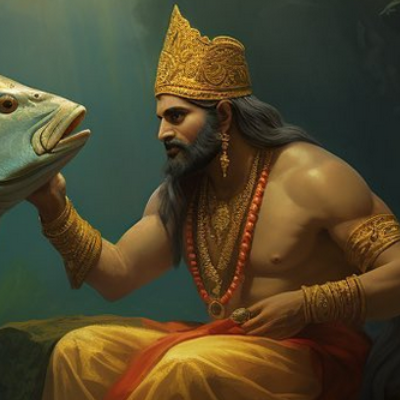
The central narrative of Vaivasvata Manu's story — narrated in the Shatapatha Brahmana (the oldest version), the Mahabharata (Vana Parva, Chapter 187), the Matsya Purana, the Bhagavata Purana (Canto 8), and the Vishnu Purana — is the great flood and the Matsya avatar of Vishnu. One morning, while Satyavrata performed his ritual water oblations at the Kritamala river, a tiny fish slipped into the folds of his cupped hands. He was about to cast it back into the river when it spoke to him — pleading to be saved from the larger fish that would devour it. Moved by its appeal, he placed it in a jar. By the next morning the fish had grown too large for the jar. He transferred it to a larger vessel; it grew again; he moved it to a well; it filled the well; he moved it to a tank; it filled the tank; he moved it to a river; it filled the river; he finally released it into the ocean. As it entered the ocean it revealed its divine nature — it was Vishnu himself in the form of a fish. The fish revealed to Satyavrata that a catastrophic flood would engulf the three worlds in seven days, marking the dissolution at the end of the Chakshusha Manvantara — the previous cosmic age — and the transition to a new one. He instructed Satyavrata to build a great boat, load it with the seeds of all plants and living beings, and bring the seven Saptarishis aboard. He told him that at the time of the flood the fish would return with a horn — and Satyavrata should fasten the boat to the horn using the great serpent Shesha (Vasuki in some versions) as a rope. Satyavrata obeyed without hesitation. He built the boat. The flood came — the Bhagavata Purana describes torrential rains covering the earth with water, the submergence of all three worlds, chaos on the cosmic waters. The great fish reappeared — now enormous, with a blazing horn. Satyavrata fastened the boat to the horn. The fish towed the boat through the raging cosmic waters, moving toward the northern mountains. In the Matsya Purana the boat rested on the Malaya Mountains; in the Bhagavata Purana on the peak called Naubandhana (the harbour) in the Himavat range; in other texts on Mount Meru or the peak of the Himalayas. When the waters receded, the fish revealed its identity fully — either as Brahma (the Shatapatha Brahmana's version) or as Vishnu (all subsequent Puranic versions). The fish instructed Satyavrata to begin the work of repopulating the earth and establishing the order of the new cosmic age, and appointed him as the Manu of the new Manvantara. After the flood, Satyavrata performed a sacrifice invoking the power of creation. From the sacrificial waters emerged a woman — Ida (also called Ila in some texts) — who declared herself his daughter and through whom he began the process of repopulating the earth. This post-flood Ida-Ila is the woman who became the mother of the Lunar Dynasty's first king Pururavas through her union with the sage Budha — establishing both the Solar Dynasty (through Ikshvaku, born later) and the Lunar Dynasty (through Ila/Ida) as flowing from Vaivasvata Manu's household.
✦ The Textual Variants — Brahma or Vishnu as the Fish
The earliest version of the flood narrative — the Shatapatha Brahmana — identifies the fish as Brahma (Prajapati), not Vishnu. The fish is explicitly identified as the Lord of all creatures who assumed fish form to save the sages and entrusted Manu to recreate all beings. In all subsequent Puranic versions — the Matsya Purana, the Bhagavata Purana, the Vishnu Purana, and the Mahabharata — the fish is consistently identified as Vishnu in the form of the Matsya avatar. The tradition's shift from Brahma-fish to Vishnu-fish reflects the broader Puranic transition from the Brahma-centred cosmology of the Vedic sacrificial tradition to the Vishnu-centred devotional theology of the Puranic tradition. Both traditions are recorded here as different textual strata of the same narrative.
✦ The Svayambhuva Manu Distinction
Vaivasvata Manu is the seventh Manu and must be carefully distinguished from Svayambhuva Manu — the first Manu, born from Brahma's own body, who is the husband of Shatarupa and the father of Priyavrata, Uttanapada, Akuti, Devahuti, and Prasuti. These two Manus represent different cosmic eras — the first and the seventh Manvantara respectively. Svayambhuva Manu is the progenitor of the genealogical series that includes Daksha, Prasuti, Sati, Parvati, and through them the divine household of Shiva. Vaivasvata Manu is the progenitor of the royal dynasties — the Solar and Lunar lines that produced Rama, the Pandavas, the Kauravas, and Krishna. The two Manus are connected in the larger cosmic genealogy: Svayambhuva Manu's daughter Devahuti is the mother of Kapila and of the nine Kardama-daughters including Khyati (wife of Bhrigu). Svayambhuva Manu's daughter Prasuti is the mother of Sati. These connections place the two Manus in a single genealogical universe while keeping them distinct as figures of different cosmic eras.
✦ The Vaivasvata Manvantara — Its Structure
The Vaivasvata Manvantara — the present cosmic age, named after Vaivasvata Manu — governs the current period of creation. Its structure, as recorded in the Bhagavata Purana (Canto 8, Chapter 1) and the Vishnu Purana (Book 3, Chapter 1), is as follows: the Manu is Vaivasvata Manu (Shraddhadeva); the Indra of Svarga is Purandara (the present Indra); the Saptarishis are Kashyapa, Atri, Vasishtha, Vishvamitra, Gautama, Jamadagni, and Bharadvaja; the divine classes include the Adityas, Vasus, Rudras, Vishvedevas, Maruts, Ashvins, and Ribhus; and Vishnu's Manvantara avatar is the Vamana — the dwarf who strode across the universe in three steps at Mahabali's sacrifice, the avatar profiled in connection with the Prahlada-Mahabali lineage at the beginning of this genealogical series. One Manvantara consists of 71 Mahayugas, each Mahayuga being 4,320,000 years — making the entire Vaivasvata Manvantara approximately 306,720,000 years in duration. We are currently in the twenty-eighth Chaturyuga of Vaivasvata's Manvantara, specifically in the Kali Yuga (the last and most degenerate of the four Yugas) of that twenty-eighth cycle.
✦ The Genealogical Significance — Both Royal Dynasties From One Household
The most extraordinary genealogical fact about Vaivasvata Manu is that both the Solar Dynasty and the Lunar Dynasty — the two great royal lineages of ancient India whose stories constitute the Ramayana and the Mahabharata respectively — flow from his single household. Ikshvaku, his eldest son, founded the Solar Dynasty from which Rama descended sixty-six generations later. Ila, his daughter (or child who alternated between male and female), founded the Lunar Dynasty through Pururavas from which the Pandavas and Kauravas descended — and through the Yadava branch of the same dynasty, Krishna descended as well. Through the Ila-Pururavas-Nahusha-Yayati-Yadu-Vrishni-Vasudeva line, Vaivasvata Manu is the direct ancestor of Krishna. Through the Ila-Pururavas-Nahusha-Yayati-Puru-Kuru-Shantanu-Pandu line he is the direct ancestor of Arjuna. The same Manu who survived the flood by the grace of a divine fish gave the world, through his two children, both the figures who participated in the Bhagavad Gita's transmission — Arjuna who received it and Krishna who gave it.
✦ The Manusmriti
The Manusmriti — the Laws of Manu — is the most comprehensive and widely cited ancient Hindu code of law and social ethics. Though its title references Manu, scholarly consensus holds that it was composed over several centuries (circa 200 BCE to 300 CE) and does not refer to Vaivasvata Manu specifically but to the first Manu, Svayambhuva, as its authority. The title uses Manu as a generalised authority for the human lawgiving tradition — every Manu is both the progenitor of humanity for his era and its lawgiver. In popular tradition, however, Manusmriti is frequently associated with Vaivasvata Manu as the current Manu and the most directly relevant lawgiving ancestor of present-day humanity.
✦ References
- Rigveda (Mandala 8, Hymns 29 and 62) — the earliest canonical references to Manu as the archetypal first man and sacrificer; Manu's sacrificial fire as the model for all subsequent Vedic ritual
- Shatapatha Brahmana (Book 1, Chapters 8.1–8.6) — the earliest full narrative of the flood: the small fish in Manu's hands; the growth through successive containers; the warning of the flood; the boat; the fastening to the horn; the fish revealed as Brahma (in this earliest version, not Vishnu); the sacrifice producing Ida; the repopulation of the earth; the foundational Vedic text for the entire tradition
- Mahabharata (Vana Parva, Chapter 187 — the Matsya Purana episode within the Mahabharata) — the flood narrative in the epic tradition; the fish identified as Vishnu; the Saptarishis aboard the boat; the Himavat peak as the landing site
- Bhagavad Gita (4.1) — the transmission chain: Vishnu taught the yoga to Vivasvat; Vivasvat to Manu; Manu to Ikshvaku; establishing Vaivasvata Manu as the second link in the Gita's teaching lineage
- Matsya Purana — the most detailed Puranic account: Satyavrata as king of Dravida; the Kritamala river; the fish growing through jar-pit-tank-river-ocean stages; Vishnu revealing himself; the seven-day warning; the boat; the Malaya Mountains as landing site; Vishnu appointing Satyavrata as Manu
- Bhagavata Purana (Canto 8, Chapters 1 and 24) — the Vaivasvata Manvantara structure; the Matsya avatar narrative; the Saptarishis and Vedas aboard the boat; Naubandhana as the mountain peak; the transition from Satyavrata to Vaivasvata Manu
- Vishnu Purana (Book 3, Chapter 1) — the Manvantara structure; the Manu list; Vaivasvata as the seventh Manu; the Solar Dynasty beginning with Ikshvaku
- Harivamsa (Adi Parva, Chapter 10) — the ten children of Vaivasvata Manu listed; the two dynasties flowing from his household
- Wikipedia — Vaivasvata Manu; Grokipedia — Vaivasvata Manu; Dharmapedia — Manu Vaivasvata; Religion Fandom — Sraddhadeva Manu; IndiaSpiritualWordpress — Story of Vaivasvata Manu; OnArtAndAesthetics — Manu and Matsya: modern summaries drawing from the above primary sources