
About
Tvashtr — Divine Craftsman of the Rigveda, Aditya, Father of Saranyu and Vishvarupa, Creator of Vritra, and Partial Identification with Vishvakarma
Tvashtr · Tvastar · Tvashtri · Devashilpi · Rupapati · Aditya · Sarvarupadhata · Vishvakarma-abheda · Soma-pala · Vajra-karta · Garbha-vidhata
Tvashtr is one of the oldest and most significant divine craftsmen in the Hindu tradition — a figure of the Rigveda whose creative and fabricating power was among the most elaborately documented of any deity in that corpus, and whose identity later merged in complex ways with that of Vishvakarma, the divine architect of the Puranic and epic traditions. He is identified in later scriptures as one of the twelve Adityas — the sons of Kashyapa and Aditi — though in the Rigveda itself his parentage is not given in the same systematic way that the Puranic tradition subsequently established. He is the craftsman who made Indra's bolt — the Vajra — the axe of Brihaspati, and the divine cup for the soma sacrifice; the fashioner of the forms of living beings and the guardian of the womb; the progenitor of humans through his daughter Saranyu who married Vivasvat the sun god; the father of the three-headed Vishvarupa; and the figure whose grief and rage at Indra's killing of his son Vishvarupa led to his creation of the demon Vritra — the act whose fatal mispronunciation gave Indra the means to defeat the demon that Tvashtr had made to destroy him. His relationship with Indra is one of the Rigveda's most sustained divine conflicts — characterised by Indra's repeated theft and aggression and Tvashtr's repeated powerlessness to prevent or avenge it until his creation of Vritra, which the tradition presents as both his most consequential act and his most consequential failure. He is identified in the later Puranic tradition with Vishvakarma — the identification is made explicitly in the Shiva Purana and the Markandeya Purana — and through this identification his daughter Saranyu is simultaneously identified as Vishvakarma's daughter Sanjana. The Wisdomlib Tvashtri article cites the Shiva Purana's explicit identification of Tvashtri with Vishvakarma. He appears in the Rigveda across multiple Mandalas, the Atharvaveda, the Taittiriya Samhita, the Shatapatha Brahmana, the Brihaddevata, the Mahabharata, and numerous Puranas.
✦ The Names
The name Tvashtr derives from the Sanskrit root tvaksh or taksh — to cut, to fashion by cutting, to shape by working material — and carries the sense of "the cutter," "the fashioner," or "the one who shapes by the craft of cutting and carving." The root taksh is the specific word for the carpenter's or craftsman's act of shaping material — distinct from the broader act of creation but denoting the specific technical process of working a material into a desired form. Tvashtr as "the fashioner" or "the cutter of forms" is thus named directly for the technical act that defines his divine function. The Vedic Index entry cited in the Wisdomlib source notes that in the Atharvaveda the word tvashtri is used once to denote a "carpenter" with a deliberate wordplay on the god's name. The epithet Rupapati means "lord of forms" — encoding his identity as the creator and fashioner of the forms of all living beings. Garbha-vidhata means "the fashioner of the womb" — his Rigvedic role as the being who shapes the embryo. Soma-pala means "guardian of soma." Vajra-karta means "maker of the Vajra." The partial identification Vishvakarma-abheda means "non-different from Vishvakarma."
✦ Lineage
- Parents — the Aditya identification: The later Puranic and epic tradition identifies Tvashtr as one of the twelve Adityas — the sons of Kashyapa and Aditi — thus giving him the same parentage as Indra, Vishnu, Vivasvat, Varuna, Mitra, and the other Adityas. The Shiva Purana passage cited in the search results explicitly lists Tvashtri among the twelve Adityas born of Aditi and Kashyapa in the Chakshusa Manvantara. The Mahabharata's Adiparva chapter 65 verse 15 and the various Puranic Aditya lists consistently include Tvashtr as one of the twelve. This later Puranic identification gives Tvashtr a systematic genealogical position that the Rigveda does not provide — in the Rigveda his parentage is not stated with the same specificity as his functional identity.
- Parents — the Rigvedic tradition: In the Rigveda itself Tvashtr is not consistently assigned specific parents. His identity is defined by his function rather than his genealogy — he is the divine craftsman, and his parentage is less important than his creative role. Some Rigvedic passages associate him with the Adityas while others treat him as an independent divine figure of ancient standing.
- Wives — variant accounts: The primary sources give Tvashtr's wives inconsistently. The Brihaddevata — the Rigvedic interpretive text attributed to Shaunaka — states that Tvashtr had two children, Saranyu and Trisiras, who were twins, and that both were born of the same mother. Some Puranic and Brahmana passages identify one of Tvashtr's wives as an Asura woman — the mother specifically of Vishvarupa — by whom he had the three-headed son. The Trisiras Wikipedia article states that according to the Mahabharata's Shanti Parva, Vishvarupa was the son of Tvashtr and Rechana — with Rechana being the Asura wife. This dual wife tradition — one divine wife who bore the daughter Saranyu and one Asura wife who bore the son Vishvarupa — is the most coherent reading of the evidence available, though not all primary sources give both wives explicitly.
- Son — Vishvarupa (also called Trisiras): The three-headed son of Tvashtr, whose three heads respectively drank soma, sura (wine), and food for the gods. He is described in the Rigveda as the guardian of cows and an adversary of Indra. In the Taittiriya Samhita and Brahmana tradition, after Brihaspati refused to serve as the gods' priest following Indra's insult, the gods appointed Vishvarupa as their new sacrificial priest. Vishvarupa, being half-Asura through his mother, secretly gave portions of the sacrifice to the Asuras as well as to the gods. Indra suspected his divided loyalty and beheaded him. The murder of Vishvarupa — his own priest — constituted the sin of brahminicide (brahmahatya) for Indra, since Vishvarupa was both a brahmin and the officiating priest. This sin had to be distributed across the earth, the trees, the water, and women before Indra could be freed from it. In the Rigveda's account, Aptya (an ally of Indra) kills Vishvarupa and Indra beheads him. In the Brihaddevata, Vishvarupa is the twin of Saranyu, born of the same Tvashtr but of his Asura wife rather than his divine wife.
- Daughter — Saranyu (also called Sanjana and Samjna): The daughter of Tvashtr who married Vivasvat the sun god — the most genealogically consequential of Tvashtr's children. The Rigveda's tenth Mandala contains the cryptic Saranyu narrative — the mysterious departure of the bride, the substitution, the births of Yama and Yami and later the Ashvins. In the Puranic tradition Saranyu becomes Sanjana and Tvashtr becomes Vishvakarma, but the narrative core is the same. Her children — Manu, Yama, Yamuna, the Ashvins, and Revanta — make Tvashtr the maternal grandfather of the progenitor of the human race, the lord of death, the river goddess, and the divine twin physicians. Her profile and the full Sanjana-Surya-Chaya episode are given in the Vishvakarma profile and in the Sanjana profile referenced in this series.
✦ Tvashtr in the Rigveda — the Fashioner of Forms
The Rigveda's Tvashtr is one of the most multiply attested divine figures in the collection — he is invoked across several Mandalas and in diverse contexts that give his identity a breadth greater than any single functional description can capture. At his most fundamental he is the fashioner of forms — rupa in Sanskrit — and this creative function operates at multiple levels simultaneously. He fashions the physical forms of living beings — including the embryonic form in the womb — making him the divine craftsman of life itself at its most originary moment. He fashions divine implements and weapons. He fashions the soma cup — the special vessel for the sacred drink. He fashions the Vajra for Indra. He shapes the two worlds — heaven and earth. He is, in the Rigveda's language, the universal fashioner whose creative act underlies all formed existence.
The Rigvedic verse cited in the Tvashtr Fandom article — "Tvashtadeva prepared for Indra a powerful thunderbolt that penetrates the target well" — is from Rigveda 1.61.6 and is one of the explicit primary source attestations of Tvashtr as the maker of the Vajra in the Rigvedic tradition. This same role — fashioning the Vajra for Indra — is later attributed to Vishvakarma in the Puranic tradition through the Dadhichi's bones episode, and the identification of the two craftsman deities is partly rooted in this shared function. The earlier Vedic tradition credits Tvashtr with making the Vajra directly; the later tradition reassigns the most famous Vajra-making episode to Vishvakarma while placing a different Vajra-making act (from Dadhichi's bones) at its centre.
Tvashtr is also the guardian of soma in the Rigvedic tradition — he presides over the sacred drink and its ritual use. His dual role as craftsman and soma-guardian gives him a position spanning the material and the ritual dimensions of the Vedic sacrificial world — he makes the implements and he protects the sacred substance that those implements serve.
✦ Tvashtr as Likely Father of Indra — and the Conflict Between Them
The Wikipedia Tvashtr article makes a claim that requires careful treatment: Tvashtr is described as "likely Indra's father as well." This identification — not universally accepted but present in the scholarly tradition — is based on certain Rigvedic passages in which Tvashtr's relationship with Indra has the quality of a father's relationship with a powerful and troublesome son. The conflict between Tvashtr and Indra in the Rigveda is one of the corpus's recurring dramatic tensions: Indra steals Tvashtr's soma, attempts to take possession of Vishvarupa's cattle, and is consistently aggressive toward Tvashtr who is consistently unable to resist him directly. If Tvashtr is Indra's father, the relationship becomes the tradition's most extreme portrait of filial aggression — the son who repeatedly robs, dominates, and eventually contributes to the death of his father's subsequent son (Vishvarupa). This interpretation is not the dominant Puranic tradition — in the Puranic tradition both Tvashtr and Indra are Adityas and therefore brothers rather than father and son — but it reflects a strand of the Rigvedic material's internal logic that Vedic scholars have noted.
✦ The Killing of Vishvarupa and the Creation of Vritra
The episode of Vishvarupa's killing by Indra and Tvashtr's creation of Vritra in revenge is one of the most consequential narratives in the entire Rigvedic and Brahmanic tradition. After Brihaspati — the divine preceptor of the gods — abandoned his role as their priest following Indra's disrespect, the gods were in danger of losing their ritual power. On Brahma's advice they appointed Vishvarupa — Tvashtr's three-headed son — as their new priest. Vishvarupa accepted the role but, being half-Asura through his mother's lineage, secretly offered portions of the sacrifice to the Asuras in addition to the gods. Indra, suspecting this divided loyalty, killed Vishvarupa without warning. By killing his own appointed priest — who was also a brahmin — Indra incurred the terrible sin of brahmahatya (brahmin-murder). The sin had to be distributed across multiple entities before Indra could be freed.
Tvashtr, in grief and consuming rage at his son's murder, performed an extraordinary sacrifice — a soma sacrifice from which he specifically excluded Indra, who came and drank the soma by force despite the exclusion. From the leftover soma of this violated sacrifice, Tvashtr fashioned a being of cosmic destructive power — Vritra — by pouring it into the fire with the specific intention of creating a destroyer of Indra. The incantation with which he created Vritra contained a mispronunciation — a single vowel-length error — that changed the meaning of the formula from "the enemy of Indra" to "the enemy of whom Indra is the enemy." This fatal mispronunciation transformed Tvashtr's intended instrument of Indra's destruction into a being that could itself be Indra's victim. Vritra became an immensely powerful demon who withheld all the waters of the world, but who was eventually defeated by Indra using the Vajra made from Dadhichi's bones. Tvashtr's act of grief and revenge, undone by a single mispronunciation, thus became the occasion of one of the tradition's most celebrated demonstrations of Indra's heroic power.
✦ The Saranyu-Vivasvat Episode
Tvashtr's most genealogically consequential act was the arrangement of his daughter Saranyu's marriage to Vivasvat the sun god. The Rigveda's tenth Mandala hymn 10.17 contains the most ancient account of this marriage and its consequences — the mysterious departure of Saranyu from Vivasvat's household, leaving a shadow-substitute in her place, and the birth of the Ashvins from the equine union of Saranyu-as-mare and Vivasvat-as-stallion in the forest of the northern Kurus. When Vivasvat discovered that his wife had been replaced and came to Tvashtr for help, Tvashtr reduced Vivasvat's excessive radiance on his divine lathe — making him bearable to his wife — and the two were reunited.
The Sanjna Wikipedia article confirms that "at her father Tvashtr's house, Samjna seeks refuge but is met with harsh disapproval" — Tvashtr told her she must fulfil her marital duties and return to her husband. This portrait of Tvashtr as a father who disapproved of his daughter's flight from her husband — even though her reasons for fleeing (the sun's unbearable radiance) were legitimate — gives him a dimension of paternal authority and social conservatism that complements his identity as the cosmic craftsman. He was both the figure who reduced Surya's radiance to solve the physical problem and the father who insisted his daughter return to her husband rather than remain in his house permanently.
✦ Tvashtr's Identification with Vishvakarma
The identification of Tvashtr with Vishvakarma is one of the most significant instances of divine figure-merging in the transition from the Vedic to the Puranic tradition. The Shiva Purana explicitly states that Tvashtri is to be identified with Vishvakarma — the Wisdomlib article on Tvashtri cites this directly. The Markandeya Purana and the Matsya Purana describe Sanjana — previously the daughter of Tvashtr in the Rigvedic tradition — as the daughter of Vishvakarma, and when this identification is made Tvashtr and Vishvakarma are effectively the same figure. The Tamil Brahmins community source cited in the search results makes this explicit: "This association is clearly seen for both Tvastr and Vishwakarma are said to have a daughter named Saranyu."
The identification is not complete or universal across all sources — some textual traditions maintain Tvashtr and Vishvakarma as distinct figures, and the Vishvakarma profile in this series gives Vishvakarma's parentage as Prabhasa the Vasu and Angirasi, while Tvashtr in the Puranic tradition is an Aditya born of Kashyapa and Aditi. These two genealogies are incompatible if the two figures are identified, but compatible if they are understood as distinct beings who share a functional identity and a daughter's name. The tradition itself does not fully resolve this question, presenting both the identification and the distinct genealogies without harmonisation.
✦ Tvashtr's Rebirth as Babhruvahana — the Manava Purana Account
The Wikipedia Tvashtr article notes that in the Manava Purana, Tvashtr took rebirth as Babhruvahana — the son of Arjuna and Chitrangada, the princess of Manipura. Babhruvahana is the figure who in the Mahabharata's Ashvamedha Parva killed his own father Arjuna in battle during the Ashvamedha sacrifice's horse-procession — a killing that was reversed when Ulupi produced the Nagamani that restored Arjuna to life. This rebirth identification connects the Rigvedic craftsman-deity to the Mahabharata's narrative world through the specific figure whose act of killing his own father — and having that death reversed — has a structural resonance with Tvashtr's own experience of losing his son Vishvarupa and his inability to avenge that loss effectively.
✦ Tvashtr's Iconography and Implements
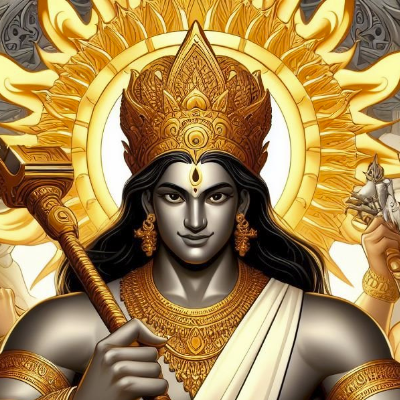
The Wikipedia article describes Tvashtr as wielding a metal axe and riding a chariot pulled by two fallow bay mares. The metal axe — svadhiti in Sanskrit — is the craftsman's primary implement in the Vedic tradition, the tool that shapes material by cutting and carving. The two fallow bay mares as his chariot animals distinguish him from most other Vedic deities who use horses of different descriptions. The Atharvaveda passage cited in the Wisdomlib article notes that Tvashtr uses an axe "to fashion from wood a well-made form" — the specific characterisation of his implement as an axe applied to wood-working gives his craftsman identity a specific material focus complementary to his broader identity as the fashioner of all forms including those of living beings.
✦ Textual Variants and Inconsistencies
The identification with Vishvakarma: As detailed above, the identification is explicit in the Shiva Purana and implied in the Markandeya and Matsya Puranas through the shared daughter Saranyu-Sanjana, but is incompatible with the genealogical accounts that give the two different fathers (Kashyapa for Tvashtr, Prabhasa for Vishvakarma). This is the central unresolved inconsistency in Tvashtr's tradition across the Vedic and Puranic sources.
Whether Tvashtr made the original Vajra: The Rigvedic tradition credits Tvashtr with making Indra's Vajra. The Puranic tradition credits Vishvakarma with making the Vajra from Dadhichi's bones. These are two different Vajra-making episodes — Tvashtr's is the original Rigvedic account and Vishvakarma's is the later Puranic account — but when the two figures are identified the tradition has two Vajra-making narratives for the same deity. Different texts handle this differently.
The mother of Vishvarupa: The Brihaddevata identifies Vishvarupa as the twin of Saranyu, born of Tvashtr's Asura wife. The Mahabharata's Shanti Parva identifies his mother as Rechana. The Rigveda does not specify the mother. These accounts are not fully consistent but agree that Vishvarupa's mother had Asura lineage — giving him the divided loyalty that eventually led to Indra's killing him.
Tvashtr as Indra's father: This identification is present in the scholarly tradition's interpretation of certain Rigvedic passages but is not the dominant Puranic account which treats both as Adityas and therefore brothers. The ambiguity is in the Rigvedic text itself rather than in the later tradition.
✦ Theological and Philosophical Significance
Tvashtr's theological significance in the tradition is of a uniquely complex kind — he is simultaneously the most skilled of the divine craftsmen and the most consistently overpowered of the major divine figures. He made the Vajra but cannot prevent Indra from stealing his soma. He fashioned Vishvarupa to serve as the gods' priest but could not prevent his son's murder. He created Vritra to avenge his son but mispronounced the incantation that would have made Vritra unstoppable. He reduced Surya's radiance but had to tell his daughter to go back to a husband she had fled. In every episode Tvashtr's extraordinary creative power is accompanied by a specific limitation — a vulnerability to force, a susceptibility to mispronunciation, a paternal authority that cannot protect his children. This pattern gives him a theological profile that is more complex and more humanly resonant than a simple divine craftsman would be — he is the great maker who cannot always protect what he has made.
✦ Connection to the Wider Genealogy
Through his parents Kashyapa and Aditi — in the Puranic Aditya identification — Tvashtr is the grandson of Marichi (one of Brahma's mind-born sons) through Kashyapa, and the son of Daksha's daughter Aditi. He is thus the nephew of all the beings born of Kashyapa's other wives — the Daityas through Diti, the Danavas through Danu, Garuda through Vinata, and the full roster of Kashyapa's offspring. As an Aditya he is the brother of Indra, Vishnu, Vivasvat, Varuna, Mitra, and the other eleven Adityas — which makes his conflict with Indra a conflict between brothers in the Puranic framework, quite different from the father-son tension implied in certain Rigvedic passages. Through his daughter Saranyu-Sanjana and her marriage to Vivasvat-Surya, Tvashtr is the maternal grandfather of Manu the progenitor of the human race, Yama the lord of death, Yamuna the river goddess, the Ashvins the divine twin physicians, and Revanta the divine master of horses. Through the Ashvins' subsequent role as the divine fathers of Nakula and Sahadeva through Kunti's mantra, Tvashtr is the remote divine great-grandfather of two of the five Pandavas. Through his son Vishvarupa's death at Indra's hands and his creation of Vritra in response, Tvashtr is the indirect cause of one of the Rigveda's most celebrated episodes of heroic divine combat — the very episode that established the Dadhichi-Vajra tradition in the Puranic elaboration of the same narrative.
✦ References
Primary Sources
- Rigveda, Mandala 1, hymn 61 verse 6: "Tvashtadeva prepared for Indra a powerful thunderbolt" — one of the primary Rigvedic attestations of Tvashtr as the maker of the Vajra.
- Rigveda, Mandala 10, hymn 17 (Saranyu narrative): The cryptic Rigvedic account of Saranyu's marriage to Vivasvat, her departure and substitution, and the birth of the Ashvins — the primary Rigvedic source for the Saranyu episode with Tvashtr as her father.
- Taittiriya Samhita and Brahmanas: The primary sources for the Vishvarupa episode — Indra's appointment of Vishvarupa as priest, his killing of Vishvarupa, Tvashtr's exclusion of Indra from the soma sacrifice, and the creation of Vritra.
- Brihaddevata (attributed to Shaunaka): Identifies Vishvarupa as the twin of Saranyu, born of Tvashtr's Asura wife; elaborates the Saranyu narrative with the Ashvins' birth from the equine union in the northern Kurus.
- Mahabharata, Shanti Parva: The account of Vishvarupa as Tvashtr's son and his role as the gods' priest; identifies his mother as Rechana.
- Shiva Purana: The passage cited in Wisdomlib that explicitly identifies Tvashtri with Vishvakarma; names Tvashtr among the twelve Adityas born of Aditi and Kashyapa.
- Markandeya Purana and Matsya Purana: Describe Sanjana as the daughter of Vishvakarma — identified with Tvashtr — and elaborate the Sanjana-Surya-Chaya episode with Tvashtr-Vishvakarma reducing Surya's radiance on his lathe.
- Manava Purana: The account of Tvashtr's rebirth as Babhruvahana, Arjuna's son by Chitrangada.
Modern Reference Works
- Vettam Mani, Puranic Encyclopaedia (1975): Entry on Tvashtr; comprehensive collation of all primary references; notes the identification with Vishvakarma and the principal narrative episodes.
- A. A. Macdonell, Vedic Mythology (1897): The most comprehensive analysis of the Rigvedic Tvashtr — his functions as craftsman and form-fashioner, his relationship with Indra, the Vishvarupa and Vritra episodes, and his position relative to other Vedic craftsman and creative deities. Essential for the Vedic dimension of his identity.
- A. A. Macdonell and A. B. Keith, Vedic Index of Names and Subjects (1912): Entry on Tvashtri — establishes the Vedic background including the axe implement and the Atharvaveda's wordplay on his name.
- Stephanie Jamison and Joel Brereton (translators), The Rigveda (2014): Critical translation with scholarly notes on the Saranyu hymn and the Tvashtr passages; the most authoritative recent English-language treatment of the primary Rigvedic sources.
- Wendy Doniger O'Flaherty, "Saranyu/Samjna" in The Mythology of Brahma (1998): The most sustained scholarly analysis of the Saranyu narrative and Tvashtr's role in it across the Rigvedic, Brahmanic, and Puranic traditions.