
About
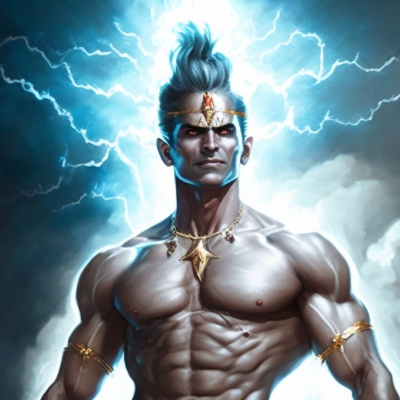
Vritra — The Enveloper, Cosmic Dragon of Drought, First Enemy of Indra
Vritra · Vritrasura · Ahi · Vritragni · Danava · Tvashtraja · Chitraketu (previous birth)
Vritra is one of the most ancient and cosmologically significant figures in the entire Hindu textual tradition, appearing first in the Rigveda as the great serpent or dragon who imprisons the cosmic waters and withholds them from the world, causing universal drought. He is identified in the Rigveda as a son of Danu — the primordial goddess who is also the mother of the entire Danava race — which establishes his classification as a Danava for the purposes of genealogical record. His slaying by Indra the king of the gods, using the thunderbolt vajra, is the most celebrated and repeatedly invoked feat in the entire Rigveda, referenced over one hundred times across its hymns. The combat between Indra and Vritra is understood as the foundational cosmogonic act — the emergence of order from chaos, of flowing water from obstruction, of day from the engulfing dark — that makes existence and life possible. In later Puranic tradition, specifically the Bhagavata Purana's Skandha VI, he is given a previous birth as the noble king Chitraketu, cursed by Parvati to become a demon, and in his asura form continues to be a devoted worshipper of Vishnu even as he fights the gods. He appears in the Rigveda, the Taittiriya Samhita, the Shatapatha Brahmana, the Mahabharata at multiple parvas, and the Bhagavata Purana among his principal sources.
✦ The Names
The name Vritra derives from the Sanskrit root vr meaning to cover, enclose, obstruct, or restrain; it yields the meaning of the enveloper, the blocker, or the one who covers over. The Proto-Indo-Iranian form is reconstructable as wrtrás and the root is shared with the Avestan vərəθraγna, literally the slayer of obstacles, which is the name given to the Persian victory deity and appears in the Rigveda as Vritraghna — the slayer of Vritra — as an epithet of Indra. The name thus identifies Vritra as the cosmic principle of obstruction and enclosure that must be broken open for the world to function. His alternate Vedic name Ahi means serpent or snake — the word is cognate with the Avestan azhi meaning dragon — and captures his serpentine form in the Rigveda as a water-hoarding creature coiling around the mountains and blocking the rivers. The compound Vritrasura, common in the Puranic and epic texts, simply adds the suffix asura to his name, marking him as belonging to the class of asuras. The epithet Tvashtraja means born of Tvashtr and applies to the Puranic account of his origin. Vritraghna, the slayer of Vritra, is exclusively an epithet of Indra rather than of Vritra himself but is attested hundreds of times in the Rigveda as the memorial of the event.
✦ Lineage — The Multiple Accounts
- Mother (per Rigveda, Hymn 1.32, stanzas 8–11): Danu — the primordial goddess described in the Rigveda at 1.32.9 as the mother of Vritra; the same Danu who in the Puranic tradition is a daughter of Daksha, a wife of Kashyapa, and the mother of the entire Danava race of asuras. This is the basis for Vritra's classification as a Danava.
- Father (per Taittiriya Samhita, Brahmanas, and Mahabharata): Tvashtr — the divine artisan, craftsman of the gods, and maker of divine weapons and forms; described in the Rigveda as the maker of Indra's thunderbolt, and in the later texts as the father of Vishvarupa or Trisiras. In this account Vritra was created from Tvashtr's sacrificial fire to avenge the killing of Vishvarupa, and has no biological mother in the ordinary sense. Tvashtr's parentage of Vritra is irreconcilable with Danu's maternity as stated in the Rigveda; both accounts are primary and both are addressed in the textual variants section.
- Half-brother (per Tvashtr parentage): Vishvarupa or Trisiras — a three-headed son of Tvashtr by a mixed divine-asura wife, who served as the gods' preceptor and was killed by Indra for secretly giving offerings to the asuras as well as the gods; his death is the direct cause of Tvashtr creating Vritra.
- Previous birth (per Bhagavata Purana, Skandha VI): Chitraketu — a powerful and righteous king blessed with divine vision through the Narayana Kavacha mantra; cursed by Parvati to be reborn as a demon after he laughed at the sight of Shiva seated with Parvati in the Ardhanari form; accepted the curse without resistance as the fruit of his karma; reborn as Vritra while retaining his inner devotion to Vishnu.
✦ Vritra in the Rigveda — The Cosmic Obstruction
Hymn 1.32 of the Rigveda, attributed to the seer Hiranystupa Angirasa and composed in the tristubh meter, is the single most detailed Vedic description of the Indra-Vritra conflict. It is also the most celebrated hymn in the Rigveda's martial corpus, and the Aitareya Brahmana records that Hiranystupa obtained the favour of Indra through its composition. The phrase ahann ahim — he slew the serpent — opens the first stanza and is employed as a formulaic refrain eleven times across the entire Rigveda, always in reference to Indra's primordial victory.
The hymn presents Vritra as a great serpentine being crouching on or in the mountains, blocking the cosmic rivers within the mountain caves or within the clouds. All the waters of existence — presented in the Vedic cosmology as the essential fluid of life, rain, the milk-cows of heaven, the flowing rivers — are imprisoned within Vritra's body or under his control. By withholding them he creates a condition of universal drought and darkness. Indra, invigorated by drinking Soma, armed with the thunderbolt vajra fashioned by Tvashtr, and aided by Vishnu who takes his celebrated three great strides to make space for the battle, attacks Vritra on the mountain. The combat is depicted as an overwhelming blow: Indra shatters Vritra's body with the vajra, the waters are released and flow like bellowing cows toward the ocean, and Vritra's mother Danu is then also struck and defeated by Indra. Indra crushes Vritra's ninety-nine fortresses — sometimes attributed elsewhere to the asura Shambara — and earns the title Vritraghna.
The hymn adds several remarkable details. Tvashtr is credited in stanza 2 with forging the vajra that kills Vritra. In stanzas 12 and 13, the battle is shown as more even than a simple rout: Vritra broke Indra's two jaws during the fight, attacking with his fangs. Stanza 14, described by scholars as puzzling, records that after the battle Indra fled in terror, frightened of a potential avenger, crossing ninety-nine rivers like a frightened falcon — a detail that the tradition generally explains as Indra's guilt over the Brahmahatya he incurred in some versions of the myth. In one verse of a Rigvedic hymn praising Sarasvati, that goddess is credited as the slayer of Vritra — a variant attribution that the tradition never fully systematised.
Beyond hymn 1.32, the Indra-Vritra conflict is referenced in over one hundred hymns across all ten mandalas of the Rigveda, making it the single most frequently invoked mythological episode in the entire Vedic corpus. The Atharvaveda incorporates the first three stanzas of Rigveda 1.32 in its hymn 2.5. Vritra is also associated in the Rigveda with other asura figures whose malevolent influences parallel his own — Shushna, Pipru, Shambara, Urana — who together constitute a loosely defined group of cosmic obstructers against whom Indra's power is perpetually invoked.
✦ The Brahmana Tradition — Tvashtr's Sacrifice and the Mispronunciation
The Taittiriya Samhita, the Brahmanas, and the Mahabharata elaborate the relationship between Vritra and Tvashtr. In this tradition, which is developed most fully in the Mahabharata's account given to Yudhishthira, the sequence begins with Indra's arrogant killing of Vishvarupa or Trisiras, the three-headed son of Tvashtr who had been serving as the gods' preceptor. Vishvarupa was offering portions of the sacrificial oblations to the asuras as well as to the gods because his mother was an asura woman; Indra, distrusting this divided loyalty, beheaded all three heads, thereby committing the terrible sin of Brahmahatya against a brahmin.
Tvashtr, enraged by this killing of his son, performed a great sacrifice specifically to produce a being who would slay Indra and avenge the death of Vishvarupa. From the sacrificial fire arose Vritra, described as having the appearance of the god of death himself, with red hair and a body growing to the size of mountains. However, the tradition records a crucial ritual error: Tvashtr mispronounced a key word in the sacrificial incantation. The intended meaning was indra-shatru — may he be the slayer of Indra; but the mispronunciation reversed the grammatical accent, changing the meaning to may Indra be his slayer. Instead of creating a being who would kill Indra, Tvashtr inadvertently created a being whom Indra would kill. This narrative of the fatal mispronunciation is one of the most celebrated demonstrations in Vedic literature of the absolute importance of correct pronunciation in ritual recitation: a single accent error in the most powerful sacrificial formula inverts its cosmic effect entirely.
✦ The Mahabharata Account — Vritra Swallows Indra, the Dadhichi Vajra, and Indra's Brahmahatya
The Mahabharata's account, narrated in response to Yudhishthira's questions, gives a fuller narrative of the battle than the Rigveda's compressed verse. Vritra led the asuras against Indra and the devas. He was a being of terrifying power and swallowed Indra whole during one phase of the combat; the other gods, alarmed, forced Vritra to vomit Indra out. Indra eventually fled the battlefield, paralysed with fear. The gods turned to Vishnu for guidance, and Vishnu directed Indra to the sage Dadhichi — an ascetic of extraordinary austerities who had stored up vast spiritual power in his very bones through lifelong practice of the Narayana Kavacha and other devotions. Only a weapon forged from Dadhichi's bones could kill Vritra.
The gods approached Dadhichi with their request. The sage, understanding the cosmic necessity and the honour of the cause, willingly gave up his life in meditation, allowing his soul to depart so that his bones could be used. The gods took the bones to Vishvakarma the divine artisan, who fashioned from them the vajra thunderbolt of irresistible power. Armed with this new weapon, Indra returned to face Vritra. The battle lasted three hundred and sixty days — one full year by cosmic reckoning — before the vajra succeeded in severing Vritra's head. At the moment of Vritra's death, the Mahabharata records that all of heaven screamed — a detail that acknowledges the scale and weight of the event.
Because Vritra, as a son of Tvashtr, was regarded as having brahminical ancestry, his killing incurred for Indra another episode of Brahmahatya, the sin of killing a brahmin. This sin — his second, following the killing of Vishvarupa — compounded Indra's spiritual debt and required further purification. In some versions of the Mahabharata tradition, Vishnu entered the foam of the ocean waves to assist Indra at the moment of Vritra's killing — paralleling the Namuchi episode — though this detail varies across textual passages.
✦ The Bhagavata Purana Account — Chitraketu, the Narayana Kavacha, and the Devotee-Demon
The Bhagavata Purana's Skandha VI, across Chapters 9 through 14, gives the most theologically complex account of Vritra. The text identifies Vritra as the reincarnation of king Chitraketu, a powerful emperor who had been childless until blessed by the sage Angiras. When his son was born, the child was murdered by jealous co-wives. The sages Angiras and Narada then performed a miracle, briefly restoring the child to life long enough to speak to his grieving father, instructing Chitraketu in the philosophy of detachment and the impermanence of worldly bonds. Chitraketu underwent eight days of intense meditation and received the Narayana Kavacha — a protective mantra of Vishnu — from the god Sankarshana, becoming a Vidyadhara of great spiritual attainment.
Some time later, while flying through the skies in his divine chariot, Chitraketu came upon the god Shiva seated with Parvati in a loving posture, with Parvati sitting on Shiva's lap or thigh. Chitraketu laughed audibly and made a disparaging comment about the unseemly nature of the scene. Parvati, incensed, pronounced a curse: for this irreverence toward Shiva and herself, Chitraketu would be reborn as a demon. Chitraketu, already well-versed in Vaishnava philosophy and equanimity, accepted the curse with complete composure, acknowledging it as the fruit of his karma and bowing respectfully to the divine couple before departing. He was accordingly reborn as Vritra.
In the Bhagavata Purana's telling, Vritra-as-Chitraketu remains throughout his demonic existence a secret devotee of Vishnu. He fights Indra and the gods as demanded by his asura nature and his position as leader of the asura forces, but internally he is serene and spiritually advanced. When the battle with Indra approaches its conclusion and the vajra crafted from Dadhichi's bones is poised to strike, Vritra accepts his death with equanimity and indeed with spiritual joy, knowing that dying in this way — cut down by the vajra while fighting — is itself a form of liberation for a being of his inner devotion. After his head falls, a luminous spark rises from his body and returns to the transcendental realm of Vishnu, where Vritra-Chitraketu becomes an associate of the god Sankarshana. The Bhagavata Purana thus transforms the archaic Vedic defeat of the cosmic obstruction demon into a devotional narrative of the soul's liberation through acceptance of karma.
✦ Vritra's Gita — The Vritragita
The Bhagavata Purana's account includes passages in which Vritra himself speaks, delivering philosophical discourse on devotion, liberation, and the nature of divine grace. This section is referred to in the tradition as the Vritragita, placing it among the sixty-four Gitas catalogued in the Puranic tradition — extended dialogues or monologues in verse that expound specific religious and philosophical teachings. The Vritragita presents Vritra as a figure of genuine spiritual attainment expressing Vaishnava devotional philosophy even as he stands on the battlefield facing his death, making him one of the tradition's most unusual examples of an asura who is simultaneously a saint.
✦ Textual Variants and Inconsistencies
The most fundamental inconsistency in Vritra's tradition concerns his parentage. The Rigveda at 1.32.9 identifies Danu as his mother, making him the eldest or most prominent of the Danavas — the Danava wikipedia article explicitly states that he is the only Danava with a prominent individual story in the Rigveda, and that Danu herself is specifically identified as the mother of Vritra by the text. This identification underpins the entire Danava racial classification. However the Taittiriya Samhita, the Shatapatha Brahmana, and the Mahabharata all identify him as a son of Tvashtr the artisan god, created from sacrificial fire. Tvashtr is classified in later Puranic literature as an Aditya — a son of Kashyapa and Aditi — making Vritra in that account not an asura by birth at all but the son of a god, created artificially to serve as an instrument of revenge. The Monier-Williams dictionary records both accounts side by side: as a Danava, Vritra is a son of Tvashtr, or of Danu. The two cannot be harmonised. The Rigvedic identification as son of Danu is older and is the basis for his Danava classification; the Brahmana tradition's identification as son of Tvashtr is the narrative used in the Mahabharata and Bhagavata Purana.
The role of the Dadhichi-derived vajra is also variable. In the Rigveda, Tvashtr forges Indra's thunderbolt himself — there is no Dadhichi. The Mahabharata and Bhagavata Purana introduce Dadhichi and his bone-vajra as essential to the defeat of Vritra. These are clearly different narrative layers grafted onto the same event across different periods of composition, and the primary sources do not reconcile them. The story is the same — Indra uses the vajra to kill Vritra — but the weapon's provenance shifts entirely between the Vedic and epic-Puranic traditions.
The Mahabharata version of the episode also appears to have merged elements of the Namuchi story — specifically the use of foam and the Brahmahatya theme — into the Vritra narrative, as noted by at least one scholar cited in the research. The Shatapatha Brahmana's Namuchi episode involves foam, twilight, and the sin of breaking a covenant; these motifs partially overlap with the Vritra story in certain Mahabharata retellings, suggesting that the two traditions influenced each other in the epic period of compilation.
✦ Cosmological and Comparative Significance
Vritra's significance in the comparative study of Indo-European religion is considerable. The Indra-Vritra conflict — storm deity slaying a water-obstructing serpent to release the cosmic waters — is closely parallel to Zeus defeating Typhon in Greek myth, Thor defeating the Midgard Serpent Jormungandr in Norse myth, and the defeat of Azhi Dahaka in Zoroastrian myth. Scholars of Proto-Indo-European religion reconstruct a common mythological template of the Thunder God versus the Cosmic Serpent that finds its fullest Vedic expression in Rigveda 1.32. Within the Indian tradition, modern geologists have proposed that the myth may encode a memory of Himalayan glacial melt — the waters of the mountains held frozen and then released in great floods — though this interpretation does not exhaust the mythological and ritual significance of the narrative.
✦ Connection to the Wider Genealogy
In the Rigvedic account, Vritra as son of Danu is the eldest or foremost of the Danavas — the being whose existence gives the Danava race its most ancient and fundamental identity as obstruction forces against the cosmic order. He is thus the original Danava in the sense that his relationship with Danu and his cosmic function as the primordial water-obstructor defined what it meant to be a Danava before the later Puranic genealogical tradition elaborated the race through Kashyapa and Daksha. Through Danu, he is also connected to the broader asura genealogical complex: Danu in the Rigveda is herself identified with the primordial waters in which Vritra hides when attempting to evade Indra — she is both his mother and his place of concealment, the water that both bore him and shelters him. This mythological identification of Danu with the waters connects the Danava race at its most archaic level not to a genealogical table but to the primordial stuff of the cosmos itself.
✦ References
- Rigveda, Hymn 1.32 (Hiranystupa Angirasa): Primary and most detailed Vedic source; the full fifteen-stanza account of Indra's slaying of Vritra; establishes Danu as Vritra's mother, the vajra as the weapon, Vishnu's three strides as making space for the battle, and the release of the cosmic waters as the outcome.
- Rigveda, Hymn 10.73 and over one hundred additional hymns across all ten mandalas: Repeated invocations of Indra as Vritraghna; the collective Vedic testimony to the centrality of this event in the tradition.
- Rigveda, 1.32.9: Specifically identifies Danu as the mother of Vritra; the key genealogical verse establishing him as a Danava.
- Atharvaveda, Hymn 2.5: Incorporates the first three stanzas of Rigveda 1.32 as a ritual invocation; confirms the hymn's liturgical spread across the Vedic corpus.
- Taittiriya Samhita and Brahmana literature (including Pancavimsa Brahmana and Maitrayani Samhita): Develops the narrative of Tvashtr's sacrifice to create Vritra in revenge for Vishvarupa's killing and the fatal mispronunciation that reversed the weapon's intended target; the primary source tradition for the Tvashtr parentage account.
- Shatapatha Brahmana (embedded in the Yajurveda): Contains Brahmana-period elaborations of the Indra-Vritra conflict; also contains the Namuchi episode whose partial thematic overlap with the Vritra story scholars have noted.
- Mahabharata (multiple parvas): The Adi Parva places Vritra in the genealogical lists; various parvas narrate different aspects of the Indra-Vritra conflict; the Mahabharata account narrated to Yudhishthira introduces the Dadhichi bone-vajra tradition and the episode of Vritra swallowing Indra.
- Bhagavata Purana, Skandha VI, Chapters 9–14: The most extensive Puranic treatment; narrates the full biography of Chitraketu including the death of his son, the Narayana Kavacha, the cursing by Parvati, the rebirth as Vritra, the battle with Indra including the Dadhichi-vajra, and the liberation of Vritra-Chitraketu's soul into Sankarshana's realm; contains the Vritragita passages.
- Vettam Mani, Puranic Encyclopaedia (1975): Modern reference; consolidates all primary source references for Vritra including the Chitraketu birth story, the Bhagavata Purana account, and the Mahabharata genealogical placements.
- Wisdomlib.org, Vritra definition entry: Modern reference; provides the Monier-Williams dual genealogy of Tvashtr or Danu as father or mother; confirms the Bhagavata Purana Chitraketu account and the Vritragita classification.
- Wikipedia, Rigveda 1.32 article: Modern secondary reference; detailed analysis of the hymn's structure, metre, and narrative content; notes the scholarly reception of the poem.
- Wikipedia, Vritra article: Modern secondary reference; surveys the Vedic, Brahmana, Mahabharata, and Puranic accounts; notes the comparative Indo-European parallels with Typhon, Jormungandr, and Azhi Dahaka.
- Monier-Williams Sanskrit-English Dictionary: Modern reference; etymology of Vritra from the root vr meaning to cover or obstruct; records the dual genealogy as son of Tvashtr or of Danu; lists associated asuras Shushna, Namuchi, Pipru, Shambara.