
About
Yama — Lord of the Dead, Judge of Souls, and Son of Vivasvat
Yama · Yamaraja · Dharmaraja · Vaivasvata · Antaka · Kala · Kritanta · Dandadhara · Shradhhadeva · Pitrupati · Pretaraja · Samavartana · Audumbara · Mrityu · Yama Dharma
Yama is the lord of the dead, the sovereign of the southern direction, the supreme judge of souls at the moment of death, and one of the eight directional guardians — the Ashtadikpalas — who preside over the cardinal and intermediate directions of the cosmos. He is the son of Vivasvat — the sun god Surya, one of the twelve Adityas born to the sage Kashyapa and his wife Aditi — and of Saranyu, the daughter of the divine craftsman Tvashtr, himself another of the twelve Adityas and therefore Yama's maternal uncle. He is the twin brother of Yami — the river goddess Yamuna — and the elder brother of the Ashvini Kumara twins, the divine physicians of the gods, whose birth from Saranyu in her form as a mare while Vivasvat had taken the form of a horse is one of the most distinctive mythological episodes in the tradition. He is also the divine half-brother of Sugriva, the Vanara king of Kishkindha, through their shared father Vivasvat. Yama appears throughout the entire canonical tradition of Hindu scripture — in the Rigveda, the Atharvaveda, the Upanishads, the Mahabharata, the Ramayana, and across virtually all eighteen Mahapuranas — in roles ranging from the first mortal to die and thereby establish the realm of the dead in the Vedic tradition, to the omniscient judge who weighs souls according to their deeds in the Puranic tradition, to a figure of philosophical instruction in the Katha Upanishad, to a cosmic sovereign whose authority is acknowledged by gods and demons alike throughout the epics and Puranas. He is one of the most theologically, philosophically, and narratively developed figures in the entire tradition, and the scope of his appearances across primary sources is among the broadest of any deity outside the supreme triad of Brahma, Vishnu, and Shiva.
✦ The Name
The name Yama derives from the Sanskrit root yam, meaning to restrain, to control, to hold back, or to govern. Yama is therefore the restrainer or the controller — the deity who restrains the living from continuing beyond their allotted span of life, who controls the passage of souls from the world of the living to the world of the dead, and who governs the realm of the ancestors with the absolute authority of one who cannot be appealed to, bribed, or circumvented. This etymology connects Yama to the broader Sanskrit conceptual field of cosmic regulation — the idea that the universe operates under principles of restraint and governance that no being can indefinitely defy — and positions him as the personal embodiment of the universal principle of limitation.
The cognate relationship between the Vedic Yama and the Avestan Yima of the ancient Iranian tradition — both names derived from the same Proto-Indo-Iranian root — reflects a shared religious heritage that predates the separation of the Vedic and Avestan traditions and establishes Yama's extraordinary antiquity as a theological concept. The Iranian Yima is the first king of a golden age who becomes associated with the realm of the dead through complex mythological transformations parallel to but distinct from the Vedic tradition's development of Yama's character.
The epithet Dharmaraja — king of dharma or the righteous king — is perhaps the most theologically significant of all Yama's names, reflecting the Puranic tradition's understanding that Yama's judgment of souls is not arbitrary but is based on a precise and impartial assessment of each soul's accumulated dharmic conduct across its lifetime. As Dharmaraja, Yama is not merely the lord of death but the embodiment of cosmic justice — the being through whom the principle of moral causation is given sovereign personal form. The epithet Vaivasvata — son of Vivasvat — is a patronymic identifying his parentage. Antaka means the ender or the terminator. Kala means time in the sense of the consuming aspect of time, the time that brings all things to their end. Kritanta means the ender of what has been done or the terminator of karma. Dandadhara means the holder of the staff or rod of punishment. Shradhhadeva means the deity of the shraddha — the ritual of ancestral offering — reflecting his sovereignty over the realm of the ancestors to whom these offerings are directed. Pitrupati means lord of the ancestors. Pretaraja means king of the pretas — the spirits of the recently dead who have not yet been fully integrated into the ancestral realm. Samavartana means the one who causes all to return or the one who brings things around — reflecting the cyclical dimension of his authority over the soul's journey.
✦ Lineage
- Father: Vivasvat — the sun god Surya; one of the twelve Adityas born to the sage Kashyapa and his wife Aditi, daughter of the patriarch Daksha; the source of solar light, warmth, and cosmic order; the progenitor through his son Vaivasvata Manu of the current human race and of the Ikshvaku royal dynasty of Ayodhya. Vivasvat is one of the most genealogically significant of the Adityas — his descendants populate both the divine and human worlds of the tradition across multiple lineages simultaneously.
- Mother: Saranyu — daughter of Tvashtr, the divine craftsman and one of the twelve Adityas; a goddess of exceptional beauty whose inability to endure the overwhelming radiance of Vivasvat led to the mythological episode of substitution and the birth of multiple divine offspring. Saranyu's story is one of the most mythologically elaborate of all the Aditya-related narratives and is discussed in detail below.
- Maternal grandfather: Tvashtr — the divine craftsman and artisan of the gods; one of the twelve Adityas born to Kashyapa and Aditi; maker of the vajra thunderbolt for Indra; father of Vishvarupa whose killing by Indra set in motion the chain of events leading to the birth of Vritra; a figure of significant narrative presence across the Vedic and Puranic traditions.
- Twin sister: Yami — the river goddess Yamuna; born simultaneously with Yama from Vivasvat and Saranyu; one of the seven great sacred rivers of India; the dark river whose waters are considered holy and purifying; the river that flows through Mathura and Vrindavana, the sacred landscape of Krishna's childhood.
- Half-brothers (through Vivasvat and Chhaya): Shani — the planet Saturn, god of karmic consequence and the most feared of the nine planetary deities; Savarni Manu — another Manu who will preside over the eighth manvantara, the eighth cosmic age; and Tapati — the river goddess of the Tapti river, born as a daughter in some accounts. These children were born of Chhaya — the shadow double whom Saranyu left in her place when she fled Vivasvat's radiance — and are therefore half-siblings of Yama through their shared father Vivasvat.
- Brother through Vivasvat: Vaivasvata Manu — the progenitor of the current human race; survivor of the great flood; ancestor of all the royal dynasties of the present age including the Ikshvaku solar dynasty of Ayodhya and the Lunar dynasty; the most direct human heir of Vivasvat's solar line.
- Brothers through Vivasvat (the Ashvini Kumaras): Nasatya and Dasra — the twin divine physicians of the gods; born of Saranyu in her form as a mare while Vivasvat had taken the form of a horse; fathers of the Vanara heroes Mainda and Dvivida respectively.
- Half-brother through Vivasvat: Sugriva — king of Kishkindha; son of Vivasvat and a Vanara woman in the tradition that makes Vivasvat the divine father of Sugriva; Rama's principal Vanara ally in the campaign against Ravana. The precise relationship between Yama and Sugriva through their shared divine father Vivasvat is established by the Vanara divine parentage tradition of the Valmiki Ramayana.
- Paternal uncles (the Adityas): Indra, Varuna, Mitra, Vishnu, Bhaga, Pushan, Aryaman, Amsha, Parjanya, Dhata, and Tvashtr — all twelve Adityas being born to Kashyapa and Aditi, making them Yama's paternal uncles as the brothers of his father Vivasvat.
- Consort: Yama's wife is named in some Puranic texts as Hemamala or Sushila, though she is not a developed figure in the primary narrative tradition. In some passages the goddess Dhumorna is identified as Yama's consort. The identity of Yama's wife is not consistently established across the primary sources.
- Son: Yudhisthira — the eldest of the five Pandava brothers of the Mahabharata — is identified as the son of Yama in the tradition of divine parentage that governs the births of the Pandavas. Kunti, the wife of the blind king Pandu's brother and the mother of the three elder Pandavas, invoked Yama through a divine mantra obtained from the sage Durvasa, and Yudhishthira was born of this invocation. Yudhishthira is therefore Yama's son, and his celebrated quality of absolute truthfulness and his epithet Dharmaraja — which he shares with Yama — reflect his divine paternal inheritance.
- Son (in a specific tradition): Katila or Sunitha — named in certain Puranic passages as a son of Yama, though this attribution is of limited attestation and the figure is not narratively developed.
✦ The Birth of Yama — Saranyu and the Episode of the Shadow
The narrative of Yama's birth is inseparable from one of the most mythologically complex episodes in the tradition — the story of Saranyu, the daughter of the divine craftsman Tvashtr, and her relationship with the sun god Vivasvat. This episode is attested in the Rigveda, elaborated in the Shatapatha Brahmana, and given its most developed form in the Vishnu Purana and the Matsya Purana.
Saranyu was given in marriage to Vivasvat by her father Tvashtr. She was a goddess of exceptional radiance and beauty, but even she could not endure the overwhelming, blinding heat and light that Vivasvat radiated as the sun god. Unable to remain with her husband in comfort, Saranyu created from her own shadow — or from her own power — a double called Chhaya, meaning shadow, who was identical to herself in appearance. She installed Chhaya in her place with Vivasvat, enjoining her to care for the children Saranyu had already borne — Yama and Yami, the divine twins — without revealing her true identity, and then Saranyu fled. She took the form of a mare and lived in secret in the northern regions, performing austerities.
Vivasvat, unaware of the substitution, lived with Chhaya for some time and fathered further children upon her: Shani the planet Saturn, Savarni Manu, and in some accounts the river goddess Tapati. Chhaya, being a shadow rather than the true Saranyu, treated Yama and Yami with less care and affection than she showed her own children. Yama, perceiving this differential treatment, became angry with Chhaya and at one point raised his foot threateningly toward her — an act of disrespect toward a mother figure. Chhaya, in response, cursed Yama: his foot would be afflicted and fall away. Vivasvat, learning of this curse, was troubled and negotiated a partial modification — worms would emerge from Yama's foot and fall to the earth, where they would enrich the soil, but his foot would not be entirely lost. In some versions of this episode the curse is said to explain Yama's characteristic limp, though this iconographic detail is not universally consistent.
Eventually Vivasvat discovered Chhaya's true identity — the discovery prompted by her partiality toward her own children and by Chhaya's inability to curse her own children as effectively as she had cursed Yama. Vivasvat learned from Tvashtr that Saranyu had fled. He went to the northern regions, found Saranyu in her mare form, recognised her, and himself took the form of a horse. From their union in these animal forms were born the Ashvini Kumara twins — the divine physicians — and in some accounts the dark deity Revanta. Saranyu then resumed her true form and returned to live with Vivasvat, whose overwhelming radiance had been reduced to a manageable level — in the account given by the Vishnu Purana, Tvashtr placed Vivasvat on his lathe and trimmed away the excess of his light, from the shavings of which various divine weapons and objects were formed.
Yama's birth from this episode positions him from the outset within a family marked by extraordinary divine power, its difficult consequences for those who must live near it, and the complex dynamics of substitute identity and differential parental affection. His identity as the first being to die — or the first to establish the path to death — connects directly to his origin as the son of a solar deity whose radiance is literally too great for those close to him to sustain.
✦ Yama in the Rigveda — The First Mortal and Lord of the Ancestors
In the Rigveda, Yama occupies a position of profound theological importance as the first mortal to die and thereby the one who established the realm of the ancestors — the path that all subsequent mortals would follow. This Vedic conception of Yama is fundamentally different from the Puranic conception in one crucial respect: in the Rigveda, Yama is not a deity who kills or who presides over judgment and punishment, but rather the first of all mortals who chose to die, thereby making death possible for all beings who came after him, and who now dwells in the pleasant realm of the ancestors where the good dead go to enjoy their reward.
The Rigvedic Yama is a welcoming figure in the funeral hymns — the god who receives the dead and houses them in his pleasant realm, where they drink Soma and enjoy the company of the ancestors under the shade of a great tree. He is a king who has pioneered the path and who now rules over those who follow him. The hymns addressed to him in the context of funerary ritual ask him to receive the dead soul benevolently, to give it a place in his realm, and to grant it the pleasures of the ancestral world. His two dogs — broad-nosed, four-eyed, spotted beings who serve as guardians and messengers — are asked to treat the dead well on their journey to Yama's realm.
The Rigveda's tenth book contains a celebrated dialogue between Yama and his twin sister Yami — one of the most discussed passages in all of Vedic literature. Yami, overcome with longing and loneliness, repeatedly proposes union with Yama, arguing that as primordial twins they were destined for each other by the creator and that their union would produce progeny for the world. Yama refuses with equal persistence, arguing that such union between a brother and sister would violate the divine law that governs right conduct, and that he will not transgress that law regardless of his sister's distress. The dialogue is one of the earliest preserved examples of a moral argument based on the principle of incest prohibition and of a character's adherence to moral law over personal feeling — an adherence that the tradition consistently treats as one of Yama's defining characteristics.
✦ Yama in the Katha Upanishad — The Instruction of Nachiketa
The Katha Upanishad contains one of the most celebrated philosophical episodes in the entire Sanskrit tradition — the instruction of the young brahmin Nachiketa by Yama himself — and it represents Yama's most significant appearance in the Upanishadic philosophical literature. The episode is also referenced in the Taittiriya Brahmana and in a different form in the Mahabharata, which testifies to its antiquity and its centrality to the tradition's engagement with the theme of death and the knowledge that lies beyond it.
The narrative begins with the brahmin Vajashravasa performing a sacrifice in which he was giving away his possessions as ritual gifts. His son Nachiketa, watching the sacrifice, observed that the cattle being given away were old and worthless — past the age of bearing calves or giving milk — and that his father was therefore giving gifts that would earn him no true merit. Troubled by this, Nachiketa asked his father repeatedly to whom he would give Nachiketa himself. Frustrated by his son's persistent questioning, Vajashravasa finally declared in anger that he gave Nachiketa to Death — to Yama.
Nachiketa, taking his father's words seriously even though they were spoken in anger, went to Yama's realm. He arrived to find Yama absent — the lord of death was away on business — and waited for three days and three nights without food or water at Yama's door. When Yama returned and found that a brahmin guest had waited without being received and fed, he was concerned — to neglect a guest for three days was a serious breach of hospitality that generated negative consequences even for a king — and offered Nachiketa three boons in compensation, one for each night he had waited.
For his first boon, Nachiketa asked that his father's anger be pacified and that he recognise and welcome Nachiketa on his return. Yama granted this. For his second boon, Nachiketa asked for knowledge of the fire sacrifice that leads to the heavenly world — the Nachiketa fire — and Yama taught him this knowledge in full, naming the fire after him as a further honour. These two boons were accepted and granted straightforwardly.
For his third boon, Nachiketa asked Yama to reveal what happens to the person after death — whether the person exists or does not exist after the dissolution of the body. This question, Nachiketa said, was the one that even the gods debated without agreement, and he wanted Yama — the one who knew death from the inside — to tell him the truth of it. Yama immediately attempted to dissuade Nachiketa from this third boon, urging him to ask for something else — sons, grandsons, cattle, gold, elephants, horses, the pleasures of music and dancing, a kingdom, long life, beautiful women, great wealth — anything other than the knowledge of what lies beyond death. He said this was a question even the gods had found difficult, that the knowledge was subtle and not easily grasped, and that Nachiketa should choose a different boon.
Nachiketa refused every offered substitute with dignity and persistence. He argued that all the pleasures Yama offered were transient, that they would not outlast a single life, and that a person who had once encountered the lord of death and had the opportunity to ask this question would be a fool to exchange it for anything less than the answer. He had come to the threshold of death itself and he would not leave without the knowledge that death alone could give.
Yama, satisfied by Nachiketa's philosophical seriousness and his refusal to be deflected by temptation, declared that Nachiketa was a worthy student and proceeded to teach him. The teaching that follows — occupying the bulk of the Katha Upanishad — is one of the most significant presentations of Vedanta philosophy in the entire corpus. Yama taught Nachiketa that the Atman — the individual self or soul — is not born and does not die; that it is eternal, unslain when the body is slain, ancient, undying, and primordial; that it is subtler than the subtle and greater than the great; that it can be known only through the grace of the Atman itself and not through learning or intellect alone; that the wise person, having known this Atman as the Lord seated within, leaves sorrow behind; and that the goal of the highest wisdom is the recognition of the individual Atman's identity with Brahman — the universal ground of all existence. Yama also taught the image of the body as a chariot, the intellect as the charioteer, the mind as the reins, and the senses as the horses — an image that was later used in a similar form in the Bhagavad Gita. After completing his teaching, Yama added further gifts to Nachiketa and sent him back to his father.
The Katha Upanishad episode is theologically significant on multiple levels. It presents Yama not as a figure of terror but as the supreme teacher of the knowledge that lies beyond death — the one being in the cosmos who is in a position to teach this knowledge authoritatively because he himself is death, and because the question of what lies beyond death is precisely his domain. The episode also presents Nachiketa as a model of the philosophical student — one who is not deflected by the temptations of the world, who persists in seeking fundamental knowledge over all consolations, and who is rewarded for this philosophical seriousness with the highest teaching the tradition possesses.
✦ Yama's Realm — Yamaloka and its Structure
The Puranic tradition, particularly the Vishnu Purana, the Bhagavata Purana, the Garuda Purana, the Agni Purana, and the Markandeya Purana, provides extensive accounts of the structure and functioning of Yama's realm — Yamaloka — the cosmic domain in which souls are received after death, judged, and assigned their subsequent destinies. These accounts are not entirely consistent with one another in every detail, but they share a coherent general picture.
Yamaloka is located in the south — the direction of which Yama is the sovereign guardian — and is reached by the soul after death through a journey along the path of Yama (Yamamarga), which the soul travels in a subtle body after the dissolution of the physical body. The soul is accompanied on this journey by the messengers of Yama — the Yamadutas — who are described in the Puranas as dark-complexioned, fearsome-looking beings who carry the soul to Yama's court regardless of the soul's wishes or resistance. The Bhagavata Purana, however, contains the notable episode in which the Vishnu devotee Ajamila was being taken by the Yamadutas when the Vishnudutas — the messengers of Vishnu — intervened and freed him on the grounds that his final utterance of Narayana's name, even though intended to summon his son of that name rather than the deity, had earned him divine protection. This episode generated a celebrated philosophical debate in the Bhagavata Purana between the Yamadutas and the Vishnudutas about the respective jurisdictions of Yama's law and Vishnu's grace.
At Yama's court, the soul stands before Yama and his court recorder Chitragupta — a figure of considerable importance in the tradition, discussed separately below — who reads from his record of all the deeds, thoughts, and words the soul performed during its lifetime. The record is understood as absolutely complete and accurate: no act, however small, no thought, however private, has escaped Chitragupta's notation. Yama, hearing the record, pronounces judgment: the soul is assigned to one of the heavenly realms if its accumulated merit exceeds its demerit, to one of the various hells if demerit exceeds merit, or to an intermediate state or a new birth on earth if the balance is mixed or requires specific karmic resolution. The Puranas describe the various hells over which Yama presides in considerable and often graphic detail, listing different places of punishment for different categories of sin and the specific experiences suffered there.
Yama's court is described in the Puranas as a magnificent palace of immense dimensions, populated by divine beings, surrounded by the souls awaiting judgment, and presided over by Yama himself seated on his throne of judgment — the Vichara Bhu or the dharma seat. He holds in his hand the danda — the rod or staff of punishment — from which his epithet Dandadhara derives, and he is attended by Chitragupta, by his ministers, and by the various beings who serve the administration of his vast cosmic domain.
✦ Chitragupta — Yama's Recorder
Chitragupta is one of the most important figures in the functioning of Yama's court and deserves specific attention within this profile. The name Chitragupta means the one whose accounts are hidden or the one with secret records — citra meaning variegated or pictured and gupta meaning hidden or secret. He is described in the Puranic tradition — most fully in the Garuda Purana and the Padma Purana — as having been created by Brahma from his own body for the specific purpose of maintaining the record of all living beings' deeds, to be read out at the moment of judgment in Yama's court.
Chitragupta holds the ledger — the Agrasandhani — in which every deed of every living being in every birth is recorded without error or omission. He is the cosmic accountant whose records are the evidentiary basis for Yama's judgments, and the tradition is emphatic that these records are complete, accurate, and immune to any form of falsification. The relationship between Chitragupta and Yama is one of absolute complementarity: Yama provides the sovereign judicial authority and pronounces the sentence; Chitragupta provides the evidence upon which the sentence is based. Neither can function without the other. Chitragupta is worshipped in some traditions — particularly among the Kayastha community of scribes and administrators who regard him as their divine progenitor — as an independent deity in his own right, and his worship on the day of Yama Dvitiya (Bhai Dooj) is an established practice in several regional traditions.
✦ Yama's Two Dogs
Among the most ancient and consistently attested of all Yama's attributes are his two dogs — four-eyed, broad-nosed, spotted beings who serve as his messengers and as guardians of the path to his realm. These dogs are mentioned in the Rigvedic funeral hymns, where the deceased is asked to run past them swiftly on the road to Yama's realm, and where they are described as the offspring of Sarama — the divine hound of Indra — making them divine animals of impeccable lineage. They are addressed in the funeral hymns as watchers and guardians, beings who know the way and who accompany souls on the journey.
In the Puranic tradition, Yama's dogs are developed further as the Shyama and Shabala — meaning the dark one and the spotted or variegated one — who roam the world of the living as well as guarding the approaches to Yamaloka, sometimes appearing at the moment of death to escort the soul. Their four eyes — two on the front of their heads and two on the back — give them a vision that encompasses all directions simultaneously and that cannot be deceived or evaded. The tradition holds that these dogs can perceive beings that are otherwise invisible, including beings who have died but whose souls have not yet been properly guided toward Yama's realm through funeral rites.
✦ Yama and the Mahabharata — Yudhishthira as His Son
Yama's most significant presence in the Mahabharata comes through his son Yudhishthira — the eldest of the five Pandava brothers, the king of Indraprastha and subsequently of Hastinapura, and the central moral figure of the epic. The Mahabharata's narrative of Yudhishthira's life is in many respects a sustained meditation on the character of Yama's son: Yudhishthira is celebrated above all for his absolute and unconditional adherence to truth — his epithet Dharmaraja, shared with his father, reflects this — and for his capacity to maintain moral principle under conditions of extraordinary difficulty and temptation.
The connection between Yama and Yudhishthira is made explicit not only through the divine parentage tradition but through the narrative episode of the Yaksha Prashna — the questions of the Yaksha — in the Vana Parva of the Mahabharata. In this episode, Yudhishthira and his brothers came to a lake where a divine being in the form of a crane or a Yaksha had killed all four of Yudhishthira's brothers after they attempted to drink from the lake without answering the being's questions. Yudhishthira arrived, found his brothers dead, and was confronted by the Yaksha who demanded that Yudhishthira answer a series of philosophical questions before drinking.
Yudhishthira answered the questions — a series of riddles about dharma, about the nature of the world, about what is the greatest wonder of existence, what is swifter than the wind, what is greater than the earth, and many others — with a wisdom and precision that satisfied the Yaksha completely. The Yaksha then revealed himself as Yama — Yudhishthira's own divine father — and restored the four dead brothers to life. Yama further granted Yudhishthira a boon: that Yudhishthira's identity would remain unrecognised during the crucial thirteenth year of the Pandavas' exile, when they were required to live in anonymity or face a further twelve years of forest exile. The episode is one of the most celebrated philosophical passages of the Mahabharata and represents Yama's active intervention in his son's life at a moment of critical need.
Yama appears again in the Mahabharata in the context of Savitri and Satyavat — the celebrated episode in the Vana Parva in which the devoted wife Savitri follows Yama when he comes to take the soul of her husband Satyavat and through the force of her devotion and her philosophical arguments persuades Yama to return her husband's life. This episode is one of the tradition's most famous narratives of conjugal devotion and is discussed in detail below.
The Mahabharata also records that Yama appeared before the assembled kings and sages at various points to give counsel, to proclaim cosmic truths, and to participate in the celestial assemblies described in the Sabha Parva. His assembly hall — the Yamasabha — is described in the Sabha Parva with the same elaboration given to the halls of Indra, Varuna, and Brahma, establishing his status as one of the principal cosmic sovereigns whose realm is as magnificent as those of the other great divine rulers.
✦ Savitri and Satyavat — The Defeat of Yama by Devotion
The episode of Savitri and Satyavat is one of the most celebrated narratives in the entire Mahabharata and one of the tradition's most powerful statements about the force of conjugal devotion and its capacity to overcome even the inevitable and absolute authority of death. It is recounted in the Vana Parva and has become one of the defining stories of the tradition's engagement with Yama as a figure who can be approached, argued with, and — in exceptional circumstances — persuaded.
Savitri was a princess of exceptional virtue, beauty, and intelligence who chose as her husband Satyavat — a prince living in the forest, the son of a blind exiled king — despite being warned by the sage Narada that Satyavat was destined to die within one year. Savitri refused to change her choice and married Satyavat, living with him in the forest through the one year that remained to him. As the destined day approached, Savitri began a period of intense ascetic observance — fasting and maintaining vows of heightened purity for three days before the appointed day. On the day itself, she accompanied Satyavat into the forest where he went to cut wood. While there, Satyavat felt suddenly ill, lay down with his head in Savitri's lap, and died. Yama himself came in person — the southward direction from which he came being noted — accompanied by his messengers, to collect Satyavat's soul. He bound the subtle body of Satyavat and began to lead it southward.
Savitri rose and followed Yama. Yama told her that she had fulfilled all the duties of a wife and should return home — mortals could not follow him into his realm. Savitri replied with a philosophical statement about the nature of those who walk with the virtuous, saying that she had no fear in Yama's company since she was walking with the righteous. Yama was moved by the quality of her speech and offered her a boon — anything she wished except the life of Satyavat. She asked for the restoration of her father-in-law's sight and kingdom, and Yama granted it.
Still she continued to follow. Again Yama urged her to return; again she replied with a philosophical statement of such quality and precision that Yama offered a second boon — again excluding Satyavat's life. She asked for sons for her father, and Yama granted it. She continued to follow. A third time Yama was moved by her speech and offered a third boon — again excluding Satyavat's life. She asked for sons for herself from Satyavat. Yama granted this without immediately perceiving the implication — for Savitri to have sons from Satyavat, Satyavat had to be alive. When Yama recognised what he had granted, he was caught by the logic of his own boon: he had promised sons from Satyavat, which required Satyavat's life. He could not go back on his word. He released Satyavat's soul, and Satyavat revived. Yama returned to his realm without the soul he had come for.
The episode is theologically significant as one of the very rare instances in the tradition in which Yama is persuaded to return a soul already taken — an event so exceptional that the narrative devotes considerable space to establishing the extraordinary quality of Savitri's virtue and philosophical intelligence that made it possible. It also establishes that Yama, while absolutely sovereign within his domain, is not beyond the reach of those who combine perfect virtue with perfect persistence, and that the force of righteousness operating through a human being of sufficient quality can, in the most exceptional circumstances, move even the lord of death.
✦ Yama and Markandeya — The Sage Who Defeated Death
A parallel episode of a mortal surviving beyond Yama's appointed time through divine intervention — this time through the power of Shiva rather than through personal philosophical persuasion — is the story of the sage Markandeya, recorded in the Markandeya Purana, the Shiva Purana, and other texts. Markandeya was destined to die at the age of sixteen. When Yama's messengers came to take him at the appointed moment, Markandeya was in the act of worshipping the Shivalinga with total absorption. He clung to the linga in his devotion, and when Yama's noose was thrown over him it encircled the linga as well as the sage. Shiva himself emerged in fury from the linga and struck Yama, killing him or severely injuring him — in different versions of the account, Yama is either killed outright or merely rendered unconscious. The other gods intervened urgently, for without Yama the cosmic order could not be maintained and the dead could not be properly received and judged. Shiva, at the gods' pleading, revived Yama but granted Markandeya the boon of eternal youth and life — the sage would remain sixteen years old forever, beyond Yama's reach for eternity.
This episode establishes several important theological principles. It demonstrates Shiva's supreme power — that even Yama, the lord of death, is subject to Shiva's authority and can be defeated by him. It demonstrates the indispensability of Yama to the cosmic order — that the other gods urgently require his functioning and cannot allow him to remain incapacitated regardless of the circumstances that led to his defeat. And it establishes the category of chiranjivis — eternally long-lived beings — as a real theological possibility within the tradition: beings who, through divine grace or extraordinary devotion, exist beyond the normal reach of Yama's authority.
✦ Yama and the Ajamila Episode
The Bhagavata Purana's sixth book contains one of the most theologically developed episodes involving Yama in the entire Puranic corpus — the story of Ajamila and the debate between the Yamadutas and the Vishnudutas. Ajamila was a brahmin who had abandoned his righteous conduct, fallen into sinful behaviour, and lived a life of considerable moral compromise. At the moment of his death, the Yamadutas came to collect his soul for judgment. At the same moment, Ajamila — in his fear and distress — called out the name of his beloved youngest son, who was named Narayana, another name for Vishnu. The Vishnudutas heard the utterance of Narayana's name and immediately came to Ajamila's aid, driving away the Yamadutas and protecting Ajamila's soul.
The Yamadutas returned to Yama and reported what had happened, expressing confusion about why the Vishnudutas had intervened and on what authority. Yama's response — recorded in the Bhagavata Purana — is one of the most important statements of Vaishnava theology in the entire text. He explained that there was a law above the law of karma — the law of bhakti, the devotion to Vishnu — and that those who had taken refuge in Vishnu were beyond Yama's jurisdiction. He acknowledged that Vishnu's authority was supreme and that his own authority, however absolute within its domain, operated within the framework of Vishnu's overarching sovereignty. He instructed the Yamadutas never again to approach a devotee of Vishnu, since such persons were protected by a grace that transcended karmic accounting. This statement represents Yama's own acknowledgment, within the Bhagavata Purana's theological framework, of the supremacy of Vishnu's grace over the law of karma that Yama administers.
✦ Yama in the Ramayana
Yama appears in the Valmiki Ramayana in several contexts. He is invoked as a divine witness and cosmic power in the formulation of oaths and alliances, and his name is regularly used in similes describing the terrifying appearance and power of great warriors on both sides of the battle of Lanka — to fight like Yama, to be as unassailable as Yama, to appear as fearsome as Yama to those who face you, are among the most common similes in the Yuddha Kanda's battle narrative. These similes establish Yama's place in the tradition's symbolic vocabulary as the ultimate image of irresistible and inescapable power.
More substantively, Yama appears in the Yuddha Kanda in the context of the divine assistance given to Rama during the battle of Lanka. When Ravana was at his most formidable and Rama was struggling to overcome him, the divine charioteer Matali — who normally drove Indra's chariot — descended from heaven at Indra's direction to serve as Rama's charioteer, bringing with him the divine chariot and weapons of Indra. The celestial assembly that watched the battle from the sky included Yama alongside the other great divine beings — Indra, Brahma, Varuna, and the assembled gods — all present as witnesses to the cosmic significance of the conflict. Yama's presence in this celestial assembly reflects his standing as one of the eight cosmic sovereigns whose attendance validates the divine importance of the event they witness.
The Yuddha Kanda also records Yama's role in the context of the deaths of the great demon warriors: when warriors of the stature of Kumbhakarna or Ravana himself are killed, they are described as going to Yama's realm or as having their souls escorted there — the magnitude of their deaths being marked by the involvement of the cosmic sovereign of the dead rather than merely his messengers.
✦ Yama as One of the Ashtadikpalas
Yama is one of the eight directional guardians — the Ashtadikpalas — who preside over the eight cardinal and intermediate directions of the cosmos. He is the sovereign of the southern direction, the dakshinadisha, which in Indian cosmology is associated with death, the realm of the ancestors, and the path taken by the soul after death. The south as the direction of death and the direction of Yama is a consistent element of the tradition across both the Vedic and Puranic periods, and it explains why the corpse is placed with the head pointing south during funerary rites in many Hindu communities — it orients the dead person toward Yama's realm.
As a directional guardian, Yama is invoked in the consecration of temples and sacred spaces, where the eight directional guardians are formally invited to take their positions at the eight directions and to protect the sacred space from any influences that might enter from their respective directions. In temple architecture, the southern face of the sanctuary is associated with Yama, and iconographic representations of Yama may be placed in the southern section of the temple's outer enclosure as part of the directional guardian scheme.
✦ Yama Dvitiya — The Festival of Yama
The festival of Yama Dvitiya — also called Bhai Dooj in the northern Indian tradition — occurs on the second day of the bright fortnight of the month of Kartika, two days after Diwali. The festival's mythological basis in the tradition involving Yama connects it to the relationship between Yama and his twin sister Yami — the goddess of the river Yamuna. On this day, Yami is said to have invited Yama to her home and welcomed him with love and hospitality, applying the auspicious tilak mark to his forehead and praying for his welfare. Yama, moved by his sister's devotion, declared that any brother who received the tilak from his sister on this day and dined at her home would be blessed and protected from untimely death during the coming year. The festival celebrates the bond between brothers and sisters and invokes Yama's blessing for the brother's long life and protection from his own cosmic authority.
✦ Yama in the Garuda Purana
The Garuda Purana is the primary Puranic text devoted to a comprehensive account of the journey of the soul after death and of the functioning of Yama's court, and it represents the most extensive single treatment of Yama's domain in the entire Puranic corpus. The text describes in considerable detail the sixteen days following death during which the soul is in transit, the specific rituals — shraddha, pinda offerings, water libations — that the living must perform for the dead to ease the soul's passage, the geography of the path to Yamaloka, the various hells and heavens to which souls are assigned based on their karmic record, and the functioning of Yama's court itself.
The Garuda Purana's treatment of Yama presents him as a figure who is not simply punitive but genuinely judicial — a cosmic judge who wants to give each soul exactly what its conduct warrants, neither more severe than the karmic record justifies nor more lenient. Yama is described in the Garuda Purana as expressing concern for those who arrive at his court without having received proper funeral rites from their surviving relatives, and as instructing on the importance of these rites for the smooth passage of the soul. His authority in the Garuda Purana is presented as ultimately oriented toward the restoration of cosmic moral order rather than toward punishment for its own sake.
✦ Iconography and Worship
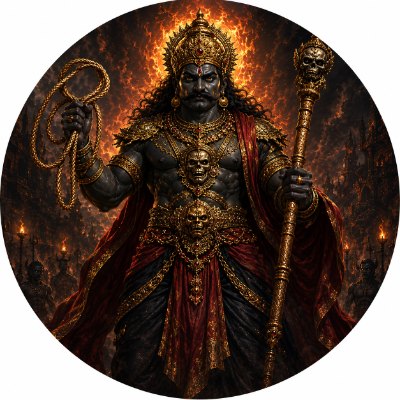
Yama is depicted in the iconographic tradition as a figure of dark or deep green complexion — the dark colour associated with death and the realm of the dead — of fearsome aspect, dressed in red garments, and seated on a throne or upon his vehicle the buffalo (mahisha). He holds in one hand the danda — the staff or rod of punishment — and in the other hand the pasha — the noose with which souls are bound and led to his realm. He is sometimes depicted carrying a sword. He is accompanied by his two four-eyed dogs, by Chitragupta his recorder, and by the assembled souls of the dead who stand before him in judgment. His vahana — the vehicle or mount — the buffalo represents the heavy, plodding, irresistible inevitability of death: the buffalo moves slowly but cannot be stopped.
As an object of independent worship, Yama is propitiated primarily in the context of death-related rituals — the shraddha ceremonies for the ancestors, the rites performed on the anniversary of a person's death, and the Tarpana — water offerings to the ancestors — performed on specific days of the lunar calendar. He is propitiated to ensure that the souls of the dead are treated benevolently in his court and that the karmic balance of the deceased is viewed favourably. The Yama Tarpana — water offerings specifically directed to Yama — is performed by many households during the period of Pitru Paksha, the fortnight of the ancestors in the month of Bhadrapada, when all the deceased ancestors of a family are commemorated and propitiated.
✦ Textual Variants and Inconsistencies
The textual tradition surrounding Yama is vast and spans several millennia of composition across many different genres and theological orientations. Several significant inconsistencies deserve acknowledgment.
The most fundamental inconsistency is the shift in Yama's character between the Vedic and Puranic traditions. The Rigvedic Yama is the first mortal who chose to die and who now dwells pleasantly in the realm of the ancestors — a welcoming, benevolent figure who receives the good dead into his pleasant realm. The Puranic Yama is a cosmic judge who administers both reward and punishment, presides over hells of considerable severity, and sends his messengers to collect the dead regardless of their wishes. These are not minor variations of the same conception but represent a fundamental shift in the tradition's understanding of death's governance — from a welcoming ancestral realm to a judicial system of moral accounting and differential treatment. This shift occurred gradually across the Brahmana and early Puranic periods and is not resolved into a single canonical account in the primary sources.
The parentage of Yama is consistent in identifying Vivasvat as his father and Saranyu as his mother, but the details of the Saranyu-Chhaya episode and specifically which children belong to Saranyu and which to Chhaya vary across the Vishnu Purana, the Matsya Purana, the Markandeya Purana, and the Shatapatha Brahmana. The Ashvini Kumara twins are sometimes identified as the children of Saranyu by Vivasvat-as-horse, sometimes as children of Vivasvat and Saranyu before her flight, and the specific assignment of each child to Saranyu or to Chhaya is not uniform across all texts.
The Markandeya episode — in which Yama is defeated or killed by Shiva — is not consistent across all texts in its resolution. In some versions Yama is killed outright and then revived; in others he is merely defeated and driven away; and in others the confrontation is described more symbolically as Shiva's assertion of his supremacy over death rather than a literal physical combat. The different versions reflect the different theological priorities of their respective source texts.
The jurisdiction of Yama's authority in relation to Vishnu's grace — addressed most directly in the Ajamila episode of the Bhagavata Purana — represents a specifically Vaishnava theological position that is not shared by all Puranic texts. Shaiva texts maintain a different hierarchy of divine authority, and texts of a non-sectarian Puranic character do not always privilege either Vishnu's grace or Shiva's power over Yama's cosmic jurisdiction in the same explicit way.
✦ Theological Significance
Yama's theological significance in the Hindu tradition is among the deepest and most multi-layered of any deity. At the most fundamental level he represents the universal principle of limitation — the fact that all conditioned existence is finite, that every being that comes into the world will leave it, and that this leaving is not arbitrary but is governed by a principle of moral causation that operates with absolute consistency and cannot be evaded. As the embodiment of this principle, Yama is the cosmic guarantee that the moral order is real — that what a being does during its life has consequences that persist beyond that life, that the universe is not morally indifferent to how its inhabitants conduct themselves.
This makes Yama philosophically important in a way that goes beyond his role in narratives of death and judgment. He is the cosmic enforcer of the principle that dharma — righteous conduct — matters, that its violation has consequences, and that no being, however powerful, ultimately escapes the accounting. The tradition's consistent portrayal of Yama as absolutely impartial — treating king and commoner, brahmin and outcaste, god and demon with the same judicial evenhandedness — encodes a principle of cosmic equality before the moral law that cuts across every social hierarchy the living world imposes.
The Katha Upanishad's use of Yama as the teacher of the highest philosophical knowledge — the knowledge of the deathless Atman — adds a dimension of profound irony and theological subtlety: the lord of death is the supreme teacher of the knowledge of what is beyond death. This paradox is not accidental but reflects the tradition's understanding that the deepest knowledge of death can only come from the inside, from the being who is death itself, and that the path through the terror of mortality leads, in the Upanishadic vision, to the knowledge of what is utterly beyond it.
✦ Connection to the Wider Genealogy
Yama's genealogical position connects him to the supreme tier of the divine lineage through his father Vivasvat — one of the twelve Adityas born to the sage Kashyapa and his wife Aditi. Through Kashyapa and Aditi, Yama is the grandson of Kashyapa — the progenitor of all orders of beings — and the great-grandson of Marichi, one of the mind-born sons of Brahma the creator. Through Aditi, he is the great-grandson of the patriarch Daksha. As the son of Vivasvat, Yama's brothers and half-brothers among the solar lineage include Vaivasvata Manu — the progenitor of the current human race, whose descendants include all the royal dynasties of the present age — the Ashvini Kumara twins whose sons Mainda and Dvivida are Vanara heroes of the Ramayana, and Sugriva the Vanara king. Through Vivasvat's Aditya brothers, Yama's uncles include Indra the king of the gods, Varuna the lord of the cosmic waters, Vishnu the supreme deity of the Vaishnava tradition, Mitra the deity of covenant, Bhaga the deity of fortune, Pushan the deity of paths, and all the other Adityas.
Through his son Yudhishthira — fathered upon Kunti through the divine mantra — Yama is connected to the central narrative of the Mahabharata: Yudhishthira as his son is the king whose dharmic conduct and eventual restoration to the throne is the positive resolution of the epic's conflict. Through Yudhishthira's descendants, Yama's lineage connects to the tradition of dharmic kingship that the Mahabharata celebrates as the ideal of human governance. Through his twin sister Yami — the river Yamuna — Yama is connected to one of the most sacred rivers of the Indian subcontinent, a river whose banks became the sacred landscape of Krishna's childhood in Vrindavana and whose waters are considered among the most purifying in the tradition.
✦ References
- Primary Sources
- Rigveda, Book X, Hymns 13–14 (funeral hymns to Yama); Book X, Hymn 10 (the Yama-Yami dialogue): The foundational Vedic sources for Yama as the first mortal, the lord of the ancestors, and the being who established the realm of the dead; contains the celebrated dialogue between Yama and his twin sister Yami.
- Atharvaveda (funeral hymns and hymns to Yama): Contains additional Vedic material on Yama's character as lord of the dead, his two dogs, and the path to his realm.
- Katha Upanishad (complete text): The primary philosophical source for Yama as the teacher of the knowledge of the deathless Atman; contains the full episode of Nachiketa's three boons and the philosophical instruction that constitutes the Upanishad's central content.
- Shatapatha Brahmana (passages on Yama and the Saranyu episode): Contains early post-Vedic cosmological and ritual elaboration of Yama's parentage and the mythology of Vivasvat and Saranyu.
- Mahabharata, Vana Parva (Savitri-Satyavat episode; Yaksha Prashna episode); Sabha Parva (description of Yama's assembly hall); Anushasana Parva (Yama's instructions on dharma): The primary epic sources for Yama's most significant narrative appearances; contains the Savitri episode, the Yaksha-Prashna episode, and the description of the Yamasabha.
- Valmiki Ramayana, Yuddha Kanda (Yama's presence as a celestial witness and similes): Records Yama's role as a cosmic sovereign witnessing the battle of Lanka and his use as a simile for irresistible warrior power throughout the battle narrative.
- Bhagavata Purana, Skandha VI (the Ajamila episode and Yama's instruction to the Yamadutas); Skandha IX (genealogical material on Vivasvat's lineage): The most theologically developed Puranic treatment of Yama's relationship to Vishnu's grace; contains Yama's own acknowledgment of Vishnu's supremacy over his own karmic jurisdiction.
- Vishnu Purana, Book III (the Saranyu-Chhaya episode and Vivasvat's lineage): The most detailed Puranic account of Yama's birth and the Saranyu mythology; provides the genealogical framework for Yama's relationship to the Aditya lineage.
- Garuda Purana (complete text, especially the Pretakalpa section): The most extensive single Puranic treatment of Yama's realm, its structure, the journey of the soul after death, and the functioning of Yama's court; the primary source for the detailed geography and administration of Yamaloka.
- Markandeya Purana (the Markandeya-Shiva episode): Contains the narrative of Yama's defeat by Shiva in the context of the sage Markandeya's preservation from death through Shiva-devotion.
- Shiva Purana (the Markandeya episode in its Shaiva framing): Contains the Shaiva version of the episode in which Shiva defeats Yama to protect his devotee Markandeya.
- Matsya Purana (genealogical passages on Vivasvat and Yama): Contains variant genealogical material on the Saranyu episode and Yama's lineage.
- Agni Purana (passages on Yamaloka and Yama's court): Contains additional Puranic material on the structure of Yama's realm and the fate of souls after death.
- Padma Purana (passages on Chitragupta and Yama's court): Contains material on Chitragupta's creation and function within Yama's judicial system.
- Secondary Sources
- Macdonell, A. A. Vedic Mythology (1897): Detailed scholarly analysis of the Vedic Yama, his hymns, his character as the first mortal and lord of the ancestors, and the shift in his conception from the Rigvedic to the later tradition.
- Mani, Vettam. Puranic Encyclopaedia (1975): Entries on Yama, Yamaraja, Chitragupta, Saranyu, Chhaya, Vivasvat, and related figures; invaluable for cross-referencing textual sources and variant accounts across the full Puranic corpus.
- Olivelle, Patrick (translator). Upanisads (Oxford University Press, 1996): Critical translation of the Katha Upanishad with scholarly notes; the most authoritative modern translation of the philosophical episode in which Yama instructs Nachiketa.
- Doniger O'Flaherty, Wendy. The Origins of Evil in Hindu Mythology (1976): Contains scholarly analysis of Yama's role in the tradition's engagement with death, judgment, and the moral order; addresses the transition from the benevolent Vedic Yama to the judicial Puranic Yama.
- Doniger O'Flaherty, Wendy. Women, Androgynes, and Other Mythical Beasts (1980): Contains analysis of the Saranyu-Chhaya episode and its mythological significance for Yama's birth and the solar lineage.
- Lochtefeld, James G. The Illustrated Encyclopedia of Hinduism (2002): Entries on Yama, Yamaloka, Chitragupta, and related concepts; useful for synthesising the tradition's treatment of Yama across its major dimensions.
- Wisdomlib (wisdomlib.org), entries on Yama, Yamaraja, Dharmaraja, Chitragupta, Yamaloka, the Ajamila episode, the Savitri episode, and Nachiketa: Aggregates verse references from digitised primary texts; useful for locating specific passages, tracking variant readings across recensions, and cross-referencing the tradition's treatment of Yama across the full primary corpus.