
About
Nasatya — Divine Physician, Ashvini Twin, and Father of Mainda
Nasatya · Nasatya Ashvin · Ashvini Kumara · Ashvin · Nashata · Dasra (as collective epithet) · Devavriddha
Nasatya is one of the two Ashvini Kumaras — the divine twin physicians of the gods, among the most frequently invoked deities in the Rigveda and among the oldest divine figures in the entire Indo-Iranian religious heritage. He is the son of Vivasvat — the sun god Surya, one of the twelve Adityas born to the sage Kashyapa and his wife Aditi — and of Saranyu, the daughter of the divine craftsman Tvashtr. He is the twin brother of Dasra, the other Ashvini Kumara, and together the two constitute an inseparable divine pair whose nature, domains, and mythological episodes are almost always treated collectively in the primary sources, making the individual characterisation of either twin independently from the other an exercise that the tradition itself rarely attempts. In the tradition that assigns individual paternity to the Vanara heroes born of the Ashvini Kumaras, Nasatya is identified as the father of Mainda — a Vanara warrior of Kishkindha who participated in the campaign against Ravana under Sugriva's command. Nasatya appears across the entire Vedic corpus, in the Upanishads, in the Mahabharata, in the Puranas, and in the extended Ramayana tradition, always in the company of his twin and always as one half of the most celebrated divine pair in the tradition of healing and beneficent intervention.
✦ The Name
The etymology of the name Nasatya has been a subject of scholarly debate since the earliest period of Vedic philology, and no single universally accepted derivation has been established. The most widely discussed derivation connects Nasatya to a negative root — na and satya, meaning not untruthful or the truthful one, making Nasatya an epithet meaning the genuine or the true, possibly in the sense of the one who truly helps or the one who is genuinely beneficent. Another derivation connects the name to a root meaning born from the nose — nas meaning nose — in connection with a specific mythological account of the Ashvini Kumaras' birth, though this derivation is not universally accepted. A third derivation connects it to the root nas meaning to reach or to attain, giving the meaning the one who reaches or the one who attains, consistent with the Ashvini Kumaras' role as beings who reach those in distress and attain their rescue. The primary Vedic texts do not themselves provide an explicit etymological gloss for the name.
In several Vedic passages, the name Nasatya is applied to both Ashvini Kumaras collectively rather than to one twin individually, functioning as a collective epithet for the pair. This usage reflects the extreme difficulty the tradition itself had in consistently distinguishing the two twins as individual divine personalities — a difficulty that pervades the entire Ashvini Kumara tradition and that is a genuine feature of the primary sources rather than a modern analytical problem. The name Dasra is similarly used both as an individual name for one twin and as a collective epithet in some passages.
✦ Lineage
- Father: Vivasvat — the sun god Surya; one of the twelve Adityas born to the sage Kashyapa and his wife Aditi, daughter of the patriarch Daksha; the source of solar light and warmth; the progenitor through his various children of Yama the lord of the dead, Yamuna the river goddess, Vaivasvata Manu the progenitor of the current human race, and Sugriva the Vanara king.
- Mother: Saranyu — daughter of Tvashtr the divine craftsman, himself one of the twelve Adityas; a goddess who created the shadow double Chhaya and fled Vivasvat's overwhelming radiance, eventually taking the form of a mare in the northern regions. The Ashvini Kumara twins — Nasatya and Dasra — were born of the union of Vivasvat and Saranyu in their respective horse and mare forms, distinguishing the twins' birth from that of Yama and Yamuna who were born of Vivasvat and Saranyu in their divine human forms before Saranyu's flight.
- Maternal grandfather: Tvashtr — the divine craftsman; one of the twelve Adityas; maker of divine weapons including the thunderbolt Vajra for Indra; Nasatya's maternal grandfather and simultaneously his paternal uncle through the Aditya lineage, since Tvashtr is both Saranyu's father and Vivasvat's Aditya brother.
- Twin brother: Dasra — the other Ashvini Kumara; born simultaneously with Nasatya of the same divine parents in the same miraculous horse-form union; inseparable from Nasatya in virtually every narrative and ritual context of the tradition; father of Dvivida the Vanara hero.
- Siblings through Vivasvat and Saranyu: Yama — lord of the dead; Yamuna — the river goddess; and Vaivasvata Manu — progenitor of the current human race. These siblings were born of Vivasvat and Saranyu in her divine form before her flight.
- Half-siblings through Vivasvat and Chhaya: Shani — the planet Saturn; Savarni Manu — Manu of the coming eighth cosmic age; and Tapati — the river goddess of the Tapti river in some accounts.
- Son: Mainda — a Vanara hero of Kishkindha; constant companion of Dvivida, the son of Nasatya's twin brother Dasra; participant in the campaign against Ravana under Sugriva's command; identified in certain Puranic traditions as a recipient of the Amrita boon from the Ashvini Kumaras granting him extraordinary vitality and longevity.
- Paternal uncles (through Vivasvat's Aditya brothers): Indra, Varuna, Mitra, Vishnu, Bhaga, Pushan, Aryaman, Amsha, Parjanya, Dhata, and Tvashtr — all twelve Adityas being born to Kashyapa and Aditi, making them Nasatya's paternal uncles as the brothers of his father Vivasvat.
✦ The Birth of the Ashvini Kumaras
The birth of the Ashvini Kumara twins — including Nasatya — is connected to the episode of Saranyu's flight from Vivasvat, which is one of the most elaborate birth mythologies in the tradition. The account is given in the Rigveda in compressed form, elaborated in the Shatapatha Brahmana, and given its most developed Puranic form in the Vishnu Purana and the Matsya Purana.
After Saranyu had created her shadow double Chhaya and fled Vivasvat's overwhelming solar radiance, she took the form of a mare in the northern regions — either the Uttarakuru region or the Himalayas, depending on the specific text — and lived there performing austerities. Vivasvat eventually discovered her absence and the substitution of Chhaya. He found Saranyu in her mare form, recognised her, and himself assumed the form of a horse. From their union in these animal forms were born the Ashvini Kumara twins — born as divine beings of exceptional appearance from a horse-form union, which explains both their association with horses and their epithet Ashvini, meaning horse-born or horse-related. In some accounts, a third being was also born of this union — the dark deity Revanta, who is associated with horses and hunting — making the horse-form births productive of three divine beings rather than two.
The horse-born nature of the Ashvini Kumara twins is fundamental to their character and to the symbolism attached to them throughout the tradition. Horses in the Vedic world were the most prestigious of all animals — associated with speed, power, the sun's chariot, and the royal horse sacrifice. To be born of a divine union in horse form was to carry within one's nature the purest expression of solar speed and divine vitality, and this is precisely the character that the Ashvini Kumaras display throughout their mythological appearances: they are swift, luminous, youthful, and endlessly energetic in their service to those who call upon them.
✦ The Ashvini Kumaras in the Rigveda
The Ashvini Kumaras — with Nasatya as one of the pair — receive more hymns in the Rigveda than any deity except Indra, Agni, and Soma, reflecting the extraordinary importance of these divine physicians in the Vedic sacrificial and community life. The Rigvedic Ashvins are gods of the dawn — they travel across the sky in their golden three-wheeled chariot at the boundary between night and full day, at the twilight moment before the sun rises, and they are the deities of that liminal luminosity when darkness has retreated but daylight has not yet fully asserted itself. This association with the transition between darkness and light is consistent with their healing role: they operate at the threshold, at the moment of transition between illness and health, between death and life, between distress and relief.
The Rigvedic hymns to the Ashvins catalogue their exploits with a delight in variety and ingenuity that makes the collection of their rescue acts one of the most vivid bodies of mythological narrative in the Vedic corpus. They gave sight to the blind Rijrashva. They restored the sage Chyavana to youth from extreme old age. They gave the sage Shyavashva a horse. They rescued Vandana, who had been buried alive in a pit, or who had fallen into a well. They rescued the quail Vartika from the jaws of the wolf. They helped Atri, who was trapped in a burning pit. They restored Vishnapa's son to life. They gave the widow Ghoshā — who had suffered from a disfiguring disease — a husband by curing her. They rescued Bhujyu, the son of Tugra, from the middle of the ocean when his father had abandoned him there — carrying him to safety in their winged ship or in their chariot across the sea. They gave the sage Dadhichi — or in a related tradition — new jaws made of metal (ashva, horse) so that he could speak the Madhu Vidya, the honey-knowledge, which he had been forbidden to teach to ordinary men but which he taught to the Ashvins in exchange for the metal jaw, knowing that Indra would behead him for the transgression and that the Ashvins would then restore his original head. They helped the ailing Paravrij. They gave Pedu a white horse of extraordinary speed. They brought rain to Gotama's cattle in a time of drought.
This list of exploits — only a selection of what the Rigvedic hymns record — establishes the character of the Ashvini Kumaras as fundamentally interventionist and fundamentally compassionate: they are the divine beings who notice suffering, who respond to calls for help with immediate and ingenious action, and whose medical and practical skills are at the service of anyone in genuine distress regardless of that person's status or species. The breadth of their compassion — extending to a quail threatened by a wolf, to a widow disfigured by disease, to a young man abandoned at sea by his own father — is one of the most distinctive features of the Ashvini Kumara tradition and gives Nasatya, as one of the pair, a character of universal benevolence that few other Vedic deities quite match.
✦ The Exclusion from Soma and the Dadhichi Episode
One of the most significant mythological episodes associated with the Ashvini Kumaras — including Nasatya — in the Vedic and post-Vedic literature concerns their exclusion from the Soma sacrifice and their eventual admission through a dramatic act of mutual obligation with the sage Dadhichi. The episode is attested in the Shatapatha Brahmana and in later Puranic references and reflects the ambiguous status of the Ashvini Kumaras within the divine hierarchy of the Vedic tradition.
Despite their immense popularity in the hymns of the common worshipper, the Ashvini Kumaras were at some point in the tradition's development excluded from participation in the Soma sacrifice — the central ritual of the Vedic sacrificial system and the supreme offering shared among the gods. The grounds for their exclusion varied across different accounts: in some passages they were excluded because they were physicians — practitioners of a craft that was considered ritually impure by some brahminical classifications — in others because they were considered too close to the human world, spending too much time among mortals and being too directly involved in the physical world of illness and remedy to be appropriate recipients of the divine drink. In still other passages their exclusion is attributed to their horse-born nature — their animal-form birth placing them in a different ontological category from the gods born in divine human form.
The Shatapatha Brahmana records the episode by which they were eventually admitted to the Soma. The Ashvini Kumaras knew that the sage Dadhichi possessed the Madhu Vidya — a sacred esoteric knowledge — but that Indra had forbidden Dadhichi to teach it to them under threat of beheading him if he did. The Ashvini Kumaras approached Dadhichi and offered him a remarkable bargain: they would remove his original head, replace it with a horse's head, and he could teach them the Madhu Vidya through the horse head. When Indra came and beheaded the horse head — as he had threatened — the Ashvini Kumaras would restore Dadhichi's original head. The sage agreed. He taught them the Madhu Vidya, Indra beheaded the horse head, and the Ashvini Kumaras restored Dadhichi's original head as promised. Armed with the Madhu Vidya — and with the leverage it gave them — the Ashvini Kumaras eventually gained admission to the Soma sacrifice. The episode illustrates both their ingenuity and their determination to achieve inclusion in the divine community from which they had been excluded.
✦ The Restoration of Chyavana — The Most Celebrated Healing
Of all the healing episodes associated with the Ashvini Kumaras in the tradition, the restoration of the ancient sage Chyavana to youth is the most elaborately narrated and the most theologically significant. The account is given in the Shatapatha Brahmana, the Mahabharata's Vana Parva, and in several Puranic texts, with variation in detail across these sources.
Chyavana was an ancient sage — so old that his body had become nearly motionless, his eyes sealed shut with age, and he was covered by an anthill so that only his eyes remained visible. The princess Sukanya — daughter of the king Sharyata — while wandering in the forest with her companions, saw what appeared to be two gleaming points of light in the anthill and, curious, poked at them with a thorn or a stick. She had unknowingly poked Chyavana's eyes, blinding him and causing him great pain. Her father Sharyata, when Chyavana communicated his distress and anger through signs to the royal party, understood that a serious wrong had been done and offered Sukanya to Chyavana in marriage as restitution.
Sukanya accepted and lived faithfully with the ancient, barely alive sage as his wife. The Ashvini Kumaras came to Chyavana's hermitage and, struck by the devotion of the beautiful young princess caring for the near-dead sage, offered Chyavana a bargain: they would restore him to youth and beauty if he would secure for them the right to drink Soma at the sacrifice — the right from which they had been excluded. Chyavana agreed. The Ashvini Kumaras instructed him to enter a particular sacred pond together with them. He did so, and all three emerged from the water as identically beautiful young men. Sukanya was asked to identify her husband — all three were now equally young and equally radiant — and she recognised Chyavana through the quality of his gaze. The Ashvini Kumaras then held Chyavana to his promise, and Chyavana, at the sacrifice of King Sharyata, prepared a Soma cup for the Ashvini Kumaras despite Indra's furious objections. When Indra threatened to hurl his thunderbolt at Chyavana, Chyavana paralysed Indra's arm through the power of his austerities and proceeded with the offering. The Ashvini Kumaras drank the Soma. Their admission to the divine feast was thereafter established.
The Chyavana episode is theologically significant as a demonstration of the Ashvini Kumaras' transformative healing power at its most extreme — they did not merely cure an illness or rescue a drowning man but reversed the entire process of aging and physical degeneration, restoring a being at the very threshold of death to the full vigour of youth. It also illustrates the complementarity of their healing power and their social ambition: the restoration of Chyavana was not performed as pure charity but as a bargain whose other side was the achievement of their own inclusion in the divine community's most sacred ritual. This combination of compassionate capability with shrewd self-interest is a characteristic of the Ashvini Kumara tradition that distinguishes them from purely selfless divine physicians and gives their character a pragmatic dimension that the Rigvedic hymns' celebration of their benevolence does not always foreground.
✦ Nasatya as One of the Ashtadikpalas — An Inconsistency
In certain lists of the directional guardians found in some Puranic and Agamic texts, the Ashvini Kumaras are mentioned in connection with specific directions or with the divine assembly that governs cosmic governance — though they are not among the canonical eight directional guardians (Ashtadikpalas) in most mainstream Puranic enumeration, which assigns those positions to Indra (east), Agni (southeast), Yama (south), Nirrti (southwest), Varuna (west), Vayu (northwest), Kubera (north), and Ishana or Shiva (northeast). Their appearance in some variant directional lists reflects their importance as divine beings without fitting comfortably into the canonical cosmic governance structure. This inconsistency is a genuine feature of the textual tradition rather than an error, reflecting the Ashvini Kumaras' position as deities of enormous Vedic prominence who were not easily integrated into the Puranic systematic cosmological structures.
✦ Nasatya's Son Mainda and the Vanara Lineage
In the tradition that assigns individual divine paternity to the major Vanara heroes of the Ramayana, Nasatya is identified as the father of Mainda — the constant companion of Dvivida, son of Nasatya's twin brother Dasra. This pairing of the two Vanara heroes as sons of the two Ashvini Kumara twins is one of the most structurally elegant genealogical constructions in the Ramayana's divine parentage tradition: just as the Ashvini Kumaras are themselves an inseparable twin pair, so their sons Mainda and Dvivida are an inseparable paired duo throughout the narrative. The twinned structure of the fathers is reproduced in the paired structure of the sons, creating a two-generation pattern of divine companionship that the Valmiki Ramayana records without elaborating upon.
Certain Puranic traditions record that Nasatya — along with Dasra — granted the boon of Amrita to their Vanara sons, giving Mainda and Dvivida a share of the nectar of immortality that the Ashvini Kumaras themselves had presumably obtained through their medical expertise and their eventual admission to the divine Soma feast. This boon of Amrita is understood as the theological explanation for Mainda and Dvivida's survival from the Treta Yuga of the Ramayana into the Dvapara Yuga of the Mahabharata — a span of cosmic time that only beings of extraordinary divine vitality could bridge.
✦ The Ashvini Kumaras in the Mahabharata
The Ashvini Kumaras appear in the Mahabharata in several narrative and genealogical contexts. The most significant is the divine parentage of the twin Pandavas Nakula and Sahadeva — the youngest two of the five Pandava brothers — who were born of the Ashvini Kumaras through the invocation of the divine mantra by Madri, the second wife of Pandu. When Pandu was cursed to die if he touched a woman with desire and could therefore not father children himself, his two wives — Kunti and Madri — obtained children through divine invocations. Kunti obtained Yudhishthira from Yama, Bhima from Vayu the wind god, and Arjuna from Indra. Madri obtained the twin boys Nakula and Sahadeva from the Ashvini Kumara twins. The assignment of Nakula to one Ashvin and Sahadeva to the other reflects the twinned parentage, though the texts do not consistently specify which Ashvin fathered which twin — whether Nasatya fathered Nakula and Dasra fathered Sahadeva, or the reverse.
Through this divine parentage of Nakula and Sahadeva, Nasatya is the divine father of one of the five Pandavas — the heroes of the Mahabharata — and thereby connected to the central narrative of the epic at the level of genealogical origin. The qualities attributed to Nakula and Sahadeva — their beauty, their expertise with horses, and their skill in medicine and the care of animals — reflect their Ashvini Kumara divine inheritance directly: the divine physicians' sons excel in the domains of physical beauty, equine expertise, and healing arts that characterise the Ashvini Kumaras' own tradition.
The Mahabharata also records the Ashvini Kumaras appearing in the celestial assembly scenes — particularly in the Udyoga Parva and the Shanti Parva — where the divine beings gather to witness or counsel on the events of the epic. Their presence in these assemblies reflects their standing as senior divine beings whose authority in the divine community is established and acknowledged, even though their primary domain is medical rather than martial or political.
✦ Iconography
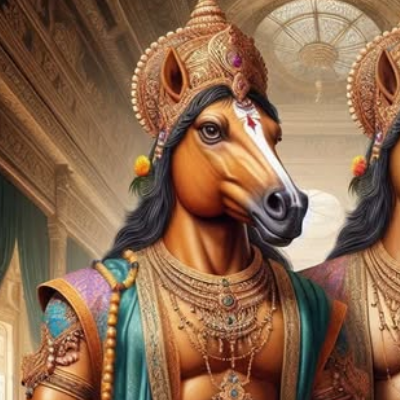
The Ashvini Kumaras are depicted in the iconographic tradition as two identically youthful, handsome, golden-complexioned figures — their youth and beauty being among their most consistently noted attributes in the Vedic hymns, which address them repeatedly as young, lovely, and swift. They are sometimes shown with horse heads — reflecting their horse-born nature — though in many depictions they have fully human forms with golden or solar complexions. They travel in a golden chariot of three wheels that moves with extraordinary speed, and they hold the implements of their medical practice — herbs, water pots, and sometimes a honeycomb, reflecting the Vedic tradition's association of the Ashvins with honey (madhu) and the Madhu Vidya. They are sometimes depicted together in sculpture in a single iconographic field, their identical appearance emphasising their twin identity, and individual distinguishing attributes between the two twins are not consistently established in the iconographic tradition any more than they are in the textual tradition.
✦ Textual Variants and Inconsistencies
The most fundamental inconsistency in the textual tradition concerning Nasatya is the question of which twin he is — that is, whether Nasatya and Dasra are reliably distinguishable as individuals with separate identities in the primary sources. The honest answer is that they largely are not. In the Rigveda the two names are used both as individual epithets for one twin each and as collective epithets for both twins together, without consistent differentiation of which name applies to which individual twin in most passages. The assignment of Nasatya specifically to one twin and Dasra to the other — and the consequent attribution of specific children such as Mainda to Nasatya and Dvivida to Dasra — represents a tradition of individual differentiation that some texts pursue and others do not. The Valmiki Ramayana's divine parentage passages do not always specify which Ashvin is the father of which Vanara son. The assignment of Nakula to one Ashvin and Sahadeva to the other in the Mahabharata parentage tradition shows the same inconsistency — different texts assign the twins differently.
The parentage of the Ashvini Kumaras themselves shows some variation across texts. The Vivasvat-Saranyu horse-form birth is the most widely attested account in the major Puranas, but some passages give alternative parentage — the Ashvins as sons of the sky (Dyaus) or of the ocean or of various other divine beings. These alternatives are minority traditions that do not displace the solar parentage in the mainstream of the tradition but that exist as genuine textual variants rather than scribal errors.
✦ Theological Significance
Nasatya's theological significance, shared with his twin Dasra as one of the Ashvini Kumara pair, is rooted in the Vedic concept of divine compassion expressed through practical intervention. The Ashvini Kumaras embody the principle that the divine is not merely transcendent and governing — as Varuna governs cosmic law from his sovereign height — but actively present in the world of suffering, willing and able to come down into the specific situations of specific beings in distress and to apply whatever ingenuity and skill are required to relieve that distress. This active, engaged compassion has no parallel among the Vedic sovereign deities, and the Ashvins' popularity in the hymns of the common worshipper reflects the universal appeal of divine beings who notice human suffering and respond to it with direct and effective action.
The Ashvini Kumaras also represent the principle of healing as a cosmic force — the idea that restoration to health, vitality, and wholeness is a divinely sanctioned and divinely supported activity, and that the arts of medicine have their ultimate source and sanction in the twin physicians of the gods themselves. This divine legitimation of medical practice is one of the Ashvini Kumara tradition's most practically significant contributions to the tradition, and the connection of Ayurveda — the traditional Indian medical system — to the Ashvini Kumara archetype is a persistent element of the tradition's self-understanding.
✦ Connection to the Wider Genealogy
Through his father Vivasvat — one of the twelve Adityas — Nasatya is the grandson of Kashyapa and Aditi and the great-grandson of the patriarch Daksha. His siblings include Yama the lord of the dead, Yamuna the river goddess, and Vaivasvata Manu the progenitor of the human race — making Nasatya a divine brother of the sovereign of death, of one of the most sacred rivers, and of the ancestor of all current humanity. Through Manu's royal descendants — the Ikshvaku dynasty of Ayodhya — Nasatya is the divine uncle of the entire solar royal lineage including Rama, the avatar of Vishnu. Through his son Mainda and Mainda's association with the Kishkindha Vanara community, Nasatya is connected to the Ramayana's secondary divine world. Through the Mahabharata's tradition of Nakula and Sahadeva as the Ashvini Kumaras' sons, Nasatya is the divine father of one of the five Pandavas and thereby connected to the central genealogical structure of the Mahabharata's heroic world.
✦ References
- Primary Sources
- Rigveda, Books I–X (numerous hymns to the Ashvini Kumaras): The foundational and most extensive source for the character, exploits, and domains of the Ashvini Kumaras including Nasatya; establishes their identity as divine physicians, dawn deities, and universal helpers of those in distress.
- Shatapatha Brahmana (the Dadhichi episode; the Chyavana restoration; the exclusion from and admission to Soma): The primary early post-Vedic source for the most significant narrative episodes involving the Ashvini Kumaras; elaborates the Vedic mythological kernels into narrative form.
- Mahabharata, Vana Parva (the Chyavana episode in its full narrative form); Adi Parva (the divine parentage of the Pandavas including Nakula and Sahadeva); Udyoga Parva and Shanti Parva (celestial assembly appearances): The primary epic source for the Ashvini Kumaras' major narrative appearances and for their role as divine fathers of two of the five Pandavas.
- Vishnu Purana, Book III (the Saranyu-Chhaya episode and the birth of the Ashvini Kumaras): The most detailed Puranic account of the Ashvini Kumaras' birth from Vivasvat and Saranyu in their horse forms.
- Valmiki Ramayana, Bala Kanda (divine parentage of the Vanaras): Establishes Mainda as the son of the Ashvini Kumaras in the tradition that identifies Nasatya specifically as Mainda's father.
- Matsya Purana and Bhagavata Purana (genealogical passages on Vivasvat's lineage): Additional Puranic sources for the Ashvini Kumaras' genealogy and their place within the solar divine lineage.
- Secondary Sources
- Macdonell, A. A. Vedic Mythology (1897): The most comprehensive scholarly analysis of the Vedic Ashvini Kumaras — their hymns, their exploits, their character, their disputed etymology, and their place in the Vedic divine hierarchy; essential for understanding Nasatya's Vedic dimension.
- Mani, Vettam. Puranic Encyclopaedia (1975): Entries on Nasatya, Dasra, the Ashvini Kumaras, Mainda, Dvivida, Nakula, Sahadeva, and Chyavana; invaluable for cross-referencing textual sources and identifying the full scope of the Ashvini Kumara tradition.
- Jamison, Stephanie W. and Brereton, Joel P. The Rigveda: The Earliest Religious Poetry of India (2014): Modern critical translation of the Rigveda with commentary; provides translations and analysis of the Ashvini Kumara hymns and contextualises their character within the full Rigvedic pantheon.
- Wisdomlib (wisdomlib.org), entries on Nasatya, Dasra, the Ashvini Kumaras, Chyavana, Madhu Vidya, Mainda, Nakula, and Sahadeva: Aggregates verse references from digitised primary texts; useful for locating specific passages and comparing variant readings across the primary corpus.