
About
Dasra — Divine Physician, Ashvini Twin, and Father of Dvivida
Dasra · Dasra Ashvin · Ashvini Kumara · Ashvin · Nasatya (as collective epithet) · Purandhri
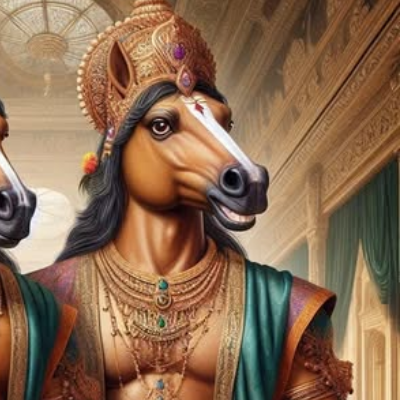
Dasra is one of the two Ashvini Kumaras — the divine twin physicians of the gods whose prominence in the Rigveda, whose extraordinary record of healing exploits, and whose eventual admission to the divine Soma sacrifice make them among the most theologically and narratively developed of all the Vedic divine pairs. He is the son of Vivasvat — the sun god Surya, one of the twelve Adityas born to the sage Kashyapa and his wife Aditi — and of Saranyu, the daughter of the divine craftsman Tvashtr. He is the twin brother of Nasatya, the other Ashvini Kumara, and the two constitute an inseparable divine pair whose collective exploits, shared domains, and joint mythological episodes the primary sources treat almost always as a unit. In the tradition that assigns individual divine paternity to the major Vanara heroes of the Ramayana, Dasra is identified as the father of Dvivida — the companion and paired figure of Mainda, the son of Dasra's twin Nasatya, and the Vanara warrior whose later life and dramatic death at the hands of Balarama in the Harivamsa episode is one of the most significant post-Ramayana appearances of any Vanara figure in the tradition. Dasra appears across the Rigveda, the Atharvaveda, the Brahmanas, the Mahabharata, and the Puranas, always in company with Nasatya and always as one of the pair whose combined nature as divine healers, dawn deities, and universal helpers constitutes one of the most enduring and theologically productive concepts in the entire Sanskrit religious tradition.
✦ The Name
The name Dasra derives from a Sanskrit root connected to the concept of performing wonders, achieving marvels, or accomplishing extraordinary acts — from the root das or similar forms meaning to accomplish or to perform. Dasra therefore means the wonderful one, the one who performs marvels, or the accomplisher of extraordinary feats, a meaning directly consistent with the Ashvini Kumaras' characteristic mode of action: their intervention in the lives of those in distress is always characterised by ingenuity, by solutions that are unexpected and technically astonishing, and by a quality of miraculous effectiveness that the Vedic hymns celebrate with evident delight. The name thus encodes the very quality that makes the Ashvini Kumaras distinctive among the Vedic gods — not sovereign power or martial force, but the power of skilled, creative, compassionate intervention.
As with the name Nasatya, the name Dasra is used in some Rigvedic passages as a collective epithet applying to both Ashvini Kumara twins rather than as an individual name for one twin only. The difficulty of consistently distinguishing the two twins as separate individuals is a genuine feature of the primary source tradition and is discussed further in the section on textual variants. The epithet Purandhri — meaning the city-breaker or the breaker of fortresses — is applied to the Ashvini Kumaras in some passages and may carry the sense of those who break through whatever barriers stand between those in distress and their relief, consistent with the general character of divine intervention that the Ashvins embody.
✦ Lineage
- Father: Vivasvat — the sun god Surya; one of the twelve Adityas born to the sage Kashyapa and his wife Aditi, daughter of the patriarch Daksha; the source of solar light, warmth, and cosmic order; father of Yama the lord of the dead, Yamuna the river goddess, Vaivasvata Manu the progenitor of the current human race, and — in the divine parentage tradition of the Ramayana — of Sugriva the Vanara king.
- Mother: Saranyu — daughter of Tvashtr the divine craftsman, himself one of the twelve Adityas; born of the union between Vivasvat in horse form and Saranyu in mare form, after Saranyu had fled Vivasvat's overwhelming solar radiance and was living in the northern regions in the form of a mare.
- Maternal grandfather: Tvashtr — the divine craftsman; one of the twelve Adityas born to Kashyapa and Aditi; simultaneously Dasra's maternal grandfather and his paternal uncle through the Aditya lineage, since Tvashtr is both Saranyu's father and Vivasvat's Aditya brother.
- Twin brother: Nasatya — the other Ashvini Kumara; born simultaneously with Dasra of the same divine parents in the same horse-form union; inseparable from Dasra in virtually every narrative and ritual context; father of Mainda the Vanara hero.
- Siblings through Vivasvat and Saranyu: Yama — lord of the dead; Yamuna — the river goddess; and Vaivasvata Manu — progenitor of the current human race. These elder siblings were born of Vivasvat and Saranyu in her divine form before Saranyu's flight.
- Half-siblings through Vivasvat and Chhaya: Shani — the planet Saturn; Savarni Manu — Manu of the coming eighth cosmic age; and Tapati — the river goddess in some accounts.
- Son: Dvivida — a Vanara hero of Kishkindha; constant companion of Mainda, son of Dasra's twin Nasatya; participant in the campaign against Ravana under Sugriva's command in the Ramayana; friend of the demon king Narakasura in the post-Ramayana period; killed by Balarama in the celebrated episode of the Harivamsa and Bhagavata Purana after a period of destructive behaviour in the region of the Raivataka mountain; the most individually narratively prominent of the Ashvini Kumaras' Vanara sons.
- Paternal uncles (through Vivasvat's Aditya brothers): Indra, Varuna, Mitra, Vishnu, Bhaga, Pushan, Aryaman, Amsha, Parjanya, Dhata, and Tvashtr — all twelve Adityas being born to Kashyapa and Aditi, making them Dasra's paternal uncles as the brothers of his father Vivasvat.
✦ Dasra and the Ashvini Kumaras in the Rigveda
The Rigvedic character and exploits of Dasra as one of the Ashvini Kumara pair are entirely shared with those of his twin Nasatya, since the primary Vedic sources treat the two as an inseparable unit. The full account of their Rigvedic character — their identity as dawn deities, divine physicians, helpers of the distressed, beings of exceptional speed and youth and beauty — and the full catalogue of their healing exploits across the Rigvedic hymns, are given in the profile of Nasatya above and apply equally to Dasra. The relevant episodes include the rescue of Bhujyu from the ocean, the restoration of Chyavana to youth, the restoration of sight to the blind, the rescue of those trapped or buried, the assistance given to widows and to those in disease, and the full range of compassionate interventions that the Rigvedic hymns enumerate with sustained celebration across more than fifty hymns addressed to the pair.
What can be said specifically of Dasra as an individual divine personality — beyond his shared identity with Nasatya as one of the Ashvini pair — is limited by the primary sources' own consistent treatment of the two as inseparable. The tradition that makes Dasra the specific father of Dvivida and Nasatya the specific father of Mainda represents the extent to which the individual differentiation of the twins was pursued in the genealogical tradition, and it is a differentiation that the Rigvedic hymns themselves do not clearly support in most passages.
✦ The Rescue of Bhujyu — The Most Celebrated Maritime Rescue
Among the Rigvedic exploits of the Ashvini Kumaras, the rescue of Bhujyu — the son of Tugra — from the middle of the ocean is one of the most frequently referenced and the most dramatically narrated. The account appears across multiple hymns of the Rigveda in compressed mythological allusions rather than as a single sustained narrative, but the essential outline is clear: Bhujyu had been abandoned or had fallen in the midst of the ocean — some passages suggest his own father Tugra had abandoned him there, others suggest he was shipwrecked — and was in mortal peril with no prospect of rescue. The Ashvini Kumaras heard his appeal and came to his rescue, carrying him across the ocean in their chariot or in a winged ship to safety on the shore.
The rescue of Bhujyu is significant as one of the Ashvini Kumaras' most structurally complex rescues — it required travel across the ocean, the use of their celestial vehicle in a maritime context, and the navigation of conditions that would have been fatal to any ordinary being. The hymns celebrate the rescue with a sense of the Ashvins' mastery over all environments — sky, earth, and sea — that gives their divine capability a comprehensiveness consistent with their role as universal helpers without domain restriction.
✦ Dasra's Son Dvivida — The Most Individually Developed Ashvini Kumara Descendant
Among all the descendants of the Ashvini Kumaras in the primary sources, Dasra's son Dvivida is the most individually developed as a narrative figure. This distinction is achieved primarily through the Harivamsa and Bhagavata Purana episode in which Dvivida — acting out of grief and loyalty following the death of his friend the demon king Narakasura — undertook a period of widespread destruction in the regions surrounding the Raivataka mountain, causing devastation to forests, villages, rivers, and the human communities living in the area, before being confronted and killed by Balarama, the elder brother of Krishna and an avatar of Shesha the cosmic serpent.
The full account of Dvivida's depredations and his death at Balarama's hands is given in the profile of Dvivida above. What is relevant to Dasra's profile is the theological and genealogical significance of his son's arc across the two great epics: Dvivida began as a righteous warrior who fought in the campaign against Ravana — the campaign in service of Vishnu's avatar Rama — and ended as a destructive force killed by another manifestation of the same supreme deity in a later age. The contrast between the son's beginning in righteous service and his ending in destructive action — and the role of the Amrita boon from the Ashvini Kumaras in sustaining Dvivida's life across the vast span of cosmic time separating the two events — gives Dasra's paternity a narrative consequence that exceeds what the profile of most secondary divine fathers in the tradition involves.
The Amrita boon — the gift of a share of the nectar of immortality that the Ashvini Kumaras gave to their Vanara sons — is the theological mechanism that made Dvivida's multi-age survival possible, and it is a boon entirely consistent with the Ashvini Kumaras' identity as the divine physicians who possess the supreme life-sustaining substance. Dasra's gift of Amrita to his son reflects the father's defining medical power translated into a parental act of supreme protection — giving the child the one substance that keeps the boundary between life and death open indefinitely.
✦ Dasra as Father of Sahadeva — The Mahabharata Connection
In the Mahabharata's tradition of divine parentage for the five Pandavas, the Ashvini Kumara twins are identified as the divine fathers of the twin Pandavas Nakula and Sahadeva, born of Madri — the second wife of Pandu — through the power of the divine mantra she received from Kunti. In the tradition that assigns individual paternity — specifying which Ashvini Kumara fathered which Pandava twin — Dasra is sometimes identified as the father of Sahadeva, while Nasatya is the father of Nakula. This assignment, however, is not consistently maintained across all manuscripts and recensions of the Mahabharata, and in some passages the reverse assignment is given or no individual distinction is made between the twins' divine fathers.
Sahadeva, if accepted as Dasra's son, carries his divine father's qualities in the tradition's characterisation of the youngest Pandava: Sahadeva is celebrated in the Mahabharata for his wisdom, his expertise in astrology and the knowledge of time, his skill with cattle — consistent with the Ashvini Kumaras' pastoral associations — and his extraordinary intelligence. His wisdom is considered so great that he knew the outcomes of the Kurukshetra war in advance but was bound by a curse not to reveal what he knew unless asked directly, a condition that gave him a peculiar relationship to the foreknowledge that his divine father Dasra's twin origins in the twilight between night and day might symbolically encode.
✦ Textual Variants and Inconsistencies
The textual variants and inconsistencies relevant to Dasra are substantially identical to those relevant to Nasatya, since both arise from the same fundamental characteristic of the Ashvini Kumara tradition: the extreme difficulty of consistently differentiating the two twins as separate individuals in a tradition that treats them as an inseparable pair. The use of both names — Nasatya and Dasra — as collective epithets for both twins in some passages, combined with their use as individual distinguishing names in other passages, creates a genuine and irresolvable ambiguity in the primary sources about which twin is specifically Dasra.
The assignment of Dvivida to Dasra and Mainda to Nasatya in the Vanara parentage tradition is a specific differentiation that some texts pursue but that is not universally confirmed across all passages of the Valmiki Ramayana and its Puranic treatments. Similarly, the assignment of Sahadeva to Dasra in the Mahabharata parentage tradition is one of several possible configurations given across the manuscript tradition and is not the universally canonical assignment.
The parentage of the Ashvini Kumaras themselves — while the Vivasvat-Saranyu horse-form birth is the most widely attested account — shows variation across texts, with some passages giving alternative origins. These variants are noted in the profile of Nasatya above and apply equally to Dasra.
✦ Theological Significance
Dasra's theological significance, shared with his twin Nasatya as one of the Ashvini Kumara pair, is fully addressed in the theological significance section of the Nasatya profile above and is not repeated here in its entirety. What can be noted specifically in Dasra's context is that his son Dvivida's trajectory — from righteous warrior to destructive force to a death delivered by Vishnu's avatar — gives the Ashvini Kumara tradition, through Dasra's lineage, a connection to the theological principle of divine correction that complements the Ashvini Kumaras' own tradition of divine healing and beneficent intervention. Just as the Ashvini Kumaras heal and restore through skilled intervention, so the supreme deity corrects and restores the cosmic order when the Ashvini Kumara's son has become a source of disruption rather than healing — a structural parallel between the fathers' cosmic function and the divine response to the son's departure from righteous conduct.
✦ Connection to the Wider Genealogy
Through his father Vivasvat — one of the twelve Adityas — Dasra is the grandson of Kashyapa and Aditi and the great-grandson of the patriarch Daksha. His siblings through Vivasvat and Saranyu include Yama the lord of the dead, Yamuna the river goddess, and Vaivasvata Manu the progenitor of the current human race. Through Manu's royal descendants — the Ikshvaku dynasty of Ayodhya — Dasra is the divine uncle of the entire solar royal lineage including Rama. Through his son Dvivida and Dvivida's role in the campaign against Ravana under Sugriva's command, Dasra is connected to the Ramayana's secondary divine world. Through Dvivida's later death at Balarama's hands, Dasra is connected to the Mahabharata-period narrative of Krishna's divine play and the ongoing cosmic correction that Vishnu's avatars perform across successive ages.
If Sahadeva is accepted as Dasra's son through Madri, Dasra is the divine father of one of the five Pandavas — the heroes of the Mahabharata — and thereby connected to the epic's central genealogical structure. Through Sahadeva's knowledge and wisdom, Dasra's inheritance of divine intelligence and foresight — qualities consistent with the twilight nature of the dawn deities who see between darkness and light — is passed to the wisest of the Pandava twins. The full Aditya network connecting Dasra to Indra, Varuna, Vishnu, and the other eleven Adityas through his father Vivasvat's fraternal relationships gives him a genealogical depth within the divine lineage structure that matches the cosmic importance of the healing tradition he and his twin embody.
✦ References
- Primary Sources
- Rigveda, Books I–X (numerous hymns to the Ashvini Kumaras): The foundational Vedic source for the character, exploits, and domains of the Ashvini Kumaras including Dasra; the rescue of Bhujyu, the healing of Chyavana, the restoration of sight, and the full range of compassionate interventions are recorded across more than fifty hymns addressed to the pair.
- Shatapatha Brahmana (the Dadhichi episode; the Chyavana restoration; the Soma admission): The primary early post-Vedic source for the major narrative episodes involving the Ashvini Kumaras and applicable equally to Dasra as to Nasatya.
- Mahabharata, Adi Parva (the divine parentage of the Pandavas including Nakula and Sahadeva); Vana Parva (the Chyavana episode in full narrative form): The primary epic source for the Ashvini Kumaras' role as divine fathers of the Pandava twins and for the full narrative of the Chyavana restoration.
- Valmiki Ramayana, Bala Kanda (divine parentage of the Vanaras): Establishes Dvivida as the son of the Ashvini Kumaras in the tradition that identifies Dasra specifically as Dvivida's father.
- Harivamsa (Dvivida's depredations and death at Balarama's hands): The primary source for the most significant narrative episode involving Dasra's son; records Dvivida's destructive period and his death in the Dvapara Yuga.
- Bhagavata Purana, Skandha X, Chapter 67 (the Dvivida episode): The most elaborated Puranic version of Dvivida's confrontation with Balarama; the most important single Puranic source for Dasra's son's individual narrative.
- Vishnu Purana, Book III (the Saranyu-Chhaya episode and the birth of the Ashvini Kumaras): The most detailed Puranic account of Dasra's birth from Vivasvat and Saranyu in their horse forms.
- Matsya Purana and Bhagavata Purana (genealogical passages on Vivasvat's lineage): Additional Puranic sources for the Ashvini Kumaras' genealogy.
- Secondary Sources
- Macdonell, A. A. Vedic Mythology (1897): The most comprehensive scholarly analysis of the Vedic Ashvini Kumaras — their hymns, their character, their disputed etymology, and their place in the Vedic divine hierarchy; essential for understanding Dasra's Vedic dimension and the tradition's treatment of the twins as a collective pair.
- Mani, Vettam. Puranic Encyclopaedia (1975): Entries on Dasra, Nasatya, the Ashvini Kumaras, Dvivida, Mainda, Nakula, Sahadeva, and Chyavana; invaluable for cross-referencing textual sources and identifying the full scope of the Ashvini Kumara tradition across the primary corpus.
- Jamison, Stephanie W. and Brereton, Joel P. The Rigveda: The Earliest Religious Poetry of India (2014): Modern critical translation of the Rigveda with commentary; provides translations and analysis of the Ashvini Kumara hymns, the rescue of Bhujyu, and the healing of Chyavana within the full Rigvedic context.
- Bryant, Edwin F. Krishna: A Sourcebook (2007): Contains relevant discussion of the Harivamsa and Bhagavata Purana narratives in which Dasra's son Dvivida appears and dies at Balarama's hands; useful for contextualising the episode within the Krishna narrative tradition.
- Wisdomlib (wisdomlib.org), entries on Dasra, Nasatya, the Ashvini Kumaras, Dvivida, Sahadeva, Bhujyu, and Chyavana: Aggregates verse references from digitised primary texts; useful for locating specific passages, tracking variant readings across recensions, and cross-referencing the tradition's treatment of Dasra and his son across the full primary corpus.