
About
Revanta — Son of Vivasvat, Lord of Horses, and Deity of the Hunt
Revanta · Raivata · Revantadeva · Surya-putra · Vaivasvata · Ashvadhipati · Mrigayadhipati
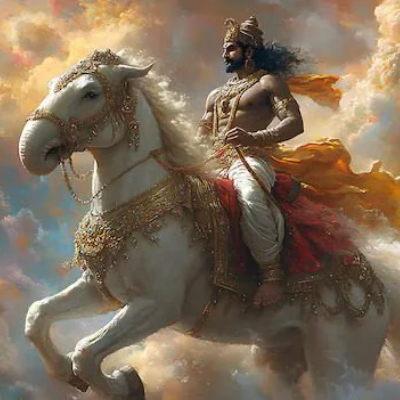
Revanta is a deity of the Hindu tradition born of the sun god Vivasvat — the solar Aditya also known as Surya, one of the twelve Adityas born to the sage Kashyapa and his wife Aditi — and associated primarily with horses, hunting, and the forests through which hunters and horsemen move. He is one of the lesser-known divine sons of Vivasvat, born in circumstances connected to the episode of Saranyu's flight and the horse-form union of Vivasvat and Saranyu from which the Ashvini Kumara twins also emerged. Revanta is therefore a sibling of the Ashvini Kumara twins Nasatya and Dasra, of Yama the lord of the dead, of Yamuna the river goddess, and of Vaivasvata Manu the progenitor of the current human race. His narrative presence in the primary sources is considerably more limited than that of his more prominent siblings — he receives no major independent episode in the Mahabharata or the Valmiki Ramayana, and his principal appearances are in the Vishnu Purana, the Devi Bhagavata Purana, the Markandeya Purana, and certain regional traditions. He is, however, a deity with a distinctive iconography, a defined domain of worship, and a specific mythological origin story that makes him a genuine figure of the Puranic tradition rather than merely a name in a genealogical list. He appears most fully in the Vishnu Purana's account of his birth and in the worship traditions of certain regions — particularly in parts of northern and western India — where he is venerated as a deity of horsemen, hunters, and those who move through forest and wilderness.
✦ The Name
The name Revanta is derived from the Sanskrit root rev or ri, connected to concepts of going, moving, or leaping, combined with anta meaning end or limit, or alternatively from a root associated with wealth, splendour, or brilliance. Some commentators connect Revanta to the root rev meaning to sound, to roar, or to reverberate — consistent with the sounds of the hunt, the thunder of horses' hooves, and the noise of a moving army or hunting party. Others derive the name from a form meaning the brilliant one or the luminous one, consistent with his solar parentage through Vivasvat. The primary sources do not provide an explicit etymological gloss for the name, and the multiple possible derivations reflect the same uncertainty about this figure's name that attends many of the less prominently attested deities in the tradition. The alternate name or epithet Raivata — used in some regional traditions and in certain Puranic passages — may be derived from a related root or may represent a regional form of the name. The epithet Ashvadhipati means lord of horses, and Mrigayadhipati means lord of the hunt or lord of hunting — both reflecting his primary divine domains as understood in the Puranic tradition.
✦ Lineage
- Father: Vivasvat — the sun god Surya; one of the twelve Adityas born to the sage Kashyapa and his wife Aditi, daughter of the patriarch Daksha; the principal solar deity of the Vedic and Puranic tradition; progenitor of Yama, Yamuna, Vaivasvata Manu, the Ashvini Kumara twins, Sugriva, and Revanta through various unions and circumstances.
- Mother: Saranyu — daughter of Tvashtr the divine craftsman, himself one of the twelve Adityas; the wife of Vivasvat who created the shadow double Chhaya and fled her husband's overwhelming solar radiance, eventually taking the form of a mare in the northern regions. Revanta is born of the horse-form union between Vivasvat and Saranyu — the same union that produced the Ashvini Kumara twins — though the specific birth account of Revanta relative to the Ashvini twins varies across the sources, as discussed below.
- Maternal grandfather: Tvashtr — the divine craftsman; one of the twelve Adityas born to Kashyapa and Aditi; maker of divine weapons; Revanta's maternal grandfather and simultaneously his paternal uncle through the Aditya lineage, since Tvashtr is both Saranyu's father and Vivasvat's Aditya brother.
- Siblings through Vivasvat and Saranyu: Yama — lord of the dead and sovereign judge of souls; Yamuna — the river goddess; Vaivasvata Manu — progenitor of the current human race and ancestor of all royal dynasties of the present age; Nasatya — one of the Ashvini Kumara twins; Dasra — the other Ashvini Kumara twin. The relationship between Revanta and the Ashvini twins — whether Revanta is born of the same horse-form union or is a separate birth — is discussed in the textual variants section below.
- Half-siblings through Vivasvat and Chhaya: Shani — the planet Saturn, deity of karmic consequence; Savarni Manu — the Manu of the coming eighth cosmic age; Tapati — the river goddess of the Tapti river in some accounts.
- Paternal half-brother through Vivasvat: Sugriva — king of Kishkindha; son of Vivasvat in the divine parentage tradition of the Vanara heroes of the Ramayana.
- Paternal uncles (through Vivasvat's Aditya brothers): Indra, Varuna, Mitra, Vishnu, Bhaga, Pushan, Aryaman, Amsha, Parjanya, Dhata, and Tvashtr — all twelve Adityas being sons of Kashyapa and Aditi and therefore brothers of Revanta's father Vivasvat.
- Spouse and children: The primary sources do not consistently record a wife or children for Revanta. He is presented in the tradition primarily as a deity defined by his domain and his birth rather than as a progenitor of a lineage of his own.
✦ The Birth of Revanta
The account of Revanta's birth is most fully given in the Vishnu Purana and is connected to the same episode of Vivasvat's horse-form union with Saranyu that produced the Ashvini Kumara twins. The Vishnu Purana records that when Vivasvat — having discovered that his wife Saranyu had fled and had taken the form of a mare in the northern regions — himself assumed the form of a horse and went to find her, the two were united in their horse forms. From this union were born the Ashvini Kumara twins and, in addition, Revanta — making Revanta a third offspring of the horse-form union rather than exclusively a twin birth product.
The Vishnu Purana's account specifically states that Revanta was born as a being of exceptional equestrian nature — a horseman of divine quality from birth, reflecting the horse-form circumstances of his conception and birth. He emerged from the horse-form union already associated with horses in his very nature, and his subsequent identification as a deity of horses and horsemen is understood in this tradition as an organic expression of his origin rather than an assigned domain. Just as the Ashvini Kumara twins are horse-born divine physicians whose horse nature manifests in their speed, beauty, and their specifically equine-connected mythological episodes, so Revanta is a horse-born deity whose nature manifests in his identification with the world of horses, horsemanship, and the horse-dependent activities of hunting and military movement through forests and wilderness.
The Devi Bhagavata Purana gives a different account of Revanta's birth that is worth noting. In this version, Revanta is born of Vivasvat not through the horse-form union with Saranyu but through a different mechanism connected to the episode in which Lakshmi — the goddess of fortune and the consort of Vishnu — was seated in Vishnu's presence and became so entranced by the beauty of a magnificent horse that Revanta was riding that she lost her attention and failed to respond to Vishnu's words. In consequence of this lapse of attention while in Vishnu's presence, Lakshmi was cursed by Vishnu to take birth on earth — an episode that connects Revanta to the circumstances of Lakshmi's earthly birth in one strand of the tradition. This version does not give Revanta an origin connected to Saranyu's horse-form and represents a distinct tradition about his nature and his significance.
✦ Revanta's Domain — Horses, Hunting, and the Forest
Revanta's primary divine domain is the world of horses and horsemanship — he is the presiding deity of those who work with, ride, care for, and depend upon horses for their livelihood and their activity. In the social world of the tradition, this domain encompassed warriors who fought from horseback, kings whose military power was expressed through their cavalry, traders who transported goods on horseback, and all who depended on equine power for movement through the world. His association with horses is simultaneously a matter of his own horse-born nature and of the practical patronage he extends to the human activities that involve horses.
His second major domain — hunting and the hunt — connects directly to the equestrian world through the aristocratic and royal hunting traditions of ancient and medieval India, in which hunting from horseback was one of the primary expressions of martial skill and royal power. The hunt was not merely a source of food but a form of warfare training, a demonstration of courage and skill, and a ritual activity with its own traditions and protocols. As the deity of the hunt, Revanta presided over the safety of hunters in the forest, the success of the hunt, and the protection of those who moved through the wilderness in pursuit of game.
The forest itself — as the domain through which hunters and horsemen move — is therefore implicitly part of Revanta's realm. In the Indian cosmological understanding, the forest is a liminal space, a space beyond the settled order of village and city, in which different powers and different dangers operate. The deity who presides over activities within this liminal space is appropriate to be a being of liminal birth — born of a horse-form divine union in the wilderness of the northern regions rather than in the ordered divine world of the celestial realm — and Revanta's forest associations are consistent with this liminal character.
✦ The Devi Bhagavata Purana Episode — Revanta and Lakshmi
The most narratively developed episode involving Revanta in the Puranic literature is the account given in the Devi Bhagavata Purana in which Revanta's appearance on a magnificent horse in Vishnu's presence caused Lakshmi to lose her attentive composure and thereby precipitated her earthly birth. The episode deserves extended attention as it represents Revanta's most theologically significant moment in the tradition.
According to this account, Revanta came to the divine realm riding the celestial horse Uchchaishravas — the magnificent white horse that had emerged from the churning of the cosmic ocean and was regarded as the king of all horses. The appearance of Revanta on Uchchaishravas in the divine assembly was an event of extraordinary visual splendour: the combination of a divine rider of solar lineage mounted on the supreme horse of the cosmos created an image of equestrian beauty so compelling that it arrested the attention of everyone present.
Lakshmi, the goddess of fortune and beauty who was seated beside Vishnu in his divine assembly, was so captivated by the beauty of the horse that she could not take her eyes from it. When Vishnu addressed her directly — either asking her a question or speaking to her — she failed to hear him or failed to respond appropriately, her attention entirely absorbed by the magnificent animal before her. Vishnu, perceiving that she had been distracted from attention to him by a horse — that the beauty of a created being had temporarily displaced the goddess of fortune from her proper contemplation of the supreme deity — was displeased at this lapse. He declared that since her mind had been caught by a horse, she would be born on earth in a form connected to horses or would spend time among those who work with horses, according to variant readings of the specific curse.
The curse led to Lakshmi's earthly birth in circumstances connected to horses and the pastoral world — the specific details of this earthly birth varying across different versions of the account. In some versions she is born as a mare or lives among horses; in others she is born as a woman in a household connected to the horse-dependent world. The episode is used in the Devi Bhagavata Purana as an origin story for a particular form of Lakshmi and as a demonstration of the power of divine beauty — specifically equine beauty, which Revanta embodies through his horse-born nature — to momentarily distract even the supreme goddess of fortune from her proper devotion.
Revanta's role in this episode is passive in the sense that he does not intentionally cause Lakshmi's distraction — he simply appears in his natural form on the supreme horse, and the distraction is a consequence of the beauty inherent in his nature rather than of any deliberate action on his part. Nevertheless the episode gives him a specific narrative function in the Devi Bhagavata Purana that is not shared by most minor deities and establishes a connection between Revanta's solar equestrian nature and the cosmic events that flow from it.
✦ Revanta in Regional Worship Traditions
Revanta's most significant presence in the living tradition is not in the major Puranic texts but in the regional worship traditions of certain parts of India — particularly in Rajasthan, Gujarat, and parts of central India — where he has been venerated as a deity of horsemen, hunters, and the warrior aristocracy. In these regional traditions, Revanta is worshipped at specific shrines, often located near the edges of settlements at the boundary between the cultivated world and the forest or wilderness, consistent with his domain as the deity of the spaces between the ordered world and the wild.
The worship of Revanta in these regional traditions is associated particularly with the equestrian castes and communities — those whose traditional occupations involved horses, hunting, and military service from horseback. For such communities, Revanta as the divine patron of their mode of life and their primary animal was a figure of direct practical relevance, and his worship was integrated into the ritual life surrounding horses — the care of horses, the beginning of hunting expeditions, the protection of horses from disease and injury, and the propitiation of the deity before military campaigns.
Archaeological evidence of Revanta's worship is preserved in a number of sculptural representations from the medieval period — particularly from the eighth to twelfth centuries — that have been found at various sites in northern India. These sculptures typically depict Revanta as a mounted hunter surrounded by a retinue of attendants, with hunting dogs, with game animals, and with the paraphernalia of the hunt. The sculptural tradition of Revanta as the mounted hunter deity is one of the most consistently developed iconographic traditions for any of the solar subsidiary deities, and it reflects the genuine regional importance of his worship in the medieval period even as his presence in the mainstream Puranic textual tradition remained relatively limited.
✦ Iconography
Revanta's iconography is among the most consistently martial and equestrian of all the Puranic deities associated with the solar lineage. He is depicted as a young, handsome warrior mounted on a magnificent horse — typically shown in the posture of a hunter or a rider in active movement. He is armed with a bow and arrows — the weapons of the hunt — and is surrounded by a retinue of attendants who may include other mounted figures, hunting dogs, and servants bearing the spoils of the hunt. The composition of Revanta panels in medieval North Indian sculpture often shows him as the central figure in a hunting scene, with multiple attendants and animals arranged around him in a way that emphasises his status as a divine lord of the hunt rather than merely a participant in it.
His complexion is typically golden or bright — consistent with his solar parentage through Vivasvat — and he is depicted with the ornaments and equipment of a divine warrior-hunter rather than with the meditative or benevolent attributes of a deity of peace or wisdom. The overall iconographic impression of Revanta is of vigour, movement, and martial capability — a deity of the active outdoor world rather than of the temple inner sanctum or the philosophical discourse.
The horse that Revanta rides in the iconographic tradition is sometimes identified as Uchchaishravas — the divine horse that emerged from the churning of the cosmic ocean — reflecting the Devi Bhagavata Purana's account of Revanta's appearance before Vishnu on this supreme horse. At other times the horse is simply the finest of mortal horses, a being of extraordinary equine quality that expresses through the animal's excellence the divine authority of its rider over all of horse-kind.
✦ Textual Variants and Inconsistencies
The textual tradition concerning Revanta is characterised by two primary types of inconsistency: inconsistency in his birth account, and inconsistency in the nature and scope of his divine domain.
Regarding his birth, the Vishnu Purana's account that Revanta was born of the horse-form union between Vivasvat and Saranyu — alongside or in addition to the Ashvini Kumara twins — is the most widely attested Puranic version and is the account followed in this profile. The Devi Bhagavata Purana's version does not give a birth account for Revanta that clearly situates him in the Saranyu episode; its account implies a Revanta already existing as a divine being who comes to Vishnu's assembly on Uchchaishravas, without specifying the circumstances of his birth in that context. These two primary Puranic sources thus give partially incompatible pictures of Revanta's narrative context, and the tradition does not provide a single canonical resolution.
The question of whether Revanta is born simultaneously with the Ashvini Kumara twins from the same horse-form union or is a separate and subsequent birth from the same parents is not clearly resolved in the Vishnu Purana's account itself. Some readings of the relevant passage treat all three — the two Ashvins and Revanta — as simultaneous products of the horse-form union; others treat Revanta as a separate birth that occurred in the same general context but not as a twin birth alongside the Ashvins. This ambiguity has been noted in scholarly treatments of the Vivasvat-Saranyu mythology without a definitive resolution being established.
Regarding his divine domain, the tradition is consistent in associating Revanta with horses and hunting but varies in the specific scope of these associations. Some regional traditions extend his domain to include the protection of travellers through forests and wilderness more generally — not only hunters and horsemen but anyone moving through the liminal spaces between settlements. Other regional traditions limit his worship specifically to equestrian communities and treat him as a more specialised deity of horsemen rather than as a general deity of the forest and the wilderness. These differences reflect the variation in regional worship traditions discussed above rather than differences in the primary Puranic texts.
✦ Theological Significance
Revanta's theological significance is more modest than that of his more prominent solar siblings but is genuine within its specific domain. As the deity of horses and the hunt, he represents the divine sanctioning and oversight of a specific and important domain of human activity — the equestrian and hunting world that was central to the martial aristocracy's self-understanding and practical power. The tradition's creation of a divine patron specifically for this domain reflects the importance of horses and hunting in the social world that produced the Puranic tradition, and Revanta's solar parentage gives this patronage a cosmic legitimation — the deity of horses is the son of the solar deity, reflecting the sun's own association with horses through his chariot drawn by seven solar horses, and the divine authority over equestrian activity flows from the supreme solar source.
The Devi Bhagavata Purana episode gives Revanta an unexpected theological significance as the inadvertent cause of Lakshmi's earthly birth — a significance that exceeds what his relatively modest Puranic profile might suggest. In this episode, his horse-born beauty becomes the trigger for a cosmic event of considerable consequence, establishing him as a figure whose equestrian nature has implications far beyond the practical world of horsemanship and hunting. The episode can be read as a statement about the power of natural beauty — specifically the beauty of the horse as the most magnificent of all animals — to penetrate even the divine realm and affect even the most exalted of goddesses. In this reading, Revanta embodies the divine natural beauty of the horse at its most concentrated and its most powerful, and his appearance in Vishnu's assembly with Uchchaishravas is the supreme expression of that beauty meeting the supreme context of the divine court.
✦ Connection to the Wider Genealogy
As a son of Vivasvat — one of the twelve Adityas born to Kashyapa and Aditi — Revanta is the grandson of Kashyapa and Aditi and the great-grandson of the patriarch Daksha. He is the nephew of all the other eleven Adityas including Indra the king of the gods, Varuna the lord of the cosmic waters, Vishnu the supreme deity of the Vaishnava tradition, Mitra the deity of covenant, Bhaga the deity of fortune, Pushan the deity of paths, Aryaman the deity of social order, and the rest. Through his mother Saranyu's father Tvashtr — who is simultaneously his paternal uncle — he has a double connection to the Aditya lineage.
Among his siblings, Revanta is the divine brother of Yama the lord of the dead, whose sovereignty over the southern direction and over the souls of the departed makes him one of the most cosmically significant of all Puranic deities. He is the divine brother of Yamuna the river goddess, whose waters flow through the sacred landscape of Krishna's childhood and whose connection to the Vaishnava devotional tradition gives her extraordinary importance in the living religion of the tradition. He is the divine brother of Vaivasvata Manu, whose survival of the great cosmic flood and whose role as the progenitor of the current human race makes him the ancestor of all the royal dynasties of the present age and of the human race as a whole. He is the divine brother of the Ashvini Kumara twins Nasatya and Dasra — born of the same horse-form union — whose roles as divine physicians, fathers of Vanara heroes, and divine fathers of Pandava twins give them a narrative presence across both of the great epics that Revanta does not share.
Through Vaivasvata Manu's royal descendants — the Ikshvaku dynasty of Ayodhya — Revanta is the divine uncle of the entire solar royal lineage including Rama, the seventh avatar of Vishnu. Through Sugriva — identified as Vivasvat's son in the divine parentage tradition of the Vanara heroes — Revanta is the divine half-brother of the Vanara king who was Rama's principal ally in the campaign against Ravana, giving him a connection to the central narrative of the Ramayana through family relationship even though he himself does not appear in that narrative. Through Yama's son Yudhishthira, born of the Pandava divine parentage tradition, Revanta is the divine uncle of the eldest Pandava and thereby connected to the central genealogical structure of the Mahabharata's heroic world.
✦ References
- Primary Sources
- Vishnu Purana, Book III, Chapter 2 (the Saranyu-Chhaya episode and the birth of Vivasvat's children including Revanta): The primary Puranic source for Revanta's birth from the horse-form union of Vivasvat and Saranyu; establishes his position within the solar divine lineage and his relationship to the Ashvini Kumara twins.
- Devi Bhagavata Purana (the episode of Revanta's appearance before Vishnu on Uchchaishravas and Lakshmi's distraction): The primary source for Revanta's most significant individual narrative episode; gives the account of his arrival on the divine horse and the cosmic consequence of Lakshmi's resulting distraction.
- Markandeya Purana (passages on Vivasvat's lineage and Revanta's solar connection): Contains additional Puranic material on Revanta's place within the solar divine lineage and his character as a deity of equestrian activity.
- Matsya Purana (genealogical passages on Vivasvat's children): Contains variant genealogical material on the children of Vivasvat including Revanta, with some variation in the specific account of the horse-form births.
- Regional worship texts and Agamic literature (shrine traditions and puja vidhi for Revanta worship in Rajasthan, Gujarat, and central India): The primary sources for the living regional worship traditions of Revanta as a deity of horsemen and hunters; these traditions are attested in local shrine inscriptions, regional Puranas, and the iconographic programs of medieval temple sculptures rather than in the major Mahapuranic texts.
- Secondary Sources
- Mani, Vettam. Puranic Encyclopaedia (1975): Entry on Revanta; provides cross-references to the primary Puranic passages in which Revanta appears and summarises the main traditions concerning his birth and domain.
- Doniger O'Flaherty, Wendy. Women, Androgynes, and Other Mythical Beasts (1980): Contains scholarly analysis of the Saranyu-Chhaya episode and the horse-form births including Revanta's; essential for understanding the mythological context of his origin within the broader solar mythology.
- Pal, Pratapaditya. Hindu Religion and Iconology According to the Tantrasara (1981) and related iconographic studies: Contains discussion of Revanta's iconographic tradition in medieval North Indian sculpture, including the mounted hunter panels and their distribution across archaeological sites.
- Bhandarkar, R. G. Vaisnavism, Saivism and Minor Religious Systems (1913): Contains discussion of Revanta as one of the minor solar deities with a regional worship tradition; useful for understanding his place within the broader taxonomy of Hindu divine figures.
- Wisdomlib (wisdomlib.org), entries on Revanta, Raivata, Vivasvat, Saranyu, Uchchaishravas, and the solar divine lineage: Aggregates verse references from digitised primary texts; useful for locating the specific passages in which Revanta is named and for cross-referencing his genealogical position across the primary corpus.