
About
Shani — God of Karma and Consequence, Personification of Saturn, Son of Surya and Chhaya
Shani · Shanaishhchara · Shanaishchara · Saneeswar · Saura · Manda · Kroor Drishti · Asit · Pangu · Saptaarchi · Karmaphaldata · Navagraha · Surya-putra · Chhaya-suta · Yama-sodara
Shani — the divine personification of the planet Saturn — is the son of Vivasvat (Surya) and Chhaya; the half-brother of Yama (god of death), Yami (river Yamuna), Vaivasvata Manu, and the Ashvini Kumaras; the full brother of Savarni Manu and Tapati; the husband of Neela (Neelima) and Manda (Dhamini); and the father of Kuligna and Gulikan. He is one of the nine Navagrahas — the celestial bodies of Vedic astrology — and is designated as the giver of the fruits of one's actions, making him the most directly theological of all the planetary deities. His name Shanaishchara means the one who moves slowly — Saturn takes approximately thirty years to orbit the sun — and his entire symbolic vocabulary is built from this slow movement: patience, delay, restriction, consequence, the weight of accumulated deeds arriving in their own time. He is the controller of karma, time, longevity, discipline, restriction, responsibility, old age, misery, humility, and the wisdom that is born only of lived experience. He is widely regarded as the most feared deity in the Hindu astrological tradition — yet the tradition simultaneously insists that he punishes only those who act unrighteously, and that he is a teacher of justice rather than a bringer of arbitrary misfortune. The Brahma Vaivarta Purana records Krishna's statement that he is Shani among the planets — identifying Shani as a partial incarnation of Krishna himself.
✦ The Names
The name Shani derives from the Sanskrit root shana — slow, deliberate, gentle — and refers directly to the slow orbital movement of Saturn. Shanaishchara — his full epithet — means the slow-mover. Saneeswar means lord of Saturn. Saura means son of the sun. Manda means slow, dull, sluggish — another name for his planetary movement. Kroor Drishti or Kroor Lochan means cruel-eyed, one of terrible gaze — recording the feared power of his direct vision, which is the consequence of the curse his wife Manda placed upon him. Asit means dark-complexioned. Pangu means the lame one — recording the disability of his leg. Saptaarchi means seven-eyed. Karmaphaldata — the giver of the fruits of karma — is his most theologically precise title. Saturday is called Shanivara in Hindi, Marathi, Telugu, Bengali, Kannada, Gujarati, and Odia; Sani Kizhamai in Tamil; Shaniyazhcha in Malayalam — all deriving from his name. The English word Saturday derives from the Latin Saturni dies — day of Saturn — the same planet.
✦ Lineage
- Father: Vivasvat (Surya) — the sun god; seventh of the twelve Adityas; son of Kashyapa and Aditi
- Mother: Chhaya — the shadow-wife of Surya; created from Sanjna's shadow or her biological sister per the Bhagavata Purana; whose intense penance to Shiva during Shani's gestation is the cause of his dark complexion
- Half-brothers: Vaivasvata Manu (seventh Manu; progenitor of current humanity; son of Sanjna); Yama (god of death; son of Sanjna); Revanta (master of horses; son of Sanjna in most texts)
- Half-sister: Yami — the river goddess Yamuna; twin of Yama; daughter of Sanjna
- Full brothers: Savarni Manu — the eighth and future Manu; Vishti — per the Matsya Purana
- Full sister: Tapati — the river Tapti; wife of Samvarana; mother of Kuru
- Paternal grandfather: Kashyapa; paternal grandmother: Aditi
- First wife: Neela — also called Neelima or Neela Devi; goddess of the sapphire gemstone; believed to have been created from Shiva's spiritual powers; enhances and balances Shani's power; mother of Kuligna; in some accounts formerly his enemy before becoming his consort through his persistent devotion
- Second wife: Manda — also called Dhamini or Damini; described as a Gandharva princess; daughter of Chitraratha (the gandharva king) per several popular sources; whose curse on Shani — that his gaze would always be turned downward and that direct sight from him would bring destruction — is the origin of his feared drishti; mother of Gulikan
- Sons: Kuligna (son of Neela) and Gulikan (son of Manda); Gulikan is also recorded in some astrological texts as a shadow planet or sub-planet associated with Shani
- Patron god: Shiva — Shani's supreme devotion to Shiva is one of his most celebrated characteristics; the Skanda Purana records that Chhaya's intense penance to Shiva during Shani's gestation transmitted Shiva's spiritual force to the unborn child; after birth, Shani performed his own penance to Shiva and received the role of Karmaphaldata — giver of karmic results — as his divine commission; he is regarded as Shiva's student
✦ Birth and the Dark Complexion
The Skanda Purana provides the most widely accepted account of Shani's birth. While Chhaya was carrying him in the womb, she performed such intense penance to Shiva — fasting for days, sitting without shade in the sun — that the austerities affected the developing child. He was born with a dark complexion — a direct transmission of his mother's shadow-nature, of the intensity of her penance, and of the power of Shiva that she had absorbed. When Surya first saw the dark-skinned infant, he doubted the child was his — the blazing solar father could not reconcile himself to this dark son. The Brahmanda Purana records the strained father-son relationship arising from this doubt. Shani, even as a newborn, turned his gaze upon his father — and Surya's horses went lame and the solar chariot stalled. This was the first manifestation of the terrible power of Shani's direct sight. Surya recognised the child's extraordinary power and accepted him, though the tension between the blazing solar father and the patient karmic son persisted through the tradition's subsequent stories of their relationship. One account records that Surya eventually apologised to Shani after being subjected to the consequences of Shani's own influence — a remarkable theological inversion in which the father submits to the judgment of the son whose legitimacy he had doubted.
✦ The Lameness — Chhaya's Curse and Its Variant
The tradition records two accounts of how Shani's leg was disabled. In the first — found across the Shani PDF source — when Shani was hungry as a child, Chhaya asked him to wait while she completed offerings to the gods. Shani, impatient, kicked her in anger. Chhaya cursed him that his leg would break. A distressed Shani went to his father; Surya was surprised that a mother would curse her own son and confronted Chhaya — this confrontation led eventually to the exposure of the full Sanjna-Chhaya secret. Surya acknowledged the curse could not be undone but gave Shani a blessing to mitigate its effects. In the second and more widely popular account found in the Skanda Purana, the lameness came from a childhood fight with his older brother Yama — the two judges of human deeds, the agents respectively of karmic consequence in life and after death, clashing in their divine infancy. In both accounts Shani walks with a limp. The disability is sometimes read theologically: he who moves slowly through the heavens is himself slow in his physical movement — the lord of patient consequence cannot arrive quickly even if he wished to.
✦ The Terrible Gaze — Manda's Curse
The origin of Shani's feared downward gaze — and the reason why his direct glance is said to bring destruction — is traced to a curse placed by his wife Manda. Shani, as was his nature, was deeply absorbed in meditation on Krishna during a time when Manda returned to him after a period of ritual purification. He did not look at her. Feeling neglected and humiliated by his indifference, she cursed him: since you are so absorbed in Krishna that you cannot even glance at me, your gaze will always be turned downward, and anyone or anything you look at directly will be destroyed. A separate tradition records that Parvati once insisted Shani look directly at the newborn Ganesha despite his repeated protests that his direct gaze was destructive. When he finally obeyed and turned his eyes on the infant, Ganesha's head was severed — the elephant head later supplied by Shiva's ganas being the theological consequence of Shani's reluctant compliance. This story explains why Shani always keeps his eyes downcast and averts his direct gaze. The Puranic commentary on both episodes makes consistent the same point: Shani's power of vision is not malice but the inevitable consequence of concentrated karmic force. What he sees is not destroyed arbitrarily but stripped of its false form — the physical ego, the outer appearance — to reveal the karmic reality underneath.
✦ Shani and Hanuman — The Alliance
One of the most widely told stories connecting Shani to the Ramayana tradition concerns his imprisonment in Lanka by Ravana and his rescue by Hanuman. When Hanuman was burning Lanka with his tail-fire, he found Shani imprisoned in Ravana's palace — Ravana had captured and confined the planetary deity to prevent the astrological afflictions that Shani would have brought to his kingdom and its people. Hanuman freed Shani. In gratitude, Shani gave Hanuman a boon: those who are devoted to Hanuman will not be troubled by his adverse astrological influence. This compact between the monkey god and the planet of karma is the foundation of the widespread popular practice of worshipping Hanuman specifically on Saturdays as a means of mitigating Shani's difficult transits.
✦ Iconography and Worship
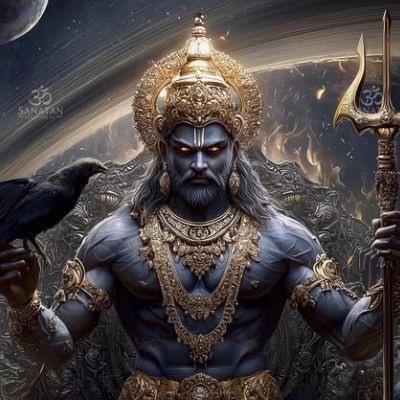
Shani is depicted as a dark or black-complexioned deity — sometimes blue-black — wearing dark blue or black garments. He carries a bow, two arrows, a sword, a trident, and an axe in his multiple arms. He rides a crow or a vulture, or sometimes a buffalo — all dark, patient, scavenging animals that share his quality of slow, inexorable movement through environments that others avoid. His gemstone is the blue sapphire (Neelam) — named for and associated with his wife Neela. His sacred day is Saturday (Shanivara). Offerings to him include black sesame seeds (til), iron, black cloth, mustard oil, and blue flowers. The Shani Shingnapur temple in Maharashtra — where Shani is worshipped as a large flat stone with no roof and no doors on any of the buildings in the surrounding village, the inhabitants trusting entirely in Shani's protection — is one of the most celebrated Shani pilgrimage sites. Shani Jayanti is observed on the Amavasya (new moon) of the month Vaishakha (April-May) as his birthday.
✦ In Vedic Astrology — Sade Sati
In Vedic astrology Shani governs the planet Saturn, one of the nine Navagrahas. His influence is considered the most powerful and the most feared of all the planetary deities. The most widely known astrological phenomenon associated with him is Sade Sati — the seven-and-a-half year period during which Saturn transits through the sign just before a person's natal moon sign, through the moon sign itself, and through the sign immediately after. This transit is regarded as a period of intense pressure, difficulty, and transformation — a time when the accumulated consequences of past actions come due, and when character is tested and reformed. The tradition consistently reframes Sade Sati not as punishment but as education: Shani is a teacher, and difficulty is his medium of instruction. Yama and Shani are described in the tradition as the two sons of Surya who are both judges of a person's deeds — Shani delivering consequences during life, Yama delivering them after death.
✦ References
- Skanda Purana (Kashi Khanda) — the most widely accepted account of Shani's birth; Chhaya's penance to Shiva during gestation; the dark complexion; Surya's doubt; the first manifestation of Shani's powerful gaze; his early devotion to Shiva; his receipt of the Karmaphaldata role
- Brahmanda Purana — the strained father-son relationship between Surya and Shani arising from the dark complexion; the consequences of Chhaya's presence in the household
- Brahma Vaivarta Purana — Krishna's identification of himself as Shani among the planets; the episode of Shani's absorption in Krishna-meditation; Manda's curse on his gaze; the origins of his downcast eyes
- Markandeya Purana — Shani as child of Chhaya alongside Savarni Manu and Tapati; the Yama-foot-Chhaya-curse episode in which Shani is referenced as her favoured child
- Vishnu Purana and Harivamsa — Shani in the list of Chhaya's children; the solar family genealogy
- Shiva Purana — the Ganesha episode; Shani's reluctant glance at the newborn Ganesha; the severing of Ganesha's head; the theological explanation of Shani's downcast eyes
- Wikipedia — Shani; Exotic India Art — All About Shani Dev; Shani PDF (Dolls of India); VedicAstro — Planet Story Saturn; TemplePurohit — Shani Dev Story; Poojat — Wife of Shani Neelima and Manda; MPanchang — Lord Shani Dev; HinduPad — Neela; Komilla.com — Myths of Saturn: modern summaries drawing from the above primary sources